
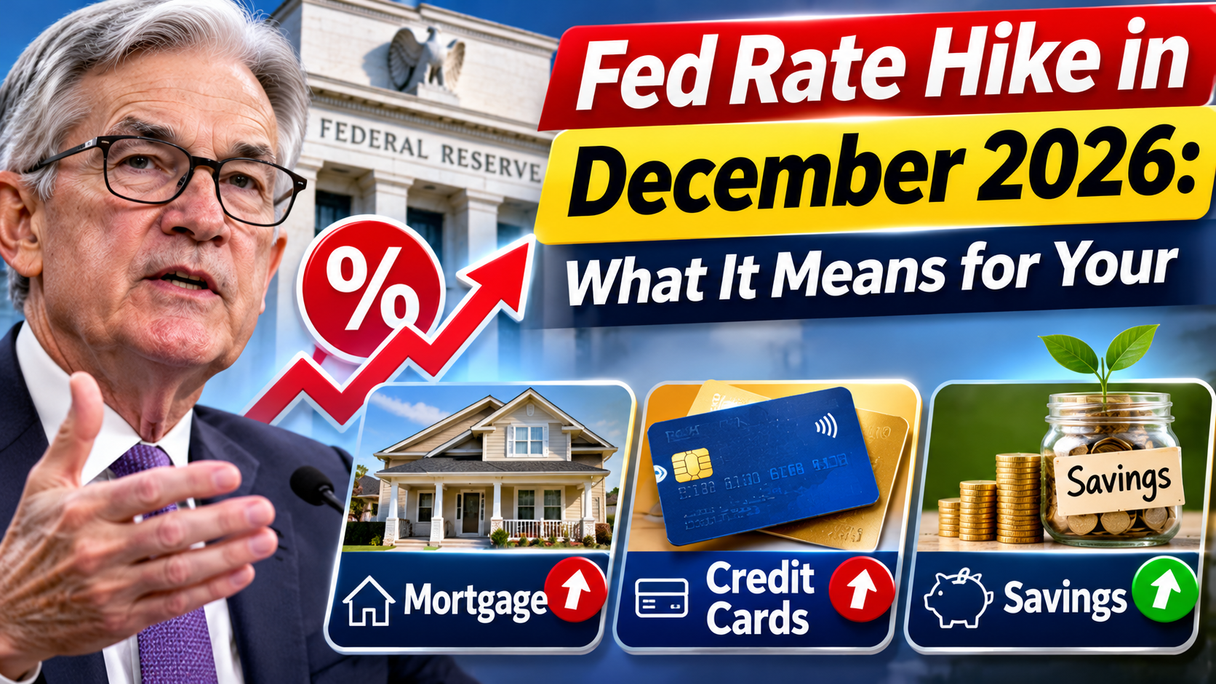
Fed Rate Hike in December 2026: Let’s get one thing straight before the headlines run away with you: the Federal Reserve has not raised rates in December, because December hasn’t happened yet. The Fed’s next meeting wraps up on Wednesday, Dec. 9, and as of today, Nov. 11, a quarter-point hike is what traders overwhelmingly expect. Nothing is official until the Fed releases its statement that afternoon.
Still, the odds are high enough that it makes sense to plan now. A hike would lift the federal funds target range from 3.75%–4.00% to 4.00%–4.25%. That sounds tiny, and for some of your money it is. For other parts of your budget it matters more than the number suggests, and for mortgages the link is looser than most headlines admit. Below is what the official data says, what it likely means for your wallet, and what’s worth doing before Dec. 9.
Where the Fed stands right now
Rewind a few months. For most of 2026 the Fed sat still, and plenty of people assumed the next move would be a cut. Instead, on Sept. 16, under new Chair Kevin Warsh, the committee raised rates a quarter point to 3.75%–4.00%. It was the first increase since 2023, and the vote was unanimous.
On Oct. 28 the Fed paused. The vote was 10-2, with Governor Lisa Cook and Cleveland Fed President Beth Hammack dissenting because they wanted another quarter-point hike right then. The statement described the economy as expanding at a strong pace and said inflation remains elevated. It also said the committee will deliver price stability, which reads less like a hint and more like a promise.
The September projections matter too. Sixteen of the 18 officials who submitted forecasts expected at least one more hike this year, and December is the only meeting left. (Warsh didn’t submit a projection himself.) The Fed’s own numbers put 2026 headline PCE inflation at 3.7%, far above its 2% goal, with unemployment projected at 4.1%.
There’s a counterargument, though. The job market isn’t exactly roaring. September payrolls grew by only 29,000 and the unemployment rate edged up to 4.2%. That’s the case for patience. The hawks on the committee are looking at prices instead.
Why December is important
If October was a pause, why is a December hike so likely? Mostly because of one report. On Tuesday the Bureau of Labor Statistics said consumer prices rose 0.4% in October, hotter than the 0.3% economists expected. Core prices, which leave out food and energy, rose 0.3%, also above forecasts. Shelter accounted for more than 30% of the monthly increase.
One catch: because of last year’s government shutdown, the BLS couldn’t collect October 2025 data, so it did not publish a 12-month inflation rate this time. You’ll see estimates floating around online, but those are outside guesses, not official figures. The latest official annual number I found is for September, which Bankrate put at 3.7%.
Then came Fed Governor Christopher Waller, who said he’s leaning toward a quarter-point hike and that a half-point move deserves consideration, arguing that doing too little would put the Fed’s credibility at risk. Markets reacted. According to CME’s FedWatch tool, the odds of at least a quarter-point hike in December are above 85%, with a half-point hike somewhere between roughly 9% and 14% depending on which snapshot you look at.
Those are market probabilities, not Fed decisions, and they can swing fast. A weak jobs report or a cool inflation reading before Dec. 9 could change the picture.
Loans to Pay Rent: Why More Americans Are Borrowing for Housing and What Help Is Available
Social Security Phone Claims New Process in 2026: What Changed and New Process Explained
What it means for your mortgage
Here’s the part that surprises people: the Fed doesn’t set mortgage rates. Fixed mortgage rates follow longer-term bond yields, especially the 10-year Treasury, and those react to inflation, growth and the Fed’s expected path all at once. Very often the market moves well before the Fed does.
That’s exactly what’s been happening. Freddie Mac’s survey released Nov. 5 put the 30-year fixed average at 7.18%, down from 7.24% the week before and 7.32% on Oct. 22. That’s three straight weekly declines. The 15-year fixed averaged 6.57%, and a year ago the 30-year was 6.22%. Then Tuesday’s inflation report sent the 10-year Treasury yield back up to roughly 5%, which usually drags mortgage rates up with it. So if the next Freddie Mac reading doesn’t keep falling, that’s why.
A quarter-point hike the market already expects is mostly baked in. The bigger risks for borrowers are a surprise half-point move, or a hard-line tone from Chair Warsh about 2027. Either could push yields, and mortgage rates, higher.
To make it concrete: on a $400,000 30-year loan, principal and interest at 7.18% comes to about $2,710 a month. At 7.43%, it’s about $2,778, or roughly $68 more. (That’s my own math, before taxes and insurance.)
Who feels a hike directly? If you already have a fixed-rate mortgage, nothing changes. Adjustable-rate mortgages and home equity lines of credit are different, since many are tied to the prime rate and reset after the Fed moves. If you’re shopping for a loan, Freddie Mac says getting offers from several lenders could save $600 to $1,200 a year. And while Bankrate’s data shows 30-year rates hit a 2026 low of 6.09% earlier this year, an oil-driven jump in inflation helped push them back up, so waiting for that level to return could be a long wait.
What it means for your credit cards
This is where a hike lands fastest. Most card APRs are variable: the prime rate plus a markup your issuer picks, often 12 to 13 percentage points. Prime sits three points above the top of the Fed’s target range, so it’s 7% today and would move to 7.25% after a December hike. Your APR typically follows within a month or two. Issuers don’t have to warn you, because the adjustment is written into your cardholder agreement, and it applies to the balance you already carry, not just new purchases.
Bankrate’s national average APR was 19.71% as of Nov. 4. That’s under the record 20.79% set in August 2024, but it’s inching up again. After the September hike, the average rose about 0.12 points over the following month.
The dollars are smaller than the headlines suggest. A quarter-point increase on a $5,000 balance adds about $12.50 a year, roughly a dollar a month. A half-point adds $25. The real damage is the starting rate: at around 20%, that same $5,000 costs you about $82 a month in interest. Bankrate’s own example shows that paying only the minimum on $5,000 at 20% takes about 23 years and costs roughly $7,723 in interest.
If you pay your statement in full every month, you’re not charged interest at all, and you typically get a grace period of at least 21 days, so a hike barely touches you. If you carry a balance, it’s worth calling your issuer to ask for a lower rate, or looking at a 0% balance transfer offer or a fixed-rate personal loan. Just check the transfer fee before you jump.
What it means for your savings
Savers get the one piece of good news, with a catch. Banks don’t pass Fed hikes along evenly, and the traditional big-bank savings account barely budges. The FDIC’s national average for savings accounts is about 0.38%, while Bankrate’s own survey shows 0.57%. The two use different methods, but either way it’s tiny.
Online banks are another story. Bankrate’s top high-yield savings account was paying 4.35% APY as of Nov. 7, and another daily check on Nov. 3 found rates up to 4.40%. On $10,000, a 4.40% account earns about $440 a year. The same money at 0.38% earns about $38. That gap is the whole point of moving.
A December hike could nudge those top rates up a little, but they’re variable and banks can change them any day, in either direction. Don’t assume a bump is coming.
It also helps to keep inflation in view. With September’s official annual inflation at 3.7%, a 4.4% yield beats it, though not by a lot. Certificates of deposit are the other option for locking in a rate. With the Fed still tightening, though, a long CD could leave you stuck below what’s available a few months from now, so shorter terms make more sense if you go that route. Whatever you pick, confirm the account is FDIC-insured (or NCUA-insured at a credit union), which covers up to $250,000 per depositor.
What to do before Dec. 9
None of this requires panic. A few sensible steps are enough:
- Carrying card debt? Put extra payments toward the highest-APR card first, and ask your issuer about a lower rate. A hike makes every month of delay a little more expensive.
- Variable-rate loans? If you have an ARM or a HELOC, check when it resets and budget for a payment that’s a bit higher. Fixed-rate borrowers can relax.
- House hunting? Collect quotes from at least two or three lenders, and ask how long a rate lock lasts and what it costs. Don’t wait for a drop that may not come.
- Cash sitting in a low-yield account? Move what you don’t need this week into a high-yield savings account, and keep your emergency fund somewhere you can reach it quickly.
- Watch the calendar. The decision lands Dec. 9, and any new inflation or jobs data before then can shift the odds.
The bottom line is pretty plain. A quarter-point hike is a small nudge for most households, and the market has largely priced it in. The people with the most at stake are those carrying credit card balances or holding variable-rate debt, along with savers who are still earning next to nothing at a big bank. The one real uncertainty is size: a half-point move or a tough message from the Fed about 2027 would matter more than the quarter point itself.
This is general information, not personal financial advice. Your situation, and the actual numbers on your accounts, are what count.
$5181 SSDI Payment 2026: Who Gets Paid Today and Who Can Really Collect?
December 11 Shutdown Deadline: SNAP, Federal Pay, Benefits
No Tax on Tips and Overtime: What to Know for Your 2026 Return (Filed in 2027)
Alberta Child and Family Benefit Payment Date Nov 27, Up to $5,882