
Meta Safety Changes on Instagram and Facebook: Meta Platforms has agreed to the most sweeping child safety overhaul in its history, but the fine print carries a catch that has parents outside America paying close attention. The company confirmed this week that new default screen time limits, a midnight shutdown window, and a ban on visible “like” counts for teenagers will only apply inside the United States for now, even though Instagram and Facebook are used by teenagers on every continent. The announcement came out of a courtroom in Oakland, California, where Meta was staring down a trial that plaintiffs said could have cost the company more than a trillion dollars in damages.
The settlement resolves a multi-year legal fight brought by dozens of state attorneys general who accused Meta of deliberately designing Instagram and Facebook to be addictive to children while hiding internal research about the harm. Instead of letting the case go to a jury, Meta chose to settle on the eve of testimony from CEO Mark Zuckerberg, agreeing to pay a combined figure that different court filings put between $16.7 billion and $18 billion, spread across ten years, and to redesign core features that teenagers use every day. We’ll be updating this article monthly as the rollout expands and as regulators in other countries respond to the US-only nature of the deal.
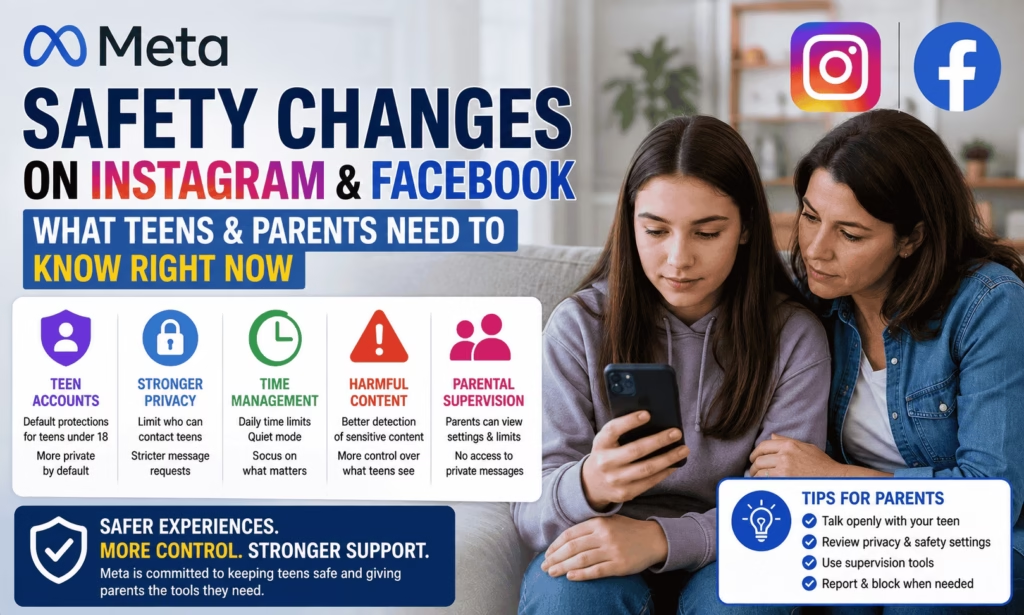
Key Highlights: Meta’s New Safety Changes for Teens
| Detail | What Is Confirmed |
|---|---|
| States involved in settlement | 47 to 51 US states, territories, and the District of Columbia, depending on the filing cited |
| Total settlement value | Reported between $16.7 billion and $18.3 billion over 10 years |
| Geographic scope | United States only, for now |
| Daily screen time limit for under-18 users | 2 hours combined across Instagram and Facebook |
| Overnight access block | Midnight to 6 a.m. local time, on by default |
| School hours notification mute | 8 a.m. to 3 p.m., except direct messages and safety alerts |
| Break reminder prompts | Appear at 15 minutes, 60 minutes, and 90 minutes of continuous use |
| Like counts on teen posts | Hidden by default |
| Cosmetic surgery and extreme makeup filters | Blocked for users under 18 |
| Court filing date | August 26, 2026 |
| Court overseeing settlement | US District Court, Northern District of California |
| Rollout timeline | Expected to begin within months, per California Attorney General Rob Bonta |
The Latest Update: Meta Confirms Settlement, but Only for US Teens
Late Wednesday, Meta filed a proposed settlement in federal court that ends a bellwether trial brought by a coalition led by California, Colorado, Kentucky, and New Jersey, joined by dozens of other states. The states had accused Meta of knowingly building engagement features, including infinite scroll, autoplay video, and algorithmic recommendation feeds, that hooked young users despite internal research reportedly showing the company understood the risks. California Attorney General Rob Bonta, who has been the most vocal state official on the case, said the agreement represents real change, real transparency, and real enforceable protections for children, and confirmed the new default settings should start appearing on teenage accounts within months, pending final court approval.
What makes this settlement different from Meta’s earlier safety announcements is the word default. Previous Instagram Teen Accounts features, first introduced in 2024 and later expanded to Facebook and Messenger, relied heavily on optional settings that most teenagers and parents never touched. Under the new agreement, several of the most significant protections, including the two hour daily cap and the overnight block, cannot be switched off by a teenager alone. Only a parent can lift them. That single design shift, moving from opt-in to default-on with parental override, is what child safety researchers have been asking platforms to do for years.
Why the Changes Apply Only in the United States
The settlement is a resolution of claims brought specifically by American state governments under US consumer protection and child privacy law, most notably the Children’s Online Privacy Protection Act. Because the lawsuit itself was filed by state attorneys general rather than an international body, the legal remedy Meta agreed to is scoped to US users. Meta has publicly said the new safeguards will apply in the United States, with most requirements locked in place for a decade, while confirming there is currently no binding requirement to extend identical protections to Instagram and Facebook users elsewhere.
This has not gone unnoticed by regulators abroad. The United Kingdom, European Union, and Australia already enforce their own separate child safety frameworks, including the UK’s Online Safety Act and the EU’s Digital Services Act, which have pushed Meta to make some parallel changes in those markets independently. But none of those existing frameworks currently mirror the specific two hour cumulative limit or the midnight-to-6-a.m. shutdown that US teenagers are about to receive. Child advocacy groups outside the US have already begun asking why the same protections shouldn’t extend globally, especially since Meta itself has called the settlement a template for the industry.
What Exactly Is Changing on Instagram and Facebook
The settlement lays out a detailed list of default changes for any account Meta identifies as belonging to a user under 18. Below is a full breakdown of what is confirmed.
Daily Time Limits and Night Mode
Teen accounts will default to a combined two hour daily limit across Instagram and Facebook. Time spent on either app counts toward the same shared limit, and only a parent can extend or remove it through parental supervision tools. A separate Night Mode will block most app functions between midnight and 6 a.m. local time, while a School Mode mutes non-essential notifications from 8 a.m. to 3 p.m., preserving only direct messages and safety alerts.
Break Reminders and Engagement Prompts
Any user under 18 will receive an on-screen prompt after 15 consecutive minutes of use, with additional reminders at the 60 minute and 90 minute marks. Meta has not detailed the exact wording of these prompts, but they are intended to interrupt continuous scrolling sessions rather than simply logging screen time in the background.
Hidden Like Counts and Content Filters
Like and reaction counts on posts made by minors will be hidden by default, addressing years of research linking visible engagement metrics to teenage anxiety and social comparison. Meta will also block “extreme makeup filters” and filters that mimic cosmetic surgery for users under 18, a response to long standing concerns from psychologists about body image pressure on younger users.
Non-Algorithmic Feed Option
Teens and their parents will have the option to switch to a non-personalized feed that is not ordered by Meta’s recommendation systems. Autoplay for videos can also be disabled, meaning a teenager would need to actively tap to watch the next video rather than having it start automatically. Both of these settings, notably, require the user or parent to opt in rather than being turned on automatically.
Stronger Contact and Age Verification Rules
Meta says it is investing in stronger technology to detect users under 18 who misrepresent their age when creating an account, and it has called on Apple’s and Google’s app stores to help verify user ages at the device level. Adults will continue to face restrictions on messaging or viewing content posted by accounts identified as belonging to teenagers.
The Money: How Much Is Meta Actually Paying
Court filings and statements from different state attorneys general have cited slightly different totals, which is why headlines this week have ranged from $16.7 billion to $18.3 billion. The structure explains the discrepancy: Meta has agreed to guaranteed payments distributed over ten annual installments, plus additional contingent payments tied to compliance milestones and to whether other major platforms, including YouTube, TikTok, and Snapchat, also agree to comparable safety commitments. If those companies do not settle on similar terms, part of the larger contingent payment pool may not be triggered. Even at the higher end of the range, analysts have pointed out that spreading payments over a decade significantly reduces the annual financial impact on a company whose yearly revenue exceeds the gross domestic product of many countries.
Criticism: Why Some Experts Say the Deal Doesn’t Go Far Enough
Not everyone is calling this a clean win for teen safety. Researchers who study platform design point out that several of the strongest protections, including the non-algorithmic feed and disabled autoplay, remain opt-in features rather than defaults, and adoption of optional safety tools has historically been extremely low. One widely cited internal example from Meta’s own data showed that fewer than two-tenths of one percent of teenagers enabled an earlier optional break reminder feature after it launched.
Yaël Eisenstat, a director at the Cybersafety Research Center who has audited safety tools across several major platforms, said it remains too early to know whether all the promised changes will actually materialize as described, though she called the settlement itself a milestone in showing that alternative platform designs are possible. Other critics note that the entire framework depends on Meta’s ability to accurately detect which accounts belong to minors in the first place, a technical challenge that has tripped up other companies. Discord, for example, had to delay a planned global age verification rollout earlier this year after significant user backlash over privacy concerns tied to age-check technology.
2027 Social Security COLA Estimate Falls to 3.4%: How Much Could Your Check Increase?
How Age Verification Will Actually Work
Meta has not published a single, mandatory age-verification method as part of the settlement. Instead, the company says it will layer several signals, including declared birthdates, behavioral patterns, and account interactions, to estimate a user’s age and route suspected minors into restricted teen experiences automatically. Privacy researchers have raised concerns that more aggressive age verification could require collecting additional personal data, including government identification or facial scans, which introduces its own set of privacy trade-offs that regulators will likely scrutinize as the rollout continues.
Independent Oversight and Enforcement
As part of the agreement, Meta must accept an independent auditor with what court documents describe as expansive access to the company’s internal information and systems, along with the ability to communicate directly with state attorneys general about compliance. Meta is also subject to a court injunction prohibiting it from making further false or misleading statements about the safety of its products for children, a provision state officials have described as giving the settlement real enforcement teeth rather than leaving compliance to Meta’s own discretion.
How Families Can Prepare for the Rollout
Parents in the United States do not need to take any immediate action to receive these protections, since the settlement requires the safety features to apply automatically to any account Meta identifies as belonging to a minor. That said, families who want more control sooner have a few practical steps available right now.
- Confirm any teenager’s account is correctly set up as a Teen Account inside Instagram or Facebook settings, since accurate birthdate information determines whether these protections apply.
- Turn on Meta’s existing Parental Supervision tools, which already allow parents to view time spent on the app, set current time limits, and receive notifications about certain account changes, ahead of the new defaults taking full effect.
- Watch for an in-app notification or settings update in the coming months, since California’s Attorney General has indicated the changes should begin appearing within months of court approval rather than immediately.
- Review Meta’s Family Center and Help Center pages periodically for confirmation of which specific features have gone live in a given wave, since the rollout is expected to happen in stages rather than all at once.
What Happens Next in Court
The settlement is not final. It still requires approval from the presiding federal judge in the Northern District of California, and that review process typically takes weeks to a few months depending on the complexity of the agreement and whether any objections are filed. Once approved, the independent auditor process begins, and California’s Attorney General has said enforcement mechanisms will allow the states to return to court if Meta falls short of its commitments.
Separately, Meta continues to face other legal challenges tied to child safety that this settlement does not resolve, including thousands of individual personal injury lawsuits and litigation brought by school districts across the country. A New Mexico court also issued its own ruling earlier this month in a related case, ordering financial penalties and platform changes specific to that state, illustrating that this settlement, while broad, does not close out every legal front Meta is currently fighting on youth safety issues.
Official Meta and Regulator Resources
| Resource | Purpose | Link |
|---|---|---|
| Meta Family Center | Parental controls, guides, and supervision setup | facebook.com/safety/family |
| Instagram Parental Supervision | Enable and manage teen account settings | help.instagram.com/parental-supervision |
| Meta Teen Safety Newsroom | Official company statements on safety updates | about.fb.com/news |
| California Attorney General’s Office | Official statements on the settlement | oag.ca.gov |
| Meta Transparency Center | Reports on enforcement and platform policy | transparency.fb.com |
| Report a Safety Concern | Report harmful content or contact involving a minor | facebook.com/help/reportlinks |
People Also Ask
Is Meta rolling out these safety changes worldwide? No. Meta has confirmed the new default protections apply only in the United States for now, since the settlement resolves claims brought specifically by US state governments.
What is the new Instagram and Facebook time limit for teens? Teen accounts will default to a combined two hour daily limit across both Instagram and Facebook, which only a parent can extend or remove.
When do the new Meta safety changes take effect? California’s Attorney General has said the changes are expected to roll out within months of final court approval, though an exact nationwide date has not been announced.
How much is Meta paying in the settlement? Reported figures range from $16.7 billion to $18.3 billion, paid in installments over 10 years, with part of the total contingent on other platforms also agreeing to similar safety measures.
Can teenagers turn off the new safety features themselves? No. The most significant defaults, including the daily time limit and the overnight block, can only be adjusted by a parent, not by the teenager using the account.
Does this settlement affect Instagram users in the UK, Canada, or Australia? Not directly. Those countries have their own separate child safety regulations, and Meta has not committed to extending these exact US settlement terms to those markets.
Will Meta hide like counts for all users, not just teens? No. The like count change applies specifically to accounts identified as belonging to users under 18, not to adult accounts.
What happens if Meta doesn’t follow through on the settlement? An independent auditor will monitor compliance, and state attorneys general retain the right to return to court if Meta fails to meet its commitments under the agreement.
Conclusion
Meta’s settlement with dozens of US states marks the most detailed, enforceable set of child safety commitments the company has ever agreed to, moving several protections from optional settings to defaults that only parents can override. But the deal’s geographic limits are just as newsworthy as its content. For now, a teenager in Toronto, London, or Sydney will not automatically receive the same two hour cap or midnight shutdown that a teenager in California or Texas will see in the coming months, even though they are using the exact same apps. Whether other governments move to require similar defaults, and whether Meta extends any of this voluntarily beyond US borders, is likely to be the next chapter in this story. We’ll keep updating this article monthly as the rollout begins and as other countries respond.