USCIS Form I-485 Update: Green card applicants have a hard filing deadline bearing down on them, and it has nothing to do with visa bulletins or priority dates. USCIS has confirmed it will release a revised edition of Form I-485, the Application to Register Permanent Residence or Adjust Status, and starting September 18, 2026, any older version of the form postmarked or submitted electronically will be rejected outright, not delayed, not flagged for correction, but returned unfiled. The change is tied directly to a Department of Homeland Security final rule rescinding the 2022 public charge regulation, which restores broad officer discretion to weigh an applicant’s use of public benefits when deciding whether to approve a green card.
For applicants and immigration attorneys, the practical stakes go well beyond paperwork. A rejected Form I-485 is not treated as a delayed filing, it is treated as though nothing was ever submitted, which means the applicant loses their original filing date entirely. For anyone whose eligibility depends on a visa priority date staying current, on maintaining continuous lawful status, or on a child’s age remaining protected under the Child Status Protection Act, a rejection caused by simply using the wrong edition of Form I-485 could cost far more than the few weeks it takes to refile. We’ll be updating this article monthly as USCIS publishes the new form and releases further filing guidance ahead of the deadline.
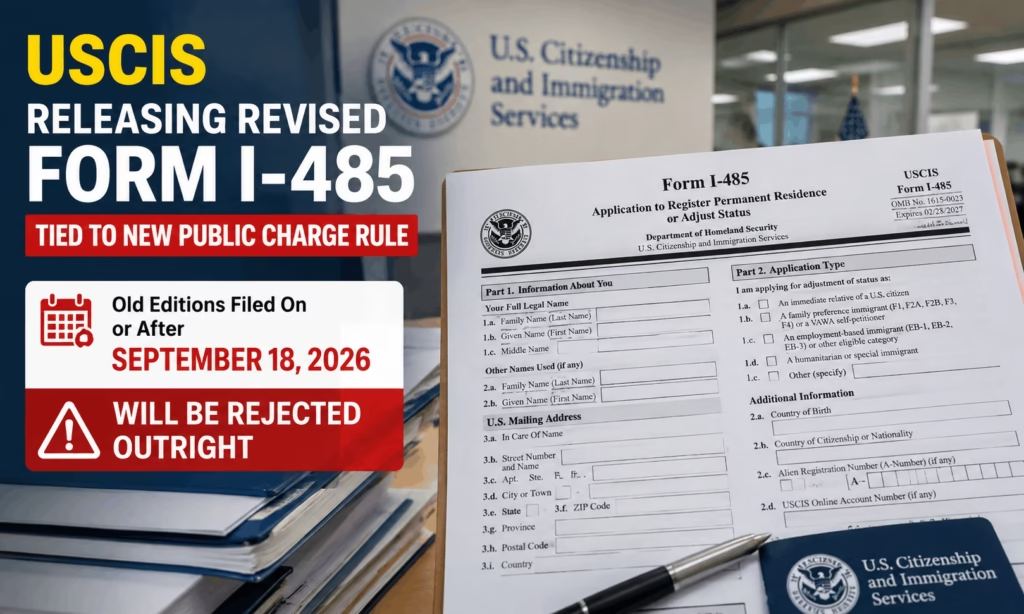
Latest Update On The USCIS Form I-485 Revision
As of this month, USCIS has not yet published the actual revised edition of Form I-485, though the agency has confirmed one is coming and that it will be mandatory for any adjustment of status application postmarked or filed online on or after September 18, 2026. Immigration law firms tracking the rollout are advising clients to check the current form edition directly on uscis.gov on the same day they file, rather than relying on a form downloaded or saved even a few days earlier, since USCIS could publish the new edition at any point before the effective date.
The Department of Homeland Security’s own filing offers a striking justification for the change. DHS estimates the rescission will save the government roughly $13.05 billion annually, attributing the figure to reduced enrollment in public benefits among low-income immigrant families once the broader discretionary standard takes hold. Advocacy groups reviewing the rule’s preamble have flagged that this same language appears to leave the door open for officers to weigh benefit receipt by other household members, not just the applicant, a notable departure from the 2022 framework, which explicitly excluded benefits used by family members from an applicant’s own public charge review. Catholic Legal Immigration Network, which tracks the rule closely, is actively encouraging practitioners to file adjustment of status applications before September 18, 2026 specifically to lock in the current, narrower definition.
The form change is being driven by the underlying policy shift itself. DHS published its final rule rescinding the 2022 public charge regulation on July 16, 2026, with the rule appearing in the Federal Register on July 20, 2026 and an effective date of September 18, 2026. Because the new rule requires officers to evaluate a broader set of factors than the outgoing regulation allowed, the revised Form I-485 is expected to include expanded questions covering an applicant’s household composition, financial resources, health insurance status, education, employment history, and receipt of means-tested public benefits, going well beyond what the current form asks. Notably, this particular rule change applies only to adjustment of status filed on Form I-485 inside the United States, since the Department of State has separately moved to redefine public charge standards for immigrant and nonimmigrant visa applicants processing abroad.
Why USCIS Is Revising Form I-485?
Form I-485 is the core application used by most green card seekers already inside the United States to adjust their status to lawful permanent resident. Because the form has historically doubled as the primary vehicle for collecting public charge information from adjustment applicants, any significant change to the public charge standard tends to trigger a matching revision to the form itself, and this rollout follows that same pattern.
The 2022 regulation being rescinded had limited public charge determinations narrowly to two factors, namely a history of receiving public cash assistance for income maintenance or requiring long-term institutionalized care at government expense. The new framework removes that narrow definition entirely and restores a broader statutory totality of the circumstances test, allowing officers to weigh a wider range of means-tested benefits, including non-cash programs, alongside factors such as age, health, family status, assets, education and skills, when deciding whether an applicant is likely to become a public charge.
Direct Express Card Transition to Fifth Third Bank: What 3.6 Million Cardholders Need to Know
Federal Fuel Excise Tax Suspension: Ford Pushes Carney to Extend Relief Past Labour Day
FTC Refund 2026: Millions of Americans May Be Owed Money and Most Don’t Know It
USCIS Form I-485 Update Key Highlights
| Detail | Information |
|---|---|
| Form affected | Form I-485, Application to Register Permanent Residence or Adjust Status |
| Old editions rejected starting | September 18, 2026 |
| Underlying rule | DHS final rule rescinding the 2022 public charge regulation |
| Rule published | July 16, 2026, Federal Register publication July 20, 2026 |
| Rule effective date | September 18, 2026 |
| Filing standard for applications before Sept 18 | Governed by the outgoing 2022 public charge framework |
| Filing standard for applications on or after Sept 18 | Governed by the new discretionary totality of the circumstances test |
| Consequence of using an old form edition | Application rejected and returned unfiled, not delayed |
| Exempt categories | Refugees, asylees, VAWA self-petitioners, T and U visa applicants, special immigrant juveniles, Cuban Adjustment Act applicants |
| Where to verify current form edition | uscis.gov, Form I-485 page |
| DHS estimated annual savings from rescission | Approximately $13.05 billion |
| Affidavit of Support (Form I-864) treatment | No longer automatically weighed as a favorable factor |
| Scope of this specific rule change | Applies to Form I-485 adjustment of status only, not visas processed abroad |
What Changes On The New Form I-485
Immigration attorneys reviewing early guidance on the revision expect the new Form I-485 to demand significantly more detailed financial and personal disclosures than the current edition. Applicants should anticipate more granular questions about household income and composition, employment history, education and skills, health insurance coverage or the practical ability to pay for medical care, and a more detailed accounting of any means-tested public benefits received, both cash and non-cash.
Notably, the new public charge rule does not appear to revive Form I-944, the separate Declaration of Self-Sufficiency that was used under the 2019 Trump-era public charge rule before it was struck down by the Supreme Court. Instead, USCIS is expected to fold the expanded disclosure requirements directly into the revised Form I-485 itself, meaning the questions applicants would have previously answered on a standalone form will now likely appear as an expanded section within the main adjustment of status application.
The revised form also arrives alongside a policy change affecting how sponsors’ Affidavit of Support filings are treated. Under the outgoing 2022 rule, officers were required to count a financially sufficient Form I-864 as a positive factor in an applicant’s favor. That automatic favorable weighing has been removed, meaning a technically complete affidavit filed alongside the new Form I-485 no longer guarantees the same weight it carried under the previous standard, and sponsors should expect officers to scrutinize the underlying financial documentation more closely rather than treating a sufficient affidavit as conclusive on its own.
Which Filing Date Determines Which Rules Apply
The date an application is postmarked or submitted electronically, not the date USCIS receives or processes it, determines which public charge framework governs a case. Applications postmarked or e-filed before September 18, 2026 will continue to be evaluated under the current, narrower 2022 framework, even if USCIS does not actually adjudicate the case until months later. Applications postmarked or e-filed on or after September 18, 2026 will be evaluated under the new, broader discretionary standard, and must use the revised form edition to be accepted at all.
Pending cases that were already properly filed and accepted before the effective date remain protected under the old framework regardless of when USCIS eventually issues a decision. This distinction matters most for applicants who are currently eligible to file and are weighing whether to submit before the deadline, since filing early locks in both the current legal standard and the current form requirements.
ICE Detained Military Families: AP Finds 50+ Spouses and Parents Held
Who Should File Before September 18
Immigration attorneys are broadly advising eligible applicants who are ready to submit a complete, well-documented Form I-485 to consider filing before September 18, 2026, since doing so preserves the current, more limited public charge framework. This guidance comes with an important caveat, however, that applicants should not rush an incomplete or poorly documented filing simply to beat the deadline, since a rejected or denied application for reasons unrelated to timing can create its own complications.
Family-based adjustment applicants, spouses, parents and children of US citizens who are already eligible to adjust status, represent one of the largest groups directly affected by the transition, since this population files Form I-485 in high volume and is the category most likely to have straightforward cases ready to submit ahead of the cutoff.
Who Remains Exempt From The Public Charge Test
Certain categories of applicants are statutorily exempt from the public charge ground of inadmissibility altogether, and the rescission of the 2022 rule does not change that exemption. Refugees, asylees, Cuban Adjustment Act applicants, VAWA self-petitioners, T and U nonimmigrant visa applicants, and special immigrant juveniles remain excluded from public charge review regardless of which version of Form I-485 they use or when they file.
For everyone else, one detail that continues to cause confusion deserves clarification. The public charge test has historically looked specifically at the applicant’s own history of benefit use, not benefits received by a US citizen child in the same household. A child born in the United States is a citizen by birth and qualifies for programs such as Medicaid or nutritional assistance in their own right, independent of a parent’s immigration case. That said, policy analysts reviewing the new rule’s preamble note it does not explicitly rule out officers considering benefit use by other household members going forward, unlike the 2022 rule, which contained a clear bar on that practice. Immigration attorneys say this ambiguity is one of the most important open questions applicants should ask about once USCIS issues its promised interpretive guidance, and in the meantime, families should not assume removing a citizen child from benefits they are legally entitled to is necessary or advisable for a parent’s adjustment of status application.
2027 Social Security COLA: 3.6% Estimate Beats Medicare Hike
2027 HSA Contribution Limits Announced: IRS Confirms $4,500 and $9,000 Caps
What Happens If Your Form I-485 Gets Rejected
A rejected Form I-485 is fundamentally different from a Request for Evidence or a delayed decision. USCIS treats a rejected filing as though it was never submitted, which means the applicant’s original filing date is lost entirely and a new application, using the correct current form edition, must be filed from scratch. For most applicants this primarily costs time and requires paying filing fees again, but for cases where a visa priority date, a maintenance-of-status deadline, or a child’s age-out protection under the Child Status Protection Act depends on the original filing date, the consequences of a rejection can be significantly more serious than a simple delay.
Official Sources
| Resource | Link |
|---|---|
| Form I-485 official page and current edition | uscis.gov/i-485 |
| USCIS online filing account | myaccount.uscis.gov |
| Check case status | egov.uscis.gov/casestatus |
| DHS public charge final rule, Federal Register | federalregister.gov |
| USCIS Policy Manual, public charge guidance | uscis.gov/policy-manual |
FAQs About USCIS Form I-485 Update
When will USCIS start rejecting old editions of Form I-485?
Starting September 18, 2026, USCIS will reject any Form I-485 postmarked or submitted electronically using an older edition of the form.
Why is USCIS revising Form I-485 right now?
The revision is tied to a Department of Homeland Security final rule rescinding the 2022 public charge regulation, which restores broader officer discretion and requires more detailed applicant disclosures on the form.
What happens if I file the old version of Form I-485 after September 18?
Your application will be rejected and returned unfiled, not delayed for correction, meaning you lose your original filing date and must refile using the correct current edition.
Does the new public charge rule apply to pending Form I-485 applications?
No. Applications properly filed and accepted before September 18, 2026 remain governed by the current 2022 public charge framework, even if USCIS decides the case later.
Will USCIS bring back Form I-944 along with the new Form I-485?
It does not appear so. USCIS is expected to fold the expanded public charge disclosure questions directly into the revised Form I-485 rather than reviving the separate I-944 declaration used under the 2019 rule.
Who is exempt from the public charge test regardless of the Form I-485 update?
Refugees, asylees, Cuban Adjustment Act applicants, VAWA self-petitioners, T and U visa applicants, and special immigrant juveniles remain statutorily exempt from public charge review.
Does the Affidavit of Support still guarantee a favorable outcome under the new Form I-485?
No. A sufficient Form I-864 is still required for most family-based cases, but officers are no longer required to automatically count it as a positive factor, giving them more room to scrutinize a sponsor’s full financial picture.
How much money does DHS say this rule change will save?
DHS estimates roughly $13.05 billion in annual savings, attributing the figure mainly to reduced enrollment in public benefits among low-income immigrant families under the broader discretionary standard.
People Also Ask
What is Form I-485 used for? It is the application most green card seekers already inside the United States use to adjust their status to lawful permanent resident.
How do I know which edition of Form I-485 to use? Always check the current edition date directly on uscis.gov before filing, since USCIS is expected to publish the revised form at some point before the September 18, 2026 deadline.
Does receiving public benefits automatically disqualify me from a green card? No. Under the new rule, receipt of a means-tested benefit is one factor considered within a broader totality of the circumstances review, not an automatic disqualification on its own.
Can a citizen child’s benefits affect a parent’s Form I-485 application? No. The public charge test evaluates the applicant’s own benefit history, not benefits legally received by a US citizen child in the same household.
Conclusion
The revised Form I-485 and the September 18, 2026 rejection deadline mark one of the more procedurally unforgiving changes in recent USCIS history, since a simple form-edition mistake can cost an applicant their original filing date entirely. With DHS projecting billions in savings from reduced benefit enrollment and removing the automatic favorable treatment of a sufficient Affidavit of Support, the substance of the review is changing just as much as the paperwork. Eligible applicants who are ready with a complete, well-documented case should strongly consider filing before the deadline to lock in the current public charge framework, while anyone filing on or after September 18 should verify the current form edition directly on uscis.gov on the day of submission rather than relying on a previously downloaded copy. Given how much is riding on getting this transition right, applicants with a complicated case history, a mixed-status household, or prior benefit use should consult an immigration attorney before filing under either the old or new framework.
Canada FMCSP Study Permit: 2,970 Spots Open August 26, See Eligibility, PR Pathway & How to Apply?