The New Student Loan Rules 2026 officially took effect on July 1, 2026, and this is genuinely one of the largest overhauls to federal student aid in decades, not a minor policy tweak. Under the One Big Beautiful Bill Act (OBBBA), signed into law in July 2025, the Department of Education has eliminated the Graduate PLUS Loan program for new borrowers, replaced most income-driven repayment plans with a single new option, and introduced hard dollar caps on how much students and parents can borrow. If you were reading coverage from 2025 describing these changes as “proposed” or “expected,” that information is now outdated, since final federal rules have since been published and the changes are actively in force for anyone borrowing on or after this date.
This guide has been rebuilt using the finalized Department of Education rules rather than earlier draft interpretations, covering the new Repayment Assistance Program (RAP), the new Tiered Standard Plan, the elimination of SAVE, PAYE, and ICR, updated graduate and professional borrowing limits, and the new $257,500 lifetime federal loan cap. We’ll be updating this article monthly, since the Department of Education has indicated additional sub-regulatory guidance is still being issued to support implementation of several provisions.
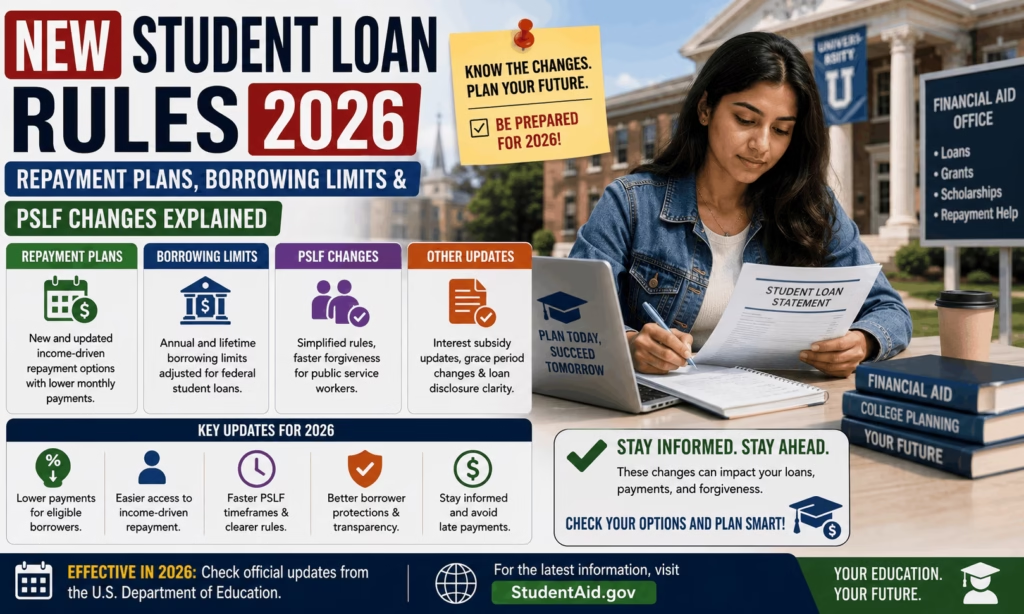
New Student Loan Rules USA Key Highlights
| Detail | Confirmed Information |
|---|---|
| Governing legislation | One Big Beautiful Bill Act (OBBBA), signed July 2025 |
| Effective date for new loans | July 1, 2026 |
| New repayment plans for new borrowers | Repayment Assistance Program (RAP) and Tiered Standard Plan only |
| Plans being phased out | SAVE, PAYE, and ICR |
| Deadline to leave phased-out plans | July 1, 2028 |
| Graduate PLUS Loan program | Eliminated for new borrowers from July 1, 2026 |
| General graduate annual/aggregate limit | $20,500/year, $100,000 lifetime |
| Professional degree annual/aggregate limit | $50,000/year, $200,000 lifetime |
| Parent PLUS annual/aggregate limit | $20,000/year, $65,000 per child lifetime |
| Overall federal lifetime loan cap (excludes Parent PLUS) | $257,500 |
| Subsidized loans for undergraduates | Eliminated for loans disbursed after July 1, 2026 |
| Forbearance cap | 9 months within any 2-year period |
| Official student aid portal | studentaid.gov |
Why These Student Loan Changes Are Happening Now
These changes stem from the One Big Beautiful Bill Act, a sweeping piece of fiscal legislation signed into law in mid-2025. While a handful of provisions, including tighter deferment and forbearance rules, began applying to loans issued on or after July 1, 2025, the bulk of the overhaul, including new repayment plans and new borrowing limits, took effect exactly one year later, on July 1, 2026. Sarah Austin, a policy analyst at the National Association of Student Financial Aid Administrators, has publicly described this as one of the largest single-year changes to the federal loan system in a very long time, affecting millions of current and future borrowers.
£5959 Attendance Allowance Could Boost Your Pension, Check If You Qualify
The New Repayment Plan Structure for 2026
This is the single biggest shift for anyone borrowing federal student loans going forward. For new loans disbursed on or after July 1, 2026, borrowers now have exactly two repayment options.
1. Repayment Assistance Program (RAP) RAP is the new income-driven repayment plan, replacing SAVE, PAYE, and ICR entirely for new borrowers. Unlike SAVE, RAP does not require borrowers to demonstrate partial financial hardship to qualify. Importantly, RAP borrowers are not locked into a fixed 30-year term. They retain the ability to switch over to the standard plan later if that becomes more favorable.
2. Tiered Standard Repayment Plan This new standard plan replaces the old single 10-year standard option with four fixed terms of 10, 15, 20, or 25 years, with the applicable term determined by the total amount borrowed or the outstanding balance for someone already in repayment. If a new borrower does not actively select a plan, they are automatically assigned to this Tiered Standard Plan.
A critical detail borrowers frequently misunderstand: all of a borrower’s loans must be repaid under the same plan. This means someone who borrowed loans before July 1, 2026, but then takes out even one additional loan after that date, is moved entirely into the new system, only able to choose between RAP and the Tiered Standard Plan for their full loan balance, including older loans.
What Happens to Existing Borrowers on SAVE, PAYE, and ICR
If you have no new loans disbursed on or after July 1, 2026, you are considered a “legacy borrower” and retain more flexibility for now. Current borrowers with no new borrowing after that date can continue enrolling in the current Standard, Graduated, Extended, or current Income-Based Repayment (IBR) plans, or opt into the new RAP if they prefer it. However, borrowers specifically enrolled in SAVE, PAYE, or ICR must transition to a different eligible plan by July 1, 2028, since those three programs are being sunset entirely. If no selection is made by that deadline, affected borrowers will be automatically moved into a replacement plan. The current IBR plan itself survives this transition and remains available, now without the previous partial financial hardship requirement, and still offers forgiveness after 25 years of qualifying payments, or 20 years for newer IBR borrowers.
New Federal Student Loan Borrowing Limits for 2026-27
Beyond repayment plans, the OBBBA introduces genuinely new dollar limits that fundamentally change how much students can borrow through federal programs.
| Borrower Type | Annual Limit | Aggregate (Lifetime) Limit |
|---|---|---|
| General graduate students (most master’s degrees, including MBA) | $20,500 | $100,000 (excludes undergraduate borrowing) |
| Professional degree students (medicine, dentistry, law, pharmacy, and other qualifying fields) | $50,000 | $200,000 (excludes undergraduate borrowing) |
| Parent PLUS borrowers | $20,000 per student | $65,000 per student |
| Overall federal lifetime cap, all levels combined | — | $257,500 (excludes Parent PLUS) |
Notably, the MBA is classified as a general graduate degree, not a professional degree, under the finalized rules, meaning MBA students borrow under the lower $20,500 annual cap rather than the higher professional tier, despite the “M” in the degree name. The Department of Education has narrowed the definition of “professional degree” to 11 specific fields: chiropractic, clinical psychology, dentistry, law, medicine, optometry, osteopathic medicine, pharmacy, podiatry, theology, and veterinary medicine.
The End of the Graduate PLUS Loan Program
Effective July 1, 2026, the Graduate PLUS Loan program has been eliminated for new borrowers. Previously, graduate and professional students could borrow up to their full cost of attendance through this program. That option is now gone, replaced by the hard annual and aggregate caps described above. Students facing a genuine funding gap beyond these new federal limits will need to look at private loans or other financing options to cover the difference.
A Legacy Provision softens this transition for students already partway through a program. If you received a Graduate PLUS Loan disbursement before July 1, 2026, and remain enrolled in the same program, you can continue borrowing under the old rules, including access to the full cost of attendance, for up to three additional academic years or the remainder of your program, whichever comes first.
Parent PLUS Loans Are Now Capped Too
Parent PLUS Loans previously allowed parents to borrow up to their child’s full cost of attendance, with no fixed dollar ceiling. As of July 1, 2026, that changes significantly. Parent PLUS borrowing is now capped at $20,000 per student per year, with a $65,000 lifetime limit per child. Parents who already borrowed a Parent PLUS Loan for a specific student before July 1, 2026, and whose student remains in the same program, can continue borrowing under the old full cost of attendance model for up to three additional years under a similar legacy provision. Families facing a shortfall beyond the new caps will need to explore private parent loan options.
Subsidized Loans, Forbearance, and PSLF Changes Borrowers Should Know
Several additional changes round out this overhaul, and they matter even for borrowers not directly affected by the new repayment plan restructuring:
- Subsidized loans for undergraduates are eliminated for loans disbursed after July 1, 2026, meaning newly borrowing undergraduates will only have access to unsubsidized federal loans going forward.
- Deferment due to economic hardship or unemployment is no longer available for new loans issued on or after July 1, 2025, an earlier-effective provision under the same legislation.
- Forbearance is now capped at nine months within any two-year period, a significant tightening compared with prior flexibility.
- Public Service Loan Forgiveness (PSLF) now requires borrowers to be enrolled in either an income-driven plan, meaning current IBR or the new RAP, or the old Standard Repayment Plan, to have payments count. Parent PLUS borrowers who lose access to income-driven options under the new structure may also lose PSLF eligibility as a result.
- Medical and dental residency periods no longer count toward PSLF unless the underlying loan was disbursed before June 30, 2025.
- Borrowers who have previously defaulted gain a second chance at loan rehabilitation if they have not already used that option, for loans issued on or after July 1, 2025.
$1600 Property Tax Credit 2026 Fact Check, Eligibility, Dates & How to Apply
Trump’s $100000 H-1B Visa Fee 2026: Current Legal Status After the Court’s Latest Ruling
Practical Steps to Take Before Borrowing Under the New Rules
Financial planners specializing in student debt are urging current and prospective borrowers to plan deliberately given how significantly the rules have shifted.
- Update your studentaid.gov login and contact details now, especially if you have not actively managed your loans in several years.
- Understand your “new borrower” vs “legacy borrower” status. Taking out even one new loan after July 1, 2026, moves your entire balance, including older loans, into the new repayment plan system.
- Compare RAP and the Tiered Standard Plan carefully before your loan servicer defaults you into the standard option automatically.
- If you are on SAVE, PAYE, or ICR, start planning your transition now rather than waiting until the July 1, 2028 deadline, since servicers may see a surge in transition requests as that date approaches.
- Reconsider timing for large graduate or professional program borrowing, since finishing current borrowing needs before July 1, 2026, may have preserved more repayment flexibility under legacy provisions, and understanding your program’s classification, general graduate versus professional, materially affects your available limits going forward.
Official Student Loan Resources and Links
| Purpose | Official Resource |
|---|---|
| Manage your federal student loans, check balances | studentaid.gov |
| Log in to your Federal Student Aid account | studentaid.gov login (FSA ID) |
| Apply for or update your repayment plan | studentaid.gov Loan Simulator and repayment plan selection tool |
| Complete the FAFSA | studentaid.gov/fafsa |
| Official Department of Education rulemaking updates | ed.gov Federal Student Aid Knowledge Center |
| Check your National Student Loan Data System (NSLDS) record | studentaid.gov, Financial Aid Dashboard |
People Also Ask
What are the new student loan repayment plans for 2026? For loans disbursed on or after July 1, 2026, borrowers can choose only between the new Repayment Assistance Program (RAP) and the new Tiered Standard Plan, with fixed terms of 10, 15, 20, or 25 years.
Is the SAVE plan still available in 2026? SAVE, along with PAYE and ICR, is being phased out. Current borrowers in these plans must transition to a different eligible option by July 1, 2028.
What is the new student loan borrowing limit for graduate students? General graduate students are limited to $20,500 per year with a $100,000 lifetime cap, while students in the 11 designated professional degree fields can borrow up to $50,000 per year with a $200,000 lifetime cap.
Is the Graduate PLUS Loan program gone in 2026? Yes, it has been eliminated for new borrowers as of July 1, 2026, though a legacy provision allows existing Graduate PLUS borrowers in the same program to continue under the old rules for up to three more years.
How much can parents borrow under Parent PLUS Loans now? Parent PLUS Loans are now capped at $20,000 per student per year, with a $65,000 lifetime limit per child, down from the previous full cost of attendance model.
FAQs
When did the new student loan rules take effect?
The major repayment plan and borrowing limit changes took effect July 1, 2026, though certain deferment and forbearance provisions began applying to loans issued from July 1, 2025.
What is the Repayment Assistance Program (RAP)?
RAP is the new federal income-driven repayment plan for new borrowers, replacing SAVE, PAYE, and ICR, and it does not require demonstrating partial financial hardship to qualify.
What happens if I take out a new loan but already had older loans?
Your entire loan balance, including older loans, becomes subject to the new repayment plan rules, limiting you to RAP or the Tiered Standard Plan only.
Is the MBA considered a professional degree under the new loan limits?
No. Despite the “M” in MBA, it is classified as a general graduate degree, subject to the lower $20,500 annual and $100,000 lifetime borrowing caps rather than the professional tier.
What is the total lifetime federal student loan limit now?
The overall lifetime cap on federal student loans, excluding Parent PLUS loans, is $257,500 across undergraduate, graduate, and professional borrowing combined.
Does forbearance still work the same way in 2026?
No. Forbearance is now capped at nine months within any two-year period, and economic hardship or unemployment deferment is no longer available for loans issued on or after July 1, 2025.
Conclusion
The new student loan rules 2026 represent a fundamental restructuring of federal student aid, driven by the One Big Beautiful Bill Act, with the Graduate PLUS program eliminated, hard new borrowing caps introduced for graduate, professional, and parent borrowers, and the repayment landscape narrowed to just the Repayment Assistance Program and the Tiered Standard Plan for anyone borrowing after July 1, 2026. Existing borrowers on SAVE, PAYE, or ICR have until July 1, 2028 to transition, but understanding your legacy borrower status now, and how a single new loan can shift your entire balance into the new system, is essential before making any further borrowing decisions. Because the Department of Education has indicated further sub-regulatory guidance is still being finalized, always confirm the latest details directly through studentaid.gov, and check back here for monthly updates as implementation continues.
Also Read
Trump’s $100000 H-1B Visa Fee 2026: Current Legal Status After the Court’s Latest Ruling
2027 Social Security COLA Forecast: Latest Estimate, Medicare Offset & What Retirees Can Expect
Social Security Changes 2026: New Rules, COLA Increase & What Changed This Year
H-1B Visa Alert 2026: $100,000 Fee Blocked in Court as USCIS Keeps Issuing RFEs