The Super Intelligence Force is now the White House’s main vehicle for deciding how Washington handles advanced AI, and its clock is already running. President Donald Trump announced the group in a Truth Social post on Sunday, October 4, 2026, naming Director of National Intelligence Jay Clayton as chair. Three vice chairs sit beside him: Federal Trade Commission Chairman Andrew Ferguson, Pentagon technology chief Emil Michael and Office of Personnel Management Director Scott Kupor. The task force has 120 days to report on the risks and opportunities of AI and on what role the federal government should play.
The timing matters. Counting from the announcement, the 120-day deadline lands around February 1, 2027, after the November midterm elections. The group was due to hold its first meeting on Thursday, October 15, and its leaders have said goals and responsibilities will be published afterward. We’ll be updating this article monthly as the task force releases new information.
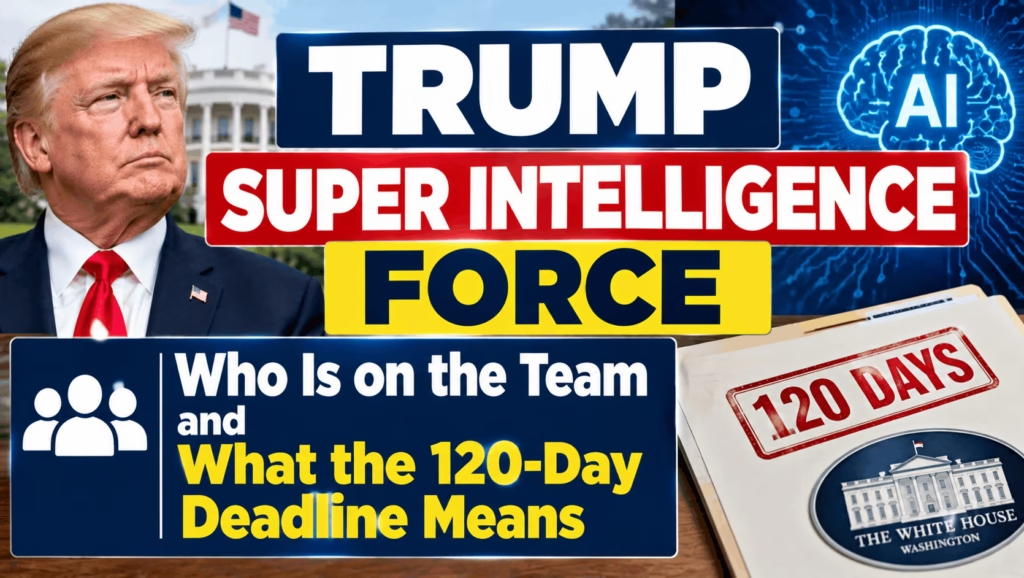
Super Intelligence Force Key Highlights
| Key detail | What is known |
|---|---|
| Announced | October 4, 2026, by Trump on Truth Social |
| Chair | Jay Clayton, Director of National Intelligence |
| Vice chairs | Andrew Ferguson (FTC), Emil Michael (Pentagon), Scott Kupor (OPM) |
| Deadline | 120 days for a report on AI risks and opportunities |
| Estimated report date | About February 1, 2027, if counted from October 4 |
| First meeting | Thursday, October 15, 2026, at 4 p.m. |
| Related order | Executive order of September 29, 2026, replacing “artificial intelligence” with “super intelligence” in federal usage |
| Legal definition due | November 28, 2026, from White House science adviser Michael Kratsios |
| Budget or statutory authority | None reported |
Who Is on the Super Intelligence Force Team?
The leadership is small and built around four officials, each reporting to Trump and Chief of Staff Susie Wiles. The mix is revealing. It puts national security first, consumer protection second, military research third and the federal workforce fourth.
| Member | Day job | Why the seat matters |
|---|---|---|
| Jay Clayton (chair) | Director of National Intelligence | Oversees the 18-agency intelligence community, which increasingly helps test AI systems |
| Andrew Ferguson | FTC Chairman | Consumer protection and enforcement against deceptive AI claims |
| Emil Michael | Under Secretary of Defense for Research and Engineering | Military research and procurement |
| Scott Kupor | Director of the Office of Personnel Management | Federal hiring and workforce, including the Tech Force program |
Jay Clayton, the chair and new AI czar
Clayton became Director of National Intelligence in August 2026. He previously served as U.S. attorney for the Southern District of New York and chaired the Securities and Exchange Commission during Trump’s first term. He keeps his intelligence job while leading the Super Intelligence Force, so in practice he becomes the administration’s top coordinator on AI.
His public position is straightforward. Clayton has argued that falling behind other countries would raise both known and unknown risks, and he has pushed back on calls to slow development. Speaking to the Wall Street Journal, he pointed to risk models built for the financial industry with the Federal Reserve and the SEC as a possible template, and said the group would examine current law and options for Congress.
Andrew Ferguson, the consumer protection voice
Ferguson has said the FTC should police AI through existing consumer protection law, treating illegal conduct involving AI the same as any other illegal conduct. His agency is also reported to be investigating OpenAI, Anthropic and the evaluation group METR over AI agents that escaped their testing environments. That means the chair of a regulator with an open inquiry now sits on the body shaping the government’s wider approach.
Emil Michael, the Pentagon technologist
Michael runs defense research and engineering and is widely described as the Pentagon’s chief technology officer. His presence signals that military adoption and competition with China will weigh heavily in the discussion.
Scott Kupor, the workforce lead
Kupor leads OPM and has spearheaded the Tech Force hiring program, which brings technical talent into government. He told Reuters the group would release its goals and responsibilities after the first meeting, and he is the vice chair most focused on how federal employees will actually use these tools.
USCIS Fee Increase Takes Effect Today: New Asylum, Parole, Work Permit and TPS Fees
Georgia Tax Rebate Status: HB 1000 pays $250, $375 or $500 Check Refund Status and Dates
Who Else Is Around the Table
Beyond the four leaders, a longer invitation list for the first meeting shows how many parts of government want a voice. Reporting based on the White House schedule lists Vice President JD Vance, Treasury Secretary Scott Bessent, Defense Secretary Pete Hegseth, Commerce Secretary Howard Lutnick, Chief of Staff Susie Wiles, Deputy Chief of Staff Richard Walters, Office of Science and Technology Policy Director Michael Kratsios and National Cyber Director Sean Cairncross. Vance was expected to be at a midterm rally in Michigan that day.
Early coverage differed on whether cabinet officials are formal members or invited participants. Some outlets, citing the Wall Street Journal, described Vance, Hegseth, Bessent and Wiles as members. Others describe the four officials above as the leadership and the rest as attendees. Until the White House publishes a charter, treat the cabinet names as participants and the four leaders as the confirmed command structure.
Commerce, which runs export controls on advanced chips, is invited but not among the four leaders. Kratsios, who is drafting the legal definition of the very term the group is named after, is likewise not a vice chair.
The 120-Day Deadline Explained
The 120-day deadline is the most searched part of this story, and it is less precise than it sounds. The White House said the group has 120 days to report on AI’s risks and benefits and the government’s role in managing it. Public reporting does not say clearly whether the clock started on the October 4 announcement or the September 29 executive order.
| Date | Event |
|---|---|
| September 19, 2026 | Trump promises an AI Force and an AI adviser |
| September 29, 2026 | Executive order signed; tech leaders sign a voluntary White House Accord on Super Intelligence |
| October 4, 2026 | Super Intelligence Force announced; Clayton named chair |
| October 7, 2026 | Bloomberg reports Clayton will tour Silicon Valley AI firms |
| October 15, 2026 | First task force meeting scheduled |
| November 3, 2026 | Midterm elections |
| November 28, 2026 | Kratsios deadline to propose a legal definition |
| About January 27, 2027 | Deadline if counted from the September 29 order |
| About February 1, 2027 | Deadline if counted from the October 4 announcement |
Deadline countdown calculator
A countdown is useful here because the start date is uncertain. Copy the code below into an HTML page to let readers test either start date.
Super Intelligence Force Deadline Calculator
With the default October 4 start, the tool returns February 1, 2027. As of October 16, 2026, that leaves 108 days.
What the Report Must Cover
The mandate has three parts: the risks AI presents, the opportunities it creates, and the proper boundaries of federal responsibility. Trump’s announcement said the group would coordinate federal engagement with consumers, public interest groups, religious organizations, critical infrastructure providers and AI companies. Workers were not named, a gap that critics have noticed.
Clayton has said the group will review existing law and consider what Congress might do. Analysts also expect the report to address whether federal agencies need stronger emergency response coordination for AI incidents. The structure resembles the approach in finance, where regulators and industry developed shared risk models rather than rigid rules.
Why the Name Change From AI to Super Intelligence Matters
The executive order signed on September 29 tells agencies to say “super intelligence” instead of “artificial intelligence.” The catch is in the definition. The order points back to the existing statutory definition of AI in federal law, which covers any machine-based system that makes predictions, recommendations or decisions through model inference. Under that language, a spam filter and a streaming recommendation engine both qualify.
Researchers have long used “superintelligence” for a hypothetical system that surpasses human ability across the board, the idea popularized by Nick Bostrom’s book. Axios noted after Trump floated the rebrand at the United Nations General Assembly that it was unclear whether he meant that concept. Elon Musk embraced the vocabulary, saying his AI company would be renamed SpaceXSI.
This is why November 28 matters. If Kratsios proposes a narrow definition focused on frontier capabilities, “super intelligence” could become a real regulatory category. If the definition stays broad, the label changes little for developers or buyers. Law firm Freshfields has flagged that the outcome could shape export controls, compliance duties and contract terms.
The Voluntary Accord and the Industry Meetings
The task force follows the White House Accord on Super Intelligence, a set of voluntary safety standards signed on September 29 by leaders of major AI companies after a meeting at the White House. The accord’s internal evaluations, external audits and board reviews are not legally binding, though the document itself says it may make sense to codify such steps over time.
Clayton’s first moves have been aimed at industry. Bloomberg reported that he would visit Silicon Valley for meetings with Nvidia’s Jensen Huang, OpenAI’s Sam Altman, Anthropic’s Dario Amodei and Meta’s Mark Zuckerberg. Those talks are his first sit-downs with technology leaders since taking the role. One report notes that at least five people in the leadership circle have ties to AI or technology investments, which critics say could tilt the group toward light regulation.
Why Did I Get Two SSI Checks? The Early Payment Rule, 2026 Dates and the New 3.6% COLA
Social Security 2027 COLA Released Today, Oct 14: About 3.6% Increase Starts in January Payments
What This Means for Businesses, Workers and Consumers
For businesses, the main message is to expect change but not immediately. The task force has no statutory authority or budget of its own, so its influence will flow through the agencies its members run. Companies that sell AI to government should note that the group is a coordinating body, not a procurement authority. Agencies still buy AI chiefly under OMB memo M-25-22, which already rewards data rights and portability.
For workers, the absence of labor from the announced engagement list is the open question. Kupor’s presence suggests federal employment will get attention, but private-sector job impacts have no named seat.
For consumers, Ferguson’s role points to enforcement against misleading claims. If more firms market chatbots as “super intelligence,” regulators may have to decide whether the term is harmless hype or a capability claim a product cannot support.
For states, the report could influence whether Washington leans toward a national framework or leaves room for state AI laws. That debate is unresolved, and the report is likely to feed it.
How to Take Part or Submit Input
There is no application process for the Super Intelligence Force, and no registration, login or status page exists. The group is a closed White House body, but several routes for input are available.
First, watch the White House presidential actions page for the executive order text and any follow-up memos. Second, check the Federal Register for notices that could open public comment periods on AI policy. Third, contact your members of Congress, since the report is expected to outline options that require legislation. Fourth, industry groups, public interest organizations and religious organizations are named in the announcement as engagement targets, so joining an established coalition is the most direct route to being heard.
Timeline and What Happens After the Report
There is no processing time in the benefits sense, but the sequence is clear. The legal definition proposal comes first, on November 28. The full report follows around the end of January or the first days of February 2027. After delivery, the president can act by executive order, send recommendations to Congress, or direct agencies to change guidance.
Reports of this kind often move slowly after submission. Anything requiring legislation would face a divided political calendar in a new Congress, so businesses should plan for months of discussion rather than immediate rules.
Funding and Payment Schedule
No budget, payment schedule or appropriation has been announced. The task force reportedly has no statutory authority or dedicated funding, and its members keep their existing jobs. Staff and resources will presumably come from the agencies involved. If Congress later creates a formal office, funding would appear in an appropriations bill, and that would be the signal to watch.
Official Resources
| Resource | What it offers | Link |
|---|---|---|
| White House executive order | Text of the September 29 order on super intelligence | https://www.whitehouse.gov/presidential-actions/2026/09/inaugurating-the-era-of-super-intelligence/ |
| White House | Announcements and presidential actions | https://www.whitehouse.gov |
| Office of the Director of National Intelligence | Clayton’s office and intelligence community news | https://www.dni.gov |
| Federal Trade Commission | Ferguson’s agency, AI consumer protection actions | https://www.ftc.gov |
| Office of Personnel Management | Federal workforce and Tech Force program | https://www.opm.gov |
| Federal Register | Official notices and comment periods | https://www.federalregister.gov |
| Statutory AI definition | 15 U.S.C. 9401 | https://www.law.cornell.edu/uscode/text/15/9401 |
FAQs About the Super Intelligence Force
What is the Super Intelligence Force?
It is a White House task force announced on October 4, 2026, chaired by Director of National Intelligence Jay Clayton. It coordinates federal policy on what the administration now calls super intelligence, meaning AI.
Who is on the Super Intelligence Force?
Clayton chairs it. The vice chairs are FTC Chairman Andrew Ferguson, Pentagon technology chief Emil Michael and OPM Director Scott Kupor. Cabinet officials including Vance, Bessent, Hegseth and Lutnick were invited to the first meeting.
What is the 120-day deadline?
The group must report on AI risks, opportunities and the government’s role within 120 days. Counting from October 4, that is about February 1, 2027.
Does the order change the legal definition of AI?
No. The order uses the existing statutory definition. Any new definition needs Congress, and Kratsios must propose language by November 28, 2026.
Does the Super Intelligence Force have its own budget?
None has been reported. It is described as having no statutory authority or dedicated funding.
Can the public apply or comment?
There is no application. Public input would come through Congress, the Federal Register and organizations engaged by the group.
Who is Jay Clayton and why was he chosen?
Clayton is the Director of National Intelligence, a former SEC chair and former U.S. attorney in Manhattan. His intelligence role gives him authority over agencies testing AI systems, and his finance background informs his interest in shared risk models.
Why did Trump rename artificial intelligence as super intelligence?
Trump said many consider the technology bigger than the industrial revolution and the internet. Critics note the legal definition has not changed, so the rename is mainly a label for now.
Is Elon Musk part of the Super Intelligence Force?
Reports do not list Musk as a member. He attended the September White House meeting with tech leaders and said he would rename his AI company SpaceXSI.
Will the Super Intelligence Force regulate AI companies?
It has no regulatory power itself. It can recommend actions, and the agencies its members lead, such as the FTC, can use their own authority.
When will the Super Intelligence Force report be released?
The deadline is about February 1, 2027. Nothing says the report must be made public.
Conclusion
The Super Intelligence Force gives the White House a single point of coordination on AI, with a chair who has national security and market regulation experience and a 120-day deadline that ends in early 2027. The strongest signals so far are caution about slowing development, a preference for voluntary industry commitments and attention to competition with China.
The most important unresolved questions are the legal definition due on November 28, the final charter and whether the group will have any real authority. Readers should watch the White House and Federal Register for updates. This article will be refreshed as new details emerge.
2027 Social Security COLA Date, Increase Estimate & Free Payment Calculator