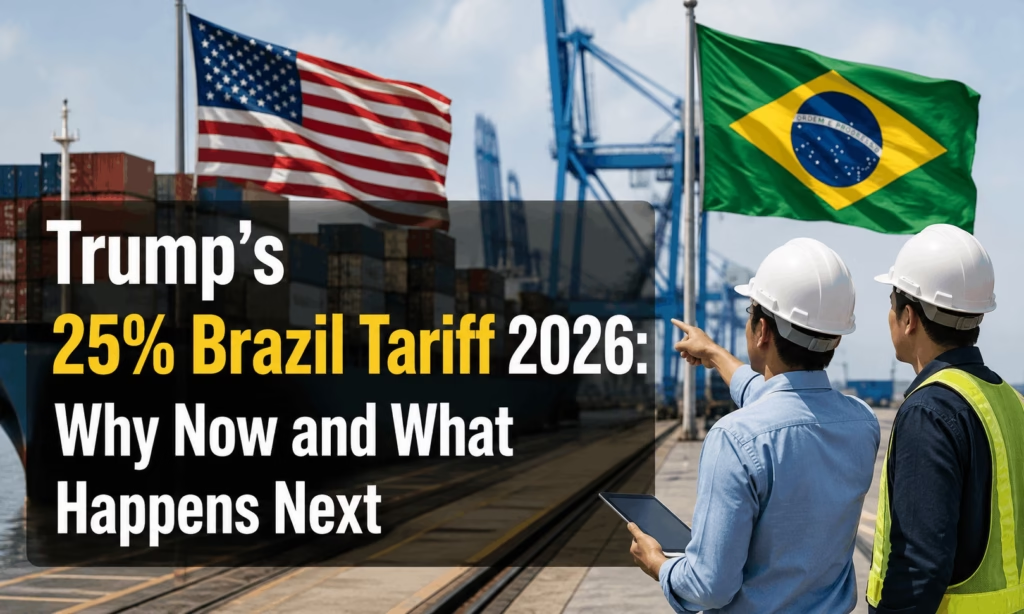
Trump’s 25% Brazil Tariff 2026: Brazil is scrambling to salvage its trade relationship with Washington after President Trump’s new tariffs stacked a second round of duties on top of the first, pushing the combined rate on many Brazilian goods toward 37.5 percent by late July. What started as a 25 percent levy under Section 301 of the Trade Act of 1974, formally imposed on July 16 and effective July 22, was compounded just one week later by an additional 12.5 percent forced-labor tariff that applies to Brazil alongside roughly 60 other countries. Brazilian officials say the two rates are cumulative, and industry groups like Amcham Brasil estimate a large share of the country’s exports will now face the combined burden.
Trump’s 25% Brazil tariff replaced an earlier and far more aggressive 50 percent tariff that Trump had imposed in August 2025, explicitly tied to the criminal trial of former Brazilian president Jair Bolsonaro. That original tariff was struck down by the U.S. Supreme Court in February 2026, which ruled the emergency powers Trump used to justify it did not apply. Rather than abandon tariff pressure on Brazil, the administration pivoted to Section 301, a statutory tool that is far harder to challenge in court, and used it to reimpose duties on most Brazilian imports starting in July. We’ll be updating this article monthly as the trade dispute and any Brazil tariff negotiation develop further.
Trump’s 25% Brazil Tariff 2026 Key Highlights
| Detail | Current Status |
|---|---|
| Original 2025 tariff | 50 percent, imposed August 1, 2025, tied to the Bolsonaro trial |
| Supreme Court ruling | Struck down IEEPA-based tariffs in February 2026 |
| Section 122 stopgap tariff | 10 percent, expired July 24, 2026 |
| New Section 301 tariff | 25 percent, announced July 16, effective July 22, 2026 |
| Additional forced-labor tariff | 12.5 percent, effective July 25, 2026, stacks on the 25 percent |
| Combined rate on affected goods | Up to 37.5 percent per Brazilian government estimates |
| Legal basis | Section 301 of the Trade Act of 1974 |
| Exempt goods | Coffee, beef, orange juice, aircraft parts, rare earths, energy, and about 400 tariff subheadings |
| Share of Brazilian exports exempted | About 44 percent under the Section 301 exemption annex |
| Brazil’s response | Reciprocity Law consultations opened, WTO dispute process referenced, no retaliatory tariffs imposed as of late August 2026 |
| Brazilian presidential election | October 2026, with Lula facing Bolsonaro’s son Flavio |
Why Trump Imposed a 25 Percent Tariff on Brazil
Trump’s 25% Brazil tariff did not emerge overnight. It followed a year-long Section 301 investigation opened by the Office of the U.S. Trade Representative at Trump’s direction. USTR concluded that Brazil had engaged in a pattern of unreasonable acts, policies, and practices that burden or restrict American commerce, citing six categories of concern that officials say include inadequate anti-corruption enforcement, weak intellectual property protection, restricted access for U.S. ethanol, and continued illegal deforestation.
Secretary of State Marco Rubio framed the tariff announcement as the direct consequence of failed negotiations, stating that Brazil’s government had not negotiated in good faith and that President Luiz Inacio Lula da Silva had prioritized political posturing over reaching an agreement. USTR representative Jamieson Greer said the investigation had been ongoing since April 2025, involving multiple rounds of talks that failed to resolve the underlying disputes.
Brazil disputes this characterization entirely. Lula’s office issued a statement saying Brazil had worked tirelessly with USTR to end the investigation, presenting evidence refuting each allegation of unfair trade practice. Brazilian officials have also pointed out that the United States actually runs a trade surplus with Brazil, not a deficit, making Brazil an unusual target for tariffs typically justified by trade imbalances. Last year alone, U.S. exports to Brazil exceeded imports by nearly 42 billion dollars, one of America’s largest bilateral trade surpluses with any country.
The Path From a 50 Percent Tariff to a 25 Percent Tariff
Understanding the shift from 50 percent to 25 percent requires tracing the entire legal sequence that unfolded over roughly twelve months.
In July 2025, Trump announced a 50 percent tariff on nearly all Brazilian goods, set to take effect August 1, 2025. That tariff was explicitly political, tied to Trump’s anger over the prosecution of Bolsonaro, whom Trump described as the victim of a witch hunt over an alleged 2023 coup attempt against Lula. Trump used the International Emergency Economic Powers Act, or IEEPA, to justify the move, along with a warning that any retaliatory tariff increase from Brazil would be added directly on top of the 50 percent rate.
In February 2026, the U.S. Supreme Court ruled against the administration’s IEEPA-based tariffs across the board, finding that the law did not authorize the kind of broad, non-emergency tariff program Trump had built. This ruling invalidated the 50 percent Brazil tariff along with similar IEEPA tariffs applied to dozens of other countries.
The administration responded by invoking Section 122 of the Trade Act of 1974, a provision allowing temporary tariffs of up to 15 percent for balance-of-payments emergencies, and applied a 10 percent global stopgap tariff. This measure was always designed to be temporary and was set to expire July 24, 2026.
To build something more durable, USTR opened the Section 301 investigation into Brazil specifically, alongside a broader Section 301 forced-labor investigation covering roughly 60 countries representing 99.4 percent of all U.S. imports. On June 2, 2026, USTR proposed a 25 percent tariff on Brazilian goods under this new authority. On July 16, 2026, the administration formally announced the tariff, and it took effect July 22, 2026, just two days before the Section 122 stopgap tariff was set to expire.
| Timeline | Event |
|---|---|
| August 1, 2025 | 50 percent IEEPA tariff on Brazil takes effect, tied to the Bolsonaro trial |
| February 2026 | Supreme Court strikes down IEEPA tariffs nationwide |
| February to July 2026 | 10 percent Section 122 stopgap tariff applies globally |
| June 2, 2026 | USTR proposes new 25 percent Section 301 tariff on Brazil |
| July 16, 2026 | Trump formally announces the 25 percent tariff |
| July 22, 2026 | 25 percent tariff takes effect |
| July 24, 2026 | Section 122 stopgap tariff expires |
| July 25, 2026 | Additional 12.5 percent forced-labor tariff takes effect, stacking on the 25 percent |
| August 2026 | Brazil opens Reciprocity Law consultations, Lula calls Trump seeking renewed talks |
Canada 50% Tariff 2026: 700 US Goods Hit With Tariffs Up to 50% From September 8
Social Security Changes September 2026: SSA Announces Major Update for Retirees and Beneficiaries
Minimum Wage Increase in 5 Canadian Provinces: What Changes October 1, 2026
Which Brazilian Products Are Exempt From the Tariff
A significant share of Brazil’s exports to the United States escape the new duties entirely. USTR’s exemption annex covers roughly 400 tariff subheadings, sparing about 44 percent of Brazil’s total exports to the U.S. from the Section 301 tariff. The largest exemptions include coffee, orange juice, beef, cocoa, nuts, tropical fruit, iron and manganese ore, chemical wood pulp, crude and refined petroleum, and civil aircraft parts, a category that reflects the importance of Brazil’s Embraer, one of the world’s top builders of regional commercial jets.
An additional 13 percent of Brazil’s exports avoid the Section 301 action altogether because those goods are already covered separately under Section 232 tariffs on steel, aluminum, copper, autos, and lumber, meaning they are taxed under a different legal framework rather than being double-counted.
| Product Category | Tariff Status |
|---|---|
| Coffee | Exempt from the 25 percent tariff |
| Beef | Exempt from the 25 percent tariff |
| Orange juice | Exempt from the 25 percent tariff |
| Aircraft and aircraft parts | Exempt from the 25 percent tariff |
| Rare earths and other metals | Exempt from the 25 percent tariff |
| Energy products, crude and refined petroleum | Exempt from the 25 percent tariff |
| Steel, aluminum, copper, autos, lumber | Covered separately under Section 232, not double-taxed |
| Aluminum, cotton, electronics, lithium batteries, tobacco | Cited categories affected by the added 12.5 percent forced-labor tariff |
| Most other manufactured and industrial goods | Subject to the full 25 percent, plus 12.5 percent where applicable |
The Separate 12.5 Percent Forced-Labor Tariff
A week after the Section 301 tariff took effect, USTR layered on a second measure targeting 60 countries it says have failed to adequately prohibit or enforce bans on goods produced with forced labor. Brazil was assigned the higher 12.5 percent rate rather than the lower 10 percent rate given to countries the U.S. considers to have taken stronger action, such as Canada, Mexico, the European Union, Indonesia, Ecuador, and Pakistan.
Brazil’s government strongly disputes the basis for this tariff. Foreign Affairs Minister Mauro Vieira said the United States failed to present evidence supporting the claim that Brazil imports goods produced through forced labor from third countries at a rate justifying the penalty. Brazilian officials note the country’s own domestic labor inspection system, including a public registry of employers caught using forced labor known as the Lista Suja, has operated since 2003 and has been praised by the International Labour Organization as a model enforcement mechanism.
Economists at the Peterson Institute for International Economics have described the forced-labor case as functioning less like a genuine labor standards enforcement tool and more like an additional lever of tariff leverage, since countries can reduce the rate through trade concessions unrelated to labor practices, via what USTR calls Agreements on Reciprocal Trade.
How Brazil Is Responding
Lula’s government has so far avoided immediate retaliation, choosing a more measured legal and diplomatic path. Brazil opened formal consultations under its domestic Reciprocity Law, a mechanism that allows the country to eventually respond with its own countermeasures, including tariffs, once the review process concludes. Brazil has also said it will pursue the matter through the World Trade Organization’s dispute settlement system.
Despite the tough rhetoric, Lula told reporters in late August that Brazil is in no rush to impose retaliatory tariffs and reiterated his preference for negotiation over confrontation. In a phone call with Trump around the same period, Lula pushed to restart formal trade talks, a move widely seen as connected to Brazil’s tightening October presidential race, in which Lula faces Flavio Bolsonaro, son of the former president whose prosecution originally triggered the trade dispute.
Brazilian export data through the first half of 2026 shows the pressure is already being felt. Brazilian exports to the United States fell 13 percent, totaling 17.4 billion dollars, with the American share of Brazil’s total trade dropping to 9.4 percent, its lowest level since 1997. Losses were concentrated in coffee, oil, and steel-adjacent industries. At the same time, Brazil has redirected significant trade volume toward China, which absorbed roughly 37 percent of Brazil’s exports by the end of 2025, continuing a trend of trade diversion away from the United States that began with the earlier 50 percent tariff round.
Trump Accounts Dell $250 Grant: Did Deposits Actually Start Monday? Here’s Who’s Actually Been Paid
2027 Social Security COLA Forecast: Latest 3.6% Estimate and How Much Retirees Could Get
$2000 Stimulus Payment September 2026 Fact-Check: Is It Really Coming?
What Happens Next
Several developments are likely to shape where this dispute goes over the coming months. Brazil’s Reciprocity Law consultation process is expected to continue running in parallel with renewed diplomatic contact between Lula and Trump, and a negotiated reduction in tariff rates remains possible if both sides reach a deal before Brazil’s October election concerns dominate the political calendar entirely.
Trade analysts expect the Trump administration to continue expanding its use of Section 301 as the primary legal foundation for tariffs going forward, since it is significantly more resistant to court challenges than the IEEPA authority the Supreme Court rejected in February. This suggests the current 25 percent and 12.5 percent rates on Brazil are more likely to persist or shift through negotiation than to be struck down through litigation the way the original 50 percent tariff was.
Brazilian industry groups, including Amcham Brasil, continue lobbying both governments for an expanded exemption list, particularly for manufactured goods not currently covered by the existing 400-subheading exemption annex. Whether that expansion happens will likely depend heavily on the outcome of Brazil’s presidential election in October and whichever candidate is positioned to negotiate with Washington afterward.
Impact on Prices and Supply Chains
Because coffee, beef, and orange juice remain exempt, U.S. grocery prices for these specific Brazilian staples are not expected to see direct tariff-driven increases, a detail that has softened some of the domestic economic backlash compared to earlier tariff rounds. However, industries reliant on Brazilian aluminum, electronics components, lithium batteries, tobacco, and other goods now facing the stacked 25 plus 12.5 percent rate are more exposed to cost pass-through, and companies in these sectors have already begun adjusting sourcing strategies. U.S. importers who relied heavily on Brazilian industrial inputs are increasingly evaluating alternative suppliers in Mexico, Southeast Asia, and elsewhere in Latin America to avoid the combined tariff burden.
How This Compares to Other Recent Section 301 Tariff Actions
Brazil was the first country targeted under the administration’s new Section 301 approach following the Supreme Court’s rejection of the IEEPA tariffs, making it something of a test case for how this legal strategy would hold up both politically and economically. The forced-labor investigation that added the 12.5 percent surcharge covered roughly 60 economies simultaneously, meaning Brazil’s situation is not unique in structure, but the combination of a country-specific 25 percent Section 301 tariff stacked with the broader forced-labor tariff makes Brazil one of the more heavily affected trading partners in this new tariff regime. Countries like Canada, Mexico, the European Union, Indonesia, Ecuador, and Pakistan received the lower 10 percent forced-labor rate rather than the 12.5 percent rate applied to Brazil, a distinction USTR attributes to those economies having taken steps such as adopting a forced-labor import prohibition or entering into a formal Agreement on Reciprocal Trade with the United States.
Trade analysts note that this two-tier structure effectively invites countries to negotiate bilateral concessions with Washington in exchange for a lower rate, even when the stated justification is forced-labor enforcement rather than broader trade policy. Brazil has not yet secured this kind of arrangement, which is part of why officials in Brasilia have continued pushing for renewed high-level talks rather than allowing the current rates to stand indefinitely.
$400 Inflation Refund Checks 2026: New York’s Real Program, Fact-Checked
Stimulus Check 2026: Fact-Checking Every Viral Payment Claim (Tracker)
Social Security SSI Payment Date September 2026 Confirmed by SSA- Check Full Schedule here!
Economic Ripple Effects Beyond Direct Tariff Costs
Beyond the immediate cost added to specific product categories, the tariff dispute has already reshaped broader patterns in Brazil’s trade relationships. The shift of nearly 37 percent of Brazil’s export volume toward China reflects a structural change that trade economists say tends to persist even after tariff disputes eventually resolve, since new supply chain relationships and shipping contracts are costly to unwind once established. Some U.S. industries that depend on Brazilian inputs, particularly in electronics manufacturing and battery production, have reported longer lead times and higher input costs as they diversify away from Brazilian suppliers facing the stacked tariff rate, even for components not directly named among the five product categories cited in the forced-labor case.
Currency markets have also responded to the uncertainty. The Brazilian real has seen periods of volatility tied to tariff headlines throughout 2026, with traders pricing in both the risk of prolonged tariff pressure and the possibility of a negotiated settlement tied to the outcome of Brazil’s October election. Brazilian exporters in affected industries have in some cases absorbed part of the tariff cost rather than passing the full amount to American buyers, a strategy aimed at preserving market share while negotiations continue, though how long companies can sustain that approach without raising prices remains an open question heading into the final months of 2026.
Official Resources
| Resource | Purpose | Link |
|---|---|---|
| USTR Section 301 Brazil Fact Sheet | Official tariff announcement and legal basis | ustr.gov/node/14362 |
| USTR Forced Labor Section 301 Findings | Details on the additional 12.5 percent tariff | ustr.gov |
| U.S. Customs and Border Protection | Check current tariff classifications and rates | cbp.gov |
| Brazil Ministry of Foreign Affairs | Brazil’s official response and trade statements | gov.br/mre |
| World Trade Organization Dispute Settlement | Track Brazil’s WTO complaint status | wto.org |
FAQs About Trump’s 25% Brazil Tariff 2026
Why did Trump impose a 25 percent tariff on Brazil?
Trump imposed the tariff after a Section 301 investigation concluded Brazil engaged in unreasonable trade practices, including weak anti-corruption enforcement, restricted ethanol market access, and inadequate intellectual property protection, following the Supreme Court’s rejection of his earlier 50 percent IEEPA-based tariff.
Is the Brazil tariff still 50 percent or is it 25 percent now?
The original 50 percent tariff from August 2025 was struck down by the Supreme Court in February 2026. It was replaced by a new 25 percent Section 301 tariff effective July 22, 2026, though a separate 12.5 percent forced-labor tariff now stacks on top of it for many goods.
What products are exempt from the Brazil tariff?
Coffee, beef, orange juice, aircraft parts, rare earths, and energy products are among the roughly 400 tariff subheadings exempted, covering about 44 percent of Brazil’s total exports to the United States.
Has Brazil retaliated against the US tariffs?
As of late August 2026, Brazil has not imposed retaliatory tariffs. The government has opened Reciprocity Law consultations and referenced the World Trade Organization dispute process, while Lula has pushed for renewed negotiations with Trump instead of immediate countermeasures.
Will the Brazil tariff affect coffee and beef prices in the US?
No direct increase is expected from this specific tariff, since coffee, beef, and orange juice are explicitly exempted from both the 25 percent and the 12.5 percent forced-labor tariff.
What is Section 301 and why is Trump using it now?
Section 301 of the Trade Act of 1974 allows the president to impose tariffs after USTR investigates unfair foreign trade practices. The administration shifted to this legal basis after the Supreme Court struck down its broader IEEPA tariffs, since Section 301 rests on a statutory foundation that is harder to challenge in court.
Could the Brazil tariff be reduced or removed?
Yes, reduction remains possible through negotiation. Lula and Trump have both signaled openness to renewed talks, though no agreement has been finalized as of this article’s publication, and Brazil’s October election is likely to influence the timeline.
People Also Ask
What triggered Trump’s tariffs on Brazil?
The original 2025 tariff was tied to the prosecution of former president Jair Bolsonaro. The current 25 percent tariff stems from a separate Section 301 investigation into broader Brazilian trade practices, including deforestation, ethanol access, and intellectual property enforcement.
How much is the total tariff on Brazilian goods now?
Many Brazilian goods face a combined rate of up to 37.5 percent, combining the 25 percent Section 301 tariff with the additional 12.5 percent forced-labor tariff, according to Brazilian government estimates.
Did the Supreme Court block Trump’s Brazil tariffs?
The Supreme Court struck down Trump’s original IEEPA-based tariffs, including the 50 percent Brazil tariff, in February 2026. The current 25 percent tariff uses a different legal authority, Section 301, which was not affected by that ruling.
Is Brazil still trading with the United States?
Yes, though trade volume has shifted. Brazilian exports to the U.S. fell 13 percent in the first half of 2026, and Brazil has increasingly redirected trade toward China and other markets.
When will the Brazil tariff dispute be resolved?
There is no confirmed resolution date. Both governments have signaled willingness to negotiate, and developments are likely tied to the outcome of Brazil’s October 2026 presidential election.
Conclusion
Trump’s 25% Brazil tariff marks the second major escalation in a trade dispute that began with a politically charged 50 percent tariff in 2025 and was reshaped after the Supreme Court intervened in February 2026. The current 25 percent Section 301 tariff, layered with an additional 12.5 percent forced-labor duty, has already reduced Brazilian exports to the U.S. and pushed Brazil to explore, but not yet use, retaliatory options under its own Reciprocity Law. With key staples like coffee, beef, and orange juice exempted, the direct impact on U.S. consumer prices has been limited so far, but industries relying on Brazilian metals, batteries, and electronics face real cost pressure. Whether the dispute cools through negotiation or hardens further will likely become clearer only after Brazil’s October presidential election settles who Washington will be negotiating with next.
OAS Payment Increase September 2026: Confirmed Amounts, Payment Date, and the Annual GIS Reset !
Ohio SNAP Food Ban starts October 1, 2026: What’s Banned, Court Update & Rules
UK Free Bus Pass Rules 2026: What’s Officially Changing
$200 Extra Social Security Payment: When Is It Being Approved, and Who Can Get It?
VA Benefits Lawyer: For Which Claims Do You Need One, and How Much Can They Cost?