
US Government Shutdown December 2026: The possibility of a US government shutdown is becoming an important concern as the December 11, 2026, federal funding deadline approaches. The temporary funding measure signed by President Donald Trump keeps federal agencies operating through this date, but Congress must approve new funding or another temporary extension to avoid a potential shutdown starting December 12. A funding lapse could affect federal employees, government offices, national parks and some public services, although programs such as Social Security are generally expected to continue. Here’s what Americans need to know about the December deadline, Congress’s next steps and the possible impact of a government shutdown.
No Government Shutdown happens on December 11. Federal funding is in place through the end of that day. The real risk begins at 12:01 a.m. on Saturday, December 12, 2026, if Congress has not passed a new funding law by then. As of November 5, no deal has been announced.
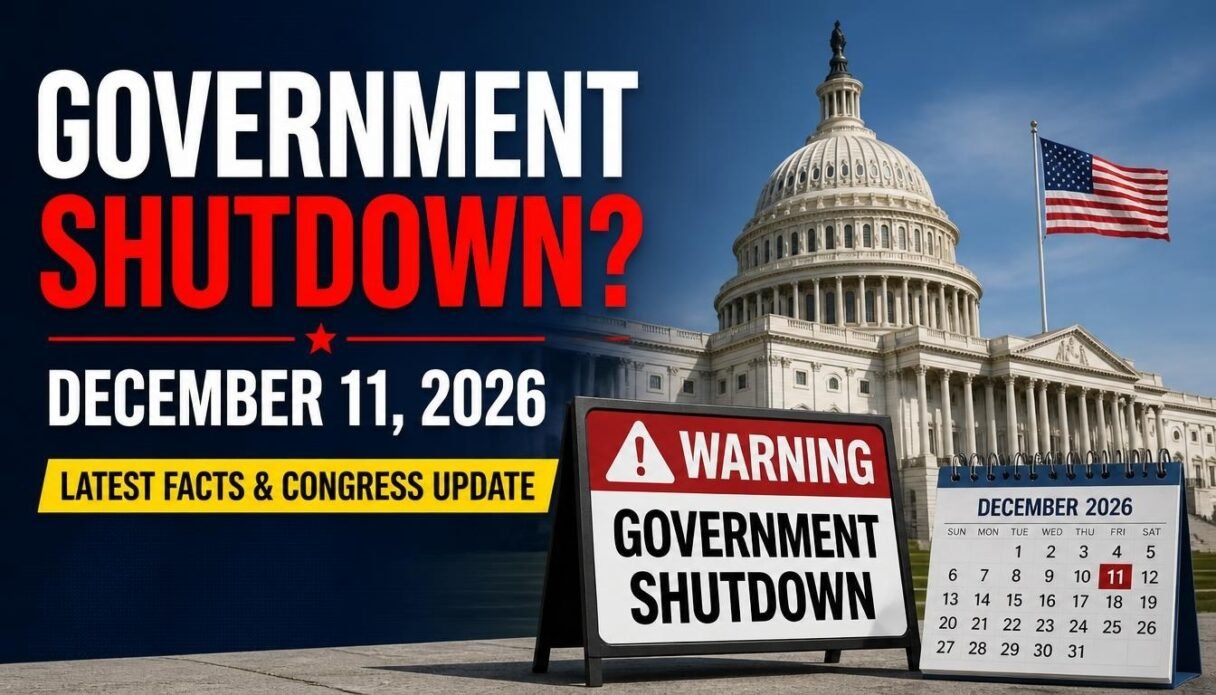
Where things stand today?
President Trump signed H.R. 6500, the Continuing Appropriations and Extensions Act, 2027, on September 2, 2026. Its Division A funds agencies under all 12 regular appropriations bills from October 1 through December 11, 2026. The Congressional Research Service says Congress must enact FY2027 bills or another stopgap before then to avoid a funding gap starting December 12.
The House approved the Senate’s bipartisan version 370-48. The Senate had passed it 90-6 on August 8, and the law generally keeps spending at FY2026 levels. CBO estimates the annualized discretionary spending under the stopgap at about $1.701 trillion.
The stopgap was a delay, not a solution. None of the 12 spending bills has become law, and the Senate has not reported one. As of November 3, the Senate had passed none of the 12.
The big new factor: the midterm results
The November 3 elections changed the political picture. CBS News projects that Democrats won both chambers, with at least 54 Senate seats and an estimated 251 to 268 House seats once all votes are counted. Alaska and Mississippi Senate races were still uncalled as of Wednesday morning. Treat the final seat counts as provisional.
The new Congress does not take over immediately. Republicans run Congress until noon on January 3, 2027, so the lame-duck Republican majorities must deal with the December 11 deadline. Both chambers return on November 9 for two weeks, break for Thanksgiving, then return for two or three weeks, giving a maximum of about five legislative weeks.
Why a Government Shutdown is possible?
1. No spending topline. Reporting from the start of the fiscal year said there was no progress on topline defense and non-defense levels, and that the quickest appropriators can usually draft and vote on final bills is about four weeks after a topline deal. Senate Appropriations Chair Susan Collins and Vice Chair Patty Murray had not announced agreement on total spending.
2. The defense fight. No Labels reports the Trump administration wants a record $1.5 trillion for defense, which Senate Democrats reject. Shortfalls tied to the Iran war and the broader military buildup make the defense number especially hard to settle.
3. Limits on withholding funds. Senate appropriators are pushing to block the administration from withholding congressionally approved funding. The September stopgap also bars OMB from finalizing its proposed federal grants rule through December 11. That fight will return when the CR expires.
4. A crowded deadline. Surface transportation authority and National Flood Insurance Program authority also expire December 11. Some health and farm programs lapse on December 31 unless Congress acts. Holland & Knight notes the Community Health Center Fund expires December 31, so the December 11 deadline is a natural vehicle for those extensions.
5. A lame-duck Congress. Lame-duck sessions are tricky because many members are retiring or have lost reelection, so motivations and even attendance are unpredictable.
Why a Government Shutdown is not certain?
Harbinger Strategies says another CR that pushes funding into 2027 is likely, though it cannot rule out a December shutdown. It also says both sides may want funding off the table early in the new Congress. House Appropriations Chair Tom Cole said in September that the outcome would be either a yearlong stopgap or a shutdown. Treat that as a forecast by one official, not a fact.
Both parties showed they wanted to avoid a pre-election Government . Collins and Murray struck the Senate stopgap deal, and Murray called it a CR that averts a shutdown no one wants.
The likeliest paths are a short CR into early 2027, a yearlong CR, or an omnibus or minibus package. A short CR would let the incoming Democratic majorities negotiate with more leverage. A longer deal would lock in Republican-era terms. That tension is the main thing to watch. A lapse is possible if the two sides cannot agree on which path to take.
Key dates
| Date | What happens |
| Nov 9 (Mon) | Congress returns for lame duck |
| Nov 26 (Thu) | Thanksgiving; Congress typically recesses that week |
| Dec 11 (Fri) | Stopgap, surface transportation and NFIP authority expire |
| Dec 12 (Sat) | Funding gap would begin if nothing passes |
| Dec 31 (Thu) | Health center and other program authorities expire |
| Jan 3, 2027 (noon) | New Congress sworn in |
Trump Midterm Losses: “I Wasn’t on the Ballot” and What Happens Next in Congress
Full Social Security at 60: Who Qualifies Under the New Blue Collar Bill?
Cash App CFPB Settlement Checks: Why You’re Getting a “Compensation Payment Is on the Way” Email
What a Government Shutdown would mean for payments?
Social Security and SSI. Payments continue during a shutdown. SSA stated during the earlier 2026 shutdown that payments to current Social Security and SSI recipients continue with no change in payment dates. SSA’s schedule for December 2026 is:
| Group | Payment date |
| SSI | Tue, Dec 1 |
| Pre-May 1997 / dual beneficiaries | Thu, Dec 3 |
| Birthdays 1st-10th | Wed, Dec 9 |
| Birthdays 11th-20th | Wed, Dec 16 |
| Birthdays 21st-31st | Wed, Dec 23 |
| SSI (January 2027, paid early) | Thu, Dec 31 |
These dates match the SSA schedule as reproduced by Disabled World. Cronista reports SSA announced a 3.6% COLA on October 14, 2026, with SSI recipients receiving the adjusted amount on December 31. Confirm the COLA figure on SSA.gov.
Federal employees. Under the Government Employee Fair Treatment Act of 2019, federal employees are paid retroactively for the shutdown period after it ends, including furloughed and excepted workers. Contractors typically do not receive back pay.
Military. Servicemembers keep working but are not paid during a shutdown, and they receive back pay once appropriations pass. Military pay usually lands on the 1st and 15th, so the December 15 paycheck would be the first at risk in a lapse. Check current Defense Department guidance, because past shutdowns saw ad hoc workarounds.
Military retirees. Military retirees and annuitants continue to be paid, because their pay is funded from a different source.
SNAP. USAFacts says SNAP benefits can be disrupted in a prolonged shutdown. A lapse that is short would likely matter less than one that stretches into January issuance.
TSA and air traffic. TSA officers, air traffic controllers and CBP agents work without pay, and absences in past shutdowns caused delays.
Recent History
- The October 1 to November 12, 2025 shutdown lasted 43 days, the longest full shutdown in U.S. history.
- A first 2026 lapse ran from January 31 to February 3 and affected roughly half of federal agencies.
- A DHS-only lapse began February 14 and ended around April 30. Sources count it at roughly 75 to 76 days.
What to watch before December 11?
- Whether Collins and Murray announce a spending topline.
- Whether leaders choose an omnibus, a short CR or a yearlong CR.
- Statements from President Trump, Speaker Johnson, Sen. Thune and incoming Democratic leaders.
- Whether health, farm and transportation extensions get attached.
- Whether the House calendar leaves enough time. Because December 12 is a Saturday, a short lapse could cover the weekend first.
Official and Verified Sources
| Source | Type | Link |
| CRS: Overview of Continuing Appropriations for FY2027 (P.L. 119-103) | Official (Congress) | congress.gov |
| SSA: 2026 Payment Schedule (PDF) | Official | ssa.gov |
| SSA: Payment calendar | Official | ssa.gov |
| SSA: How a shutdown affects payments | Official | ssa.gov |
| Sen. Murray: CR text statement | Official (Senate Approps) | appropriations.senate.gov |
| Sen. Murray: remarks on the stopgap | Official (Senate Approps) | appropriations.senate.gov |
| House Appropriations: DHS shutdown releases | Official | appropriations.house.gov |
| CBS News: Midterm results | News | cbsnews.com |
| CBS News: House passes stopgap | News | cbsnews.com |
| NBC News: Senate CR deal | News | nbcnews.com |
| Ballotpedia: Stopgap and OMB rule | Reference | ballotpedia.org |
| Holland & Knight: Year-end deadlines | Law firm analysis | hklaw.com |
| Harbinger Strategies: Lame duck preview | Analysis | harbingerdc.com |
| Akin: Approps Drop | Law firm analysis | akingump.com |
Government Shutdown 2026- FAQ’s
1. Will the government shut down on December 11, 2026?
No. Funding runs through the end of December 11. A lapse would begin December 12 if Congress does not act.
2. Is the government shut down right now?
No. A funding tracker recorded federal funding verified through December 11 as of October 2.
3. Is a shutdown certain?
No. Congress could pass full-year bills, an omnibus or another CR. One analyst considers another CR likely.
4. Who controls Congress during the deadline?
Republicans, until January 3, 2027, even though Democrats are projected to control the next Congress.
5. Will my Social Security check be delayed?
No. Payments continue, though some services may slow down.
6. Will federal employees get back pay?
Yes, by law, for federal employees. Contractors usually do not.
7. What happens to troops’ pay?
They keep working and get back pay afterward. Watch the December 15 paycheck for news.
8. What else expires on December 11?
Surface transportation and flood insurance authorities, per GOV.HOUSE.
9. What else expires on December 31?
Health center funding, TANF and some farm programs, per Holland & Knight and Breezy Scroll.
10. Has Congress used a yearlong stopgap before?
I did not verify historical precedent here, so I will not state it as fact.
Also Read :-
Tariffs After the Midterms: What Congress Can and Can’t Do?
What the 2026 Midterm Results Could Mean for Your ACA Health Insurance and Medicaid?
When Will You Learn Your Exact 2027 Social Security Amount? Dates and Steps