The USA OPT Program 2026 allows eligible F-1 international students to work legally in the United States in a job directly related to their field of study, either during or after completing their degree. In 2026, the program remains structured around 12 months of standard OPT, extendable to 36 months total for students with a qualifying STEM degree, but a major regulatory shift is reshaping how international students maintain status: on July 17, 2026, the Department of Homeland Security published a final rule eliminating “Duration of Status” (D/S) for F-1 students, replacing it with a fixed admission period effective September 15, 2026. This means F-1 students, including those on OPT, will now need to track a specific expiration date and may need to file an Extension of Stay (EOS) application to remain authorized.
This guide breaks down OPT eligibility, the current I-765 filing fee, the STEM OPT extension pathway to H-1B, the 90/150-day unemployment rules, and exactly how the new fixed admission period rule affects OPT applicants in 2026. We’ll be updating this article monthly as USCIS and DHS release further guidance on implementing the fixed admission period rule. Whether you’re preparing to file for post-completion OPT, considering a STEM extension, or trying to understand how the September 2026 rule change affects your status, the sections below cover exactly what current and prospective F-1 students need to know.
USA OPT Program 2026 Key Highlights
| Key Data Point | 2026 Detail |
|---|---|
| Standard OPT duration | 12 months |
| STEM OPT extension | Additional 24 months (36 months total) |
| Standard OPT unemployment limit | 90 days |
| Combined OPT + STEM OPT unemployment limit | 150 days |
| Form I-765 filing fee (online) | $470 |
| Form I-765 filing fee (paper) | $520 |
| Premium processing fee (I-907) | $1,780 (30 business days) |
| Recommended filing window before graduation | Up to 90 days before, no later than 60 days after program end date |
| Cap-gap protection | Extends status through September 30 if selected in H-1B lottery |
| DHS Fixed Admission Period final rule published | July 17, 2026 |
| Fixed admission rule effective date | September 15, 2026 |
| Post-graduation departure grace period (new rule) | Reduced from 60 days to 30 days |
What Is the USA OPT Program 2026?
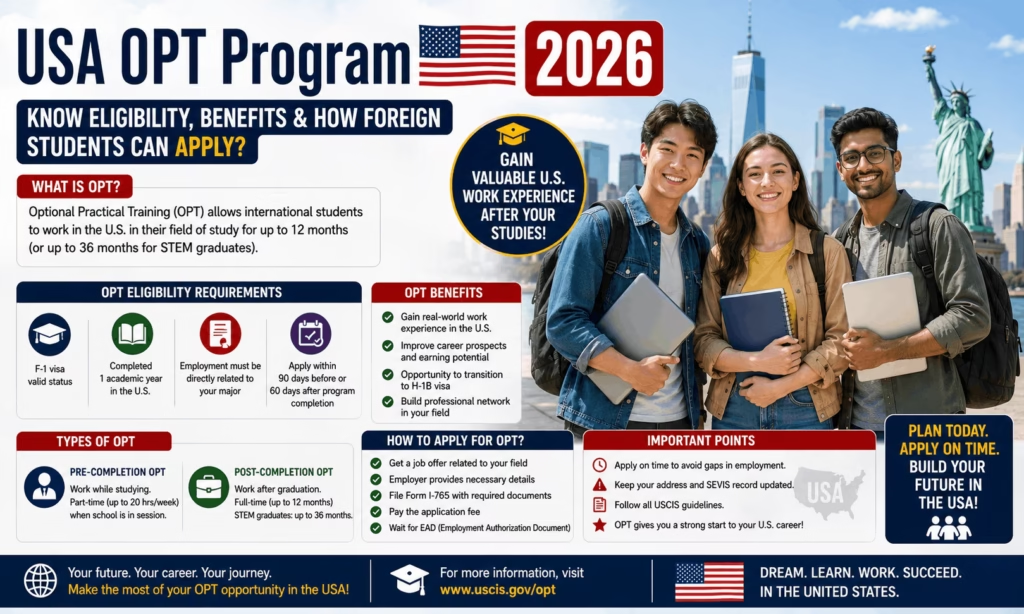
Optional Practical Training (OPT) is temporary employment authorization that allows F-1 international students to gain hands-on work experience directly related to their academic major. Eligible students can receive up to 12 months of OPT either before completing their studies (pre-completion) or after graduation (post-completion), and students with an eligible STEM degree can extend that authorization by an additional 24 months. Since OPT work authorization is tied to F-1 student status rather than a separate work visa, it often serves as a critical bridge for graduates seeking to transition into longer-term U.S. work authorization, most commonly through the H-1B visa lottery.
OPT Eligibility Requirements for F-1 Students
To qualify for OPT in 2026, a student must generally meet the following conditions:
- Maintain valid F-1 nonimmigrant student status at a school certified by the Student and Exchange Visitor Program (SEVP)
- Be enrolled full-time for at least one full academic year before applying for OPT, in most cases
- Have their Designated School Official (DSO) recommend OPT in SEVIS before submitting Form I-765
- Not have exceeded 12 months of full-time Curricular Practical Training (CPT) at the same education level
- Apply for OPT for the same degree level only once (bachelor’s, master’s, or doctorate), except where a STEM extension applies
Pre-Completion vs. Post-Completion OPT
Pre-completion OPT allows students to work part-time, up to 20 hours per week, while school is in session, and full-time during school breaks. Any time used during pre-completion OPT is subtracted from the total 12-month OPT allowance, so a student who works part-time before graduation will have fewer months of post-completion OPT remaining. Post-completion OPT, used after finishing a degree, allows students to work part-time or full-time with no weekly hour restriction, and covers the remainder of the 12-month allowance not already used before graduation.
STEM OPT Extension: Eligibility and Benefits
Students who earned a qualifying Science, Technology, Engineering, or Mathematics (STEM) degree from an accredited, SEVP-certified school may apply for a one-time 24-month STEM OPT extension, bringing total OPT authorization to 36 months. To qualify, the employer must be enrolled in E-Verify, and the student must submit a Form I-983 Training Plan outlining specific learning objectives, with employer and student self-evaluations required at the 12-month mark and again at the end of the STEM extension. The 36-month total is strategically significant because it gives STEM OPT holders three separate H-1B lottery attempts across three fiscal years, compared to just one attempt for non-STEM graduates on standard 12-month OPT.
How to Apply: Form I-765 Process and Fees
Applying for OPT requires filing Form I-765, Application for Employment Authorization, with USCIS after receiving a DSO recommendation in SEVIS and an updated Form I-20. Current 2026 filing details:
- Filing fee: $470 for online submissions through a myUSCIS account, or $520 for paper filings
- Premium processing: An optional $1,780 fee (filed via Form I-907) guarantees adjudication within 30 business days
- Filing window: Students may file up to 90 days before their program end date and no later than 60 days after it, though filing early is strongly recommended to avoid gaps in work authorization
- Standard processing time: Roughly 2 to 5 months without premium processing, depending on whether the application is filed online or by paper
Filing late, or filing before the DSO’s SEVIS recommendation is entered, will result in automatic denial, so coordinating closely with a DSO before submission is essential.
The 90-Day and 150-Day Unemployment Rules
F-1 students on standard post-completion OPT are limited to 90 cumulative days of unemployment during their 12-month authorization period. Students who move into the STEM OPT extension receive an additional 60 days, for a combined maximum of 150 days of unemployment across the full 36-month OPT and STEM OPT period. Importantly, this limit is aggregate, not renewable: any unemployment days used during standard OPT carry forward and count against the STEM extension’s combined total. The unemployment clock counts calendar days, not business days, meaning weekends and holidays during a gap in employment count toward the limit, while holidays that occur during active employment do not.
Major 2026 Change: End of Duration of Status
The most significant regulatory shift affecting F-1 students in 2026 is the DHS final rule ending Duration of Status (D/S), published July 17, 2026, and effective September 15, 2026. Previously, F-1 students were admitted for an unspecified period tied to maintaining valid student status. Under the new rule:
- F-1 students will be admitted for a fixed period tied to their program length, not to exceed four years, plus 30 days for arrival and 30 days for departure
- Students needing more time, including those on OPT or STEM OPT beyond their fixed admission date, must file an Extension of Stay (EOS) application directly with USCIS
- The post-graduation departure grace period is reduced from 60 days to 30 days
- Students who timely filed for post-completion OPT or STEM OPT before March 18, 2027, and were already in the U.S. under Duration of Status when the rule took effect, generally do not need a separate EOS application
- Students who are beneficiaries of a timely filed, cap-subject H-1B petition and qualify for cap-gap protection are also generally exempt from filing a separate EOS
Because this rule is classified as a major rule subject to congressional review, its implementation timeline could still be affected by legal or legislative challenges, so students on OPT should monitor official DHS and USCIS updates closely as the effective date approaches.
OPT to H-1B: The Cap-Gap Extension
Students whose OPT or STEM OPT is set to expire before an H-1B petition takes effect may qualify for cap-gap protection, which automatically extends F-1 status and work authorization through September 30 if their employer has filed a cap-subject H-1B petition and the student was selected in the lottery. This bridge is critical because the H-1B lottery for a given fiscal year typically closes months before the October 1 start date for approved petitions, and without cap-gap protection, students could otherwise face a lapse in lawful work authorization while awaiting adjudication.
Official Resources and Links
| Resource | Purpose | Official Link |
|---|---|---|
| USCIS – Optional Practical Training (OPT) | Eligibility rules, official OPT guidance | uscis.gov |
| USCIS – STEM OPT Extension | STEM extension eligibility and I-983 details | uscis.gov |
| myUSCIS Account | File Form I-765 online, check case status | my.uscis.gov |
| Study in the States (DHS/SEVP) | Fixed admission period rule details, SEVIS guidance | studyinthestates.dhs.gov |
| USCIS Case Status Online | Track a filed Form I-765 application | egov.uscis.gov/casestatus |
FAQs
What is the maximum duration of OPT for STEM graduates?
STEM graduates can receive up to 36 months total: 12 months of standard OPT plus a 24-month STEM extension.
How much does it cost to apply for OPT in 2026?
The Form I-765 filing fee is $470 online or $520 by paper, with an optional $1,780 premium processing fee for a 30-business-day decision.
How many days of unemployment are allowed on OPT?
90 days during standard OPT, and up to 150 days total if a student proceeds to the STEM OPT extension.
What is the new Duration of Status rule for F-1 students?
Effective September 15, 2026, F-1 students will be admitted for a fixed period, up to four years, instead of an open-ended Duration of Status, and may need to file an Extension of Stay application to remain authorized.
Can I work full-time during pre-completion OPT?
Only during school breaks. While school is in session, pre-completion OPT is limited to 20 hours per week.
What happens if my OPT expires before my H-1B starts?
If your employer filed a timely cap-subject H-1B petition and you were selected in the lottery, cap-gap protection automatically extends your status through September 30.
People Also Ask
How long does it take to get OPT approved in 2026? Standard processing generally takes 2 to 5 months, though premium processing can guarantee a decision within 30 business days for an additional fee.
Can international students apply for OPT more than once? Students may use OPT once per degree level (bachelor’s, master’s, doctorate), with STEM graduates eligible for one additional 24-month extension per qualifying STEM degree.
Does the new fixed admission period rule affect current OPT holders? Yes. Students previously admitted under Duration of Status will transition to a fixed admission date once the rule takes effect on September 15, 2026, and may need to file for an Extension of Stay depending on their specific OPT timeline.
What documents are required for the STEM OPT extension? A completed Form I-983 Training Plan, employer E-Verify enrollment confirmation, and periodic self-evaluations submitted through the student’s DSO.
Conclusion
The USA OPT Program 2026 remains one of the most important pathways for international graduates to gain U.S. work experience and pursue longer-term visa options like H-1B, but the rules governing how long a student can remain in the country are changing significantly this year. With DHS ending Duration of Status effective September 15, 2026, and introducing fixed admission periods and a shorter departure grace window, F-1 students on OPT should confirm their specific I-94 expiration date and consult their DSO well before any filing deadlines. This guide will continue to be updated monthly as USCIS releases further implementation guidance.