$2000 Stimulus Payment in July 2026: If you’ve scrolled through Facebook, opened a text message, or checked your email in the past few weeks and seen a headline promising a $2000 Stimulus Payment in July 2026, you’re far from alone. Search interest in “stimulus check July 2026” has spiked again, fueled by viral posts, forwarded messages, and a genuine — but still unresolved — political proposal. So what’s actually true? Here’s a clear, source-backed breakdown of where this idea came from, what its real status is, and how to avoid getting scammed while you wait for an answer.
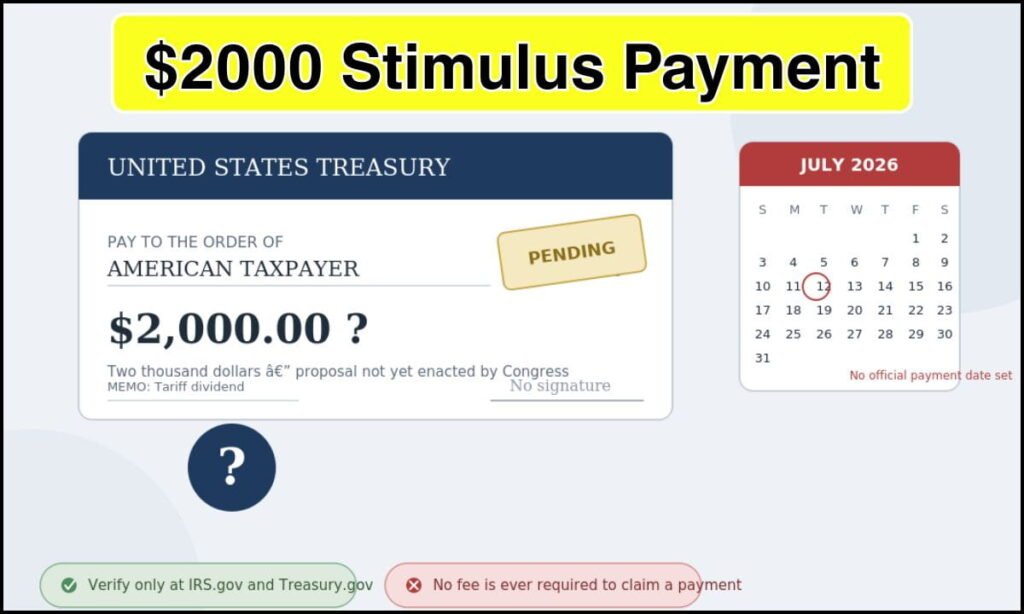
There Is No Approved $2,000 Stimulus Check for July 2026
Let’s start with the most important fact as of July 2026, there is no federal law, budget appropriation, or IRS payment schedule authorizing a $2,000 Stimulus Check for July 2026. No bill has passed Congress, and neither the Treasury Department nor the IRS has announced a payment date or eligibility process. Despite the viral claims flooding social media, this remains an unfunded proposal rather than a real, scheduled government payment.
Where the Rumor Actually Started?
The idea traces back to President Donald Trump, who floated a “tariff dividend” concept on his Truth Social platform. He suggested that revenue generated from tariffs on imported goods could be redistributed directly to Americans, framing it as a payback to working families dealing with higher costs. His post described a payment of “at least $2000 Stimulus Payment a person,” excluding higher earners, and tied the idea to record tariff revenue collected since the start of his second term.
The proposal echoed an earlier idea floated during the “DOGE Dividend” discussions tied to the Department of Government Efficiency’s cost-cutting efforts. Since Trump’s initial statement, the timeline has repeatedly shifted. He originally suggested the payments could arrive by mid-2026, then later said they might not come until the end of the year — and, in a more recent interview, acknowledged he hadn’t “made the commitment” to actually move forward, though he said he was taking the idea “seriously.”
Why the Math and the Legal Path Are Both Shaky?
Several major obstacles stand between this proposal and an actual check in anyone’s bank account:
Congress has to approve it. Any direct federal payment requires congressional legislation — the president cannot unilaterally authorize spending of this kind. Treasury Secretary Scott Bessent has said any dividend “could come in lots of forms,” pointing instead to existing tax changes like eliminating taxes on tips, overtime pay, or Social Security income rather than a lump-sum check. White House economic adviser Kevin Hassett has similarly said the outcome “depends on what happens with Congress.”
A competing bill exists, but it’s smaller. Senator Josh Hawley introduced legislation for annual “tariff rebates” targeted at lower- and middle-income families, funded by duties on Chinese imports. That bill would guarantee a minimum of $600 per adult and dependent — meaning a family of four could see at least $2,400 — but it hasn’t advanced in Congress, and it sets a much lower floor than Trump’s proposed flat $2,000 figure.
The Supreme Court disrupted the funding source. In February 2026, the Supreme Court ruled that a large portion of the tariffs underpinning Trump’s “trillions of dollars” claim were illegal. That ruling required the U.S. Court of International Trade and Customs and Border Protection to begin issuing an estimated $166 billion in tariff refunds to more than 333,000 importers — money flowing back out of government coffers rather than into a stimulus fund. This significantly shrank the very revenue pool the dividend was supposed to draw from.
The economics don’t clearly add up. Independent analysts, including experts cited by CNBC and TIME, have pointed out that the total cost of a flat $2,000 payment to eligible Americans would likely exceed total tariff revenue collected, even before accounting for the refunds now required. Some economists also note that because tariffs function as a tax passed on to consumers, everyday households have already been absorbing higher costs — with the Senate Joint Economic Committee estimating households paid roughly $1,725 in tariff-related costs between February 2025 and January 2026 alone.
What’s Actually Happening in July 2026?
While the $2000 tariff dividend remains unresolved, there are real, confirmed payments going out this month that people sometimes confuse with a new stimulus program:
- Social Security retirement payments continue on their standard monthly schedule based on recipients’ birth dates.
- Veterans disability compensation is issued monthly through the VA’s normal calendar.
- Alaska’s Permanent Fund Dividend, including an energy rebate, is expected in October 2026 for eligible state residents — not a nationwide July payout.
- Some state-level rebate programs (such as New York’s inflation-related sales tax refund checks issued to prior filers) have gone out this year, but these are state-specific and unrelated to any federal tariff dividend.
None of these existing, legitimate programs require a fee, a “processing charge,” or personal banking information sent through a text message or unsolicited email.
Scams Are Exploiting the Confusion
The IRS has issued repeated public warnings this year about a surge in $2000 Stimulus Payment related scams that exploit exactly this kind of uncertainty. Common tactics include text messages or emails claiming to be from the IRS, announcing a new stimulus payment and urging the recipient to click a link to “claim” it. Fraudsters have also impersonated the IRS on social media and left urgent voicemail messages threatening arrest warrants if the person doesn’t respond immediately.
According to the IRS, a few rules always hold true:
- The agency does not initiate contact by email, text, or social media, and only sends text messages to people who have specifically opted in.
- The IRS never charges a fee to deliver a refund or benefit payment.
- The first form of contact from the IRS is almost always a mailed letter, and taxpayers can verify any notice through their secure IRS Online Account.
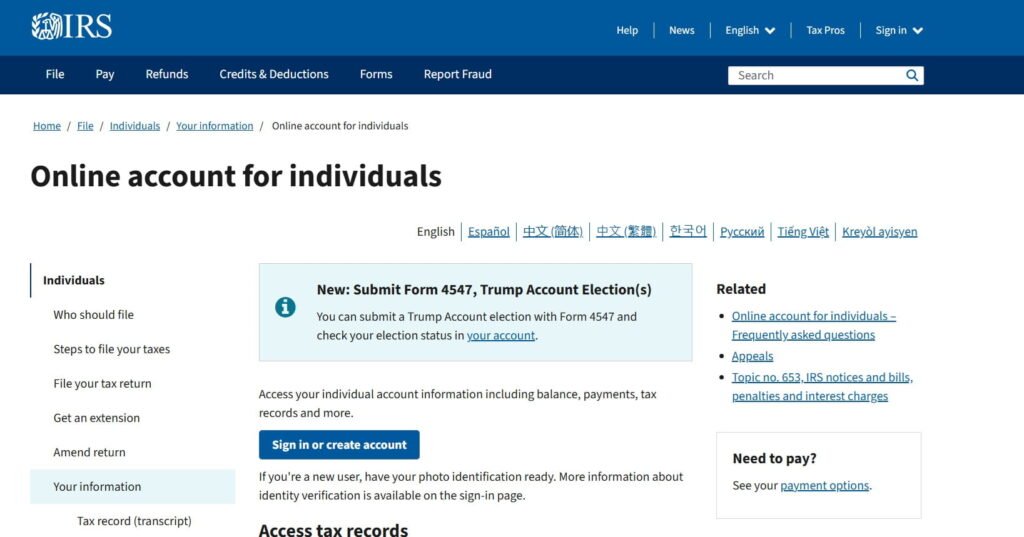
- Legitimate government agencies never request payment via gift cards, cryptocurrency, wire transfer, or prepaid debit cards.
Top Searched Questions on $2000 Stimulus Payment
Has the $2000 Stimulus Payment for July 2026 been officially approved?
No. There is no federally approved legislation, budgetary provision, or IRS program in place to distribute a $2000 Stimulus Payment. Any such payment requires formal approval from Congress.
Where would the money for the check come from?
The concept originated from a proposal to use a “tariff dividend.” The idea was to utilize revenue generated from federal tariffs to fund direct payments to citizens.
Are there sufficient funds to issue the payments?
Independent budget analysts and the Bipartisan Policy Center have highlighted significant funding and logistical challenges. Estimates suggest that making large-scale direct payments to the majority of adults would cost between $280 billion and $600 billion—an amount far exceeding current and projected tariff revenues.
If passed, who would be eligible for $2000 Stimulus Payment?
Whereas no criteria are legally binding, early discussions suggested targeting households earning less than $100,000 annually. Congress would need to officially draft and vote on specific entitlement rules before any funds could be released.