2026 Stimulus Checks and $2000 Tariff Dividend Fact Check: Every few weeks, another version of the same message lands on somebody’s phone. A $2,000 check is on the way. Or it’s $5,000 now. Maybe it’s a “tariff refund,” maybe a “stimulus,” maybe a direct deposit the IRS is about to make. The details keep shifting, but the excitement doesn’t, and the people passing it along are usually sincere. They saw a headline or heard the president say something and figured they’d share it.
So here’s where things actually stand as of October 19, 2026, based on Treasury and CBO budget data, Customs and Border Protection court filings, congressional records, the IRS’s own warnings, and the reporting of outlets that have tracked this story since the first promise in November 2025.
The short version: no $2,000 tariff dividend has been approved, funded, scheduled or sent. There are no new federal stimulus checks. The newer $5,000 “Trump Dividend” is a campaign pledge tied to the November 3 midterms, and it would need an act of Congress to become real. If a text message says otherwise, treat it as a scam until proven otherwise.
The longer version is more interesting, and it explains why this promise has been so hard to pin down.
Where the $2,000 idea came from
In early November 2025, President Trump posted on Truth Social that a dividend of at least $2,000 per person, excluding “high income” earners, would be paid out of tariff revenue. The pitch was simple. The government was collecting a lot of money from import taxes, so why not send some of it back to ordinary people?
Within days, the administration’s own officials were softening the picture. Treasury Secretary Scott Bessent said on ABC’s This Week that the dividend could arrive “in lots of forms,” and that he hadn’t discussed it with the president beforehand. He even suggested it might not be a check at all, but something delivered through tax cuts already signed into law. In December, National Economic Council Director Kevin Hassett said the payments would likely need congressional approval. Bessent said much the same: it needs legislation.
The timeline kept sliding, too. Trump first said the checks would not go out before the holidays, adding that it would be “next year sometime.” Later he pointed to mid-2026, then to some point before the midterms. By January he was telling the New York Times it could be toward the end of the year. No agency ever published a start date, an application process or an eligibility rule. That absence tells you a lot. When Washington is actually about to send money to 150 million people, there are forms, guidance and a website.
Alberta $100 Energy Rebate: Last Chance to Apply Before Oct 31, 2026
IRS 2027 Tax Brackets, Standard Deduction and 401(k) Limits: What’s Official and What’s Coming
The Supreme Court changed everything
The tariffs that were supposed to fund the dividend rested largely on the International Emergency Economic Powers Act, or IEEPA. On February 20, 2026, the Supreme Court ruled 6-3 in Learning Resources v. Trump that the law did not give the president the power to impose those sweeping tariffs. The ruling also set in motion refunds of what had been collected.
That’s the moment the dividend plan lost its foundation. A payment funded by tariff revenue gets awkward fast when a court says a big chunk of that revenue was collected illegally and has to be paid back.
The administration didn’t drop tariffs altogether. Within days it announced a temporary global surcharge under Section 122 of the Trade Act of 1974, a law that caps such duties at 150 days unless Congress extends them. Congress didn’t, and the surcharge expired on July 24. The same day, new tariffs under Section 301 took effect on 60 economies, following a forced-labor investigation.
Sector-specific Section 232 tariffs on things like steel, aluminum and autos have stayed in place. In August, the administration also invoked Section 338 of the Tariff Act of 1930, a law never used before, to put a 50 percent tariff on selected Canadian goods. The Congressional Research Service keeps a running fact sheet on all of this, current through September 30.
So tariffs still exist. But the legal basis, the rates and the revenue picture are very different from what they were when the $2,000 idea was born.
Who actually got the tariff refunds
Here’s the part that surprises people. There is a big tariff refund program underway. It just isn’t for you.
After the Supreme Court decision, the U.S. Court of International Trade ordered Customs and Border Protection to refund the IEEPA duties. CBP built a system called CAPE, short for Consolidated Administration and Processing of Entries, which began taking claims on April 20. The refunds go to the importers of record, the companies that actually paid the duties at the border. Roughly 330,000 importers paid an estimated $166 billion across about 53 million entries.
According to a CBP declaration filed with the court in mid-September, more than 286,000 CAPE declarations had been submitted, and about $134.7 billion in potential and certified refunds had been accepted into the system. Around $122 billion, interest included, had been certified and sent to the Treasury for payment. Another roughly $1.3 billion was stuck because importers hadn’t supplied bank details.
Phase 3 of CAPE, which handles older entries that were already finally liquidated, opened on October 6. But CBP’s position is that it can only refund those entries for importers who sued, and the government’s appeal over everyone else is unresolved.
Notice what’s missing from that picture. There is no consumer track. Higher prices at the checkout were real for many households, and the Tax Foundation and Yale’s Budget Lab both estimated that tariffs added more than $1,000 to the average household’s costs in 2025. But the refund process is a business-to-government transaction. Nothing in it sends money to a shopper who paid more for a toaster.
The math never worked, and now it’s worse
Even before the court ruled, budget analysts were skeptical. John Ricco of Yale’s Budget Lab estimated a $2,000 payment to every American, children included, would cost about $600 billion. The Bipartisan Policy Center put net tariff revenue for 2025 at roughly $195 billion, well short of the roughly $300 billion price tag for a more targeted version. The Committee for a Responsible Federal Budget reached a similar conclusion.
Then came the refunds. The Treasury’s monthly statements tell the story, and the Tax Foundation has laid it out clearly. In May, the government refunded about $22 billion in customs duties while collecting about the same amount, netting roughly zero. In June, it refunded about $49 billion and collected about $24 billion, so net customs revenue was negative $25.6 billion. July was negative again, with refunds of about $33 billion pushing net customs revenue below zero. Tariff money, for months, has been flowing out of the Treasury rather than in.
The Congressional Budget Office’s August monthly review pointed to smaller-than-expected tariff collections as a main reason revenue projections have weakened. Some outlets, citing updated estimates, say customs revenue for the year could run on the order of $250 billion below the forecast CBO published in February. If you’re looking for a pot of tariff cash waiting to be mailed out, it’s hard to find one.
Enter the $5,000 “Trump Dividend”
Just when the $2,000 promise had faded, a bigger one arrived. On September 9 and 10, at the Republican midterm convention in Dallas, President Trump said that if Republicans keep both the House and the Senate, he would issue a dividend of $5,000 to every adult citizen. “It will be called the Trump Dividend,” he told the crowd, according to the Associated Press.
Within about an hour, Vice President JD Vance suggested the payments wouldn’t go to wealthy Americans, a partial walk-back that left the actual eligibility rules unclear. A few days later, Trump told reporters, “The $5,000 is going to happen 100 percent,” if Republicans hold Congress. He repeated the pledge in a Truth Social video on October 3, and again this week while promoting an unrelated investment announcement. Trump has also said the only condition would be that recipients spend the money in the United States.
What has not appeared is a bill, a funding source or a score. FactCheck.org estimated that $5,000 for every adult citizen would cost around $1.2 trillion, and a George Washington University law professor put it near $1.3 trillion. Trump and Vance have pointed to tariff revenue as the source, but U.S. tariff receipts have run around $200 billion a year at their best, and that’s before the refunds. When Trump was asked how he’d pay for it, he cited $21 trillion, which the Korea Herald’s reporting suggests refers to projected foreign investment, not tariff receipts.
Senator Bernie Moreno, an Ohio Republican, says he’s drafting legislation so a “Trump Dividend” bill can move right after the November 3 election. Senate Majority Leader John Thune was more cautious, saying it “smells very much like a reconciliation issue,” a reference to the party-line budget process, and noting the idea was new to Senate Republicans. Senator Susan Collins of Maine said the few details available suggest the plan has no income cap and would be extraordinarily costly. On the other side of the aisle, Democrats have called the pledge vote-buying, and House Democratic leaders say it won’t happen.
It’s also worth remembering this isn’t the first big-dollar promise of the term. There was a “DOGE dividend” early in 2025, floated alongside Elon Musk’s promises of savings. There was the $2,000 tariff dividend. In December 2025, Trump did announce a $1,776 “warrior dividend” for roughly 1.45 million service members, and that one was real. The difference is instructive: it came with a defined group of recipients and an actual payment process. The broader promises haven’t.
$200 Extra Social Security Payment: When Is It Being Approved, and Who Can Get It?
New York POWER Rebate Checks: $100 to $200 Payments Begin Landing in Mailboxes This Fall
Can the president just send the checks?
Short answer: no.
The Constitution gives Congress the power of the purse. Money leaves the Treasury because Congress passed a law authorizing and funding it. Marc Goldwein of the Committee for a Responsible Federal Budget told reporters flatly that the president has no authority to send money to Americans without Congress. Trump said earlier this year he didn’t think he needed congressional approval for the $2,000 payments. His own Treasury secretary and economic adviser said the opposite.
There is one pending piece of legislation in this neighborhood. Senator Josh Hawley’s American Worker Rebate Act, introduced in July 2025, would send rebates of at least $600 per adult and dependent child, drawn from tariff proceeds. According to Congress.gov, it was referred to the Senate Finance Committee and has not passed either chamber. Other tariff-rebate proposals have been introduced in 2026, and none has become law.
So as of today, there is no enacted program, no Treasury authorization, no IRS payment system and no date. That doesn’t mean a bill can’t pass in the future. It means nothing is happening now, and any real payment would be preceded by months of very public legislative drama.
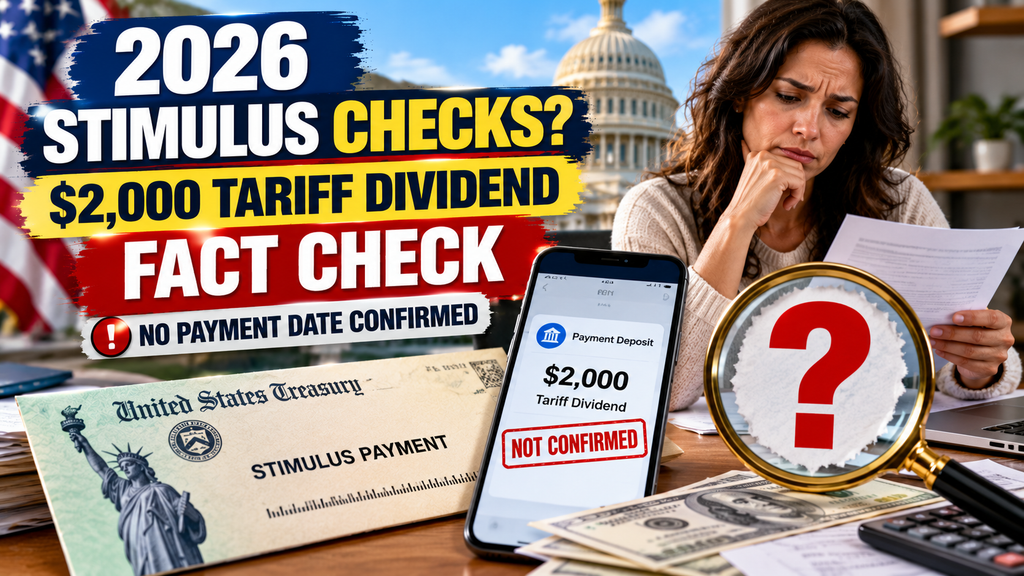
2026 Stimulus Checks and $2000 Tariff Dividend Fact Check
“Americans are getting $2,000 tariff checks.” False. Never enacted, never scheduled, never sent. The tariff authority behind it was struck down in February.
“The president can send them without Congress.” False. Both the Treasury secretary and the National Economic Council director said legislation is needed, and budget experts agree.
“Tariff revenue covers the cost.” Not supported. Net customs revenue turned negative in mid-2026 because of court-ordered refunds, and the cost of the proposals is several times what tariffs raised in a good year.
“Consumers can claim a tariff refund.” False. The refund process, run through CBP, is for the importers of record who paid the duties.
“The IRS is sending a new stimulus or tariff payment by direct deposit.” False. The IRS has no such program, and its warnings say so.
“A $5,000 Trump Dividend is coming.” A campaign promise, not a program. It’s conditional on the election, it would cost over $1 trillion, and it would need Congress to pass it.
What about real stimulus?
The last federal stimulus payments went out during the pandemic. The final window for claiming leftover pandemic money, the 2021 Recovery Rebate Credit, closed on April 15, 2025, and the IRS has said that credit has expired. Congress has not authorized any new Economic Impact Payments, and the IRS has not announced any.
That said, some money did move this year, just not as a check. The CBO’s July review noted that individual income tax refunds were about $23 billion, or 7 percent, higher than a year earlier, because of provisions in the 2025 tax law. If you got a bigger refund last spring, that was likely the reason. It’s not a stimulus, but it’s real, and it’s probably the thing most people are half-remembering when they ask whether the government has “already sent something.”
For a regular refund, the IRS’s “Where’s My Refund?” tool is the right place to look. For anything else, check irs.gov and your state’s official tax agency site. State rebate programs do exist in some places, and they’re run by state governments, with their own rules and deadlines.
The scam problem
This is where the stakes get personal. Whenever a government payment becomes a hot topic, fraudsters move in, and the tariff dividend has been a gift to them. The IRS has warned about fake stimulus and “tax credit” messages, and local news has reported text messages like one that read, “we can’t release your $2,000 Trump Check until you reply,” with a link and an artificial deadline.
A few rules cover nearly every case:
- The IRS starts contact by mail. It does not make first contact by text, email or social media, and it won’t ask you to enter bank account information through a link someone sent you.
- If a message creates urgency, like “overdue,” “act now” or a deadline tonight, that’s a red flag, not a reason to hurry.
- If you’re unsure, don’t click. Go to irs.gov directly, type the address yourself, and look at the alerts page.
- Forward suspicious texts to 7726 (SPAM) and report them. And if you already gave out information, change passwords, contact your bank, and consider freezing your credit.
Talk to older relatives, too. They’re often the targets, and a short call before they click anything can save them a lot of grief.
Future of $2,000 tariff dividend 2026
Tariff dividends and stimulus checks are going to stay in the news through November, and probably beyond, because they’re politically powerful. Here’s a quick way to sort the real from the rhetorical. Ask whether there’s a bill number you can look up on Congress.gov. Ask whether anyone has said how much it costs and where the money comes from. Ask whether the IRS or Treasury has published instructions. If the answer to all three is no, you’re looking at a promise, not a payment.
Also keep the dates straight. Election day is November 3. If Republicans hold both chambers, Moreno and others say they’ll push legislation soon after. If it passes, that’s the moment to pay attention, and the IRS and Treasury would announce the mechanics. If it doesn’t, nothing changes in your bank account. Either way, nothing arrives before a law does.
This story is moving quickly, and some details above may shift. If you’re reading this weeks from now, check the latest from the sources below rather than relying on any article, including this one.
No $2,000 tariff dividend has been paid, and the legal and fiscal ground under it collapsed this year. No new stimulus checks have been authorized. The $5,000 Trump Dividend is an election-season pledge with no bill, no funding plan and no date. The only large tariff refunds actually flowing are going to businesses. The one thing that is reliably real right now is the scam traffic, so keep your guard up.