A new push to shrink the American workweek is moving through Congress again, and it has workers asking the same question in every comment section this week: will I actually get paid the same for working less. On September 8, 2026, Senator Bernie Sanders of Vermont and Representative Mark Takano of California reintroduced the Thirty-Two Hour Workweek Act, a bill that would gradually lower the federal overtime threshold from 40 hours a week to 32 hours over a four-year phase-in period. The bill, filed in the House as H.R. 10323, amends the Fair Labor Standards Act of 1938, the same law that created the 40-hour workweek nearly nine decades ago. Sanders and Takano argue that decades of rising productivity, driven now by artificial intelligence and automation, have not translated into more free time or higher pay for ordinary workers, and that a 32-hour workweek with no loss in pay is a way to correct that imbalance.
This is not a brand-new idea. Takano first introduced a version of the 32-hour workweek bill in 2021, then again in 2023, and each version stalled in committee without a floor vote. What is different in 2026 is the political and economic backdrop. Concerns about AI replacing jobs are now mainstream, a Data for Progress poll found majority support for the idea across party lines, and the bill has already picked up backing from major labor unions including the AFL-CIO, SEIU, UAW, and National Nurses United. Whether this version moves any further than its predecessors is still uncertain, since it has just been referred to the House Committee on Education and the Workforce. We’ll be updating this article monthly as the bill moves through Congress, so bookmark this page if you want to track the 32-hour workweek bill status without digging through congressional records yourself.
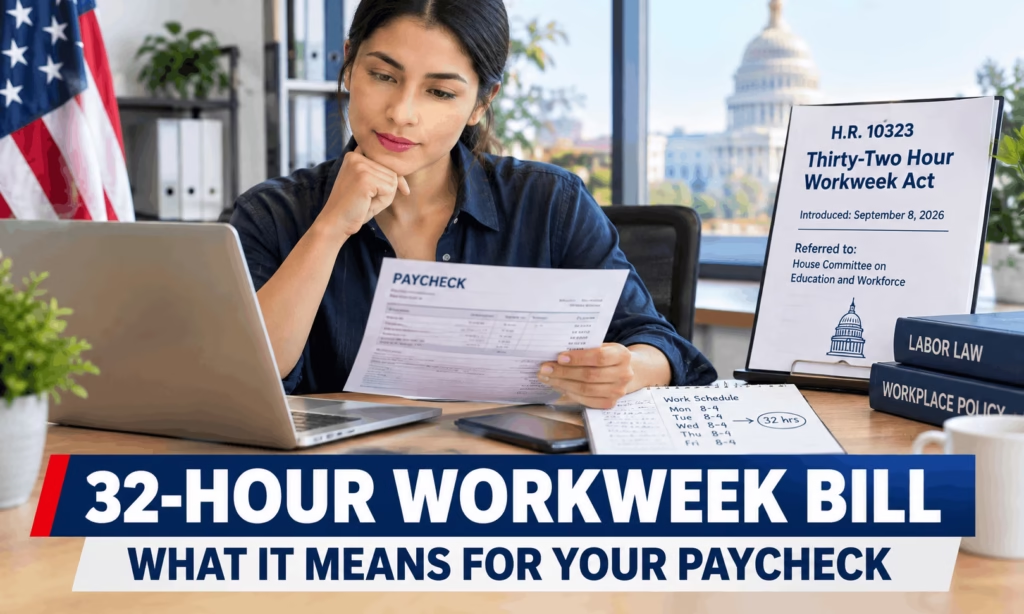
What Is the 32-Hour Workweek Bill?
The Thirty-Two Hour Workweek Act does not ban anyone from working more than 32 hours a week, and it does not force employers to switch to a four-day schedule. What it actually does is amend Section 7(a) of the Fair Labor Standards Act so that overtime pay, time and a half, kicks in at a lower weekly hours threshold. Today, under federal law, covered non-exempt employees earn overtime once they cross 40 hours in a week. Under this bill, that trigger point would fall in stages until it reaches 32 hours. In plain terms, working past 32 hours would eventually cost an employer the same overtime premium that working past 40 hours costs them today, which is the financial lever meant to nudge the standard workweek downward without an outright hours cap.
The bill also includes a daily overtime rule that does not exist in most of federal law right now. Once fully phased in, covered employees would generally be entitled to time-and-a-half pay after 8 hours in a single day, and double pay after 12 hours in a single day. That is a meaningful change for anyone working compressed schedules, since it protects against an employer simply stacking the same 40 hours into four 10-hour days without extra pay.
Key Highlights of the 32-Hour Workweek Act
| Detail | Information |
|---|---|
| Official bill name | Thirty-Two Hour Workweek Act |
| House bill number | H.R. 10323 |
| Lead House sponsor | Rep. Mark Takano (D-CA) |
| Lead Senate sponsor | Sen. Bernie Sanders (I-VT) |
| Date reintroduced | September 8, 2026 |
| Law being amended | Fair Labor Standards Act of 1938 |
| Current overtime threshold | 40 hours per week |
| Final proposed threshold | 32 hours per week |
| Phase-in length | 4 years |
| Daily overtime rule | 1.5x after 8 hours, 2x after 12 hours (once phased in) |
| Pay protection clause | Employers barred from cutting weekly pay or benefits as hours drop |
| Referred to | House Committee on Education and the Workforce |
| Status as of this update | Introduced, not yet voted on in committee |
From 44 Hours to 40 Hours: Why Congress Is Revisiting the Workweek
The last time federal law changed the standard workweek was in 1940, two years after the original Fair Labor Standards Act set it at 44 hours. It dropped to 40 hours shortly after, and it has not moved since, even as the shape of American work has changed completely. Sanders and Takano’s central argument is a productivity one. Their offices cite estimates that worker output per hour has risen more than 400 percent since the FLSA was signed in 1938, while wage growth for most workers has badly lagged behind that curve. The gap between what workers produce and what they take home is the justification lawmakers are leaning on hardest, alongside a newer worry: that AI and robotics could widen that gap further unless labor law is updated to force some of those gains back toward employees rather than concentrating them among corporate shareholders and executives.
It is worth noting that this bill has real institutional memory behind it. The Congressional Progressive Caucus, the Economic Policy Institute, and 4 Day Week Global all backed earlier versions, and this reintroduction already carries endorsements from AFA-CWA, the AFL-CIO, IFPTE, the National Employment Law Project, National Nurses United, UE, SEIU, and UAW. That kind of union coalition tends to keep a bill alive in public conversation even when it stalls procedurally, which is part of why the 32-hour workweek keeps resurfacing every congressional session instead of disappearing after one failed attempt.
How the 32-Hour Workweek Phase-In Schedule Works?
The bill does not flip a switch on day one. It steps the overtime threshold down gradually so employers and payroll systems have time to adjust. The proposed timeline looks like this:
| Phase | Overtime kicks in after | When it applies |
|---|---|---|
| Today (current law) | 40 hours/week | Now |
| Year 1 after enactment | 38 hours/week | Begins no earlier than 180 days after the bill becomes law |
| Year 2 | 36 hours/week | One year after Year 1 begins |
| Year 3 | 34 hours/week | One year after Year 2 begins |
| Year 4 and beyond | 32 hours/week | Full phase-in complete |
This staggered approach mirrors how minimum wage increases are often phased in at the state level, and it is designed to blunt the shock to small business payrolls while still moving the needle steadily toward the 32-hour standard. Nothing in the bill takes effect immediately upon passage. Even if Congress passed it today, the earliest the 38-hour threshold could start is 180 days later, and the full 32-hour standard would not apply until roughly four years after that.
Medicaid Work Requirements 2026: New Rule Rollout, State Start Dates and Who Is Exempt
ABLE Account Eligibility 2026: Who Qualifies Now, New Age Limit and Calculator
Overtime Pay Rules Under the 32-Hour Workweek Act
Once a stage of the phase-in is active, the mechanics work the same way overtime already works under the FLSA, just at a lower weekly threshold. A covered, non-exempt employee who works beyond the applicable weekly threshold earns 1.5 times their regular hourly rate for every extra hour. The bill layers a daily rule on top of that once fully phased in: more than 8 hours in one day triggers time-and-a-half, and more than 12 hours in one day triggers double time, regardless of the weekly total. That daily rule already exists in a handful of states, California among them, but it is not currently a federal standard, so the 32-hour workweek bill would effectively extend a California-style protection nationwide for covered workers.
Will Your Pay Change? The No Loss in Pay Clause
The part of the bill getting the most attention online is the promise that nobody’s weekly paycheck should shrink. The text bars employers from reducing an employee’s total weekly compensation rate or any other benefit tied to the reduction in standard hours. In practice, that means an hourly employee earning $20 an hour for 40 hours today, or $800 a week, would need to see their hourly rate rise to roughly $25 an hour once their standard week drops to 32 hours, so the weekly total stays at $800. That is the theory behind the phrase 32-hour workweek with no loss in pay that appears throughout the bill’s messaging.
Critics, including several conservative commentators and business groups, argue the no-loss clause is harder to enforce in practice than it sounds on paper. Their concern is that some employers could respond by reclassifying hourly workers as exempt, shifting roles to independent contractor status, trimming bonuses and shift differentials, or splitting one full-time position into two part-time ones to avoid the new overtime costs altogether. Supporters counter that the bill’s anti-retaliation and pay-protection language is meant to close exactly those loopholes, though how strictly that gets enforced would ultimately depend on Department of Labor rulemaking after passage, not just the bill text itself.
Who Would the 32-Hour Workweek Bill Actually Cover?
The bill changes the definition of the standard workweek inside the Fair Labor Standards Act, which means its protections follow the same coverage lines that already exist under the FLSA today. The people most directly affected are non-exempt, hourly workers, the same group currently eligible for overtime after 40 hours. Some salaried workers who are classified as non-exempt would also fall under the new threshold. Workers who are already classified as exempt under current law, many salaried managers, certain professionals, and some administrative roles, would generally stay outside the bill’s overtime protections unless their classification changes. This is exactly the gap critics point to when they warn about potential reclassification after passage.
How Soon Could the 32-Hour Workweek Take Effect?
Right now, the honest answer is not soon. The bill has only been referred to committee as of this update, which is the earliest procedural stage a bill can be at. It has not been scheduled for a committee vote, has not passed the House, and has no companion timeline yet confirmed in the Senate beyond Sanders’ introduction. Even in the optimistic scenario where the bill passes quickly, the text itself delays implementation by at least 180 days after enactment, then spreads full implementation across four years. Given that two earlier versions of this same bill, in 2021 and 2023, never made it out of committee, most policy trackers view the 32-hour workweek bill as a long-term legislative push rather than something workers should expect to see on their next paycheck.
Payment Schedule During the Phase-In Years
For workers trying to picture what their own paycheck might look like at each stage, here is how a worker currently earning $1,000 a week for 40 hours could see their numbers shift if the bill is enacted and fully enforced as written. These figures assume the no-loss-in-pay protection applies as intended.
| Phase-in year | Overtime threshold | Weekly base pay maintained | Equivalent hourly rate if working the new standard hours |
|---|---|---|---|
| Current law | 40 hours | $1,000 | $25.00/hr |
| Year 1 | 38 hours | $1,000 | $26.32/hr |
| Year 2 | 36 hours | $1,000 | $27.78/hr |
| Year 3 | 34 hours | $1,000 | $29.41/hr |
| Year 4+ | 32 hours | $1,000 | $31.25/hr |
Use the 32-hour workweek pay calculator below to run these same numbers against your own weekly, annual, or hourly pay, and to see how much overtime you would be owed if you keep working your current schedule once a lower threshold applies.
2027 Social Security Benefits Changes: COLA Increase, Possible Cuts, and New Bills
Stimulus Check 2026: Fact-Checking Every Viral Payment Claim (Tracker)
Trump $5000 Dividend Check: Latest Update on Cost, Eligibility and Payment Date
Support and Opposition: What People Are Actually Saying
Labor unions and progressive economists have been the loudest backers of the 32-hour workweek bill, framing it as a fairness correction after decades of productivity gains that never reached ordinary paychecks. Polling from Data for Progress in the last election cycle found majority support even among independents and a large share of younger voters, which supporters point to as evidence the idea is not as fringe as it once seemed.
On the other side, business groups and several Republican lawmakers argue the bill raises labor costs at a moment when many employers are already managing higher operating expenses, and that companies squeezed by a lower overtime threshold may respond in ways that hurt the very workers the bill is meant to help, through fewer hours, more part-time positions, or tighter hiring. That tension, between intended worker protections and possible employer workarounds, is likely to be the central argument in committee hearings if the bill advances.
Official Resources for the 32-Hour Workweek Bill
Always confirm the latest bill status directly from official sources rather than secondhand summaries, including this one.
| Resource | What it’s for | Link |
|---|---|---|
| Congress.gov bill tracker | Official status, votes, and full text of H.R. 10323 | https://www.congress.gov |
| U.S. Department of Labor, Wage and Hour Division | Current federal overtime rules under the FLSA | https://www.dol.gov/agencies/whd |
| Senate HELP Committee press release | Sanders and Takano’s official announcement | https://www.help.senate.gov |
| Rep. Mark Takano’s official website | Bill text, one-pagers, and sponsor updates | https://takano.house.gov |
FAQs
Is the 32-hour workweek bill law yet?
No. As of this update, the Thirty-Two Hour Workweek Act has only been introduced and referred to the House Committee on Education and the Workforce. It has not been voted on, and earlier versions of the same bill in 2021 and 2023 did not advance past committee.
Will I lose pay if my hours drop to 32 a week?
The bill is written to prevent that. It bars employers from cutting total weekly compensation or benefits because of the reduced standard hours, though your actual hourly rate would need to rise to keep your weekly pay the same.
When would the 32-hour workweek actually start?
Even if the bill passes quickly, the first phase would not begin until at least 180 days after enactment, with the full 32-hour threshold not reached until roughly four years later under the current phase-in schedule.
Does the 32-hour workweek bill apply to salaried employees?
It depends on classification. The bill changes overtime thresholds under the Fair Labor Standards Act, so it primarily affects non-exempt workers, including some salaried non-exempt employees. Exempt employees under current federal rules would generally not gain new overtime protection unless their classification changes.
What happens if I work more than 32 hours once the law is fully phased in?
Once the 32-hour threshold is fully in effect, covered employees working beyond 32 hours in a week would be entitled to overtime pay at 1.5 times their regular rate, with daily overtime rules of 1.5x after 8 hours and 2x after 12 hours in a single day.
Who is sponsoring the 32-hour workweek bill?
Representative Mark Takano of California sponsors the House bill, H.R. 10323, and Senator Bernie Sanders of Vermont is leading the companion effort in the Senate.
Has a 32-hour workweek bill been tried before?
Yes. Takano first introduced versions of this bill in 2021 and 2023. Neither advanced out of committee, which is part of why lawmakers and advocacy groups keep reintroducing an updated version each session.
Conclusion
The 32-hour workweek bill is back in Congress with more union backing and more public attention than its earlier versions ever got, but it remains an early-stage proposal rather than a settled change to your paycheck. The core promise, a shorter standard week with no loss in pay, is appealing on paper, and the phased four-year rollout is designed to make it workable for employers rather than sudden. Whether it survives committee this time, gets amended, or stalls again like its 2021 and 2023 predecessors will depend on how the political math in Congress shifts over the coming months. Check back here for updates as H.R. 10323 moves, or stalls, through the legislative process, and use the calculator above anytime you want to see what a 32-hour week could mean for your own paycheck.