FEHB 2026 Open Season: Federal employees still adjusting to their 2026 health plan are about to face a new wrinkle heading into the next enrollment cycle. OPM has confirmed the next FEHB Open Season will run from November 9 through December 14, 2026, covering coverage for plan year 2027, but the agency has also quietly tightened the rules around adding a family member to a plan. Under a new directive dated July 15, 2026, employing agencies must now verify 100 percent of Open Season elections that add a family member to FEHB or PSHB coverage, up from a minimum 10 percent sample under the prior policy. That change lands on top of a rule finalized July 2, 2026 requiring documents like marriage certificates, birth certificates, or tax returns for any dependent being added. We’ll be updating this article monthly as OPM releases 2027 premium rates and confirms which plans, if any, are leaving the program next.
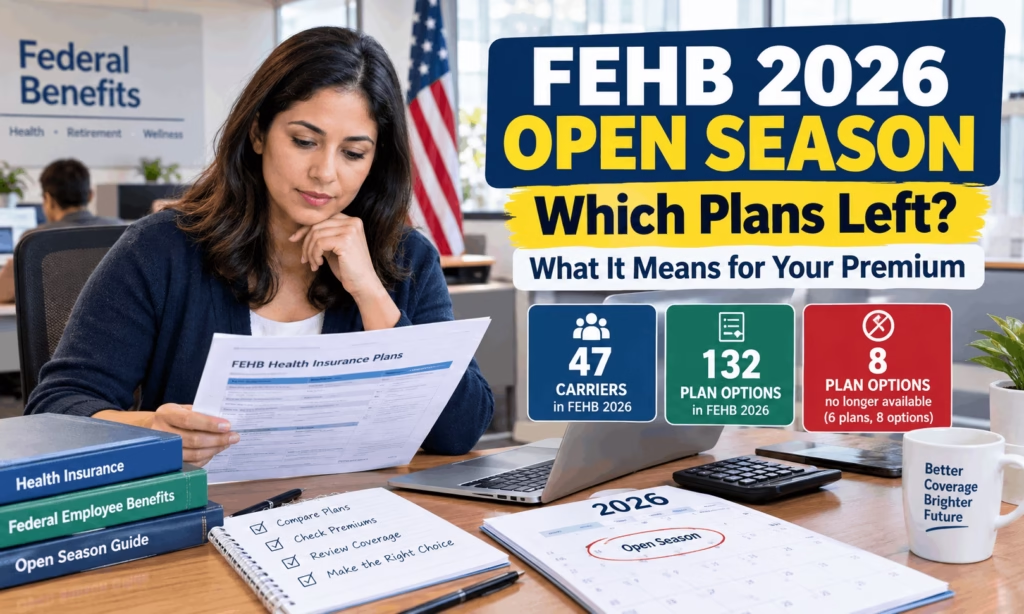
That news comes as federal employees are still living with the fallout from the last Open Season, the one that determined the health coverage most enrollees have had since January 1, 2026. Six FEHB plans, covering eight separate plan options, left the program entirely for 2026, forcing roughly 32,000 enrollees, most of them National Association of Letter Carriers members, to either actively pick a new plan or get automatically enrolled into a replacement chosen by OPM. For thousands of those enrollees, doing nothing meant a premium increase of more than 200 percent, a detail that made this past Open Season one of the more consequential in recent memory and one worth understanding fully before the next cycle opens this November.
FEHB and PSHB Plans Leaving: Key Dates and Numbers
| Item | Detail |
|---|---|
| 2026 Open Season dates | November 10 to December 8, 2025 |
| 2026 plan changes effective | January 1, 2026 (Pay Period 1) |
| FEHB plans discontinued for 2026 | 6 plans, 8 total options |
| Enrollees affected by FEHB discontinuations | Roughly 32,000, mostly NALC members |
| PSHB plans discontinued for 2026 | GEHA Indemnity Elevate Plus and Elevate |
| FEHB default plan for unselected enrollees | GEHA Benefit Plan High Option |
| PSHB default plan for unselected enrollees | BCBS Service Benefit Plan FEP Blue Focus |
| Next Open Season dates | November 9 to December 14, 2026 |
| 2027 rates and plan list expected | Early October 2026 |
Which FEHB Plans Left the Program for 2026?
Six FEHB plans, representing eight plan options, stopped participating in the Federal Employees Health Benefits program starting January 1, 2026. The largest impact fell on National Association of Letter Carriers enrollees, since both NALC plans, the Consumer Driven Health Plan and the Standard High Option, exited FEHB entirely, though NALC remains available to postal workers through the separate Postal Service Health Benefits program. The other discontinued plans were regional carriers serving specific states: Health Alliance HMO Standard, AvMed Health Plan HDHP and Standard, Independent Health High, Blue Care Network of Michigan High, and Priority Health High.
On the postal side, two PSHB options from GEHA, the Indemnity Benefit Plan Elevate Plus and Elevate, also left the program for 2026. Within the dental and vision program, FEDVIP, Health Partners Dental was discontinued, requiring its enrollees to pick a new dental carrier to keep coverage.
What It Means for Your Premium If Your Plan Was Discontinued
The financial impact of losing a plan turned out to vary enormously depending on which replacement an enrollee ended up with. Enrollees who actively picked a new plan during Open Season generally avoided the worst outcomes, since they could compare premiums and coverage before committing. The enrollees who saw the biggest shock were the ones who took no action and were automatically placed into the designated default plan. NALC CDHP enrollees in a Self and Family policy, for example, had been paying around 146 dollars biweekly, and those auto-enrolled into GEHA High Option saw that jump to roughly 525 dollars biweekly, an increase of more than 250 percent. Not every affected enrollee saw an increase that dramatic, but the pattern held broadly, doing nothing after a plan discontinuation was consistently the most expensive choice available.
FEHB Plans Leaving Open Season: What It Means for Your Premium
H-2B Visa Cap Reached: What It Means for 2027 Filings
Social Security COLA 2027 Projection: How Much Benefits Rise?
Why OPM’s Default Plan Choice Sparked Backlash
Under standard federal regulations, enrollees in a discontinued plan who take no action are normally placed into the lowest cost nationwide plan that is not a high deductible plan and does not charge membership fees. For 2026, that plan would have been GEHA Elevate. Instead, OPM exercised discretion available under the regulations to designate GEHA High Option as the default instead, a plan with meaningfully higher premiums. An OPM spokesperson told reporters the agency made the choice because it determined doing so was in the best interest of the program, without detailing the specific reasoning further. The decision drew criticism from federal employee advocacy groups, who argued it exposed tens of thousands of enrollees, many of whom may not have closely tracked Open Season deadlines, to unnecessarily high costs they could have avoided with a lower cost default.
2026 FEHB Premium Increases at a Glance
Beyond the plans that left entirely, every remaining FEHB enrollee absorbed a premium increase for 2026. The overall average premium across FEHB rose 10.2 percent, while the average enrollee’s own share of that premium rose 12.3 percent, since the government’s contribution grew somewhat more slowly at 9.2 percent. PSHB enrollees saw a 9.0 percent overall premium increase, with their enrollee share rising 11.3 percent. FEDVIP premiums moved more modestly, with dental plans up 3.35 percent on average and vision plans up just 0.47 percent. OPM has attributed the broader cost growth to rising provider and prescription drug costs, particularly for GLP-1 weight loss and diabetes medications, along with expanding behavioral health utilization.
| Program | Overall Premium Increase | Enrollee Share Increase | Government Contribution Increase |
|---|---|---|---|
| FEHB | 10.2% | 12.3% | 9.2% |
| PSHB | 9.0% | 11.3% | 8.0% |
| FEDVIP dental | 3.35% average premium increase | Not government subsidized | |
| FEDVIP vision | 0.47% average premium increase | Not government subsidized | |
FEHB Open Season Countdown and Discontinued Plan Checker
2026 FEHB Premium Increases at a Glance
How much more federal employees, retirees, postal workers, and FEDVIP enrollees are paying for health coverage in 2026 compared to 2025.
| Program | Overall Premium Increase | Enrollee Share Increase | Government Contribution Increase |
|---|---|---|---|
| FEHB | 10.2% | 12.3% | 9.2% |
| PSHB | 9.0% | 11.3% | 8.0% |
| FEDVIP Dental | 3.35% average premium increase | Not government subsidized | |
| FEDVIP Vision | 0.47% average premium increase | Not government subsidized | |
OPM has attributed the broader cost growth largely to rising provider and prescription drug costs, particularly GLP-1 medications, along with expanding behavioral health utilization. Figures reflect confirmed 2026 plan year rates announced by OPM. FEDVIP dental and vision premiums are not subsidized by the federal government the way FEHB and PSHB premiums are.
What’s New for the Upcoming 2027 Open Season?
Two developments stand out heading into the November 2026 Open Season. First is the tightened family member verification requirement described above, which means enrollees adding a spouse, child, or other dependent this year should have documentation such as a marriage certificate, birth certificate, or relevant tax return ready before making the election, rather than assuming a quick self-attestation will be sufficient. Second, OPM recently named a new head of its Healthcare and Insurance office just ahead of this year’s cycle, with the incoming leadership signaling a stated focus on prevention and wellness as a cost control strategy for 2027, alongside continued efforts to reduce fraud, waste, and abuse across the programs. Premium rates and any list of plans leaving the program for 2027 have not been released as of this week, OPM traditionally publishes that information about a month ahead of Open Season, putting the announcement on track for early October 2026.
How to Apply: Making Changes During FEHB Open Season
Making a change during Open Season starts with reviewing your current plan’s summary of benefits and comparing it against available alternatives using OPM’s official plan comparison tool. Most federal employees submit their elections through their agency’s Employee Personal Page, while annuitants typically use OPM’s retirement services online system. To add a family member this year, gather supporting documentation, a marriage certificate for a spouse, a birth certificate for a child, or a recent joint tax return, before starting the enrollment process, since incomplete documentation can now delay the entire election given the new 100 percent verification requirement. Employees and annuitants can also make changes to FEDVIP dental and vision coverage and re-enroll in a flexible spending account through the same general Open Season window, though FSAFEDS specifically requires active re-enrollment every year regardless of whether other elections change.
DHS LPR Rule for Foreign Government Employees’ Children: Eligibility, Fees and How to Apply
HUD-VASH Housing Voucher New 2026 Eligibility Rules Explained
VA Disability Cancer Claims: New Conditions & Expedited Processing
Processing Time: When Your New Plan Election Takes Effect
Elections made during Open Season typically take effect at the start of the first full pay period in the new calendar year, generally early January, though the exact effective date depends on the federal pay period calendar for that year. Outside of Open Season, most enrollment changes require a qualifying life event, such as marriage, birth of a child, or loss of other coverage, and those changes generally take effect based on the date of the event rather than a fixed annual date. With the new documentation verification requirement now applying to 100 percent of family member additions rather than a small sample, employees should expect that incomplete or unclear paperwork could add processing time this cycle compared to prior years, when only a fraction of elections received this level of scrutiny.
Payment Schedule: How FEHB Premiums Are Deducted?
FEHB premiums are not billed separately, they are deducted directly from an employee’s biweekly paycheck or an annuitant’s monthly annuity payment, matching the standard federal pay or annuity schedule rather than any independent due date. When a new premium rate takes effect at the start of a plan year, the new deduction amount typically appears beginning with the first full pay period of January, so employees generally see the updated premium reflected in their first paycheck of the new year rather than retroactively adjusted later. Annuitants see the equivalent adjustment reflected in their regular monthly annuity payment.
How to Prepare Before the 2027 Plan and Rate Announcement
With the official 2027 numbers still weeks away, the most useful preparation right now is informational rather than transactional. Pull up your current plan’s summary of benefits and coverage while you have time to read it carefully, rather than skimming it during the Open Season rush in November. If anyone in your household expects a procedure, ongoing treatment, or a new prescription next year, factor that into how much weight you put on deductibles and out-of-pocket maximums versus the plain premium number once new rates are published. If you plan to add a family member this Open Season, locate the required documentation now, since the new verification standard means incomplete paperwork could hold up your election in a way it would not have in prior years.
How the NALC Cost Shock Compares to Other Discontinued Plans
Not every enrollee whose plan left FEHB for 2026 faced the same scale of increase, and understanding why helps explain the broader lesson from this cycle. NALC’s two plans historically carried some of the lowest premiums in the entire FEHB marketplace, which is part of why the jump to GEHA High Option looked so dramatic in percentage terms even though GEHA High is a fairly standard mid-range option by FEHB norms overall. Enrollees coming from AvMed, Independent Health, Blue Care Network of Michigan, and Priority Health, plans that were priced closer to the FEHB average to begin with, generally experienced smaller percentage increases when auto-enrolled, even though they were subject to the exact same default plan designation process. The size of the jump depended heavily on how far below the FEHB average an enrollee’s original premium sat, not on any factor specific to why their carrier chose to leave the program.
32-Hour Workweek Bill: What the Thirty-Two Hour Workweek Act Means for Your Paycheck
Flat-Rate COLA: What the 2027 Social Security Proposal Really Means for Retirees
Hungary Poland Immigrant Visa Resumption: What Changed and Who Is Affected?
What Federal Employee Groups Said About the Default Plan Decision
Federal employee unions and retiree advocacy organizations were vocal in the weeks following OPM’s decision to bypass GEHA Elevate in favor of GEHA High Option as the default plan. Critics argued that regulations exist specifically to protect enrollees who miss Open Season deadlines by guaranteeing them the lowest reasonable cost option, and that OPM’s discretionary override undermined the purpose of that safeguard for the very enrollees least likely to be actively monitoring premium comparisons, often lower income letter carriers and retirees. OPM’s public defense centered on program-wide considerations rather than a plan-by-plan cost comparison, without offering a detailed public breakdown of the specific factors that led to the decision, leaving many of the affected enrollees and their representatives without a fully transparent explanation months after the choice was made.
Steps to Take Before This Year’s Open Season Opens
With roughly seven weeks between now and the November 9 start date, federal employees have a real window to prepare rather than scrambling once the portal opens. Start by pulling last year’s Explanation of Benefits or claims summary from your current carrier to see how your plan actually performed against your household’s real medical usage, since a plan that looked appealing on paper in 2025 may not still be the best fit once actual claims experience is factored in. If your family situation changed this year, a marriage, a new dependent, or a dependent aging out of eligibility, confirm now which documents you will need under the new verification standard, since gathering a certified birth certificate or updated tax transcript can take longer than expected if requested at the last minute in December. Finally, set a calendar reminder for early October, when OPM’s rate and plan availability announcement typically drops, so you have the maximum possible time to compare options before the six week Open Season window closes.
Official FEHB Resources and Links
| Resource | Purpose | Link |
|---|---|---|
| OPM Open Season page | Official Open Season dates, rates, and plan information | opm.gov/healthcare-insurance/open-season |
| FEHB Plan Comparison Tool | Compare premiums, benefits, and networks by plan | opm.gov/healthcare-insurance/healthcare/plan-information |
| Employee Personal Page or agency HR system | Submit your Open Season elections | Provided by your employing agency |
| BENEFEDS | Enroll or change FEDVIP dental and vision plans | benefeds.com |
| FSAFEDS | Re-enroll in a flexible spending account | fsafeds.gov |
Conclusion
The plans that left FEHB and PSHB for 2026 already reshaped what millions of federal employees and annuitants pay for health coverage today, and the lesson from that cycle is straightforward, an automatic default enrollment can cost far more than a deliberate choice made during Open Season. Heading into the November 9 through December 14, 2026 window, the biggest confirmed change so far is procedural rather than financial, the new 100 percent family member verification requirement, with the real financial picture, premium rates and any newly discontinued plans for 2027, still to come in early October. Federal employees who start gathering documentation and reviewing their current coverage now will be in a stronger position once those numbers are finally released, rather than trying to absorb a full plan comparison and a new documentation process in the same six week window that has caught many enrollees off guard in past cycles.
FAQs About FEHB 2026 Open Season
Which FEHB plans left the program for 2026?
Six plans left FEHB for 2026: both NALC plans, Health Alliance HMO Standard, both AvMed plans, Independent Health High, Blue Care Network of Michigan High, and Priority Health High, covering eight total plan options.
What happens if I do nothing and my FEHB plan was discontinued?
You are automatically enrolled in the designated default plan, GEHA Benefit Plan High Option for FEHB or the BCBS Service Benefit Plan FEP Blue Focus for PSHB, which for many affected enrollees resulted in a significantly higher premium than their original plan.
When is the next FEHB Open Season?
The next Open Season runs from November 9 through December 14, 2026, covering coverage effective for plan year 2027.
Will more FEHB plans leave the program for 2027?
OPM has not yet announced a plan list for 2027 as of this week. That announcement, along with 2027 premium rates, is expected around early October 2026.
Why did FEHB premiums go up so much in 2026?
OPM attributed the increase primarily to rising provider and prescription drug costs, greater use of GLP-1 medications, and expanding behavioral health utilization, with the average enrollee share rising 12.3 percent.
What documents do I need to add a family member during Open Season now?
Under the new requirement effective this Open Season cycle, agencies must verify 100 percent of family member additions, so have documents like a marriage certificate, birth certificate, or relevant tax return ready before making the election.
Can I change my FEHB plan outside of Open Season?
Generally only if you experience a qualifying life event, such as marriage, the birth or adoption of a child, or the loss of other health coverage, which allows a plan change outside the annual Open Season window.
What is the difference between FEHB and PSHB?
FEHB covers most federal civilian employees and retirees, while PSHB is a separate program created for United States Postal Service employees and annuitants, each with its own plan offerings and premium structure.
How do I compare FEHB plans before Open Season?
OPM’s official FEHB Plan Comparison Tool lets you compare premiums, benefits, and provider networks side by side, and is typically updated with the new plan year’s information shortly before Open Season begins.
Does FEHB coverage continue during a government shutdown?
Yes. FEHB, PSHB, and FEDVIP coverage continues during a lapse in government funding, though premium payments for furloughed employees may be paused and then collected once pay resumes.
What is the FEHB default plan for 2026?
GEHA Benefit Plan High Option is the designated default plan for FEHB enrollees who did not actively choose a new plan after their previous plan was discontinued for 2026.
CPP OAS GIS Payment Amounts: September 25 Deposit, October Increase and Free Calculator
Canada Child Benefit Payment Date: September 18 Deposit, New CCB Amounts and Free Calculator
IRS 2027 Tax Brackets: How Much Can You Earn Before Hitting the 37% Rate