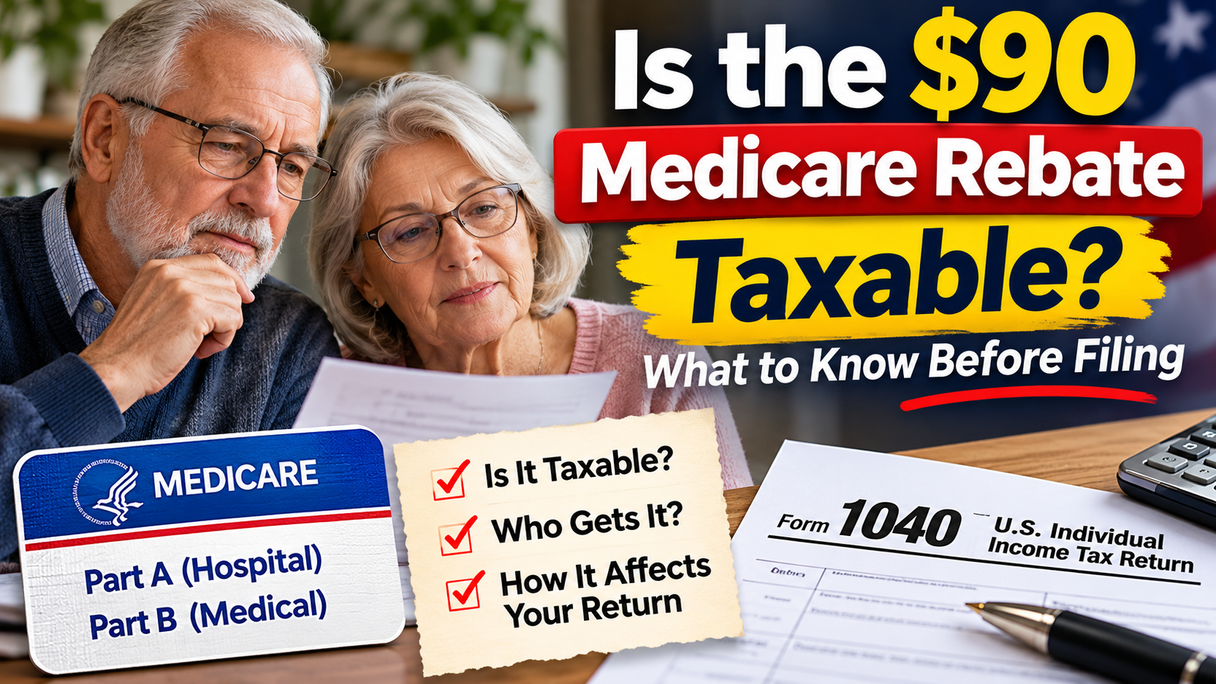
$90 Medicare Rebate Taxable: If you opened your bank statement in early October and spotted a surprise $90 deposit labeled “Medicare Improvement Fund Payment,” you’re not alone. Roughly 20.8 million people got one. And if your next thought was “Great, but is the IRS going to want a piece of this?”, that’s a perfectly reasonable question, because a lot of retirees have learned the hard way that “free money” from the government sometimes shows up again on a tax form.
Here’s the honest short answer as of today: nobody official has told us yet. Neither the IRS nor the Treasury Department has published guidance specifically on the $90 payment, and the CMS fact sheet that explains the program doesn’t mention taxes at all. What we do have is a fairly clear body of older IRS guidance on a very similar kind of payment, and that points toward the rebate being tax-free for most people. Most, not all. There’s a catch for a particular group of filers, and it’s worth understanding before you sit down with your 2026 return next winter.
In this article you will read about what the payment actually is, who got it, what the tax rules probably mean for you, and what to do in the meantime.
What the $90 payment actually is
On October 2, 2026, the White House announced one-time payments of $90 per person to help Medicare enrollees with their Part B premiums. The Centers for Medicare & Medicaid Services (CMS) followed the next day with an FAQ that lays out the rules. The official name is the Medicare Improvement Fund Premium Rebate, and that name matters, as you’ll see in a minute.
The money comes from the Medicare Improvement Fund, a pot Congress created back in 2008 through Section 7002 of the Supplemental Appropriations Act. According to CMS, the fund exists to make improvements to the original fee-for-service program under Parts A and B. For years it mostly sat there while Congress dipped into it to offset the cost of other legislation. CMS says lawmakers have pulled money out of it around 20 times, including a $20.7 billion withdrawal in 2010. This is the first time it’s been used to send money directly to beneficiaries.
At $90 apiece across 20.8 million people, the total works out to somewhere around $1.87 billion, which is most of what the fund held. That’s our arithmetic and the figure several outside analysts have also landed on, not a number CMS put in its FAQ, so treat it as a close estimate. The practical takeaway is that this looks like a one-time event. CMS describes it as “one $90 rebate in October 2026,” and with the fund largely spent, a repeat would probably need new money from Congress.
It’s also worth keeping the size of this in perspective. The standard Part B premium in 2026 is $202.90 a month, up $17.90 from $185 in 2025. The annual Part B deductible rose to $283 from $257. So $90 covers a little under half of one month’s premium, and less than 4 percent of what you’ll pay in premiums across the year. It’s nice. It’s not life-changing. But “not life-changing” is exactly the sort of amount that people either forget to think about at tax time or worry about more than they should.
US Midterm Election Results 2026: Who Won the Senate, House and Governor Races
Retirees Could Lose Up to $18,400 in 2026: Why Social Security Cuts Are Being Warned About
When Will You Learn Your Exact 2027 Social Security Amount? Dates and Steps
Who got it, and who didn’t
CMS says the payment went to people in Original Medicare Part B who live in the United States and who are not getting premium help from Medicaid and not paying an Income-Related Monthly Adjustment Amount, known as IRMAA. Medicare Advantage enrollees are not eligible. That last exclusion has surprised and annoyed a lot of people, since around 36 million Americans are in Medicare Advantage plans, and CMS hasn’t explained the reasoning beyond pointing to the fund’s statutory purpose of improving the original fee-for-service program.
Put plainly, you were left out if any of these describe you:
You’re in a Medicare Advantage plan, including one that offers a “Part B giveback.” You have Part A only and never signed up for Part B, which is common for people still covered by an employer plan. Medicaid or a Medicare Savings Program pays your Part B premium. You pay IRMAA, which for 2026 kicks in for individuals with income above $109,000 and joint filers above $218,000, based on the tax return from two years back. Or you live outside the United States.
There’s no application. If you were eligible, CMS says most people got a direct deposit from the Social Security Administration on or around October 8. Those without direct deposit on file were supposed to get a paper check from the Treasury Department later in October, mailed to the address Medicare has on record. The check carries the message “Medicare Improvement Fund Payment; $90 Payment to Offset October Premium.” Your bank may shorten that description on the statement, so look for “SSA,” “Treasury,” or “Medicare Improvement Fund.”
If you think you should have received it and didn’t, CMS gives two numbers. Call 1-800-MEDICARE (1-800-633-4227) to check your eligibility, and call Social Security at 1-800-772-1213 to check on payment status. SSA’s status line opened October 15, so it’s been a few weeks now.
One quick word on scams, because they always follow a payment like this. You don’t need to apply, pay a fee, click a link, or hand over your Medicare number, Social Security number, or bank details to “release” the $90. Anyone asking for those things is not working for Medicare. The FTC’s long-standing advice applies: caller ID can be faked, and Medicare doesn’t call out of the blue asking for personal information. If something feels off, hang up and call 1-800-MEDICARE yourself, and report impersonators at ReportFraud.ftc.gov.
So, is it taxable? What the government has said
Let’s separate what’s confirmed from what’s inference.
Confirmed: CMS’s October 3 FAQ doesn’t say anything about the tax treatment. The White House fact sheet doesn’t either. As of the most recent coverage I could find, the IRS and Treasury hadn’t issued anything on whether recipients should include the $90 in income, whether it falls under some exclusion, or whether anyone will get an information return like a 1099 reporting it. The TaxGirl column, published October 5, pointed out that the administration’s use of the word “rebate” doesn’t by itself decide the federal tax treatment, and that there’s still time for the IRS to weigh in before the 2026 filing season opens.
I want to be clear about that, because a few websites have stated flatly that the payment “is not taxable income.” That may well turn out to be right. But no agency has said it, and the better-sourced commentary I found uses words like “probably.” That’s the correct level of confidence today.
Inference: The IRS has dealt before with a closely analogous situation, and its reasoning gives us a strong clue.
How the IRS treats premium rebates
Back in 2012, when Affordable Care Act rules started forcing insurers to send rebates to policyholders when they spent too little of their premium dollars on actual care (the “medical loss ratio” rebates), the IRS published a set of FAQs explaining the tax treatment. The core idea was that a premium rebate is a “purchase price adjustment.” In other words, it’s not income. It’s the seller giving you back part of the price you already paid.
Think of it like a manufacturer’s rebate on a refrigerator. If you paid $1,000 and get $90 back, you didn’t earn $90. You just paid $910 in the end. The IRS applied the same logic to insurance: you paid premiums, the insurer gave some back, so your net cost went down.
From there, the IRS FAQs split into two cases, and this is the part that matters for you:
If you did not deduct the premiums on your tax return, the rebate isn’t taxable. You never got a tax benefit from the premiums, so there’s nothing to claw back.
If you did deduct the premiums, for example on Schedule A as part of your medical expenses or on the self-employed health insurance line, the rebate is taxable “to the extent that” you received a tax benefit from the deduction. That’s the tax benefit rule, which is a long-standing principle in tax law: if you get a deduction and later recover the amount, you may have to report the recovery as income.
Several tax commentators, including the writer behind Don’t Mess With Taxes, have applied this same framework to the $90 payment. They’re basing it on two things: CMS’s own name for the money, a “premium rebate,” and the memo line on the check, “to offset October premium.” If the government is calling it a rebate of a Part B premium, the thinking goes, then the purchase price adjustment logic fits.
Here’s my caution, and I’d rather you hear it from me than discover it in March. The IRS FAQs were written about insurance company rebates under a specific section of the ACA. They weren’t written about a payment from the Medicare Improvement Fund. The analogy is sensible, but it’s an analogy. The IRS could issue guidance that says something different, or Congress could pass a law that specifically exempts the payment from federal income tax. Until one of those things happens, “probably not taxable if you didn’t deduct the premium” is a reasonable working assumption, not a guarantee.
The three groups of people and what likely applies to each
Rather than a one-size answer, it helps to sort yourself into one of three buckets.
Group 1: You take the standard deduction
This is by far the biggest group, and the news is good. If you don’t itemize, you never deducted your Medicare premiums, which means under the purchase price adjustment logic there’s nothing to report. You’d leave the $90 off your return entirely.
How likely is it that you’re in this group? Very. Most filers, by the usual estimates around 90 percent, take the standard deduction, and the numbers have gotten more generous. For 2026 the standard deduction is $16,100 for single filers and $32,200 for married couples filing jointly. If you’re 65 or older, you get an additional amount on top: $2,050 if you’re single or head of household, or $1,650 per spouse if you’re married. On top of that, the “One Big Beautiful Bill Act” created a separate $6,000 deduction for people 65 and older, available for tax years 2025 through 2028, which phases out at higher incomes. It’s claimed on Schedule 1-A and you can take it whether you itemize or not.
Add those up for a single 65-year-old and you’re looking at about $24,150 in total deductions before the phase-out comes into play. For a retired couple both over 65, it can reach roughly $47,500. At those numbers, itemizing medical expenses doesn’t make sense for most retirees, so for most readers the $90 question is probably moot.
Social Security Changes November 2026: SSA’s 3.6% COLA, Payment Dates & What Retirees Should Know
Employment Insurance (EI) 2026 Rule Changes: What Every Canadian Worker Needs to Know
New York HEAP Program 2026: Current Status, Who Qualifies & When to Apply
Group 2: You itemize and deduct medical expenses
Here’s where it gets a little more interesting. Medicare premiums, including Part B, count as medical expenses you can include on Schedule A. But you can only deduct the part of your total medical expenses that exceeds 7.5 percent of your adjusted gross income. If your AGI is $50,000, the first $3,750 of medical costs gets you nothing, and only dollars beyond that count.
If you itemize and you’re counting your 2026 Part B premiums, the likely way to handle the $90 is simple: subtract it from your Part B premiums before you total them up. Instead of claiming 12 months at $202.90, which is $2,434.80, you’d claim $2,344.80. A couple filing jointly where both received the payment would subtract $180. Several outlets covering this, including Yahoo Finance, have suggested exactly that approach, and it’s the cleanest one because it avoids the “income” question entirely. You’re just reporting what you actually paid.
Why this approach makes sense: the tax benefit rule works by taxing the recovery only to the extent it gave you a benefit. If you subtract the $90 from the expense in the same year you received it, you’re effectively reducing the deduction by exactly the amount that was refunded. Same year, same tax return, no timing mismatch.
And an honest note: if your total medical expenses don’t even clear the 7.5 percent floor, then the premiums didn’t reduce your tax at all, and the rebate doesn’t either way. The tax benefit rule only bites if you actually got a benefit.
Group 3: You’re self-employed and deduct your premiums
If you have self-employment income and deduct your health insurance premiums on the self-employed health insurance deduction, including Medicare premiums, then you deducted your Part B premiums “above the line” on Schedule 1, rather than as an itemized deduction. In the IRS’s 2012 FAQs, a person who deducted premiums that way was treated just like someone who itemized: the rebate was taxable to the extent of the benefit.
For this group, the safest approach is probably the same: reduce your claimed premiums by $90. But because there’s also self-employment tax and other calculations that interact with this deduction, this is the group I’d most strongly encourage to check with a tax professional. A $90 change is small, but errors on the self-employed health insurance line can ripple into other places on your return.
What about a 1099 or other tax form?
This is the question almost everyone asks when a payment like this lands, and the answer right now is: we don’t know.
Typically, taxable government payments get reported on some kind of information return. Social Security benefits show up on Form SSA-1099, unemployment compensation on Form 1099-G, and so on. Nothing I found says that Social Security or Treasury will issue a form for the $90. The Tax Girl piece specifically noted that there’s no word yet on whether an information return will go out.
That uncertainty cuts both ways. If you don’t get a form, it doesn’t automatically mean the payment is tax-free. The IRS expects taxpayers to report taxable income whether or not a form shows up. But if the payment is generally not taxable, which is where the evidence leans, then a missing form is just what you’d expect to see.
What to do right now
You have time. The 2026 tax year isn’t over, and returns for 2026 aren’t due until April 2027. Given that nobody has formally weighed in yet, here’s what I’d do.
Keep a record. Save the bank statement showing the deposit or a photo of the check along with the memo line. If a deposit reads “Medicare Improvement Fund” or “SSA,” note the date and amount. Documentation is cheap, and it makes things easy if the IRS later asks questions or if you’re working with a preparer.
Figure out which group you’re in. Look at last year’s return. Did you itemize? Did you claim medical expenses? Did you take the self-employed health insurance deduction? If you took the standard deduction, you can mostly stop worrying.
Keep track of what you actually paid for Part B in 2026. If you itemize, you’ll want the real number anyway. Your Social Security statements or your quarterly Medicare bills, if you pay directly, will show it. If your premium comes out of your Social Security check, the amounts will appear on your SSA-1099 in January.
Don’t assume, one way or the other. The most common mistake with unusual government payments is deciding too early. If a guidance notice comes out in December saying the payment is excluded, great. If it says something else, you’ll want to know. The IRS often posts a news release or FAQ page on a new payment type when the filing season is approaching, so check IRS.gov in January and February.
FAQ’s About $90 Medicare Rebate Taxable
Do I have to report the $90 on my tax return? There’s no official answer yet. If you take the standard deduction, the available evidence suggests you probably don’t need to report it, because you never deducted the premiums. If you itemize medical expenses or take the self-employed health insurance deduction, the likely approach is to reduce your claimed Part B premiums by $90. Watch for IRS guidance.
Could the IRS or Congress change this? Yes. Either could issue guidance that treats the payment differently, or Congress could pass a law exempting it from tax. It’s one reason I’d resist treating any blog post, including this one, as the final word.
I didn’t get the $90 but I think I should have. What now? Call 1-800-MEDICARE to confirm your eligibility, then call SSA at 1-800-772-1213 for payment status. If you were meant to receive a paper check, confirm that Medicare has your current mailing address.
Will there be another $90 payment next year? Nothing has been announced. Given that the payments used up most of the fund’s balance, another round would likely require Congress to provide new funding.
Here’s where things stand on November 4, 2026. The $90 Medicare Improvement Fund Premium Rebate is real, it was paid in October to about 20.8 million people in Original Medicare Part B, and it’s described by CMS as a rebate to offset the October premium. No official guidance has been issued on whether it’s taxable. The best available analogy, the IRS’s treatment of insurance premium rebates as purchase price adjustments, suggests it’s not taxable income for people who never deducted their Medicare premiums, and that people who did deduct them should reduce the deduction by the amount of the rebate.
That means most retirees, who take the standard deduction, probably have nothing to do except keep a record. Itemizers and self-employed filers who deduct Part B premiums should plan to subtract the $90 from what they claim, and check for updated guidance before they file.
When the IRS or Treasury does speak, it’ll likely be through IRS.gov, so that’s the place to look first. And if you’re ever unsure, a tax professional can settle a $90 question in about five minutes.
This article is for general information and isn’t tax or legal advice. Tax rules can change, and individual situations vary, so talk with a qualified tax professional about your own return.