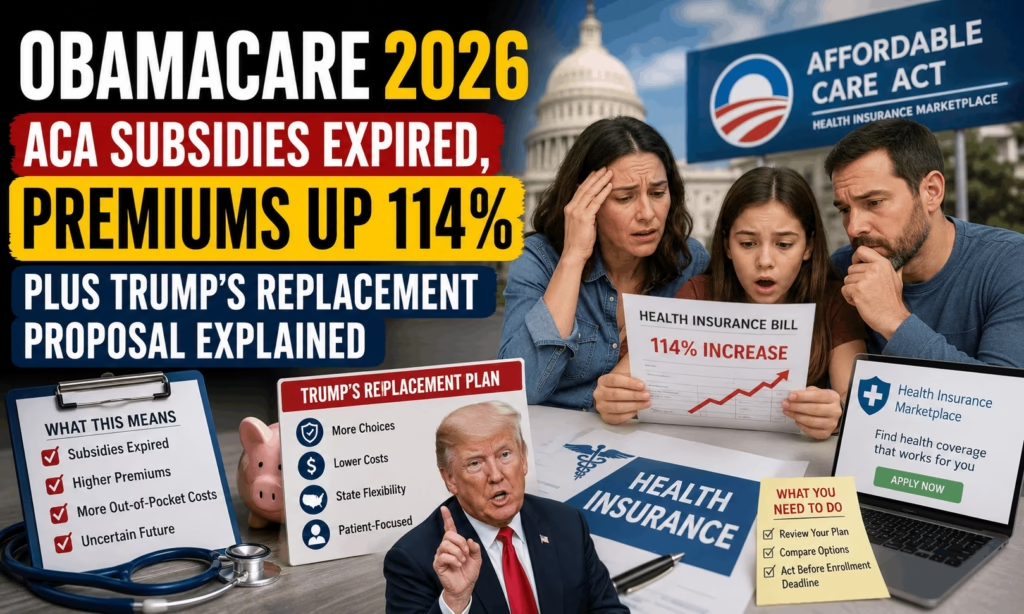
Obamacare in 2026 looks very different than it did just a year ago not because of any new replacement law, but because the enhanced Affordable Care Act (ACA) subsidies expired on January 1, 2026, after Congress failed to reach an agreement to extend them. The result has been immediate and severe: according to the Kaiser Family Foundation (KFF), more than 20 million ACA enrollees are now facing premium increases averaging 114%, with typical annual premium payments jumping from roughly $888 in 2025 to about $1,900 in 2026. Meanwhile, President Trump has floated a separate, still-informal idea to eventually replace the ACA entirely with direct cash payments Americans could use to buy their own coverage but that proposal remains just a concept, with no bill, no White House draft, and no funding details released as of this update.
This guide separates fact from speculation: what actually happened to Obamacare/ACA premiums and subsidies in 2026, who’s affected most, what options remain if your premium jumped, and a clear-eyed look at Trump’s proposed direct-payment alternative including exactly why healthcare economists are skeptical it could work without the same risk-pooling protections the ACA currently provides. We’ll be updating this article monthly as Congress, CMS, and the White House release further guidance.
Obamacare 2026 Key Highlights
| Detail | Information |
|---|---|
| What Changed | Enhanced ACA premium tax credits expired January 1, 2026 |
| Why It Expired | Congress did not extend the enhancement passed under ARPA (2021) and extended via the Inflation Reduction Act (2022) |
| Average Premium Increase | 114% (KFF analysis) |
| Average Annual Premium — 2025 | ~$888 |
| Average Annual Premium — 2026 | ~$1,900 |
| Americans Affected | 20 million+ Marketplace enrollees |
| Average Deductible Increase | ~$1,000 per person |
| Projected Enrollment Decline | 2 million+ fewer exchange enrollees (CBO estimate) |
| Subsidy Rules Now In Effect | Pre-2021 ACA rules (400% FPL income cap restored) |
| Base ACA Premium Tax Credit Status | Still exists — only the “enhanced” version expired |
| Trump Replacement Proposal Status | Informal idea only — no bill, no White House draft |
| Official Marketplace | healthcare.gov |
What Actually Happened to Obamacare Subsidies in 2026?
This is the single most important fact missing from most casual coverage of “Obamacare’s future”: the ACA itself has not been repealed or replaced. What expired was a temporary enhancement to the ACA’s existing Premium Tax Credit (PTC), not the underlying law.
The timeline:
- 2021: The American Rescue Plan Act (ARPA) temporarily expanded ACA subsidies in response to COVID-19 — increasing subsidy amounts and, critically, eliminating the income cap that previously barred anyone earning above 400% of the Federal Poverty Level (FPL) from qualifying for any subsidy at all.
- 2022: The Inflation Reduction Act extended these enhanced subsidies through the end of 2025.
- A sunset date of January 1, 2026 was written into that extension from the start.
- Late 2025: Congress failed to pass any further extension before the deadline.
- January 1, 2026: The enhanced subsidies officially expired, and ACA subsidy rules reverted to their original, pre-2021 structure.
What this means in plain terms: The base Premium Tax Credit still exists — it was never eliminated and has no expiration date written into it. But the generous enhancements that had made coverage free or nearly free for millions of lower-income enrollees, and had extended subsidy eligibility to middle- and higher-income households above 400% FPL, are gone.
Who Is Affected Most?
| Group | Impact |
|---|---|
| Households above 400% FPL | Lost subsidy eligibility entirely — many now pay full, unsubsidized premiums |
| Middle-income households (150%–400% FPL) | Still eligible for subsidies, but at reduced, pre-2021 levels |
| Households below 150% FPL | Continue to see the smallest relative impact, though still face reduced enhancement benefits |
| Older adults | See larger dollar increases, since ACA premiums rise with age |
| Residents of non-Medicaid-expansion states | Fewer alternative coverage options if Marketplace plans become unaffordable |
Under the restored pre-2021 rules, in Medicaid expansion states, people earning below 138% of the FPL typically qualify for Medicaid instead of Marketplace subsidies. In non-expansion states, people below 100% FPL may fall into the so-called coverage gap — too poor for subsidized Marketplace coverage, but not covered by Medicaid either.
Why Premiums Rose So Sharply
Beyond the direct loss of subsidy dollars, health economists point to a risk-pool effect compounding the increase. As the Congressional Budget Office (CBO) projected, once enhanced subsidies expired, healthier and younger enrollees — those with the least to lose by dropping coverage — are the most likely to exit the Marketplace entirely. That leaves a sicker, costlier remaining pool, which pushes pre-subsidy premiums up by an estimated 5% or more, on top of the direct loss of subsidy dollars for those who remain enrolled. This combination — smaller subsidies plus a costlier risk pool — is what produced the headline 114% average increase.
What Are Your Options If Your Premium Jumped?
- Check if you still qualify for the base Premium Tax Credit — it still exists at pre-2021 levels; many households retain partial subsidy eligibility even after the enhancement expired.
- Compare plan tiers during open enrollment — a lower-premium Bronze or Silver plan may offset some of the increase, though often with a higher deductible.
- Review your state’s specific rules — some states with their own exchanges have implemented supplemental state-level subsidies to soften the federal enhancement’s expiration.
- Consider whether you qualify for Medicaid — especially if your income has changed and now falls below your state’s Medicaid expansion threshold.
- Be cautious with short-term or “faith-based” alternative plans — these can be considerably cheaper but often offer limited coverage and fewer consumer protections than ACA-compliant plans; review exclusions carefully before switching.
- Consult a licensed insurance navigator — free assistance is available through healthcare.gov to help you re-shop your specific situation for 2026.
Trump’s Proposed ACA Replacement: What It Actually Is (and Isn’t)
Separate from the subsidy expiration, President Trump has floated a broader, longer-term idea: giving Americans direct cash payments to purchase their own health insurance, rather than channeling federal healthcare dollars through insurance companies. As of this update, this remains an informal concept only — no official White House draft has been published, and reports indicate Republican senators are only in the early stages of drafting a bill that would attempt to formalize the idea into legislation.
What Trump’s proposal would attempt to do:
- Redirect federal healthcare spending away from insurers and toward individuals directly
- Let people “shop” for their own health plan with government-provided funds
- Frame the approach as increasing individual choice and market competition
Why Healthcare Economists Are Skeptical
The core concern raised by health policy experts centers on risk-pooling — the foundational mechanism that allows any insurance system to function. Under the ACA’s current structure, healthy enrollees who rarely use care effectively subsidize the costs of sicker enrollees who need expensive treatment, keeping the system’s average costs manageable for everyone.
If individuals instead receive cash and shop entirely on their own, economists warn of a likely adverse selection spiral: healthier people may choose cheaper, skimpier plans or forgo coverage altogether, leaving primarily sicker individuals in the remaining risk pool — which would drive average costs, and therefore premiums, sharply higher. Without ACA-style guardrails — guaranteed issue regardless of pre-existing conditions, community rating rules preventing insurers from charging sick people more, and enforced minimum coverage standards — critics argue a pure direct-payment model could replicate, or worsen, the exact premium spiral currently unfolding from the subsidy expiration, just through a different mechanism.
The Broader Cost Context
U.S. healthcare spending remains the highest in the world relative to the size of its economy, consuming close to 18% of GDP. Beyond the ACA specifically, average family health insurance premiums (including employer-sponsored coverage) reached approximately $27,000 per year according to 2025 KFF data, with covered workers contributing roughly $1,800 out-of-pocket even before their insurance coverage begins. Multiple stakeholders — insurers, hospitals, pharmaceutical companies, and pharmacy benefit managers — each point to the others as the primary driver of these costs, and no single reform proposal currently on the table, including Trump’s direct-payment concept, has been independently verified to address the underlying structural cost drivers rather than simply shifting who pays.
What Happens Next?
For 2026, the practical reality for most ACA enrollees is straightforward: higher premiums are already in effect, based on the expired enhanced subsidies, and no retroactive fix has been enacted. Whether Congress revisits an extension, whether Trump’s direct-payment concept advances into actual legislation, or whether states continue stepping in with their own supplemental subsidies will shape the next phase of this story — but as of this update, the base ACA marketplace remains fully operational, just at reduced subsidy levels for most enrollees.
Official Resources
| Official ACA Marketplace: | healthcare.gov |
| Check Your Subsidy Eligibility: | healthcare.gov/lower-costs |
| Find a Local Navigator/Assister: | localhelp.healthcare.gov |
| KFF Subsidy Calculator: | kff.org/interactive/calculator-aca-enhanced-premium-tax-credit |
| Medicaid Eligibility Check: | medicaid.gov |
| Home Page | https://govtschemes.org/ |
FAQs Obamacare 2026
Did Obamacare get replaced in 2026?
No. The Affordable Care Act itself remains fully in effect. What changed is that a temporary enhancement to ACA subsidies, passed in 2021, expired on January 1, 2026 — leading to sharply higher premiums for many enrollees.
Why did my ACA premium go up so much in 2026?
The enhanced premium tax credits from the American Rescue Plan expired, reverting subsidy rules to their original pre-2021 structure. Combined with healthier enrollees leaving the risk pool, average premiums rose about 114%.
Is Trump actually replacing Obamacare with cash payments?
Not yet. This remains an informal proposal with no official bill, White House draft, or funding details released. Republican senators are reportedly in early drafting stages only.
Do I still qualify for any ACA subsidy in 2026?
Possibly. The base Premium Tax Credit still exists at pre-2021 levels. If your income is between 100%–400% of the Federal Poverty Level, you likely still qualify for some subsidy, just a smaller one than in 2025.
What happens if I earn above 400% of the Federal Poverty Level?
Under the restored pre-2021 rules, you no longer qualify for any premium subsidy — a change from 2021–2025, when the income cap was temporarily removed.
Will Congress bring back the enhanced ACA subsidies?
Uncertain. As of this update, no extension has been passed, though the topic remains actively debated in Congress.