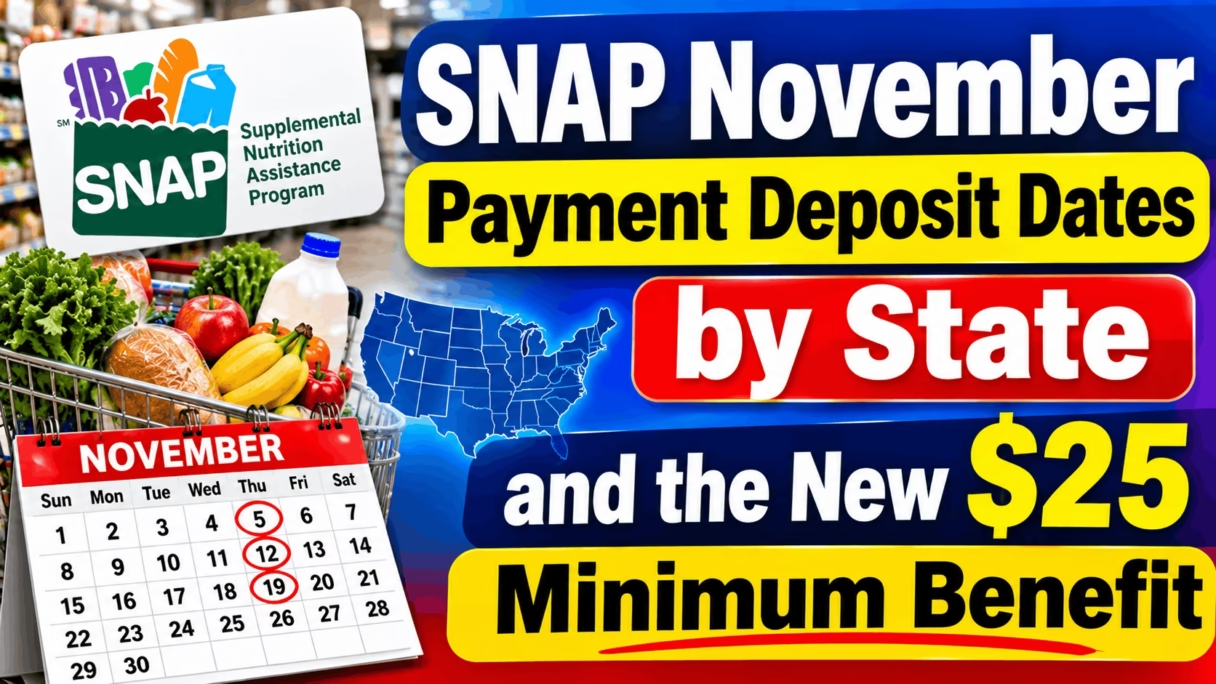
Millions of households are checking the SNAP November payment schedule this week, and the news is steadier than it was a year ago. November 2026 benefits are funded and are loading on each state’s normal calendar, starting Sunday, November 1. The bigger change for the smallest households is the new minimum: since October 1, 2026, an eligible one- or two-person household in the 48 states and D.C. is guaranteed at least $25 a month, up from $24.
That is a small rise, but it follows a federal cost-of-living adjustment that also lifted the maximum monthly SNAP benefit to $306 for one person and $1,023 for a family of four. We’ll be updating this article monthly. Your exact deposit day still depends on where you live and on a number your state assigns, usually the last digit or digits of your case number or Social Security number. Four places, Alaska, North Dakota, Rhode Island and Vermont, pay everyone on the 1st.
Others spread deposits across much of the month. Below you will find the state-by-state windows, the new amounts, a free SNAP benefit calculator, funding news ahead of the December 11 deadline, and clear steps on how to apply and what to do if your EBT balance is late.
SNAP November 2026 Key Highlights and Dates
| Item | Detail |
|---|---|
| First November deposits | Sunday, November 1, 2026 |
| USDA cost-of-living memo | August 21, 2026 |
| New amounts effective | October 1, 2026 through September 30, 2027 |
| Minimum SNAP benefit (1 to 2 people, 48 states and D.C.) | $25 per month, up from $24 |
| Maximum benefit, 1 person | $306 per month |
| Maximum benefit, family of 4 | $1,023 per month, up from $994 |
| Current federal funding runs through | December 11, 2026 |
| Next scheduled benefit adjustment | October 1, 2027 |
SNAP Payment Dates in November 2026 by State
Each state sets its own issuance calendar. Deposits post at midnight or early morning, and weekends and holidays do not delay them, so benefits are usable the day they land. The windows below come from state agency and USDA based schedules. Confirm your own date with your state agency, because a few states change how they assign days.
| State | November deposit window | What sets your day |
|---|---|---|
| Alaska, North Dakota, Rhode Island, Vermont | 1st | Everyone is paid on the 1st |
| Alabama | 4th to 23rd | Last two digits of case number |
| Arizona | 1st to 13th | Assigned by state |
| Arkansas | 4th to 13th | Last digit of case number |
| California | 1st to 10th | Last digit of case number |
| Colorado | 1st to 10th | State-assigned case details |
| Florida | 1st to 28th | Eighth and ninth digits of case number |
| Georgia | 5th to 23rd | Last two digits of client ID |
| Illinois | 1st to 10th | Last digit of case number |
| Massachusetts | 1st to 14th | Last digit of Social Security number |
| Michigan | 3rd to 21st | Last digit of case number |
| New Jersey | 1st to 5th | Seventh digit of case number |
| New York | 1st to 9th | Last digit of case number (New York City runs on its own staggered calendar over about two weeks) |
| North Carolina | 3rd to 21st | Last digit of Social Security number |
| Ohio | 2nd to 20th | Last digit of case number |
| Pennsylvania | 3rd to 14th | First ten business days, tied to case number |
| Texas | Roughly 1st to 28th | Last digits of case number and case age |
| Washington | 1st to 20th | Assigned by state |
If your state is not listed, use the USDA State Directory in the official resources table below to reach your agency’s schedule page.
How Your SNAP EBT Deposit Date Is Decided?
Most people never see the formula behind their date, which is why the same question keeps trending: when will my SNAP hit my card? States balance their workload by spreading cases across the month. A household with a case number ending in 0 might be paid on the 3rd while a neighbor ending in 9 is paid on the 12th.
Three practical points matter in November. First, your date normally stays the same every month until you recertify, so last month’s date is the best guide. Second, if you moved, changed agencies or reopened a case, the state can assign a new day. Third, unused balances generally carry over, but many states can remove benefits after about a year of no card activity, so do not let a balance sit untouched.
New SNAP Minimum Benefit: Why It Is $25 Now, Not $24
The minimum monthly benefit exists so the smallest households do not receive a trivial amount. By law it equals 8 percent of the maximum benefit for a one-person household, rounded down. When the one-person maximum rose from $298 to $306, the minimum moved from $24 to $25. It applies only to one- and two-person households in the 48 states and D.C. Larger households have no minimum, and their formula amount can reach zero.
Here is how it works in practice. A single adult has a maximum of $306. If that person has $1,000 in countable net income, the formula takes 30 percent of that ($300) and leaves $6. Because the household is eligible, the minimum lifts the payment to $25. Alaska, Hawaii, Guam and the U.S. Virgin Islands have higher minimums because food costs there are higher.
Some older articles and state pages still say $24. That figure was correct from October 2025 through September 2026 only. If your notice shows a different amount, your own income and deductions, not a general rule, usually explain it.
Maximum SNAP Benefit Amounts for November 2026
The maximum is what a household with no countable net income receives. Everyone else gets the maximum minus 30 percent of net income. These are the FY2027 amounts for the 48 states and D.C.
| Household size | Maximum monthly benefit |
|---|---|
| 1 | $306 |
| 2 | $562 |
| 3 | $808 |
| 4 | $1,023 |
| 5 | $1,217 |
| 6 | $1,463 |
| 7 | $1,616 |
| 8 | $1,841 |
| Each additional person (9 to 17) | $225 |
Hawaii is the notable exception this year. USDA lowered the maximum for a family of four in Hawaii to $1,655, down from $1,689, while Alaska’s family of four range runs from $1,306 to $2,027 depending on the area. Guam is $1,507 and the Virgin Islands $1,315 for a family of four.
SNAP Benefit Calculator: Estimate Your November Payment
The calculator that goes with this guide uses the FY2027 numbers for the 48 states and D.C. Enter your household size, earned and other income, housing costs, dependent care and, if someone is 60 or older or disabled, medical costs. It then applies the same steps your caseworker uses.
How the estimate is built:
- Take 20 percent off earned income.
- Subtract the standard deduction ($217 for one to three people).
- Subtract dependent care and, for 60+ or disabled members, medical costs above $35.
- Add any excess shelter deduction: housing and utility costs above half of remaining income, capped at $769 unless someone is 60+ or disabled.
- Multiply the resulting net income by 30 percent and subtract it from your household maximum.
- If you are a one- or two-person household and the result is below $25, the benefit is raised to $25.
This is an estimate. States apply their own utility allowances and rules, and standard deductions for households of five or more should be checked against your state’s notice. Your agency’s decision is final.
SNAP Benefit Calculator (Oct 2026 to Sep 2027)
SNAP Benefit Calculator (Oct 2026 to Sep 2027)
Estimate for the 48 states and D.C. only. Your state agency makes the final decision.
Are SNAP Benefits Safe in November and December 2026?
For November, yes. Congress passed a stopgap funding measure before the new fiscal year, and it keeps SNAP funded at current levels through December 11, 2026. States sent their November files on the usual schedule and no state has announced a delay.
The date to watch now is December 11. Unless Congress passes another stopgap or full-year appropriations by then, funding would lapse on December 12. Advocates such as the Food Research and Action Center are also pressing lawmakers to delay the state cost-share for benefits that is scheduled to begin in fiscal year 2028. None of that changes your November balance.
The reason people are cautious is last year. During the 2025 shutdown, USDA first said it could not pay November benefits, courts ordered partial and then full payment, and the shutdown ended on November 12, 2025 with a bill that restored funding. Many families waited weeks. This year there is no such disruption.
How to Apply for SNAP?
You apply through the state where you live, not through a single federal website. The process is similar everywhere.
- Find your state agency through the USDA State Directory and start an application online, by mail, by phone or in person at a local office.
- Submit the basics first. The filing date sets your benefit start date, so a simple application with your name, address and signature is enough to begin.
- Gather proof of identity, income, rent and utilities, and immigration status where required for the household members applying.
- Complete the interview, usually by phone, and send any documents the caseworker asks for.
- Receive your decision and, if approved, your EBT card by mail with instructions to set a PIN.
Many states have their own accounts for registration, login and status checks. Pennsylvania uses COMPASS, California uses BenefitsCal, New York uses myBenefits, Texas uses Your Texas Benefits and Florida uses the ACCESS portal. Links are in the table below.
SNAP Application Processing Time
Federal rules give states 30 days to process a standard application. Households with very little income and money can qualify for expedited service, with benefits issued within 7 days. Typically that applies when monthly gross income is under $150 and liquid resources are $100 or less, or when rent and utilities exceed income and resources combined.
To avoid delays, answer the interview call, keep your phone on, and upload documents the same day you are asked. If you have not heard anything after 30 days, contact your agency and ask in writing for the status of your case.
SNAP Income Limits and Eligibility for 2026 to 2027
Most households must pass two tests, a gross income test at 130 percent of the federal poverty level and a net income test at 100 percent. Households with a member who is 60 or older or disabled only need to pass the net test. Asset limits are $3,000 for most households and $4,750 for those with a member 60 or older or disabled.
| Household size | Gross monthly limit | Net monthly limit |
|---|---|---|
| 1 | $1,729 | $1,330 |
| 2 | $2,345 | $1,804 |
| 3 | $2,960 | $2,277 |
| 4 | $3,575 | $2,750 |
| 5 | $4,191 | $3,224 |
| Each additional person | $616 more | $474 more |
These limits cover the 48 states and D.C. Alaska and Hawaii have higher limits. Many states use broad based categorical eligibility, which can raise gross income limits, so check your own state’s rules before you assume you do not qualify.
SNAP Work Requirements in 2026: Who Needs to Work 80 Hours
The 2025 federal budget law widened the time limit for able bodied adults without dependents. It now covers adults ages 18 through 64, up from 54, and the earlier exemptions for veterans, people experiencing homelessness and former foster youth were removed for now. If the rule applies to you, you can get SNAP for only three months in a 36 month period unless you work, volunteer or take part in an approved program for at least 80 hours a month. Parents or caregivers of a child under 14 in the household are not subject to the time limit, and neither are people who are medically unable to work, among other exceptions.
If a notice says you are about to lose benefits, ask your caseworker right away whether you qualify for an exemption, and send proof of any hours you worked or volunteered. Recent changes also limit some benefits for certain noncitizens without a green card, so immigrant households should confirm eligibility with their state agency.
What to Do If Your SNAP Payment Is Late or Wrong
Start by confirming your deposit window in the table above and checking your balance through your state’s EBT portal or the number on the back of your card. If your date has passed, call your state agency before you assume a federal problem. Possible causes include a missed recertification, an unreported change, a pending work requirement review or a card that was replaced.
If your benefit amount drops, request a written explanation and ask for a recalculation. You have the right to appeal in writing, and in many states you can keep benefits during the appeal if you file before the effective date of the change.
Official SNAP Resources and Links
| Resource | Use it for | Link |
|---|---|---|
| USDA SNAP State Directory | Find your state agency, apply, check status | https://www.fns.usda.gov/snap/state-directory |
| USDA SNAP cost-of-living adjustments | FY2027 maximums, minimum and deductions | https://www.fns.usda.gov/snap/allotment/cola |
| USDA SNAP eligibility | Federal rules and income standards | https://www.fns.usda.gov/snap/recipient/eligibility |
| Benefits.gov | Check programs you may qualify for | https://www.benefits.gov |
| ebtEDGE | Card balance and EBT account access in many states | https://www.ebtedge.com |
| Pennsylvania COMPASS | Apply, login, status check | https://www.compass.pa.gov |
| California BenefitsCal | Apply, login, status check | https://benefitscal.com |
| New York myBenefits | Apply, login, status check | https://mybenefits.ny.gov |
| Your Texas Benefits | Apply, login, status check | https://www.yourtexasbenefits.com |
| Florida ACCESS | Apply, login, status check | https://www.myflfamilies.com/access |
SNAP November Payment Schedule FAQs
When will SNAP be deposited in November 2026?
Deposits begin Sunday, November 1 and run through the month depending on your state. Alaska, North Dakota, Rhode Island and Vermont pay everyone on the 1st, while Florida and Texas spread payments across most of the month.
What is the minimum SNAP benefit in November 2026?
The minimum is $25 a month for eligible one- and two-person households in the 48 states and D.C. It rose from $24 on October 1, 2026.
What is the maximum SNAP benefit in November 2026?
It is $306 for one person, $562 for two, $808 for three and $1,023 for four in the 48 states and D.C. Alaska, Hawaii, Guam and the Virgin Islands have higher maximums.
Are SNAP benefits funded for November 2026?
Yes. Federal funding is in place through December 11, 2026, and states are issuing November benefits on their regular schedules.
Will SNAP stop after December 11?
Not automatically. Congress needs to pass another stopgap or full-year funding by that date. If it does not, a funding gap begins December 12 and the program could face disputes similar to last year’s.
How is my SNAP benefit calculated?
Your benefit is the maximum for your household size minus 30 percent of your net income. Net income is gross income after deductions such as 20 percent of earnings, the standard deduction, dependent care, medical costs for 60+ or disabled members, and excess shelter costs.
How long does SNAP take to process?
Up to 30 days for most applications, and 7 days for expedited cases.
Do SNAP work requirements apply after age 55?
Yes, the time limit now applies through age 64 for adults without a dependent child under 14, unless an exemption applies.
What day does SNAP money hit your card?
It depends on your state and your case or Social Security number. Check your state’s window above, then confirm with your agency.
Did SNAP go up in October 2026?
Yes. USDA’s FY2027 adjustment raised maximums in the 48 states and D.C. and lifted the minimum benefit to $25. Hawaii’s maximum for a family of four went down slightly.
Can I get SNAP if I make $1,500 a month?
For a one-person household, the gross limit is $1,729 and the net limit is $1,330, so $1,500 in gross income can qualify once deductions are applied. The calculator above gives a quick estimate, and your state makes the final decision.
How do I check my SNAP application status?
Log in to your state’s benefits portal, call your agency, or use the state directory to find the status page. Have your case number or application confirmation ready.
Why did my SNAP benefits decrease?
Common reasons include higher income, a changed deduction, the end of an emergency allotment, a work requirement issue or a recertification that is out of date. Ask for the written notice, which must explain the change.
Can SNAP be used for anything besides groceries?
SNAP covers eligible food and seed or plants that grow food. It does not cover hot prepared foods, alcohol, tobacco or non-food items. Some states also have new restrictions on certain items, so check your state’s rules.
Conclusion
The SNAP November payment schedule is back to normal after last year’s shutdown turmoil. Benefits are funded, deposits began on November 1 and your date depends on your state’s calendar. The headline change is the new $25 minimum benefit, along with higher maximums for the 48 states and D.C. through September 30, 2027. The date to watch is December 11, when federal funding needs to be extended. Until then, confirm your deposit window, use the calculator for an estimate, keep your recertification and work requirement paperwork current, and rely on your state agency and USDA for final answers. We’ll be updating this article monthly.