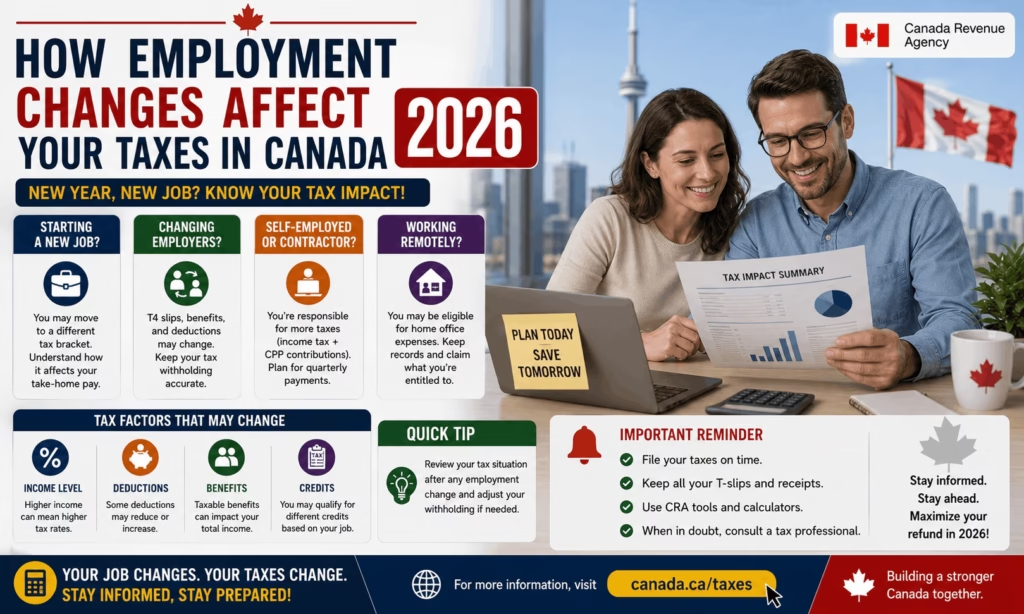
Canada’s open work permit system looks noticeably different than it did two years ago, and the tightening is still working its way through applications being decided right now. Since January 21, 2025, the federal government narrowed who can qualify for a family open work permit, cutting out most spouses of college and undergraduate students and a large share of spouses of workers in business, sales, service, and manufacturing roles. That change is still catching people off guard in 2026, because many applicants are basing their plans on rules that no longer apply, filing under outdated assumptions, and receiving refusals that then have to be disclosed on every future immigration application they submit.
At the same time, Immigration, Refugees and Citizenship Canada has extended a separate lifeline for a specific group of long-waiting permanent residence applicants. A temporary public policy that lets certain applicants who filed their permanent residence application back in 2021 keep working under an open work permit has now been extended through December 31, 2026, giving thousands of people still stuck in the queue continued authorization to work for any employer while their file is finalized. Between the narrower spousal rules and this targeted extension, 2026 has turned into a year where knowing exactly which category applies to your situation matters more than ever. We’ll be updating this article monthly as IRCC adjusts eligibility lists, fees, and processing timelines for open work permits.
What An Open Work Permit Actually Allows?
An open work permit lets a person work for almost any employer in Canada without needing a specific job offer and without the employer having to obtain a Labour Market Impact Assessment. It stands in contrast to an employer-specific, or closed, work permit, which ties the holder to one employer, one job, and often one location. Open work permit holders can switch jobs, work multiple jobs at once, change cities, or become self-employed, all under the same permit, as long as they stay within its validity period.
There are two exceptions built into the rules. Open work permit holders cannot work for an employer that appears on the government’s list of employers found non-compliant with the Temporary Foreign Worker Program, and they cannot work in a narrow set of sectors the government regulates against, specifically businesses related to erotic dance, escort services, and erotic massage. Outside of those two restrictions, an open work permit gives genuinely broad flexibility, which is exactly why demand for it remains high even as eligibility has narrowed.
SSDI Pay Chart: The Least Amount You Can Get Per Month and the Most Common Disabilities
OAS and GIS Indexation Increase: What Canadian Seniors Are Actually Getting Right Now
Canada Open Work Permit 2026 Key Changes
| Change | Effective date | What it means |
|---|---|---|
| Family open work permit eligibility narrowed | January 21, 2025 | Most spouses of college, certificate, and undergraduate students no longer qualify |
| Dependent children removed from general open work permit measure | January 21, 2025 | Only spouses or common-law partners remain eligible, not children |
| Spouses of TEER 2 and 3 workers narrowed | January 21, 2025 | Only select occupations in trades, transport, natural resources, and agriculture still qualify |
| Bridging open work permit extension for 2021 PR backlog applicants | Extended to December 31, 2026 | Eligible long-waiting applicants can keep working while their file is finalized |
| PGWP eligible field of study list | Frozen for 2026 | Same list from the prior year’s changes remains in effect, no new additions or removals |
| LMIA caps tightened | 2026 | Indirectly affects employer-specific permit volume, increasing reliance on open work permit categories |
Who Still Qualifies for a Spousal Open Work Permit?
The single biggest source of confusion in 2026 is the spousal open work permit, sometimes called a family open work permit, because the eligibility list looks completely different from what it was before January 2025.
Spouses and common-law partners of foreign workers can currently qualify if the principal worker is employed in a TEER 0 occupation, meaning management roles, or a TEER 1 occupation, meaning most professional roles requiring a university degree. Spouses of workers in select TEER 2 and TEER 3 occupations can also still qualify, but only within two specific groups: trades and transport occupations under NOC codes in the 72000 and 73000 ranges, and natural resources and agriculture occupations under NOC codes in the 82000 and 83000 ranges. Spouses of workers in most TEER 2 and 3 business, sales, service, and manufacturing occupations no longer qualify under the general measure, which is the category that has caught the most applicants off guard.
Spouses of international students face an equally narrow test. Only spouses of students enrolled in a master’s program of at least 16 months, a doctoral program, or a small list of specific professional programs identified by IRCC remain eligible. Spouses of most college diploma students, certificate program students, and undergraduate degree students no longer qualify at all, a sharp change from the rules that applied before 2025.
Timing matters just as much as occupation or program type. Eligibility for a spousal open work permit is assessed based on the principal applicant’s status on the day the spouse actually submits the application, not on the day the principal applicant started their job or program. An applicant who assumes they are covered because they had 12 months left on their permit when they accepted the job can still be refused if the underlying eligibility test is not met at the moment of filing.
Dependent Children Rule Change
Dependent children of foreign workers and international students are no longer eligible for an open work permit under the general family open work permit measure, a restriction that took effect alongside the spousal narrowing on January 21, 2025 and remains in force through 2026. This is a meaningful shift for families who previously planned around older teenage children being able to work while accompanying a parent, and it means the family open work permit category now functions almost entirely as a spousal and common-law partner benefit rather than a broader family benefit.
Bridging Open Work Permits and the Extended 2021 Backlog Policy
Separate from the spousal category, IRCC maintains a bridging open work permit for people already in Canada who have applied for permanent residence and need to keep working while their application is finalized. A more targeted version of this policy specifically covers applicants who submitted a permanent residence application back in 2021 and are still waiting for a final decision years later. That targeted policy has now been extended through December 31, 2026, allowing eligible applicants, along with qualifying spouses, common-law partners, and dependent children in that specific stream, to continue working in any occupation for any employer while Ottawa works through the backlog.
This extension does not apply automatically to everyone who once filed a permanent residence application in that window. Applicants still need to meet the conditions attached to the specific public policy, including maintaining valid status and meeting whatever application-specific requirements IRCC has published for that measure, so it is worth confirming eligibility directly against the current policy text rather than assuming coverage based on the filing year alone.
Other Groups Who Can Still Access An Open Work Permit
Beyond spouses and bridging applicants, several other categories continue to provide access to open work permits in 2026. Post-Graduation Work Permit holders, who are graduates of eligible Canadian institutions, receive an open work permit by default, allowing them to work for any employer after completing an eligible program. Vulnerable workers who can demonstrate abuse or risk of abuse from an employer can apply for an open work permit specifically designed to let them leave that employer safely without losing their status in Canada. Certain permanent residence applicants under specific economic and humanitarian pathways may also qualify for an open work permit tied directly to the conditions of their particular program, separate from the general family measure described above.
UPS Tariff Refund: Who Is Eligible to Get One and How Can You Apply?
Fees And Payment Schedule
Open work permit applications carry two separate charges rather than one, and missing either fee is one of the most common reasons an application is returned as incomplete.
| Fee type | Amount | Notes |
|---|---|---|
| Work permit processing fee | $155 | Standard fee for any work permit application, open or closed |
| Open work permit holder fee | $100 | Charged in addition to the processing fee for open work permit applications |
| Biometrics fee | Varies by applicant type | Only required if valid biometrics are not already on file within the past ten years |
| Combined typical cost | approximately $255 | Processing fee plus open work permit holder fee for a single applicant |
Applicants should always confirm the current amount on IRCC’s official fee list before paying, since fees are reviewed periodically and can change without extensive advance notice.
How To Apply For A Canada Open Work Permit?
- Confirm which open work permit category actually applies to your situation, since the spousal, bridging, PGWP, and vulnerable worker categories each have completely different eligibility tests.
- Gather the documents specific to your category, such as your spouse’s valid work permit or letter of introduction, proof of the relationship, and evidence of the principal applicant’s occupation or program.
- Create or log into your IRCC secure online account and select the correct application type rather than a general or employer-specific work permit stream.
- Pay the $155 work permit processing fee and, where applicable, the $100 open work permit holder fee through the secure payment portal.
- Submit biometrics if you do not already have valid biometrics on file, and complete any required medical exam if your intended occupation or country of residence requires one.
- Track your application through your online account, respond quickly to any request for additional documents, and watch for updates if your eligibility category is affected by a policy change while your application is pending.
Processing Time For Open Work Permit Applications
Processing times for open work permits vary by category and by where the application is submitted from, and 2026 has generally trended toward longer waits due to increased scrutiny following the eligibility narrowing.
| Application category | Typical processing consideration in 2026 |
|---|---|
| Spousal open work permit, inside Canada | Subject to standard work permit processing, longer where extra document verification is triggered |
| Bridging open work permit for PR applicants | Generally faster once a complete application is filed, since it builds on an existing PR file |
| Post-Graduation Work Permit | Processed as a standard work permit once the eligible program and graduation requirements are confirmed |
| Vulnerable worker open work permit | Prioritized processing given the safety-related nature of the application |
Because LMIA caps and closer scrutiny of family open work permits have both increased overall application volume pressure this year, applicants should expect processing to take longer than it did before the January 2025 changes, and should apply well ahead of any date they need the new permit in hand.
Common Mistakes That Lead To Refusals
The most frequent error in 2026 continues to be applicants filing spousal open work permit applications under the pre-2025 rules, assuming their partner’s occupation or program still qualifies without checking the current TEER and NOC code requirements. A second common error is applying too late, either after the principal applicant’s status has already changed in a way that breaks eligibility, or after the 16-month graduate program threshold no longer applies because of a program switch. A third error is submitting the wrong fee combination, either missing the open work permit holder fee entirely or paying it when it does not apply to that particular application type.
Official Resources
| Resource | What it is for |
|---|---|
| Open work permit overview | General eligibility, categories, and conditions |
| Family open work permit details | Current spousal and family eligibility rules |
| Official notice on the 2025 eligibility changes | Full text of the narrowed eligibility criteria |
| Bridging open work permit | Eligibility for PR applicants needing continued work authorization |
| IRCC secure account login | Apply online, upload documents, and check application status |
| Check processing times | Current estimated processing times by application type |
| Fees payable to IRCC | Full official fee schedule for work permits |
FAQs About Canada Open Work Permit 2026
Can spouses of college students still get an open work permit in Canada?
No, not under the general family open work permit measure. Since January 21, 2025, spouses of most college, certificate, and undergraduate students no longer qualify, with eligibility narrowed to spouses of master’s students in programs of 16 months or longer, doctoral students, and select professional programs.
Are dependent children still eligible for an open work permit?
No. Dependent children of foreign workers and international students were removed from the general family open work permit measure on January 21, 2025 and remain ineligible under that category in 2026.
How much does an open work permit cost in Canada?
The standard cost is $155 for the work permit processing fee plus $100 for the open work permit holder fee, for a combined total of approximately $255 per applicant, though applicants should confirm the current amount on the official fee list before paying.
Is an LMIA required for an open work permit?
No. Open work permits are LMIA-exempt by design, since they are not tied to a single employer or job offer, unlike employer-specific work permits which usually require an LMIA or a specific exemption.
What happens to applicants who filed permanent residence applications in 2021 and are still waiting?
A temporary public policy allows certain 2021 applicants who meet specific conditions to continue working under an open work permit while their file is finalized, and this measure has been extended through December 31, 2026.
Can an open work permit holder work in any job or industry?
Almost any job, with two exceptions: employers found non-compliant with the Temporary Foreign Worker Program, and businesses in sectors regulated against workers on open permits, specifically erotic dance, escort services, and erotic massage.
Does a spouse’s open work permit expire when the principal applicant’s permit expires?
Yes, generally. A spousal open work permit’s validity is tied to the principal applicant’s status and typically cannot extend beyond the principal applicant’s permit validity or the spouse’s own passport expiry, whichever comes first.
Conclusion
Canada’s open work permit system in 2026 rewards precision far more than it did before the January 2025 changes took hold. Spouses whose eligibility depended on an undergraduate program, a diploma, or a TEER 2 or 3 role outside trades, transport, natural resources, and agriculture no longer qualify under the general measure, while a specific group of long-waiting 2021 permanent residence applicants has just gained extended breathing room through the rest of the year. Anyone considering an application should check their exact category against the current rules before paying the fees, since a refusal under outdated assumptions costs both time and money and becomes part of the applicant’s immigration history going forward. This article will continue to be updated monthly as IRCC adjusts eligibility criteria, fees, and processing timelines for open work permits.
USCIS Addis Ababa Field Office: New International Office Opens September 9
Is It Hard to Refinance Student Loan, and What Are the Pros and Cons of Doing It?
Tax Filing Season 2027: IRS Start Date, Deadlines and Refund Schedule