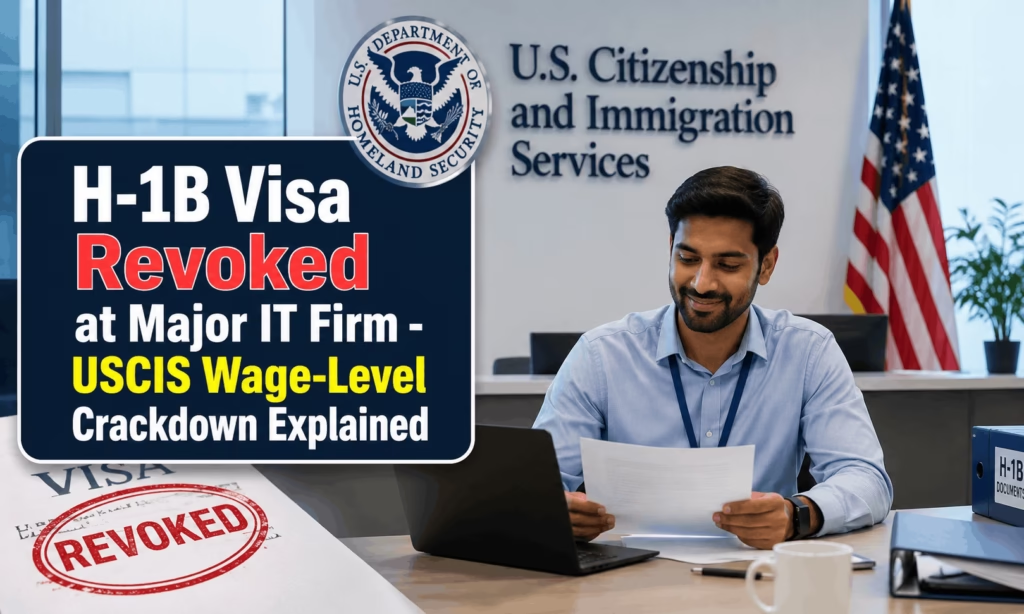
H-1B Visa Revoked at Major IT Firm: US immigration authorities have revoked and denied multiple H-1B petitions after determining that a major IT consulting company classified skilled technology positions at wage levels lower than the work actually required. The finding, confirmed by US Citizenship and Immigration Services (USCIS) in the first week of September 2026, marks one of the clearest signals yet that wage-level classification has become a central enforcement target inside the H-1B program, not just a paperwork detail buried in a Labor Condition Application.
USCIS said it denied and revoked the petitions after officials found that skilled technology roles at the firm had been assigned to lower prevailing wage levels than the duties and qualifications of the jobs actually supported. The agency framed the action in blunt terms, saying the practice creates unfair competition and can undercut the wages that both foreign and American workers in the same occupation are entitled to receive. USCIS did not publicly name the consulting company, did not disclose how many petitions were affected, and did not identify the specific technology roles under review, but confirmed the case originated from an internal compliance investigation rather than an external whistleblower complaint. We’ll be updating this article monthly as USCIS releases further details on this enforcement action and related wage-level cases.
The timing matters. This revocation lands in the middle of the most aggressive stretch of H-1B enforcement in years, one that already includes a $100,000 entry fee under a presidential proclamation, a federal court decision striking that fee down, a brand-new proposed $103,265 filing fee from the Department of Homeland Security, and a redesigned Form I-129 that asks employers pointed questions about how they arrived at a wage level in the first place. For IT consulting and staffing firms, many of which lean heavily on lower Level I and Level II wage classifications to keep bids competitive, the message from Washington is now unmistakable: wage-level mismatches are no longer a minor compliance risk, they are grounds for outright revocation.
What USCIS Actually Found
According to the agency’s statement, the core issue was a mismatch between job classification and job reality. Employers filing H-1B petitions must select a prevailing wage level, ranging from Level I through Level IV, based on the Department of Labor’s Occupational Employment and Wage Statistics (OEWS) methodology. That wage level is supposed to reflect the actual complexity, independence, and supervisory responsibility of the position, not simply the lowest number an employer can justify on paper.
USCIS said its review found that the consulting firm in question had repeatedly assigned wage levels far below what the technology positions actually demanded, particularly for roles requiring specialized technical judgment, client-facing responsibility, or project leadership. In several instances, the job descriptions on file described senior-level work, systems architecture, advanced software development, and independent decision-making, while the wage level filed with the Department of Labor corresponded to entry-level, closely supervised work. That gap is precisely what triggered the revocations.
“We denied and revoked multiple petitions, protecting American workers and preserving the integrity of employment-based immigration programs,” USCIS said in its statement, adding that the agency intends to keep examining whether wage levels assigned to H-1B positions genuinely reflect the duties and requirements of the job, particularly across the technology consulting sector.
$200 Extra Social Security Payment: When Is It Being Approved, and Who Can Get It?
VA Benefits Lawyer: For Which Claims Do You Need One, and How Much Can They Cost?
Tax Extension Deadline October 15: What Filing Late Actually Costs You
New Canada Prescription Drug Rules October 2026: What Every Patient and Pharmacy Needs to Know
Why Wage Levels Are the New Flashpoint
To understand why this single enforcement action is generating so much attention, it helps to understand what a wage level actually does inside the H-1B system. Every H-1B petition must be backed by a Labor Condition Application (LCA) filed with the Department of Labor, and every LCA must specify a prevailing wage for the occupation and geographic area involved. The Department of Labor sorts that prevailing wage into four bands using OEWS survey data:
Level I is meant for entry-level positions that require only a basic understanding of the occupation and involve close supervision. Level II covers qualified workers with a few years of experience and moderate independence. Level III applies to experienced professionals handling complex assignments, often with some supervisory input. Level IV is reserved for fully competent workers operating with minimal supervision, frequently in senior technical or leadership capacity.
The financial gap between these levels is significant, and it is exactly the gap that makes wage-level selection so consequential. An entry-level Level I classification and a fully competent Level IV classification for the same job title in the same city can differ by tens of thousands of dollars a year. For staffing and consulting firms that place H-1B workers with client companies on a project basis, choosing a lower wage level has historically been one of the easiest ways to keep costs down and remain competitive on client bids. USCIS is now signaling that this practice, when the underlying job duties do not match the low wage level filed, will be treated as a compliance violation serious enough to justify revocation rather than a simple request for evidence.
Key Highlights: Dates and Developments
| Date | Development |
|---|---|
| September 19, 2025 | Presidential Proclamation imposes a new $100,000 fee for certain H-1B workers entering the US, effective September 21, 2025 |
| October 20, 2025 | USCIS clarifies the $100,000 fee applies only to new petitions filed on or after September 21, 2025 |
| April 1, 2026 | USCIS begins requiring the revised Form I-129, with expanded wage-level and LCA consistency questions |
| June 8, 2026 | Federal judge in Massachusetts strikes down the $100,000 fee, calling it an unlawful tax rather than a regulatory payment |
| June 11, 2026 | Government appeals the ruling; the First Circuit Court of Appeals declines to reinstate the fee during the appeal |
| August 24 to 25, 2026 | DHS publishes a proposed rule creating a separate $103,265 fee for cap-subject H-1B petitions |
| September 2026 | USCIS confirms revocation and denial of multiple H-1B petitions at a major IT consulting firm over wage-level classification |
| September 21, 2026 | Current expiration date of the original $100,000 proclamation fee, pending any extension |
Note that this table will be reviewed and updated monthly as new developments are confirmed.
The Broader Crackdown: From Entry Fees to Wage Audits
This wage-level revocation did not happen in isolation. It is the latest piece of a wider enforcement push that has reshaped H-1B compliance risk over the past year.
The $100,000 proclamation fee
In September 2025, a presidential proclamation attempted to impose a $100,000 payment on certain H-1B workers entering or re-entering the United States, citing what the administration called systemic abuse of the program. After widespread confusion over which petitions the fee applied to, USCIS clarified that it covered only new petitions filed on or after the effective date for beneficiaries outside the country. In June 2026, a federal judge in Massachusetts ruled that the payment functioned as an unlawful tax regardless of how it was labeled, and struck it down. The government appealed, but the First Circuit Court of Appeals declined to reinstate the fee while the case proceeds, leaving the proclamation payment currently not being collected, with its stated expiration date falling on September 21, 2026.
The proposed $103,265 rule
Rather than abandon the effort, the Department of Homeland Security took a different legal route. In late August 2026, DHS published a proposed rule creating a brand-new $103,265 fee for every H-1B petition subject to the annual statutory cap, including petitions filed under the US advanced-degree exemption. Unlike the earlier proclamation, this fee would apply regardless of where the worker is located, and DHS has framed it as a cost-recovery charge rather than an entry restriction, an approach designed to survive the same legal challenge that sank the $100,000 payment. DHS projects the fee could apply to roughly 85,000 cap-subject petitions a year and generate close to $8.8 billion in annual revenue, split across USCIS, immigration courts, and related enforcement functions. Universities, nonprofit research organizations, and hospitals would be exempt. The rule is not yet final; a 30-day public comment period followed its Federal Register publication, and business groups including the US Chamber of Commerce have already warned it could make sponsorship cost-prohibitive for smaller employers.
The redesigned Form I-129
Since April 2026, all H-1B filings must use a revised Form I-129 that asks more detailed questions about how an employer arrived at a given wage level and demands closer alignment between the LCA, the H-1B registration, and the petition itself. Immigration attorneys tracking the change say the bigger shift is not the form itself but a new verification system, often referred to internally as VIBE, that lets USCIS cross-check employer-reported data against independent business intelligence sources such as Dun & Bradstreet. When a petitioner’s reported size, revenue, or industry classification does not match outside data, it can now trigger a Request for Evidence or a site visit automatically, without any complaint ever being filed.
Past Enforcement Cases That Set the Stage
Wage-level and job-classification violations are not new to the H-1B program, but the pattern of enforcement has hardened considerably. Several past cases illustrate why regulators are now treating wage mismatches as a serious violation rather than a technical error.
In one Department of Labor investigation, a Bay Area technology staffing company was found to have paid twelve employees far below the wage levels required for their job classifications, along with making illegal salary deductions, and the company was ordered to pay more than $173,000 in back wages. In another case, an information technology services company in Texas was found to have illegally “benched” a system analyst, failing to pay the required prevailing wage during periods of non-productive work, and had to repay tens of thousands of dollars. A Minnesota technology firm was separately ordered by an administrative law judge to pay over $43,000 in back wages after investigators found it failed to pay a foreign engineer the wage stated in its own visa application.
Criminal cases have followed a similar theme. The owner of a San Jose-based technology staffing firm was sentenced to 14 months in federal prison after admitting his company submitted H-1B petitions describing jobs that did not actually exist at the client companies named in the filings, a scheme prosecutors said was designed to secure visas for candidates before real placements were even lined up. A separate Sunnyvale-based staffing executive was sentenced to 15 months in prison for submitting more than one hundred fraudulent H-1B applications over nearly a decade, falsely describing available positions at companies that had never agreed to take the workers.
Taken together, these cases show a consistent pattern: staffing and consulting intermediaries, rather than direct technology employers, have historically accounted for a disproportionate share of H-1B compliance failures. The latest wage-level revocation fits squarely into that same category, and USCIS explicitly linked its action to broader concerns about the technology consulting sector.
$200 Extra Social Security Payment: When Is It Being Approved, and Who Can Get It?
VA Benefits Lawyer: For Which Claims Do You Need One, and How Much Can They Cost?
Tax Extension Deadline October 15: What Filing Late Actually Costs You
New Canada Prescription Drug Rules October 2026: What Every Patient and Pharmacy Needs to Know
Why This Matters for Indian IT Professionals
Indian nationals consistently account for the largest share of approved H-1B beneficiaries, and a significant portion of that population is placed through IT consulting and staffing arrangements rather than direct employment with large technology companies. That makes this enforcement trend particularly consequential for Indian tech workers, since consulting-model placements are exactly where wage-level mismatches have historically been most common.
For workers already inside the country on an affected petition, a revocation can jeopardize their ability to remain in valid H-1B status, potentially forcing a scramble to find a new sponsoring employer within the standard grace period or risk falling out of status. For workers still abroad awaiting visa stamping, a revoked petition means the underlying job offer effectively disappears, closing off entry entirely. Employers, meanwhile, now face a much higher bar: simply meeting the minimum prevailing wage number on paper is no longer sufficient if the actual job duties described in supporting documentation point toward a higher, more senior classification.
How To Apply and Stay Compliant Under the New Wage-Level Scrutiny
Employers preparing new H-1B filings, or reviewing existing ones, are now expected to treat wage-level selection as a substantive legal determination rather than a checkbox. The practical steps immigration attorneys are recommending include auditing every open position description against the actual wage level filed on the LCA, ensuring job duties, required experience, and supervisory scope genuinely match the chosen level, and correcting any historical mismatches proactively through amended filings rather than waiting for a site visit or audit to surface the discrepancy. Employers should also maintain detailed public access files documenting how each wage level was determined, since USCIS and the Department of Labor can request this material at any time during a compliance review.
For individual H-1B applicants, the practical advice is to request a copy of the certified LCA and confirm that the job title, duties, and wage level listed match what was actually communicated during hiring, and to raise any concerns directly with the sponsoring employer’s immigration counsel well before a renewal or amendment filing is due.
Processing Time for Petition Review and Revocation Cases
USCIS processing times for standard H-1B petitions currently range from a few weeks under premium processing to several months for regular processing, depending on service center workload. Cases flagged for wage-level or classification review, however, typically move on a different and considerably longer timeline, since they often involve a Request for Evidence, a site visit, or referral for further investigation before any final decision on revocation is issued. Petitioners whose cases are selected for this kind of compliance review should expect the process to extend well beyond normal processing benchmarks, and premium processing guarantees generally do not apply once a case is referred for fraud or compliance review.
Fee and Payment Schedule Overview
The table below summarizes the current fee landscape facing H-1B petitioners as of September 2026.
| Fee or Charge | Current Status | Who It Applies To |
|---|---|---|
| Standard H-1B filing fees | In effect | All H-1B petitioners |
| $100,000 proclamation fee | Struck down by federal court in June 2026; not currently collected; appeal pending | Beneficiaries abroad seeking new entry, if reinstated |
| Proposed $103,265 cap-subject fee | Proposed rule only; not yet in effect; comment period underway | All cap-subject petitions, including the advanced-degree exemption |
| Premium processing fee | In effect | Petitioners requesting expedited adjudication |
None of the newer proposed charges are currently being collected, and employers are not required to pay the $103,265 amount unless and until DHS finalizes the rule following the public comment period.
OAS Payment Increase September 2026: Confirmed Amounts, Payment Date, and the Annual GIS Reset !
Ohio SNAP Food Ban starts October 1, 2026: What’s Banned, Court Update & Rules
Official Resources and Where to Check Status
| Purpose | Official Link |
|---|---|
| Check H-1B case status | https://egov.uscis.gov/casestatus/landing.do |
| USCIS H-1B program overview | https://www.uscis.gov/working-in-the-united-states/h-1b-specialty-occupations |
| File or review Labor Condition Applications | https://flag.dol.gov/ |
| DOL Office of Foreign Labor Certification | https://www.dol.gov/agencies/eta/foreign-labor |
| Federal Register (proposed $103,265 rule and comments) | https://www.federalregister.gov/ |
| USCIS newsroom for official statements | https://www.uscis.gov/newsroom |
FAQs
Can USCIS revoke an already-approved H-1B petition?
Yes. USCIS can revoke an approved H-1B petition if it later determines the underlying filing contained material misrepresentations, including an inaccurate wage-level classification that does not match the actual job duties described.
What happens to a worker if their H-1B petition is revoked?
The worker generally loses their underlying basis for H-1B status. Depending on individual circumstances, they may have a limited grace period to find a new sponsoring employer, change status, or otherwise depart the country, so speaking with an immigration attorney immediately is strongly advised.
What is a prevailing wage level and why does it matter so much?
A prevailing wage level is a Department of Labor classification, from Level I through Level IV, that sets the minimum wage an employer must pay for a specific occupation in a specific location, based on the complexity and seniority of the role. It matters because assigning a lower wage level than the job actually warrants can now trigger a formal revocation, not just a wage dispute.
Is the $100,000 H-1B fee still in effect right now?
No. A federal court struck down the $100,000 proclamation fee in June 2026, and the appeals court declined to reinstate it while litigation continues, so it is not currently being collected as of early September 2026.
Is the new $103,265 fee already being charged to employers?
Not yet. It remains a proposed rule as of this writing, published for public comment, and would only take effect if DHS finalizes it after reviewing those comments.
Which companies are most likely to face wage-level scrutiny?
USCIS has specifically flagged the technology consulting and IT staffing sector, where third-party placements and project-based billing have historically made lower wage-level classifications more common than at direct technology employers.
How can an employer check if its own wage-level filings are at risk?
Employers can review each position’s LCA against the actual duties, required experience, and supervisory responsibility described in internal job descriptions, and correct any mismatch through an amended filing before a site visit or audit uncovers it independently.
Conclusion
The revocation of multiple H-1B petitions at a major IT consulting firm over wage-level classification is not an isolated compliance action, it is a clear marker of where H-1B enforcement is heading in late 2026. Combined with a proposed six-figure filing fee, a redesigned petition form built around wage-level consistency, and a growing history of enforcement cases concentrated in the IT staffing sector, the message to employers is straightforward: the wage level filed on paper now has to match the job actually being performed, or the petition itself is at risk. For H-1B workers, particularly those placed through consulting and staffing arrangements, staying informed about how their own wage level was determined has become just as important as tracking fee changes and lottery rules. This article will be reviewed and updated monthly as USCIS, DHS, and the Department of Labor release further guidance on wage-level enforcement and related H-1B policy changes.