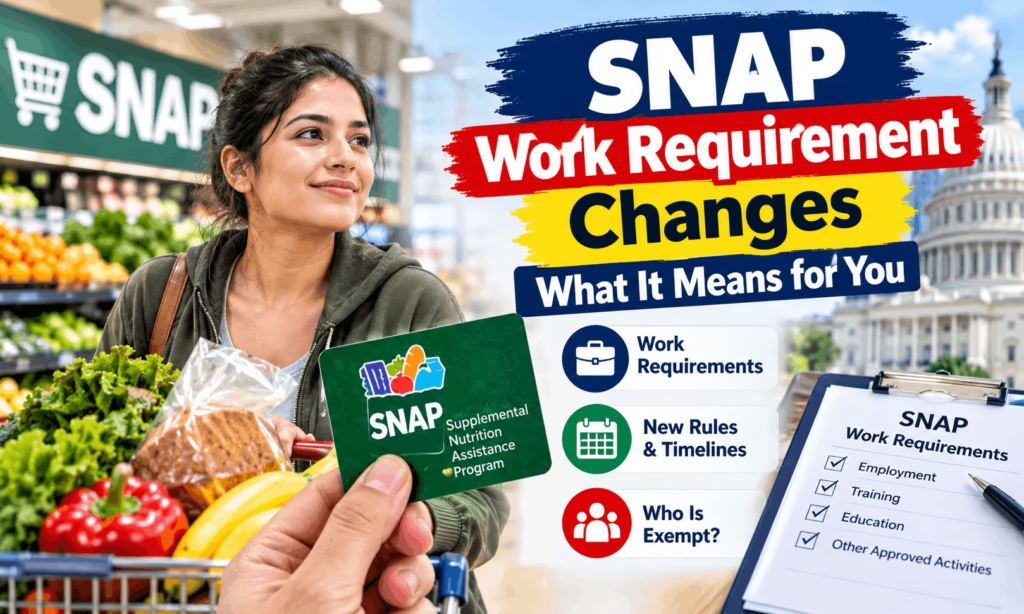
SNAP Work Requirement Changes 2026: Millions of food stamp recipients are now finding out, often through a letter they almost missed, that rules which never applied to them before suddenly do. The federal SNAP work requirement changes 2026 raised the age ceiling for mandatory work rules from 54 to 64, pulled in parents whose youngest child is 14 or older, and stripped away automatic exemptions that veterans, homeless individuals and former foster youth used to count on. The Center on Budget and Policy Priorities estimates the age change alone could push more than 1 million older adults toward losing food assistance if they cannot document 80 hours of work, training or volunteering a month. States have been mailing Work Activity Letters through the year, and enforcement is now active nationwide following waiver expirations in states like New York and Illinois. We’ll be updating this article monthly.
The rules stem from the One Big Beautiful Bill Act, and they reshape who counts as an Able-Bodied Adult Without Dependents, the group SNAP calls ABAWD. If you are between 18 and 64, do not have a young child at home, and are not disabled or otherwise exempt, you now have to prove you are working, training or volunteering at least 80 hours a month, or your benefits stop after three months. This report lays out exactly who is affected, what changed and when, which exemptions survived and which ones were removed, and the concrete steps you can take right now to keep your SNAP case active.
SNAP Work Requirement Changes 2026: Key Highlights and Dates
| Detail | What changed |
|---|---|
| Law behind the change | One Big Beautiful Bill Act (OBBBA), signed July 2025 |
| ABAWD age range before | 18 to 54 |
| ABAWD age range now | 18 to 64 |
| People newly affected by the age change | More than 1 million adults ages 55 to 64, per Center on Budget and Policy Priorities |
| Parent exemption before | Any parent with a child under 18 in the home |
| Parent exemption now | Only if youngest child is under 14 |
| Time limit without meeting the work rule | 3 months of benefits within a 36-month period, unchanged |
| Hours required each month | 80 hours of work, training, or volunteering |
| Groups that lost automatic exemptions | Veterans, people experiencing homelessness, former foster youth up to age 24 |
| New exemption added | American Indian or Alaska Native individuals |
| New York statewide waiver | Ended March 1, 2026, rules now apply statewide |
| Illinois statewide waiver | Ended November 2025 |
| Nationwide ABAWD enforcement | Fully in effect in nearly all counties as of 2026 |
| Estimated share of SNAP households with earned income already | About 60 percent, per USDA |
Social Security Payment Not Received? Here’s Exactly What to Do Next
US Visa Online Background Vetting From October 1: 3 New Groups Must Go Public
What Changed in the SNAP Work Requirement Rules This Year
The most consequential shift is the age expansion. Before the new law, once you turned 55, you were automatically exempt from ABAWD time limits, no matter your health or work history. That protection is gone. Adults ages 55 through 64 who are able-bodied and without dependents now fall under the same 80-hour-a-month rule as someone in their twenties. Analysts describe this as one of the most significant changes in the program’s history, because it applies a strict standard to an age group where finding steady, qualifying work can be harder due to health, caregiving duties, or age discrimination in hiring.
The second major change touches parents. Previously, a parent with any child under 18 living at home was exempt from ABAWD rules entirely. Under the new standard, that exemption only holds if the youngest child in the household is under 14. A parent whose only child just turned 14 can, overnight, become subject to the work requirement, even if their household routine has not changed at all.
The third change is about who lost protection outright. Veterans, individuals experiencing homelessness, and young adults aging out of foster care up to age 24 used to have blanket exemptions from ABAWD rules, regardless of age or work status. Those categorical exemptions have been eliminated. Members of these groups can still qualify for an exemption, but only if they meet a different standard, such as disability or caregiving, not simply because of their veteran or housing status.
One narrow addition works in the other direction. American Indian and Alaska Native individuals gained a new ABAWD exemption that did not exist before.
How the ABAWD Time Limit Actually Works
ABAWD stands for Able-Bodied Adult Without Dependents, and it describes a subset of SNAP recipients who face a stricter standard than the general SNAP work rules that apply more broadly to people ages 16 to 59. The general rules, such as registering for work and accepting a suitable job offer, did not change this year.
The stricter ABAWD standard works like a clock. If you are an ABAWD, not exempt, and not meeting the 80-hour rule, you can only collect SNAP for three months within any 36-month period. Once that window closes, benefits stop completely until you either meet the work requirement for 30 consecutive days or qualify for an exemption. The 80 hours can be satisfied through paid work, unpaid or in-kind work, an approved SNAP Employment and Training program, or in some states a Work Experience Program tied to your benefit amount divided by the minimum wage.
For someone newly caught by the age or parent expansion this year, the practical risk is simple. If you have not been tracking or reporting hours because you assumed you were exempt, your three-month countdown may already be running without your knowledge.
Who Is Still Exempt From the 2026 ABAWD Rules
Despite the expansion, several categories of SNAP recipients remain protected. Based on the current federal exemption list, you are generally exempt from the ABAWD work requirement if you fall into one of these groups:
- You are age 65 or older, since the ABAWD age range now tops out at 64.
- You have a physical or mental health condition that limits your ability to work, verified by a medical professional, with no specific diagnosis required.
- You are pregnant, for the full duration of the pregnancy.
- You live with a child under age 14, the new threshold that replaced the old under-18 standard.
- You already work, volunteer, or participate in approved training for 80 or more hours a month.
- You are American Indian or Alaska Native, the newly added 2026 exemption.
- You receive disability benefits from the Social Security Administration, the Department of Veterans Affairs, or another public or private disability program.
Notice what is missing from this list compared with a few years ago. Being a veteran, experiencing homelessness, or having aged out of foster care no longer guarantees an exemption on its own. People in those situations must now qualify under one of the categories above, such as a documented disability, to avoid the work requirement.
Which States Still Have ABAWD Waivers
States can request geographic waivers from the ABAWD time limit for areas with high unemployment, generally where the rate exceeds a federal threshold. Waiver approval criteria were tightened this year, which is why many waivers that existed under the older, looser “lack of sufficient jobs” standard have been terminated. That said, litigation has kept the picture unsettled. In April 2026, USDA issued guidance reinstating SNAP benefits for some ABAWDs after courts pushed back on the early termination of certain waivers.
Here is a general snapshot of waiver activity heading into late 2026, though coverage can change by county and by month, so verify with your local office before assuming your status either way.
| State | General waiver picture |
|---|---|
| Alaska | Special waiver provisions extend through 2028 |
| Hawaii | Special waiver provisions extend through 2028 |
| New York | Statewide waiver ended March 1, 2026; ABAWD rules apply statewide |
| Illinois | Statewide waiver ended November 2025; full enforcement in effect |
| California | Waivers narrowed under new federal criteria, no longer broad statewide coverage |
| Arizona, Colorado, Florida, Georgia, Michigan, Minnesota, Mississippi, New Mexico, Oregon, Texas, West Virginia | Partial coverage limited to specific high-unemployment counties |
Because waiver status shifts with each federal fiscal year and can be affected by litigation, the safest move is to ask your state SNAP office directly whether your county currently qualifies, rather than relying on last year’s list.
How to Apply: Meeting the Work Requirement or Claiming an Exemption
If you think you may now be subject to the ABAWD rule, do not wait for a letter to confirm it. Here is the practical path.
- Contact your state SNAP office or check your online case portal to confirm whether you are currently classified as an ABAWD.
- If you believe you qualify for an exemption, gather documentation. This can mean a medical provider’s statement for a disability exemption, proof of pregnancy, proof of a child’s age and residency for the caregiver exemption, or tribal enrollment documentation for the American Indian or Alaska Native exemption.
- If you do not qualify for an exemption, ask about SNAP Employment and Training, known as SNAP E&T, which many states use to help recipients find qualifying work, training or volunteer placements that count toward the 80-hour requirement.
- Report your hours each certification period exactly as your state instructs, since missing documentation is one of the most common reasons people lose benefits even when they are technically meeting the requirement.
- If you already lost benefits under the three-month limit, ask how to reestablish eligibility. You generally regain eligibility by meeting the work requirement for any 30 consecutive days, by becoming exempt, or by moving into an area with an active waiver.
$255 Social Security Death Benefit: Who Actually Qualifies and How to Apply?
White House Press Ban: CNN, Politico and MS NOW Sue Trump Over Access
Child Tax Credit Calculator: See Who Qualifies And How Much You Can Claim
2027 COLA Estimate: Latest Increase Estimate, Payment Dates, and Calculator
Processing Time: How Quickly Status Changes Take Effect
There is no single national timeline, because SNAP is administered by states within federal rules, but a few patterns are consistent nationwide. States have been sending Work Activity Letters throughout 2026 to notify recipients that they now fall under expanded ABAWD rules, and recipients generally have a defined window, often around 10 to 30 days depending on the state, to respond with documentation or a work plan. Once you submit proof of an exemption or of meeting the work requirement, most states process the update within one to two benefit cycles, meaning it can show up on your next month’s benefit determination or the one after.
If your benefits are cut off under the three-month time limit, reestablishing eligibility after meeting the 80-hour rule for 30 consecutive days is also not instant. States typically need to verify your hours before restoring benefits, which can take several weeks. This is why case workers and advocates consistently recommend documenting hours as you go, rather than waiting until a lapse happens to start gathering proof.
Payment Schedule: What Happens to Your Benefit Amount
The ABAWD rule does not reduce your monthly benefit amount while you are eligible. It is an all-or-nothing time limit. You either keep receiving your regular calculated SNAP allotment, based on household size and income, or your benefits stop entirely once the three-month countdown expires without you meeting the work rule or qualifying for an exemption. There is no partial reduction tied to ABAWD status specifically, which is different from other SNAP adjustments tied to income changes.
Outside of work requirements, SNAP payment amounts and schedules can still shift for other reasons. States continue to issue monthly allotments on set dates by case number or last name, and disaster related replacement benefits, such as those recently approved in Indiana following storm damage in September 2026, follow a separate emergency replacement schedule tied to the date benefits were originally issued.
SNAP work requirement (ABAWD) checker
SNAP work requirement (ABAWD) checker
Answer a few questions to see whether the 2026 ABAWD 80-hour work rule likely applies to you.
This is a general guide based on 2026 federal ABAWD rules and is not a benefits decision. Confirm your case with your state SNAP office. Official rules: fns.usda.gov/snap/work-requirements.
Why the Rule Change Is Hitting Older Adults Hardest
The age expansion is drawing the most attention because it reverses a protection that existed for years. Adults age 55 to 64 often face real barriers that the rule does not directly account for, including age discrimination in hiring, physical limitations that fall short of a formal disability finding, and caregiving responsibilities for aging parents or grandchildren that do not fit neatly into the current exemption categories. The Center on Budget and Policy Priorities’ estimate that more than 1 million people in this age range could lose food assistance reflects how many previously exempt adults now must actively document work activity for the first time in years, sometimes decades.
There is also a quieter overlap worth understanding. Adults ages 60 to 64 remain exempt from the broader, less strict general SNAP work requirements that apply to ages 16 to 59. But that exemption does not carry over to the stricter ABAWD time limit, which now reaches all the way to 64. In practice, someone in this bracket can be exempt from registering for work in the general sense while still facing the harder 80-hour ABAWD standard, a distinction that confuses many recipients and even some caseworkers.
Common Mistakes That Cause People to Lose Benefits
Case workers and legal aid organizations point to a consistent set of avoidable errors. People assume an old exemption, such as veteran status or having any minor child at home, still applies without checking the updated criteria. People do enough qualifying work but fail to report or document it in the format their state requires. People move to a new county without checking whether the area’s waiver status differs from their previous location. People wait until benefits are already cut off to start gathering medical documentation for a disability exemption that could have been submitted earlier.
Avoiding these mistakes mostly comes down to one habit: treat your exemption status as something to reverify every year, not something you can assume carries forward automatically.
$100000 Social Security Benefits Per Year: How Married Couples Actually Reach It in 2026
SNAP Maximum Monthly Benefits by State 2026: Full Payment Chart, Eligibility and Calculator Guide
Official Links and Resources
| Resource | What it is for | Link |
|---|---|---|
| USDA FNS, SNAP work requirements | Official federal rules and updates | https://www.fns.usda.gov/snap/work-requirements |
| USDA FNS, SNAP overview | General program information | https://www.fns.usda.gov/snap |
| Find your state SNAP agency | State-by-state contact and application portals | https://www.fns.usda.gov/snap/state-directory |
| SNAP online application (varies by state) | Apply for benefits or report changes | https://www.benefits.gov/benefit/361 |
| SNAP Employment and Training | Find qualifying work or training programs | https://www.fns.usda.gov/snap/e-t |
| USDA waiver and exemption data | Check current state and county waiver status | https://www.fns.usda.gov/snap/waivers |
| National Hunger Hotline | Free help finding food assistance and understanding your case | 1-866-3-HUNGRY or 1-877-8-HAMBRE |
What to Watch Next
Litigation over waiver terminations is still working through the courts, and rulings could restore or further narrow waiver coverage in specific states before the next federal fiscal year begins. Congress could also revisit parts of the work requirement expansion if the political pressure from affected constituents, particularly older adults and parents of teenagers, grows ahead of upcoming elections. States are also still in the process of updating their systems and mailing notices, so recipients who have not yet received a Work Activity Letter should not assume they are in the clear, since notification timelines vary widely by state agency capacity.
FAQs on SNAP Work Requirement Changes 2026
What is an ABAWD in food stamps?
ABAWD stands for Able-Bodied Adult Without Dependents, a category of SNAP recipients ages 18 to 64 who must meet stricter work requirements than general SNAP recipients.
Do I lose all my SNAP benefits if I don’t meet the work requirement?
Yes, once the three-month limit within a 36-month period is used up, benefits stop completely for non-exempt ABAWDs who are not meeting the work rule, rather than being reduced gradually.
What is the SNAP work requirement age limit in 2026?
The ABAWD work requirement now applies to adults ages 18 through 64, up from 18 through 54 before the One Big Beautiful Bill Act.
Are veterans exempt from SNAP work requirements?
Not automatically anymore. Veterans lost their blanket ABAWD exemption in 2026 and must now qualify under a different category, such as a documented disability, to be exempt.
How many hours do I need to work to keep my SNAP benefits?
You generally need 80 hours a month of work, volunteering, or an approved training or work program, unless you qualify for an exemption.
What happens if I do not meet the SNAP work requirement?
You can receive SNAP for only three months within a 36-month period if you are a non-exempt ABAWD who does not meet the work requirement. After that, benefits stop until you meet the requirement or qualify for an exemption.
Can I get SNAP back after losing it under the three-month rule?
Yes. You can reestablish eligibility by meeting the work requirement for 30 consecutive days, by qualifying for an exemption, or by moving to an area with an active ABAWD waiver.
Are parents with teenagers exempt from SNAP work requirements?
Only if their youngest child is under 14. Parents whose youngest child is 14 or older are now subject to the ABAWD work requirement unless another exemption applies.
Is there still a SNAP work requirement waiver for high unemployment areas?
Yes, but the criteria are stricter than before, and many previously waived areas have lost that status. Waiver coverage now varies significantly by county and can change with new federal fiscal years.
Who is exempt from SNAP work requirements in 2026?
People who are pregnant, medically unable to work, caring for a child under 14, already working or training 80 hours a month, American Indian or Alaska Native, or receiving disability benefits are generally exempt.
How do I prove I am exempt from SNAP work requirements?
You typically provide documentation such as a medical statement, proof of pregnancy, proof of a young child’s age, or proof of tribal enrollment to your state SNAP office.
Did SNAP work requirements change for older adults?
Yes. Adults ages 55 to 64 were previously exempt from ABAWD rules entirely and are now subject to the same 80-hour-a-month requirement as younger adults.
What states still have SNAP work requirement waivers?
Coverage varies and shifts often, with states like Alaska and Hawaii holding broader waiver provisions and many other states limited to specific high-unemployment counties. Check current status with your state SNAP office.
Conclusion
The 2026 SNAP work requirement changes are not a minor technical update. Raising the ABAWD age ceiling to 64, narrowing the parental exemption to children under 14, and removing blanket protections for veterans, homeless individuals and former foster youth together pull well over a million people into a stricter standard many had never faced before. The core advice does not change based on which category affected you: check your exemption status now rather than waiting for a notice, document any qualifying work or training as you go, and contact your state SNAP office the moment your situation shifts, whether that is a child’s birthday, a new diagnosis, or a move to a different county. Waiver status and enforcement details are still shifting through litigation and state action, so check back here for our monthly updates as the picture becomes clearer.
Canada Visitor Visa Screening Tightens: What the 40+ Criteria Mean for Your Application
Social Security October 2026 Payments: Why SSI Gets Two Checks?
Social Security COLA 2027 by State: These 10 States Could See the Biggest Dollar Increase