SNAP Payments August 2026: Millions of American households rely on the Supplemental Nutrition Assistance Program (SNAP) every single month to keep groceries in the fridge and food on the table. As August 2026 begins, SNAP recipients across the country are asking the same three questions: When will my EBT card be loaded this month? What new rules apply to me? And how do I check my payment status if my deposit doesn’t show up on time?
This complete guide answers all three questions. Below you’ll find the full August 2026 SNAP Payments schedule broken down by state, an explanation of the new work-requirement rules that are reshaping eligibility in 2026, updated maximum benefit amounts, and a step-by-step process for checking your SNAP Payments status if something looks off.
Quick Highlights: August 2026 SNAP Payments At a Glance
| Category | Details |
| Program name | Supplemental Nutrition Assistance Program (SNAP) |
| Administered by | USDA Food and Nutrition Administration (formerly FNS), through state agencies |
| Payment method | Electronic Benefits Transfer (EBT) card |
| Payment frequency | Once per month, on a state-assigned date |
| Fiscal year in effect | FY2026 (October 1, 2025 – September 30, 2026) |
| Maximum benefit | 1-person household – $298/month (48 states + DC) |
| Maximum benefit | 4-person household – $994/month (48 states + DC) |
| Biggest 2026 rule change | Expanded ABAWD work requirements (ages 18–64) |
| Deposit timing window | Between the 1st and 28th of the month, depending on state |
| Late payment? | Contact your state EBT customer service hotline first |
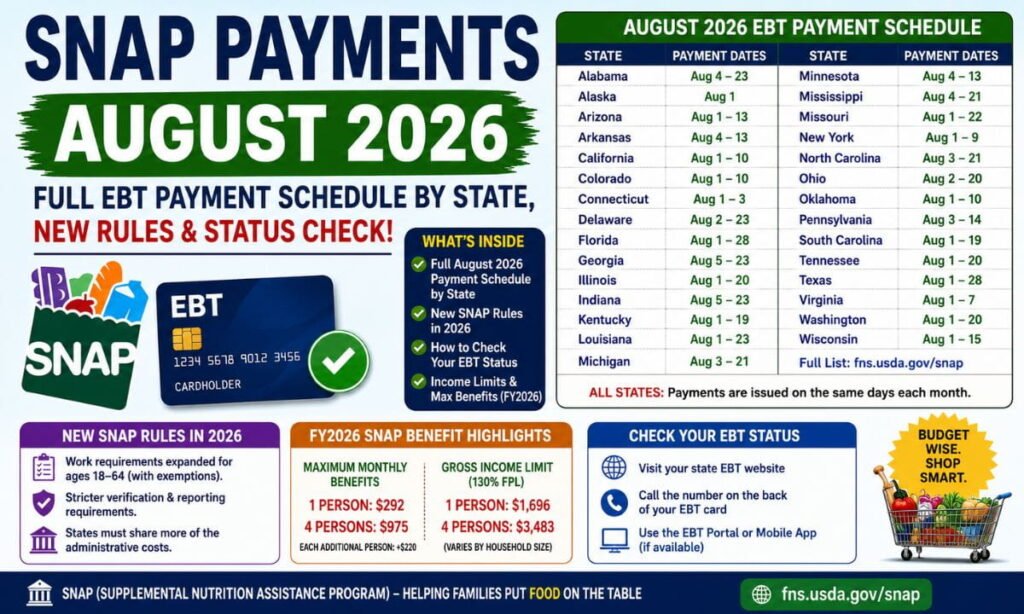
Understanding SNAP Payments : A Quick Refresher
SNAP is the largest food assistance program in the United States, reaching tens of millions of people in a typical month, including children, seniors, veterans, and working families. The program doesn’t send cash — instead, eligible households receive a monthly allotment loaded onto an EBT card, which functions much like a debit card at checkout. Recipients can use it to buy eligible food items at grocery stores, supermarkets, convenience stores, and, increasingly, through online grocery delivery platforms.
Unlike a tax refund or stimulus payment that goes out on a single nationwide date, SNAP is issued on a rolling schedule that each state designs independently, subject to federal guidelines. This decentralization is intentional: spreading deposits across the month helps state EBT systems and retailers manage transaction volume evenly, rather than facing a single massive surge of activity on the 1st of every month.
What Is SNAP and Why the SNAP Payments Date Matters ?
SNAP, once widely known as “food stamps,” is a federal nutrition assistance program funded by the USDA but administered individually by each state. Instead of paying every household in the country on the same day, each state sets its own issuance calendar, usually spreading deposits across the first one to three weeks of the month, though a few states stretch payments all the way to the 28th.
Your exact deposit date typically depends on one of the following:
- – The last digit (or last two digits) of your case number or Eligibility Determination Group (EDG) number
- – The last digit of the head of household’s Social Security number
- – The first letter of your last name
- – A fixed date that applies to every recipient in the state
Because the system is decentralized, a household in Alaska might receive benefits on the 1st of every month without exception, while a household in Texas could see benefits deposited anywhere between the 1st and the 28th. Understanding your state’s rule is the only reliable way to predict your exact August 2026 deposit date without calling your caseworker.
Full August 2026 SNAP/EBT Payment Schedule by State
The table below lists the general issuance window for each state and the factor typically used to determine your specific date within that window. Because a handful of states also adjust for weekends and federal holidays, always confirm your exact date using your state’s EBT portal, mobile app, or your original approval/award letter if your date falls near the start or end of the window.
| State | August 2026 SNAP/EBT Payment Dates |
| Alabama | August 4–23 |
| Alaska | August 1 |
| Arizona | August 1–13 |
| Arkansas | August 4–13 |
| California | August 1–10 |
| Colorado | August 1–10 |
| Connecticut | August 1–3 |
| Delaware | August 2–23 |
| District of Columbia | August 1–10 |
| Florida | August 1–28 |
| Georgia | August 5–23 |
| Hawaii | August 3–5 |
| Idaho | August 1–10 |
| Illinois | August 1–20 |
| Indiana | August 5–23 |
| Iowa | August 1–10 |
| Kansas | August 1–10 |
| Kentucky | August 1–19 |
| Louisiana | August 1–23 |
| Maine | August 10–14 |
| Maryland | August 4–23 |
| Massachusetts | August 1–14 |
| Michigan | August 3–21 |
| Minnesota | August 4–13 |
| Mississippi | August 4–21 |
| Missouri | August 1–22 |
| Montana | August 2–6 |
| Nebraska | August 1–5 |
| Nevada | August 1–10 |
| New Hampshire | August 5 |
| New Jersey | August 1–5 |
| New Mexico | August 1–20 |
| New York | August 1–9 |
| North Carolina | August 3–21 |
| North Dakota | August 1 |
| Ohio | August 2–20 |
| Oklahoma | August 1–10 |
| Oregon | August 1–9 |
| Pennsylvania | August 3–14 |
| Rhode Island | August 1 |
| South Carolina | August 1–19 |
| South Dakota | August 10 |
| Tennessee | August 1–20 |
| Texas | August 1–28 |
| Utah | August 5, 11 & 15 |
| Vermont | August 1 |
| Virginia | August 1–7 |
| Washington | August 1–20 |
| West Virginia | August 1–9 |
| Wisconsin | August 1–15 |
| Wyoming | August 1–4 |
| Guam | August 1–10 |
| Puerto Rico | August 4–22 |
| U.S. Virgin Islands | August 1 |
$2000 Tariff Dividend Fact-Check: Is It Really Coming?
CPP, OAS & GIS August 2026 Payment: New Amounts, 1.2% Increase & Full Payment Details
SNAP Maximum Monthly Benefits 2026 by State: Full Payment Chart, Eligibility & Calculator Guide
*Table compiled from state SNAP/EBT issuance calendars. Individual states may adjust dates in months where the scheduled day falls on a weekend or federal holiday, so always cross-check with your state agency if your date falls at the edge of the window.*
How to Find Your Exact SNAP Payments Date Within the Window ?
1. Locate your case number, EDG number, or the head of household’s Social Security number on your SNAP approval letter.
2. Match the last one or two digits against your state’s specific breakdown (available on your state’s Department of Health/Human Services or EBT website).
3. Cross-check the date against your state’s official August 2026 calendar, since exact day-of-month mapping can shift slightly by state.
4. If you’re unsure, call your state’s EBT customer service line — the number is printed on the back of your EBT card.
SNAP Payments Income Eligibility Limits for 2026
Before benefits can be calculated, a household has to pass an income test. Most states use “categorical eligibility,” which raises the gross income limit to as much as 200% of the federal poverty level, but the standard federal limits below still apply as a baseline in many cases. Net income (after allowable deductions) generally must fall at or below 100% of the federal poverty level.
| Household Size | Gross Monthly Income Limit | Net Monthly Income Limit |
| 1 | $1,696 | $1,305 |
| 2 | $2,292 | $1,763 |
| 3 | $2,888 | $2,221 |
| 4 | $3,483 | $2,680 |
| 5 | $4,079 | $3,138 |
| 6 | $4,675 | $3,596 |
| 7 | $5,271 | $4,055 |
| 8 | $5,867 | $4,513 |
| Each Additional Person | +$596 | +$459 |
Households where every member is elderly or disabled are only required to pass the net income test, not the gross income test, which makes it somewhat easier for seniors and people with disabilities living alone to qualify.
General Work Requirements vs. ABAWD Work Requirements
It’s easy to confuse SNAP’s two separate sets of work rules, so it’s worth breaking them apart clearly, since the consequences of not meeting each one are very different.
| Rule Type | Who It Applies To | What Happens If Not Met |
| General work requirements | Most able-bodied adults ages 16–59 | Can lose eligibility for the household until compliance is met |
| ABAWD work requirements | Able-bodied adults without dependents, ages 18–64 | Limited to 3 months of benefits in a 36-month period unless work requirement is met |
General work requirements have existed for years and mainly require recipients to register for work, accept a suitable job offer, and not voluntarily quit a job without good cause. The ABAWD rule is much stricter and time-limited, and it’s this second category that expanded significantly under the 2025 law, catching many older adults and parents of teenagers by surprise in 2026.
New SNAP Rules Taking Effect in 2026
2026 has brought some of the most significant changes to SNAP eligibility rules in years, stemming from the One Big Beautiful Bill Act (OBBBA), signed into law in July 2025. These changes are being rolled out on a rolling basis by state, with most requirements now fully active as of August 2026.
| New SNAP Rule (2026) | What Changed | Effective Date | Who Is Affected |
|---|---|---|---|
| Expanded Work Requirements | Work requirements now generally apply to able-bodied adults ages 18–64 (previously up to age 54), with additional reporting obligations. | 2026 | Many adult SNAP recipients without exemptions. (NCSL) |
| Stricter Exemptions | Several previous exemptions, including for many veterans, homeless individuals, and former foster youth, were narrowed or removed under federal law. | 2026 | Recipients who previously qualified for these exemptions. (NCSL) |
| New State Cost-Sharing | States are required to contribute a larger share of SNAP administrative costs, and some states with high payment error rates may also share benefit costs. | Phased in during 2026 | State SNAP agencies. (NCSL) |
| Limits on Future Benefit Increases | Future SNAP benefit adjustments are more tightly linked to inflation, limiting broader increases through updates to the Thrifty Food Plan. | 2026 | All SNAP households. (Wikipedia) |
| Noncitizen Eligibility Changes | Eligibility for certain humanitarian immigrant categories was restricted under the new law. | 2026 | Some lawful noncitizens. (NCSL) |
| State Food Purchase Restrictions | Several states began restricting SNAP purchases of items such as soda, candy, and certain sugary beverages through USDA-approved waivers. Rules vary by state. | Throughout 2026 | SNAP recipients in participating states only. (Farm Service Agency) |
| Retailer Stocking Standards | SNAP-authorized retailers must comply with updated stocking standards, and some products have been reclassified for retailer eligibility purposes. | 2026 | SNAP retailers. (Farm Service Agency) |
| Increased Eligibility Verification | States have implemented more frequent eligibility reviews and documentation checks to reduce payment errors. | 2026 | SNAP applicants and current beneficiaries. (NCSL) |
Who Is Considered an ABAWD?
An Able-Bodied Adult Without Dependents (ABAWD) is generally a SNAP recipient who:
– Is between 18 and 64 years old
– Is physically and mentally capable of working
– Does not have a dependent child under 14 living in the household
– Does not otherwise qualify for an exemption (disability, pregnancy, being medically certified as unfit for work, participating in a drug/alcohol treatment program, or being homeless in some jurisdictions)
If you fall into this category, federal law limits you to just 3 months of SNAP benefits within a 36-month period unless you meet the work requirement of 80 hours per month through employment, job training, or approved volunteer work.
Who Is Exempt From the New Work Requirements?
Recipients are generally exempt from ABAWD work requirements if they are:
– Under 18 or 65 and older
– Pregnant
– Medically certified as physically or mentally unfit for work
– Caring for a child under 14, or for an incapacitated household member
– Already meeting work requirements for another program (such as TANF)
– A veteran, homeless individual, or former foster youth up to age 24, in certain circumstances defined by the new law
Because states are actively re-screening cases, many recipients who were previously exempt — particularly those aged 55 to 64 — are now receiving notices asking them to document work activity or qualify for a new exemption. Missing this documentation is one of the leading causes of unexpected SNAP terminations in 2026, so responding promptly to any notice from your state agency is critical.
FY2026 Maximum SNAP Payments Benefit Amounts
SNAP benefit amounts are recalculated every fiscal year based on the USDA’s Thrifty Food Plan. These are the maximum monthly allotments in effect for the 48 contiguous states and Washington, D.C. for Fiscal Year 2026 (October 1, 2025 – September 30, 2026), including for August 2026 payments. Most households receive less than the maximum, since the exact benefit is calculated by subtracting 30% of a household’s net monthly income from the maximum allotment.
| Household Size | Maximum Monthly SNAP Benefit (FY 2026) |
| 1 | $292 |
| 2 | $536 |
| 3 | $768 |
| 4 | $975 |
| 5 | $1,158 |
| 6 | $1,390 |
| 7 | $1,536 |
| 8 | $1,756 |
| Each Additional Person | +$220 |
Alaska, Hawaii, Guam, and the U.S. Virgin Islands use separate, higher allotment tables to reflect the higher cost of food in those regions. If you live in one of those areas, check with your local SNAP office for the applicable numbers, since Alaska in particular uses three separate regional tiers.
The minimum monthly benefit for eligible one- or two-person households in the 48 states and D.C. is $24 for FY2026.
How to Check Your SNAP Payments Status ?
If your expected deposit date has passed and you don’t see funds on your EBT card, don’t panic — there are several reliable ways to check your status before assuming something is wrong.
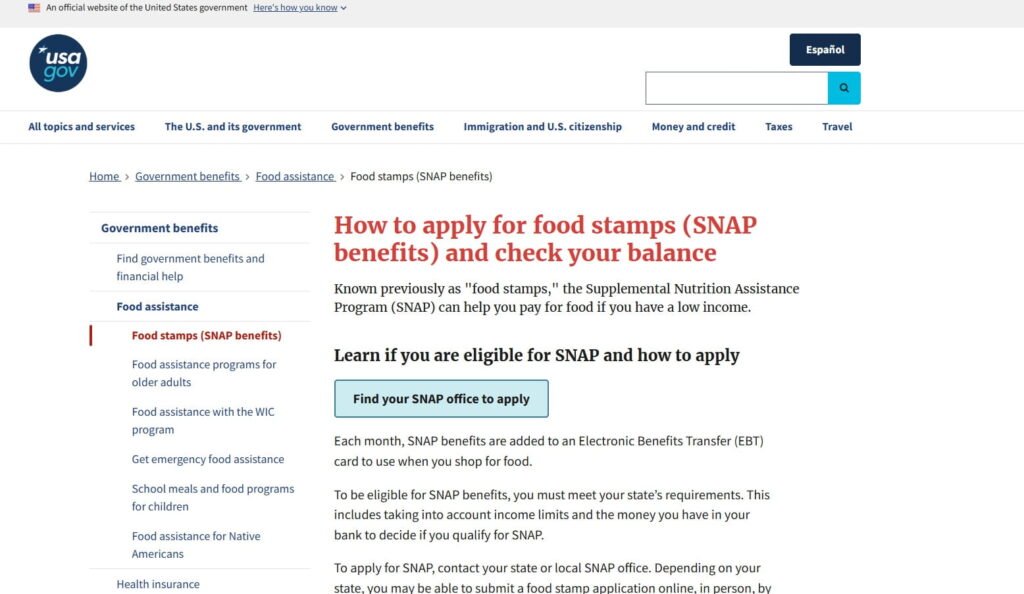
1. Check your EBT balance online or by phone. Most states have a dedicated EBT customer service number (usually printed on the back of your card) that provides your current balance and most recent deposit date through an automated system.
2. Use your state’s EBT mobile app. States including California (via the ebtEDGE or Way2Go app), Texas, Florida, and New York all offer mobile apps that show real-time balance and deposit history.
3. Log into your state’s online SNAP portal. Most states operate a case management portal (for example, ACCESS in Florida, BEACON in Wisconsin, or myWorkNumber-linked portals elsewhere) that shows your certification period, deposit schedule, and any pending action items.
4. Review notices for compliance issues. Since ABAWD reviews ramped up in 2026, a delayed or missing payment is sometimes linked to an unresolved work-requirement or recertification notice rather than a technical deposit delay. Check your mail and your state portal’s message center for any outstanding requests.
5. Call your local SNAP/DSS office directly if the automated balance line doesn’t resolve your question, particularly if you believe your case was closed in error.
Common Reasons for a Delayed August 2026 SNAP Payments
- Failure to complete re-certification: If you have not completed the required renewal or re-certification process by the deadline, your SNAP benefits may be delayed.
- Missing verification documents: Failure to submit requested documents—such as proof of income, identity, residence, or household expenses—can delay benefit approval.
- Changes in household information: Recent changes in income, employment, household size, or address that have not yet been processed by the state agency can affect the timing of payments.
- Delays in application or case processing: A high volume of applications, staff shortages, or an increased administrative workload at the SNAP office can delay the issuance of benefits.
- EBT card issues: A lost, stolen, damaged, expired, or inactive EBT card can prevent you from using your benefits even after they have been deposited.
- Incorrect personal information: Errors in your name, Social Security number, mailing address, or banking information (where applicable) can cause processing delays.
- Eligibility review or case investigation: If the agency requires additional information to verify your eligibility, your case may be temporarily put on hold.
- State system maintenance or technical issues: Scheduled maintenance of the state’s EBT system or unexpected technical glitches can cause temporary delays in benefit deposits.
- Failure to complete a required interview: Some applicants or households undergoing renewal are required to complete an eligibility interview; failure to do so can delay benefit approval.
- Benefit suspension due to non-compliance: Failure to meet mandatory work reporting rules or other program requirements can result in delays or temporary suspension of benefits. Processing on public holidays or weekends: If your scheduled payment date falls on or near a weekend or public holiday, the payment may be deposited later than expected, depending on your state’s processing schedule.
- Fraud prevention or security review: The state agency may temporarily withhold payment while reviewing your case due to suspected fraud or unusual account activity.
Tips to Avoid Missing or Delayed SNAP Payments Benefits
- Report changes quickly. Any change in income, household size, or address should be reported to your caseworker as soon as it happens to avoid processing delays.
- Respond to every notice. With expanded ABAWD reviews underway throughout 2026, ignoring a notice is one of the fastest ways to see benefits paused.
- Set a reminder for your recertification date. Missing a recertification deadline is one of the most common reasons benefits stop unexpectedly.
- Keep your EBT card secure. Set up card locks or transaction alerts if your state offers them, since EBT card skimming has become more common at some retailers.
- Use the balance line before shopping. Checking your balance before you go to the store helps you avoid a declined transaction at checkout.
- Keep documentation of work hours. If you’re subject to the ABAWD requirement, keep pay stubs, training certificates, or volunteer verification letters on hand in case your state requests proof.
EBT Card Security: What Recipients Should Know in 2026 ?
EBT card skimming — where criminals steal card information at compromised card readers — has become more common in several states over the past two years. To protect your August 2026 benefits, most states now recommend the following:
- Change your PIN regularly, especially if you’ve used your card at a gas station, small convenience store, or unfamiliar retailer.
- Enable card locking through your state’s EBT app, if available, so your card can only be used when you actively unlock it before a purchase.
- Sign up for transaction alerts by text or email, which notify you the moment a purchase or withdrawal is made.
- Avoid covering the keypad with your hand only — inspect the card reader itself for signs of tampering, such as a loose or oddly bulky card slot.
- Report stolen benefits promptly. Many states now offer at least one free replacement of stolen benefits per federal fiscal year under rules established after widespread skimming incidents in recent years, though policies vary, so check with your state agency for the current replacement process.
Regional Highlights Worth Knowing
A few states stand out for having especially unusual or noteworthy SNAP rules heading into August 2026:
- Texas has the widest deposit window of any state, spreading payments across the entire month from the 1st through the 28th based on the last two digits of a household’s EDG number.
- New York is one of the only states to assign deposit dates alphabetically by last name for New York City cases, while the rest of the state uses a numeric case-number system.
- Alaska, North Dakota, Rhode Island, and Vermont are the only states that issue benefits to every household on a single fixed date — the 1st of the month — rather than staggering deposits.
- Iowa, Utah, Nebraska, and West Virginia have each implemented state-level restrictions limiting SNAP purchases of soda, candy, or other low-nutrition items, following waivers granted by the USDA.
- Connecticut enforces a strict benefit-inactivity rule: if a household doesn’t make at least one purchase within 274 days, unused benefits can expire.
- Hawaii and Alaska use separate, higher maximum allotment tables to reflect the significantly higher cost of groceries in those states, with Alaska further divided into regional tiers based on remoteness.
What to Do If Your SNAP Case Is Terminated or Reduced ?
If you receive a notice in August 2026 stating that your SNAP case is closing or your benefit is being reduced because of the new work requirements, you still have options:
1. Read the notice carefully for the exact reason given and the deadline to respond.
2. Gather documentation immediately — pay stubs, a letter from an employer or training program, volunteer hours logs, or medical documentation supporting an exemption.
3. Request a fair hearing within your state’s deadline if you believe the decision was made in error; benefits can often continue while the hearing is pending if you request it in time.
4. Contact a local legal aid organization. Many states have free legal aid services specifically dedicated to public benefits appeals, and they can help interpret notices and prepare documentation.
5. Reapply if your case has already closed. If the 3-month ABAWD limit has been reached, you generally cannot receive benefits again until you either meet the work requirement for 30 days or a new 36-month period begins.
August 2026 brings the same core SNAP payment structure most recipients are used to — staggered deposit dates by state, tied to your case number or last name — but it also arrives in the middle of the most significant SNAP rules overhaul in years. If you’re between 18 and 64 and don’t have a young child at home, it’s worth double-checking whether the new ABAWD work requirements apply to you and whether your state has sent you a notice you may have missed.
Bookmark your state’s official EBT date, keep your documentation current, and check your balance a few days after your scheduled deposit window to make sure everything posted correctly.
Missouri SNAP Food Ban Delayed: What’s Banned & Latest Status
Hawaii SNAP Soda Ban Delayed to 2027: What Will Be Banned & Status
Florida SNAP Junk Food Ban 2026: What’s Banned, Court Update, EBT Rules & Latest Status
Nevada SNAP Food Ban: What’s Banned & Start Date Explained
North Dakota SNAP Food Ban: What’s Banned & Latest Status
| SNAP payment | CLICK HERE |
SNAP Payments – Frequently Asked Questions
When will I get my SNAP payment in August 2026?
Your deposit date depends on your state’s issuance schedule and typically your case number or Social Security number. Use the state-by-state table above to find your window, then match it against your case number to pinpoint the day.
Do SNAP benefits get deposited on weekends or holidays?
In most states, no — if your scheduled date falls on a weekend or federal holiday, funds are typically deposited on the next business day, though a handful of states still deposit on the calendar date regardless.
Will my SNAP amount change in August 2026?
Your benefit amount only changes if your household income, size, or deductions change, or if you’re newly subject to work requirements that affect your continued eligibility. The maximum allotments themselves are set once per federal fiscal year and won’t change again until October 2026.
What happens if I don’t meet the new ABAWD work requirements?
If you’re classified as an ABAWD and don’t document 80 hours per month of qualifying work, training, or volunteer activity, your SNAP eligibility is generally limited to 3 months within a 36-month period unless you qualify for an exemption.
How do I appeal a SNAP termination or reduction?
Every state offers a fair hearing process. If you receive a notice that your benefits are being reduced or terminated, you typically have a limited window (often 10–90 days depending on the state) to request a hearing and continue receiving benefits while the appeal is pending.
Can I use SNAP benefits to shop online in August 2026?
Yes. All 50 states now allow SNAP recipients to use their EBT card for online grocery orders at approved retailers, though delivery fees and tips must be paid separately and cannot be covered by SNAP funds.
Also Read :-
SNAP Delay 2026: Payment Delays, Benefit Changes, Participation Decline & State-by-State Update
Social Security 2027 COLA Forecast: Largest Raise Since 2023 — See the Latest Estimates and What They Mean for Your Check
Social Security Changes 2026: New Rules, COLA Increase & What Changed This Year