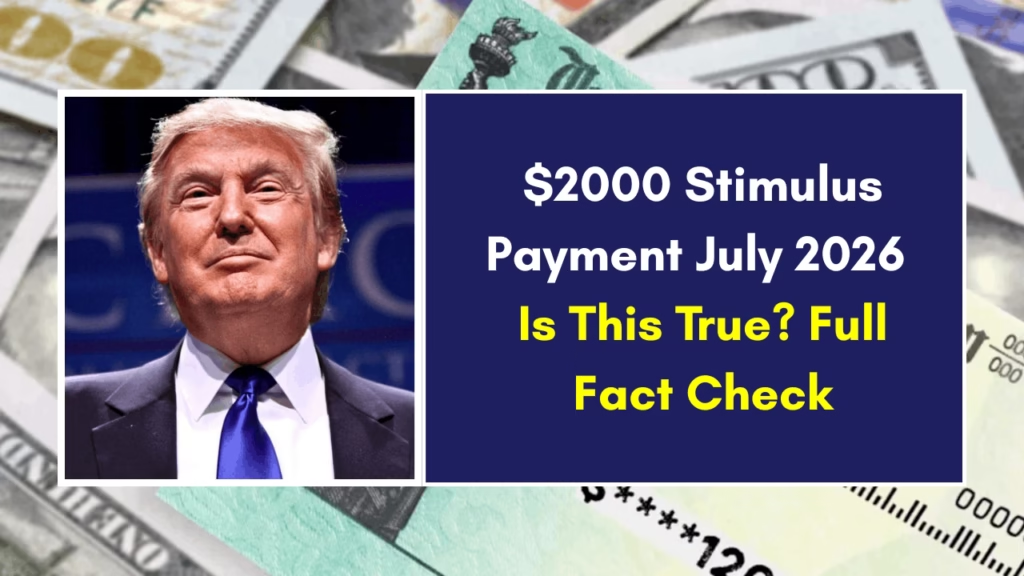
$2000 Stimulus Payment July 2026: If your social media feed, inbox, or text message app has been flooded with headlines claiming a $2,000 stimulus check is landing in American bank accounts in July 2026, you are not alone. Millions of Americans have seen these posts, clicked on these links, and asked the same urgent question: is this real? Here is the complete, verified answer backed by IRS, U.S. Treasury, and congressional records along with the full backstory of where this claim came from, why it still has no legal backing, what actually happened to the original tariff-funded proposal, and how to protect yourself from the scams that have exploded around this confusion.
No Approved $2,000 Federal Stimulus Check Exists for July 2026
Let’s establish the facts immediately and clearly. There is currently no federal program authorizing a $2,000 stimulus check for July 2026. No legislation has passed Congress. No payment schedule has been announced by the Treasury Department or the Internal Revenue Service. No disbursement portal has been launched. This verdict is not based on speculation it reflects the current legal and legislative reality as of the date this article was published.
In the United States, direct federal stimulus payments to citizens require an act of Congress. No such act has been passed for any new round of stimulus in 2026. The IRS has issued all first, second, and third Economic Impact Payments from prior COVID-era programs, and the agency has confirmed that people can no longer use the Get My Payment application to check payment status for those prior rounds because they are fully concluded. There is no fourth COVID stimulus round. There is no approved tariff dividend. Any website, text message, email, YouTube video, or social media post claiming you can receive or claim a $2,000 government payment right now is either misinformed or actively designed to mislead you.
Where the $2,000 Claim Actually Started: Trump’s Tariff Dividend Proposal
The confusion around a $2,000 payment traces directly to statements made by President Donald Trump in late 2025, when he posted on Truth Social suggesting that tariff revenue should be used to send Americans a financial windfall. His original post stated: “We are now the richest, most respected country in the world. We are taking in trillions of dollars and will soon begin paying down our enormous debt… A dividend of at least $2,000 a person (not including high-income people) will be paid to everyone.”
Trump doubled down on the idea during his Christmas address at the White House in late December 2025, suggesting that 2026 would be “the largest tax refund season of all time.” A White House official subsequently told TIME that Trump is “committed” to following through on the dividend. But critically there was still no detailed plan, no bill number, no proposed legislation, and no congressional vote.
Senior administration figures signaled their own uncertainty about the mechanics. Treasury Secretary Scott Bessent told ABC News in November 2025 that the payment could come “in lots of forms,” listing items like tax cuts on tips, overtime, and Social Security rather than a direct cash deposit. National Economic Council Director Kevin Hassett told CBS that “Congress is going to have to send that money to those people,” framing the dividend explicitly as a future proposal rather than an existing commitment. Even Trump himself, when asked by a reporter when Americans could expect the checks, replied, “I did do (promise) that? When did I do that?” before later appearing to stand behind his initial announcement, saying the checks were coming “sometime.”
This pattern bold public claims followed by vague, hedged official follow-up is the defining characteristic of the Trump $2,000 tariff dividend proposal status in 2026. As of July 2026, it remains a proposal without a vote, a bill, or a budget.
What Killed the Tariff Dividend: The Supreme Court Ruling
The path toward a tariff-funded stimulus payment became even more difficult in February 2026, when the Supreme Court ruled that the far-reaching tariffs were illegal, leaving the U.S. Court of International Trade in New York and U.S. Customs and Border Protection with the task of issuing $166 billion in tariff refunds to the more than 333,000 U.S. importers who had absorbed the levies not to individual American households. This ruling fundamentally undermined the core stated rationale for the tariff dividend: if tariff revenue itself became the subject of refunds going back to importers, the revenue pool that was supposed to fund a $2,000 per-person payment shrank dramatically.
Since then, several Democratic state-level officials including Massachusetts Governor Maura Healey, California Governor Gavin Newsom, and Illinois Governor JB Pritzker have taken state-level actions demanding refunds to households in their states, claiming their residents bore the burden of tariffs through higher prices on goods. These state-level efforts are entirely separate from any federal stimulus payment they are individual state policy responses, not a federally authorized $2,000 disbursement.
Why the Math Never Worked: A $450 Billion Problem
Beyond the legal and legislative obstacles, the financial math behind the $2,000 stimulus check consistently failed to add up under scrutiny from economists on both sides of the aisle.
A November 2025 analysis by the Tax Foundation estimated the $2,000 tariff dividend proposal would cost between $279.8 billion and $606.8 billion, depending on how eligibility was defined. The group projected tariff revenue of $158.4 billion in 2025 and $207.5 billion in 2026 well below what would be needed to cover the payments. Economists cited in reporting by major news outlets including Northeastern University argued the numbers do not add up, with one estimate putting a $2,000 rebate at about $450 billion roughly double projected 2026 tariff revenue. You cannot fund a $450 billion program with $207 billion in revenue, especially while simultaneously claiming that same revenue will pay down a $37 trillion national debt and fund other policy priorities.
Stanford Institute for Economic Policy Research’s Ryan Cummings put it plainly: “I don’t think it’s a very realistic possibility, as legislators would have a pretty large concern over its cost. The President can’t unilaterally decide he’s going to give away hundreds of billions.” He specifically noted the constitutional separation between taxing authority and spending authority: “Taxing is one component, and the spending is another component, separated by legislation. You can’t just tax people, and then use that to give out to other people again, not without legislative ability.”
Other $2,000-Adjacent Proposals That Have Also NOT Passed
The confusion around stimulus payments in 2026 is further compounded by a second, separate proposal circulating online: the “Make Billionaires Pay Their Fair Share Act”, introduced by Senator Bernie Sanders (I-Vt) and Representative Ro Khanna (D-Calif). This bill would establish a 5% annual wealth tax on billionaires and provide an annual $3,000 direct payment to every person in households earning $150,000 or less. Despite being frequently cited in online content, this bill has not passed Congress, has no scheduled vote, and is not expected to advance through a Republican-controlled chamber.
While multiple stimulus check and tariff refund proposals exist, none have been formalized or approved by Congress or the IRS to date. If you have seen social media content describing either of these proposals as approved or incoming, that content is describing a hypothetical bill not current law.
What DOGE Dividends Were (And Weren’t)
One more source of confusion worth addressing: DOGE dividends. Earlier in Trump’s second term, the administration floated the idea of payments tied to savings identified by Elon Musk’s Department of Government Efficiency. These savings were supposed to fund direct payments to American households. Those savings never materialized into verified numbers sufficient to fund a payment program, and no DOGE dividend has ever been authorized, approved, or distributed. The DOGE dividend concept has effectively been merged into the broader tariff dividend narrative in online discussions, with both being presented interchangeably as an imminent reality when neither has legal backing.
The Scam Explosion: Who Is Profiting From This Confusion
The persistent circulation of the $2,000 stimulus check claim has created a massive opportunity for fraudsters, and state officials across the country have been issuing warnings.
Scam texts and emails promising “tariff rebate” checks are proliferating, often asking recipients to click a link, create an account, or crucially provide their Social Security number, banking information, or a small “processing fee” to receive their payment. None of these requests represent legitimate government communication. The IRS and Treasury Department do not send unsolicited texts or emails announcing new payments and asking for personal information. The federal government never charges a fee to deliver a stimulus payment. Requests for a fee to unlock or receive a government payment are a defining characteristic of stimulus check fraud, not of legitimate government programs.
If you receive any communication claiming you are eligible for a $2,000 government payment and need to act immediately to claim it, treat that communication as a scam and do not respond, click any links, or provide any personal information.
What Real Federal Payments Are Actually Going Out in July 2026
If you’re looking for genuine government payments arriving this month, here is what is actually confirmed and legitimate for July 2026:
Social Security retirement payments are scheduled throughout July according to the standard SSA payment calendar based on birthdays. SSI payments arrived July 1. Social Security and SSI payments follow a known, published schedule at SSA.gov.
SNAP food assistance benefits (formerly administered by FNS, now the Food and Nutrition Administration) are being distributed between July 1 and July 28 depending on each state’s issuance schedule.
Canada Child Benefit increases take effect July 20 for Canadian residents not a U.S. payment.
Alaska Permanent Fund Dividend deposits of $1,000 plus $200 energy rebate are expected in October 2026 for verified Alaska residents not a July national payment.
Veterans disability compensation payments are issued monthly through Veterans Affairs on their standard payment calendar.
None of these are the $2,000 stimulus check circulating on social media. Each of these programs has its own official website and payment verification process and none of them requires a fee to access.
The $2,000 stimulus check July 2026 claim is not backed by any enacted law, approved budget, IRS program, or Treasury announcement. It originated in a social media post by President Trump proposing a tariff dividend, was subsequently undermined by both the Supreme Court’s tariff ruling and the basic mathematical gap between tariff revenue and the cost of the proposed payments, was never introduced as formal legislation, and has not advanced through Congress. Any online source telling you otherwise is either republishing speculative content without verification or is actively attempting to harvest your personal information through a scam.
Check your expected payments directly through SSA.gov, IRS.gov, your state’s SNAP portal, or your state’s official benefits website. These are the only reliable sources for your actual payment calendar in July 2026.
This article is intended for general informational purposes only and reflects the status of legislative and executive actions as of late June/July 2026. Government policy can change. Readers should verify current legislative status directly through Congress.gov and IRS.gov before making financial decisions based on this information.
FAQ’s
Is there really a $2000 stimulus check in July 2026?
No federal $2000 check is confirmed for July 2026. Most claims are rumors or scams. Check state programs for real relief.
How do I know if my state has a stimulus?
Visit your state’s revenue or treasury website (e.g., ny.gov for New York). Look for “rebate” or “relief” programs and check deadlines.
What’s the deal with the American Worker Rebate Act?
It’s a proposed bill for $600-$2,400 payments, but it’s not law yet. Follow updates on congress.gov for progress.
Will stimulus payments be taxed?
Most state payments are tax-free, but confirm with irs.gov/taxtopics/tc551. Federal payments (if passed) usually aren’t taxed either.