New IRS Tax Brackets 2026: The IRS tax brackets 2026 are official, published under Revenue Procedure 2025-32, and here’s the headline most people are searching for: tax rates did not go up. The seven federal income tax rates 10%, 12%, 22%, 24%, 32%, 35%, and 37% remain exactly the same as 2025, because the One Big Beautiful Bill Act (OBBBA), signed into law in July 2025, made the Tax Cuts and Jobs Act rate structure permanent rather than letting it expire and revert to the old 39.6% top rate. What actually changed is where each rate kicks in, the IRS adjusted every income threshold upward for inflation, and the standard deduction rose to $16,100 for single filers, $32,200 for married couples filing jointly, and $24,150 for heads of household.
This guide breaks down the complete 2026 IRS tax brackets by filing status, explains exactly how progressive taxation works using a real worked example, and covers the OBBBA’s new deductions on tips, overtime, and senior income that most 2026 tax guides leave out entirely, deductions that can affect your refund more than the bracket adjustments themselves. Every figure below comes directly from IRS Revenue Procedure 2025-32 and the IRS’s own October 2025 inflation-adjustment announcement. We’ll be updating this article monthly as any further IRS guidance is released.
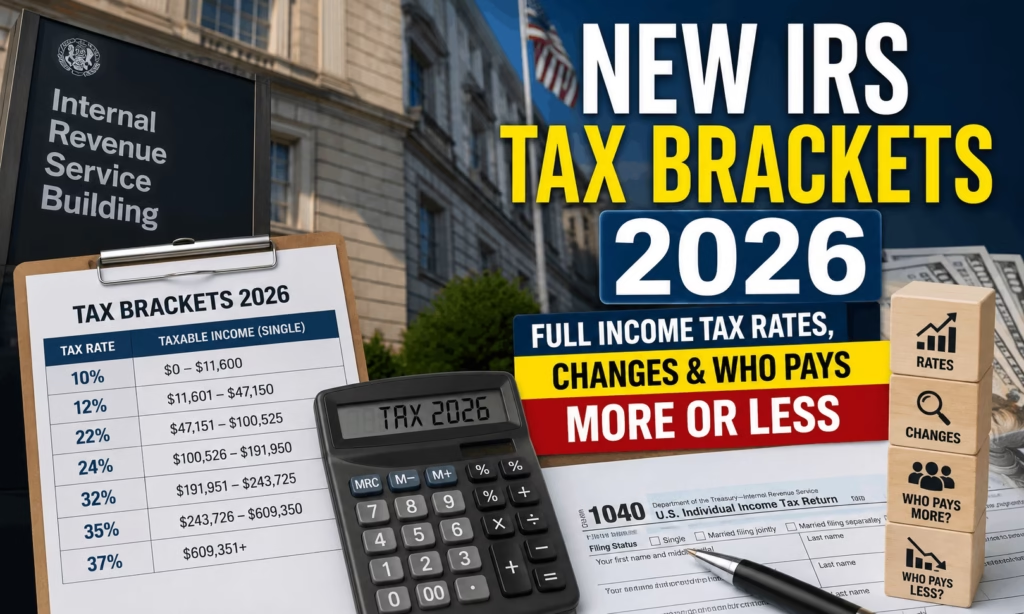
IRS Tax Brackets 2026 Key Highlights
| Detail | Information |
|---|---|
| Tax Rates (unchanged from 2025) | 10%, 12%, 22%, 24%, 32%, 35%, 37% |
| Governing Document | IRS Revenue Procedure 2025-32 |
| Made Permanent By | One Big Beautiful Bill Act (OBBBA), July 2025 |
| Standard Deduction — Single | $16,100 (up from $15,750 in 2025) |
| Standard Deduction — Married Filing Jointly | $32,200 (up from $31,500 in 2025) |
| Standard Deduction — Head of Household | $24,150 (up from $23,625 in 2025) |
| Top 37% Bracket Begins (Single) | Above $640,600 |
| Top 37% Bracket Begins (MFJ) | Above $768,700 |
| Additional Deduction (Age 65+, Unmarried) | $2,050 |
| Additional Deduction (Age 65+, Married, per spouse) | $1,650 |
| New OBBBA Senior Deduction (age 65+) | Up to $6,000 per person |
| Applies To | Income earned January 1 – December 31, 2026 |
| Filed On | Tax returns submitted in early 2027 |
| Official Source | irs.gov |
Did Tax Rates Actually Go Up in 2026?
No. This is the single most searched question about the 2026 tax brackets, and the answer is straightforward: the seven marginal tax rates are identical to 2025. Before OBBBA passed, these lower TCJA-era rates were scheduled to expire at the end of 2025 and revert to higher pre-2018 rates, with the top bracket jumping back to 39.6%. OBBBA eliminated that expiration entirely, locking in the current seven-bracket structure as the long-term baseline going forward — not a temporary extension, but a permanent change to the tax code.
What moved for 2026 are the income thresholds within each bracket, adjusted upward for inflation, plus an additional OBBBA-specific inflation boost applied specifically to the bottom two brackets (10% and 12% brackets received roughly a 4% adjustment, while higher brackets received about 2.3%).
Tax Brackets 2026 Single Filers
| Rate | Taxable Income Range | Tax Owed |
|---|---|---|
| 10% | $0 – $12,400 | 10% of taxable income |
| 12% | $12,400 – $50,400 | $1,240 + 12% over $12,400 |
| 22% | $50,400 – $105,700 | $5,800 + 22% over $50,400 |
| 24% | $105,700 – $201,775 | $17,966 + 24% over $105,700 |
| 32% | $201,775 – $256,225 | $41,024 + 32% over $201,775 |
| 35% | $256,225 – $640,600 | $58,448 + 35% over $256,225 |
| 37% | Above $640,600 | $192,979.25 + 37% over $640,600 |
Tax Brackets 2026 Married Filing Jointly
| Rate | Taxable Income Range | Tax Owed |
|---|---|---|
| 10% | $0 – $24,800 | 10% of taxable income |
| 12% | $24,800 – $100,800 | $2,480 + 12% over $24,800 |
| 22% | $100,800 – $211,400 | $11,600 + 22% over $100,800 |
| 24% | $211,400 – $403,550 | $35,932 + 24% over $211,400 |
| 32% | $403,550 – $512,450 | $82,048 + 32% over $403,550 |
| 35% | $512,450 – $768,700 | $116,896 + 35% over $512,450 |
| 37% | Above $768,700 | $206,583.50 + 37% over $768,700 |
Tax Brackets 2026 Head of Household
| Rate | Taxable Income Range |
|---|---|
| 10% | $0 – $17,700 |
| 12% | $17,700 – $67,450 |
| 22% | $67,450 – $105,700 |
| 24% | $105,700 – $201,750 |
| 32% | $201,750 – $256,200 |
| 35% | $256,200 – $640,600 |
| 37% | Above $640,600 |
Tax Brackets 2026 Married Filing Separately
| Rate | Taxable Income Range |
|---|---|
| 10% | $0 – $12,400 |
| 12% | $12,400 – $50,400 |
| 22% | $50,400 – $105,700 |
| 24% | $105,700 – $201,775 |
| 32% | $201,775 – $256,225 |
| 35% | $256,225 – $384,350 |
| 37% | Above $384,350 |
How Tax Brackets Actually Work?
Federal tax brackets are progressive, meaning a higher rate applies only to the slice of income that falls within that specific range — never to your entire income. Moving into a higher bracket doesn’t re-tax the dollars you already earned at the lower rate.
Worked example: A single filer with $70,000 of taxable income in 2026 pays:
- 10% on the first $12,400 = $1,240
- 12% on the next $38,000 (from $12,400 to $50,400) = $4,560
- 22% on the remaining $19,600 (from $50,400 to $70,000) = $4,312
- Total tax owed: $10,112
That filer’s marginal rate is 22% (the rate on their last dollar earned), but their effective rate — total tax divided by taxable income — is only about 14.4%. This distinction matters enormously for financial planning, especially around decisions like Roth conversions, where understanding your true effective rate (not just your bracket) determines whether a strategy makes sense.
Standard Deduction 2026 Complete Breakdown
| Filing Status | 2025 Standard Deduction | 2026 Standard Deduction |
|---|---|---|
| Single | $15,750 | $16,100 |
| Married Filing Jointly | $31,500 | $32,200 |
| Married Filing Separately | $15,750 | $16,100 |
| Head of Household | $23,625 | $24,150 |
Additional standard deduction for age 65+ or blind:
- $2,050 for an unmarried individual (not a surviving spouse)
- $1,650 per qualifying condition for married filers
A dependent’s standard deduction for 2026 is the greater of $1,350 or earned income plus $450.
New OBBBA Deductions Most 2026 Guides Miss
Beyond the standard bracket and deduction adjustments, OBBBA introduced several temporary deductions (2025–2028) that can meaningfully reduce taxable income for qualifying taxpayers — and these matter more for many households than the bracket shifts themselves:
| Deduction | Maximum Amount | Income Phaseout Begins (MAGI) |
|---|---|---|
| Qualified tips | $25,000 | $150,000 single / $300,000 joint |
| Qualified overtime pay | $12,500 single / $25,000 joint | $150,000 single / $300,000 joint |
| Car loan interest (US-assembled vehicles) | $10,000 | $100,000 single / $200,000 joint |
| Senior deduction (age 65+) | $6,000 per person | $75,000 single / $150,000 joint |
| Non-itemizer charitable deduction | $1,000 single / $2,000 joint | Not income-phased |
The senior deduction is a new addition on top of the existing age-65+ additional standard deduction, phasing out at a 6% rate above the listed income thresholds. The non-itemizer charitable deduction is especially notable: starting in 2026, filers who take the standard deduction (rather than itemizing) can still deduct cash charitable gifts up to the listed limit — previously, only itemizers could claim charitable deductions at all.
Other Key 2026 Figures Tied to the Brackets
| Item | 2026 Amount |
|---|---|
| AMT Exemption (Single) | $90,100 (phaseout begins at $500,000) |
| AMT Exemption (MFJ) | $140,200 (phaseout begins at $1,000,000) |
| Child Tax Credit (max per child) | $2,200 (up to $1,700 refundable) |
| EITC Maximum (3+ children) | $8,231 |
| Estate Tax Basic Exclusion | $15,000,000 per person |
| Annual Gift Tax Exclusion | $19,000 per recipient |
| Long-Term Capital Gains 0% Rate (Single) | Up to $49,450 taxable income |
| Long-Term Capital Gains 15% Rate (Single) | $49,450 – $545,500 |
| Long-Term Capital Gains 20% Rate (Single) | Above $545,500 |
The estate and gift tax lifetime exemption rose to $15 million per person, effective January 1, 2026, under OBBBA, and will be indexed for inflation in future years.
Who Pays More or Less in 2026?
Because the brackets widened and the standard deduction increased, a household earning the same nominal income in 2026 as in 2025 generally owes slightly less in federal income tax — more of their income falls into lower-taxed brackets, and a larger flat amount is deducted before any rate applies at all. Using the earlier $70,000 single-filer example: that same taxpayer would have owed roughly $10,314 on identical taxable income in 2025, versus $10,112 in 2026 — a modest but real difference of about $202 for the year.
The people who benefit most from the 2026 changes specifically include:
- Workers who regularly earn tips or overtime pay, thanks to the new OBBBA deductions
- Seniors aged 65+, who can now stack the additional standard deduction with the new $6,000 senior deduction
- Non-itemizers who give to charity, now able to deduct cash gifts for the first time without itemizing
- High-net-worth families planning estates, due to the increased $15 million exemption
How to Find Your Tax Bracket
- Calculate your gross income for 2026 — wages, self-employment income, taxable interest, and similar sources.
- Subtract adjustments and your deduction — either the standard deduction ($16,100 single / $32,200 MFJ) or your itemized deductions — to arrive at taxable income.
- Match your filing status to the correct table above and find the row where your taxable income falls; that row shows your marginal bracket.
- Calculate total tax owed using the formula in the “Tax Owed” column, or divide total tax by taxable income to find your effective rate.
Official Resources
| IRS Official Website | irs.gov |
| IRS Revenue Procedure 2025-32 (Full Text) | irs.gov/pub/irs-drop/rp-25-32.pdf |
| Check Refund Status | irs.gov/refunds |
| Free File (Income Under $79,000) | freefile.irs.gov |
| IRS Online Account (Login/Registration) | irs.gov/account |
FAQs New IRS Tax Brackets 2026
Did federal tax rates increase in 2026?
No. The seven tax rates (10%–37%) remain unchanged from 2025 — OBBBA made them permanent. Only the income thresholds and standard deduction increased for inflation.
What is the standard deduction for 2026?
$16,100 for single filers, $32,200 for married filing jointly, and $24,150 for head of household.
How much can I earn before hitting the 37% tax bracket in 2026?
Above $640,600 for single filers and heads of household, and above $768,700 for married couples filing jointly.
What’s the difference between my tax bracket and my actual tax rate?
Your bracket (marginal rate) is the rate on your last dollar earned. Your effective rate is your total tax divided by your total taxable income — almost always lower than your marginal bracket.
Are there new deductions for tips and overtime in 2026?
Yes. OBBBA introduced temporary deductions (2025–2028) of up to $25,000 for qualified tips and up to $12,500–$25,000 for qualified overtime pay, subject to income phaseouts.
Can I deduct charitable donations without itemizing in 2026?
Yes, for the first time — a new non-itemizer charitable deduction of up to $1,000 (single) or $2,000 (joint) is available starting in 2026.
When do the 2026 tax brackets apply?
To income earned from January 1 through December 31, 2026, reported on tax returns filed in early 2027.