Cockroach Janta Party Latest News 2026: India’s internet has rarely witnessed anything quite like it. In barely ten days in May 2026, a satirical political movement called the Cockroach Janta Party (CJP) rose from a casual online joke to a phenomenon with over 22 million Instagram followers, surpassing the social media reach of some of India’s most established political parties. Then the government moved to shut it down, one platform at a time. Here is the complete, fact-verified story of the Cockroach Janta Party 2026: who founded it, why it exploded, what its manifesto demands, how India’s government responded, and what the viral truth behind this unprecedented movement really says about India’s youth.
What Is the Cockroach Janta Party?
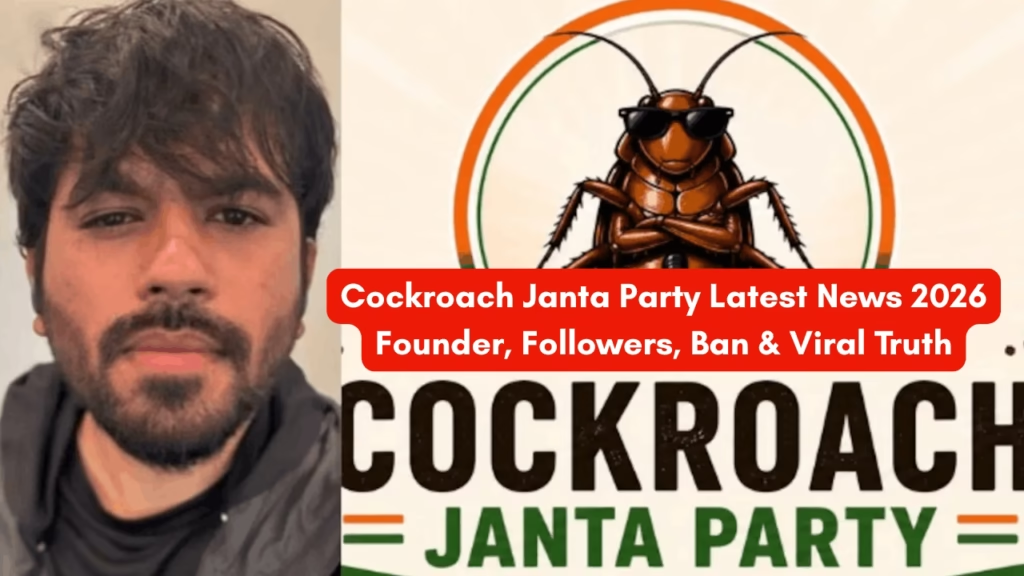
The Cockroach Janta Party, abbreviated as CJP, is an Indian satirical political movement founded on May 16, 2026, by Abhijeet Dipke, a 30-year-old political communications strategist and recent public relations graduate from Boston University in the United States. The party’s name is a deliberate and pointed parody of the ruling Bharatiya Janata Party (BJP) — Prime Minister Narendra Modi’s Hindu nationalist party — with the word “janta” meaning “people” in Hindi.
The CJP is not registered with India’s Election Commission as a formal political party, and its founder has made clear there are no plans to contest elections. Instead, it describes itself as a satirical public pressure movement — a vehicle for India’s Gen Z and millennial population to express frustration over unemployment, institutional failure, exam paper leaks, media consolidation, and what many young Indians see as an increasingly unaccountable political establishment. What began as an internet punchline turned, within days, into something that genuinely spooked India’s ruling class.
Who Is Abhijeet Dipke?
Abhijeet Dipke, the CJP founder, is a 30-year-old political communications professional who previously worked with the Aam Aadmi Party (AAP) — India’s Delhi-based reformist party. At the time of launching the movement, he was finishing his studies at Boston University in the United States. By his own account, the initial creation of the CJP involved very little sleep and very little planning — it was born as a direct, spontaneous reaction to a controversy involving India’s highest court.
Within 72 hours of launching the CJP’s website and social media accounts, Dipke found himself fielding an unending stream of messages as the movement went viral far beyond anything he had anticipated. He has described himself as the movement’s “founding president” and has been consistent in framing the CJP not as an electoral challenger but as a civic pressure campaign to make politicians more accountable. “This is something unprecedented that is happening. The plan is to change the political discourse and to make politicians more accountable,” Dipke said.
Chief Justice Surya Kant’s Remarks
The spark that ignited the Cockroach Janta Party movement can be traced to a single day: May 15, 2026, when Chief Justice of India Surya Kant made remarks during a Supreme Court hearing on fake professional credentials in which he compared certain unemployed youth to “cockroaches” and “parasites of society.”
The comment spread instantly across Indian social media, triggering furious reactions from young people already dealing with staggering unemployment rates, exam paper leak scandals, and a growing sense that India’s institutions were failing them. The Chief Justice subsequently clarified that his remarks were specifically targeted at applicants who enter professions using fraudulent degrees — not at unemployed youth broadly. He described India’s young people as “the pillars of a developed India.” But the clarification came too late to contain the backlash.
By May 16 — just one day later — Abhijeet Dipke had launched cockroachjantaparty.org, accompanying X (formerly Twitter) and Instagram accounts, a logo, a party anthem, and a full movement. Young Indians, rather than being offended by the cockroach comparison, reclaimed the insult and turned it into a rallying identity.
Cockroach Janta Party Follower Growth
The CJP follower count shattered expectations at a pace few political or social movements in Indian history have matched. The numbers, verified by multiple international outlets, tell the story:
- Over 350,000 sign-ups through the official website in less than a week
- Over 1 million people signed up to join the movement within the first week, according to Dipke
- Over 19 million Instagram followers within less than a week of launch — approximately double the BJP government’s Instagram audience at that point
- The account eventually grew to over 22 million Instagram followers before being targeted
- The CJP’s Instagram following surpassed the BJP — described as the world’s largest political party — which had roughly 9 million followers at the time
- Over 600,000 people signed the CJP’s petition demanding the resignation of Education Minister Dharmendra Pradhan over the NEET 2026 paper leak scandal
The speed and scale of the growth prompted YouTuber Meghnad S to observe that the popularity of a satirical, non-existent party was “a giant commentary on Indian political parties in general.” Social media users were split: some dismissed the CJP as “mere meme politics,” while others called it “the first party in the country which at least understands the pain of the youth.”
CJP Manifesto: The Five Demands India’s Government Tried to Silence
Published on May 18, 2026, the Cockroach Janta Party manifesto describes itself as “Secular. Socialist. Democratic. Lazy.” and outlines five core public-pressure demands:
- No post-retirement rewards for judges — The CJP demands that no Chief Justice of India be granted a Rajya Sabha seat as a post-retirement appointment, arguing that judicial independence is compromised when its highest officers are “auditioning for the next job while still on the bench.”
- 50% reservation for women in India’s parliament and cabinet, ensuring gender representation at the highest levels of governance.
- Protection of voting rights to prevent electoral manipulation and ensure free and fair elections.
- An independent press — specifically, the manifesto calls for cancelling the media licenses of “all media houses owned by Ambani and Adani,” referring to billionaires Mukesh Ambani and Gautam Adani, who own prominent television channels widely seen as sympathetic to the Modi government.
- A 20-year ban on politicians switching parties, targeting the practice of party-hopping — which critics allege is often done in exchange for financial or political rewards.
The manifesto was explicit that these were not legislative proposals but a public agenda “meant to be argued, defended, and acted upon by politicians who actually hold office.”
The Ban: How India’s Government Shut Down the CJP
The government crackdown on the Cockroach Janta Party unfolded rapidly and on multiple fronts between May 21 and May 24, 2026. The sequence of events, documented by MediaNama, Al Jazeera, and Business Today:
May 21, 2026: The Ministry of Electronics and Information Technology (MeitY) directed X (formerly Twitter) to withhold the CJP’s primary account @CJP_2029 in India under Section 69A of the Information Technology Act, 2000, acting on inputs from the Intelligence Bureau (IB). The IB cited “national security concerns” and a threat to the “sovereignty of India,” with a senior government official (speaking anonymously to The Wire) confirming: “MeitY received an input from the IB to block the X account of Cockroach Janta Party, citing that it posed a threat to the sovereignty of India. The IB believed that the account was posting inflammatory content.” The blocking order was issued confidentially under Rule 16 of the IT Blocking Rules — no public order was released.
May 22, 2026: Dipke launched a backup X account, @Cockroachisback, which gained nearly 200,000 followers before MeitY took it down on May 23.
May 23, 2026: The CJP’s official website was taken down. The site had been running an active petition demanding the resignation of Education Minister Dharmendra Pradhan over the NEET 2026 paper leak — a controversy involving alleged leaks of the national medical entrance examination that led to its cancellation and triggered large protests across India.
May 24, 2026: Dipke announced that the CJP’s Instagram page and his personal Instagram account had both been compromised — with the Instagram account, which had grown to over 21.9 million followers, taken over in what he described as a hack.
Dipke’s response was defiant: “You can hack and withhold the accounts but you cannot hack this movement. We are not going to stop and we will keep raising our voice against this autocracy. Every attack makes cockroaches stronger.”
Government Response and Political Reaction
India’s ruling establishment responded to the CJP’s viral rise with a mixture of dismissal and concern. Union Minister Sukanta Majumdar alleged that 49% of CJP followers are from Pakistan and only 9% are from India — a claim that has been widely disputed and for which no independent verification was provided, but which echoed a familiar political playbook of attributing domestic dissent to foreign interference.
The Delhi High Court petition filed by Dipke challenging the Section 69A ban on the CJP’s X account further escalated the legal and political dimensions of the story. The petition argued that the blocking of a satirical movement’s social media accounts without a public order violated constitutional guarantees of free speech.
The offline dimension of the movement also grew: volunteers participated in protests and cleanup drives dressed in cockroach costumes across multiple Indian cities, turning street activism into an extension of the digital satire.
Internal Trouble: A Lawyer Moves to Register CJP With Election Commission
As of May 26, 2026, the Cockroach Janta Party appeared to be facing its first internal crisis. An Indian lawyer filed an application with the Election Commission of India to register the CJP as a formal political party — in his own name, not Dipke’s. The development signalled the kind of identity confusion that rapid viral movements often encounter, with opportunists seeking to claim or monetise the brand once it achieves critical mass.
The Viral Truth: What the CJP Really Represents
Stripped of the memes and cockroach costumes, the Cockroach Janta Party is a mirror held up to the frustrations of India’s estimated 65 million unemployed youth — a generation dealing with soaring youth unemployment, high-stakes exams tainted by paper leaks, a media landscape dominated by billionaire ownership, and judiciary and government institutions widely perceived as serving the powerful over the people.
The fact that a satirical, non-registered, election-free “party” could accumulate 22 million followers faster than any established political force in India — and trigger a government crackdown within a week — reveals something profound: India’s young people are searching for a voice, and the existing political infrastructure is not providing one. Whether the CJP survives as a long-term movement or fades as internet culture moves on, its brief, explosive rise has already changed the conversation.
Cockroach Janta Party 2026
| Date | Event |
|---|---|
| May 15, 2026 | CJI Surya Kant’s “cockroaches” remark during Supreme Court hearing |
| May 16, 2026 | Abhijeet Dipke launches CJP website and social accounts |
| May 18, 2026 | CJP five-point manifesto published |
| May 21, 2026 | MeitY blocks @CJP_2029 on X under Section 69A |
| May 22, 2026 | CJP had surpassed 19M+ Instagram followers; backup X account launched |
| May 23, 2026 | Backup X account blocked; CJP website taken down |
| May 24, 2026 | CJP Instagram (21.9M followers) and Dipke’s personal account compromised |
| May 26, 2026 | Lawyer files Election Commission application to register CJP in his name |
| May 29, 2026 | Dipke challenges Section 69A ban at Delhi High Court |