
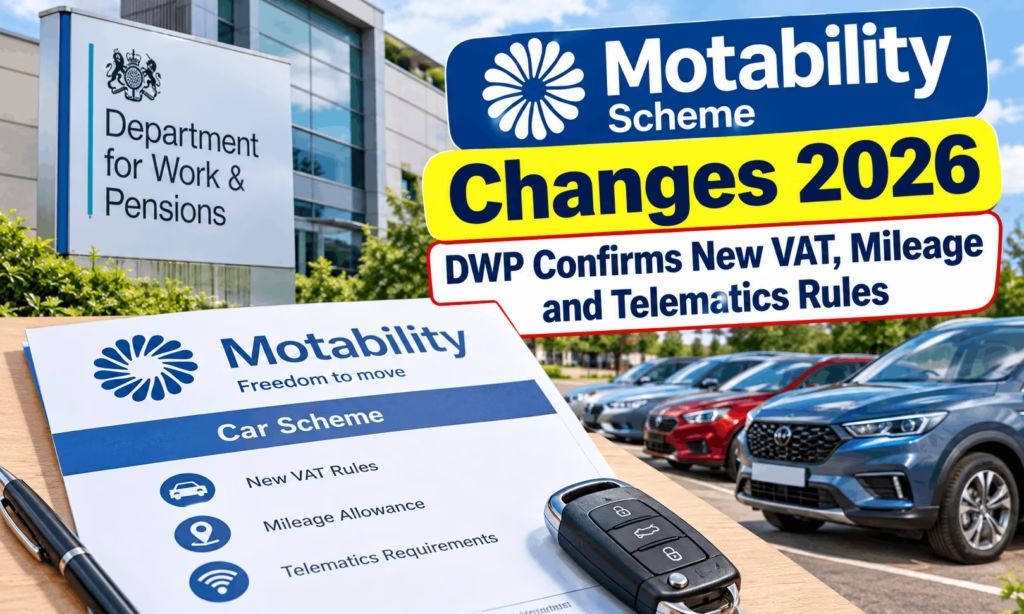
Motability Scheme Changes 2026: The Department for Work and Pensions has now confirmed, not just proposed, a major set of changes to the Motability Scheme. DWP Minister Sir Stephen Timms confirmed to the House of Commons that from 1 July 2026, new VAT and Insurance Premium Tax rules will apply to vehicles leased through the scheme. Motability itself has estimated this will push the average Advance Payment up by around 400 pounds over a typical three-year lease. For the hundreds of thousands of disabled people and families who rely on the scheme for a car, scooter or powered wheelchair, this is the clearest signal yet that costs are rising, even though weekly lease payments funded by the mobility benefit itself are largely staying the same. We’ll be updating this article monthly as the DWP and Motability release further guidance, confirm exact vehicle pricing, and roll out the remaining 2026 changes.
The tax changes are only part of the picture. Alongside the VAT and Insurance Premium Tax reforms, Motability has also confirmed a lower mileage allowance with a steeper excess charge, a new telematics requirement for all new customers, and continued uncertainty for thousands of people still migrating from Disability Living Allowance to Personal Independence Payment. This guide breaks down every confirmed change, who currently qualifies, the exact dates that matter, and includes a free calculator so you can estimate how the new tax rules could affect your own Advance Payment.
What Is the Motability Scheme?
The Motability Scheme allows people who receive certain disability benefits to lease a new car, wheelchair accessible vehicle, mobility scooter or powered wheelchair using their mobility benefit. Instead of receiving the mobility part of your benefit as cash, it is paid directly to Motability Operations to cover the lease, which typically includes insurance, servicing, maintenance, breakdown cover and tyres. The scheme is overseen by the Motability charity and run day to day by Motability Operations, and it currently supports close to a million disabled people and their families across the UK.
DWP Confirms Major Changes Key Highlights
| Item | Details |
|---|---|
| Change confirmed by | DWP Minister Sir Stephen Timms, House of Commons statement |
| Effective date for tax changes | 1 July 2026 |
| Estimated cost increase | Around £400 average increase to the Advance Payment over a typical 3-year lease |
| What’s newly taxed | VAT on Advance Payments; Insurance Premium Tax at the standard 12% rate on lease insurance |
| Weekly lease cost | Largely unchanged; the increase mainly hits the upfront Advance Payment |
| Existing leases before 1 July 2026 | Insurance remains exempt from Insurance Premium Tax for the life of that existing lease |
| No-advance-payment vehicles | Around 40 to 50 models continue to require no upfront payment |
| New mileage limit | 10,000 miles a year on new leases from July 2026, down from 20,000 miles |
| Excess mileage charge | 25 pence per mile over the limit, up from 5 pence per mile |
| Telematics requirement | All new customers from April 2026 must have a telematics, or black box, device fitted |
| Enhanced PIP mobility rate 2026 to 2027 | £80.00 a week, up from £77.05 a week previously |
The Tax Changes, Explained
From 1 July 2026, the government is amending the tax reliefs that Motability leases have historically enjoyed. Two changes have been confirmed. First, the Advance Payment, the upfront lump sum some customers pay for a more expensive vehicle, will now attract standard rate VAT at 20 percent. Second, the insurance portion of the lease will be subject to Insurance Premium Tax at the standard 12 percent rate, bringing Motability leases in line with how other commercial vehicle leases are taxed. According to government guidance, the stated policy objective is to promote fairness and value for money for taxpayers, restricting tax reliefs on more expensive vehicles while aligning insurance tax treatment with other providers.
Crucially, the weekly cost that comes out of your mobility benefit is not directly affected by this change. What changes is the size of the Advance Payment for anyone choosing a car above the standard allowance. Motability has publicly estimated the average increase at around 400 pounds across a typical three-year lease, though the actual figure will vary significantly depending on the specific vehicle chosen, since some models will see little or no change while pricier options will see a larger jump.
How Government Shutdown Affects VA Benefits, Will Your Payment Still Arrive?
Do I Qualify for ACA Subsidy 2027? The 400% FPL Cliff Explained
Healthcare.gov Premiums Rising 2027: What Changed and What It Means for Your Coverage
Who Is Affected and Who Is Protected?
The new tax rules apply only to new leases or renewals that begin on or after 1 July 2026. If you are already partway through an existing Motability lease, your current agreement is protected, and the insurance element of that lease remains exempt from Insurance Premium Tax for its full remaining term. The changes will bite when you come to renew or start a brand new agreement after that date. Around 40 to 50 vehicle models are expected to remain available with no Advance Payment at all, meaning customers who choose those models should see little to no extra cost from the tax change itself.
New Mileage and Telematics Rules from 2026
Alongside the tax reforms, Motability has confirmed a reduced annual mileage allowance for new leases starting from July 2026. The standard mileage limit is falling from 20,000 miles a year to 10,000 miles a year, and the excess mileage charge is rising sharply from 5 pence per mile to 25 pence per mile once that limit is exceeded. Motability says the changes are intended to manage rising scheme costs and keep it sustainable for the almost one million people who currently rely on it. Separately, from April 2026, all new customers joining the scheme must have a telematics device, sometimes called a black box, fitted to their vehicle, a move aimed at monitoring usage and supporting the new mileage-based charging structure.
Key Motability Scheme Dates 2026
| Date | What Happens |
|---|---|
| April 2026 | PIP and Adult Disability Payment mobility rates uprated to £80.00 a week; telematics devices become mandatory for all new customers. |
| Spring 2026 | Customer engagement and communications on the July changes begin, alongside a disability impact assessment by the Motability Foundation. |
| 1 July 2026 | VAT applied to Advance Payments and Insurance Premium Tax applied to lease insurance for new leases and renewals; new 10,000 mile annual limit and 25p excess mileage charge take effect. |
| Ongoing through 2026 | DLA to PIP migration continues; claimants must reapply within the deadline in their migration letter to avoid losing their Motability vehicle. |
Who Currently Qualifies for the Motability Scheme?
Eligibility is based entirely on the mobility component of specific disability benefits, and only at the higher or enhanced rate. Receiving a qualifying benefit is not enough by itself, since it must be the correct component at the correct rate. You typically need at least 12 months remaining on your award when you apply.
- Enhanced rate mobility component of Personal Independence Payment (PIP)
- Higher rate mobility component of Disability Living Allowance (DLA)
- Enhanced rate mobility component of Adult Disability Payment (Scotland)
- Higher rate mobility component of Child Disability Payment (Scotland)
- Armed Forces Independence Payment
- War Pensioners’ Mobility Supplement
The standard rate mobility component of PIP, the daily living component of PIP, the lower rate mobility component of DLA, and benefits such as Attendance Allowance, Carer’s Allowance and Employment and Support Allowance do not qualify on their own. You typically need to score 12 or more points across the mobility activities in a PIP assessment to reach the enhanced rate.
ACA Subsidy Cliff 2027: Premiums Could Double, Calculator Inside
ACA Open Enrollment 2027 Dates: Deadlines, New Rates and Subsidy Calculator
Diesel Prices Impact on Food Stamps: How $6-a-Gallon Fuel Is Quietly Shrinking SNAP Benefits
Is the Motability Scheme Stopping for PIP Claimants?
No. Despite widespread concern, the Motability Scheme is not being scrapped for people receiving PIP. The scheme continues to operate exactly as before for anyone on the enhanced mobility rate, and the confirmed changes affect cost and mileage terms rather than removing access to the scheme itself. The bigger risk for individual claimants comes from the ongoing move from DLA to PIP, since there is no automatic transfer between the two benefits. Anyone still receiving DLA must submit a fresh PIP application within the deadline stated in their migration letter, usually 90 days, or risk their DLA payments stopping, which would in turn cancel their Motability lease.
Why the Government Is Making These Changes?
Official guidance published alongside the announcement frames the reforms around fairness and value for money for taxpayers. VAT changes are designed to restrict tax reliefs on more expensive vehicles provided under qualifying schemes, while the Insurance Premium Tax change brings Motability leases in line with how other commercial lease providers are taxed. The Motability Scheme is currently the only qualifying scheme affected by these rules, though the changes technically apply to any similar scheme leasing vehicles to eligible disabled people, as well as to the insurance businesses that serve them. Treasury officials have argued that the previous tax exemption effectively gave a larger subsidy to customers who chose the most expensive vehicles, since a bigger Advance Payment meant a bigger amount of VAT being waived, and the new rules aim to make that relief more proportionate.
The mileage and telematics changes sit alongside the tax reforms but come from a different pressure point, the overall running cost of the scheme itself. Motability Operations has pointed to rising vehicle, insurance and repair costs across the wider motor industry, along with a scheme that has grown to serve just under a million customers, as reasons for tightening mileage terms and adding usage monitoring through telematics. Supporters of the changes argue that a lower default mileage allowance simply reflects how most current customers already drive, while critics counter that anyone in a rural area, or anyone driving further for medical appointments, caring responsibilities or work, could be disproportionately affected by the much steeper 25 pence per mile excess charge.
What This Means If You Are Renewing Soon?
If your current Motability lease is coming up for renewal around the middle of 2026, timing matters. A renewal that completes just before 1 July 2026 would still fall under the older tax treatment, while a renewal completing on or shortly after that date would be subject to the new VAT and Insurance Premium Tax rules, along with the new mileage terms. Motability dealers are expected to make this timing clear during the renewal process, but claimants with a renewal date close to the cutover should ask their dealer directly which set of rules will apply to their specific agreement, since a difference of a few days could change both the Advance Payment and the annual mileage allowance attached to the new lease.
Motability Advance Payment Cost Calculator
Use this calculator to estimate how the new VAT rule could affect your Advance Payment on a lease starting on or after 1 July 2026.
Estimate Your New Advance Payment
This calculator applies the standard 20% VAT rate to your estimated Advance Payment for general illustration only. Actual pricing is set by Motability and your dealer and may differ. It is not financial advice; confirm exact figures with Motability or your dealer before signing a lease.
How to Apply for the Motability Scheme 2026?
- Confirm you receive a qualifying mobility benefit at the enhanced or higher rate, with at least 12 months remaining on your award.
- Visit or contact a Motability approved dealer, or browse available vehicles on the official Motability website.
- Choose your vehicle, checking whether an Advance Payment applies and whether that lease will start before or after 1 July 2026.
- Complete the application at the dealership, where a Motability specialist will help you finalise the paperwork and any adaptations needed.
- Receive your vehicle, usually within a few weeks of the application being approved.
Processing Time and Payment Schedule
| Item | Typical Timing |
|---|---|
| Application to vehicle handover | Usually a few weeks once the application is approved and any adaptations are arranged |
| Mobility benefit transfer to Motability | Paid automatically and directly from DWP or Social Security Scotland once you join the scheme |
| DLA to PIP reapplication deadline | Usually 90 days from the date of your migration letter |
| PIP mobility rate uprating | Annually each April, in line with the wider benefits uprating |
$994 SNAP Benefit for a Family of 4 in 2026 — Calculate Your Exact Amount
Social Security Government Shutdown 2026: Will Your Check Still Arrive?
Federal Employees Back Pay Shutdown 2026: Are You Guaranteed to Get Paid?
What Motability and Disability Charities Are Saying
Motability has stressed that support for specialist adaptations will remain central to the scheme and that standard adaptation costs will continue to be covered. The Motability Foundation, the charity that oversees the scheme, will continue to offer means-tested grants to people who would otherwise struggle to afford the Advance Payment or adaptations. Disability charities have broadly welcomed the fact that weekly lease costs are not directly rising, but several have raised concerns about the combined effect of a bigger upfront Advance Payment, a lower mileage limit, and a much higher excess mileage charge landing on the same group of claimants at the same time, particularly those in rural areas who may naturally drive more than 10,000 miles a year.
FAQs About Motability Scheme Changes 2026
Is the Motability Scheme stopping for PIP claimants?
No. The Motability Scheme continues for anyone receiving the enhanced rate of the PIP mobility component. The confirmed 2026 changes affect costs and mileage terms, not access to the scheme itself.
How much will my Advance Payment go up by?
Motability has estimated an average increase of around 400 pounds over a typical three-year lease, though the exact amount depends on the vehicle chosen. Around 40 to 50 models are expected to remain available with no Advance Payment at all.
Will my weekly Motability payment increase because of the tax change?
No. The weekly lease cost funded directly from your mobility benefit is largely unaffected by the July 2026 tax changes. The increase mainly affects the upfront Advance Payment for more expensive vehicles.
Do the new rules apply to my existing Motability lease?
No. Existing leases that started before 1 July 2026 keep their current terms, including insurance that remains exempt from Insurance Premium Tax, for the remainder of that agreement. The new rules apply to new leases and renewals from that date onward.
What is the new Motability mileage limit?
New leases from July 2026 allow 10,000 miles a year before extra charges apply, down from the previous 20,000 mile limit, with an excess charge of 25 pence per mile over that limit.
Do I need a telematics device for my Motability car?
From April 2026, all new customers joining the Motability Scheme must have a telematics, or black box, device fitted to their vehicle. This applies regardless of age or vehicle type.
What happens if I do not reapply after moving from DLA to PIP?
If you are still on Disability Living Allowance and do not submit a fresh PIP claim within the deadline stated in your migration letter, usually 90 days, your DLA payments will stop, which will also cancel your Motability lease.
Official Resources
| Resource | Purpose | Link |
|---|---|---|
| Motability Scheme Official Site | Check eligibility, browse vehicles, find a dealer | motability.co.uk |
| GOV.UK Personal Independence Payment | Apply for PIP or check claim status | gov.uk/pip |
| GOV.UK PIP Reporting a Change | Report a change of circumstances affecting your award | gov.uk/pip/report-changes |
| Motability Foundation | Means-tested grants toward Advance Payments and adaptations | motabilityfoundation.org.uk |
| Social Security Scotland | Adult Disability Payment and Child Disability Payment applications | mygov.scot social security scotland |
| GOV.UK DLA to PIP Move | Guidance on reapplying when moving from DLA to PIP | gov.uk DLA guidance |
Conclusion
The DWP has now put beyond doubt that the Motability Scheme is changing in 2026, with new VAT and Insurance Premium Tax rules landing on 1 July, a sharply lower mileage allowance, a much higher excess mileage charge, and a new telematics requirement for all new customers. None of this ends the scheme itself, and for anyone on the enhanced rate of PIP or an equivalent qualifying benefit, weekly lease costs funded by that benefit remain largely unchanged. Where people will feel the difference is in the size of the Advance Payment on new leases and renewals, and in how far they can drive before facing a much steeper excess charge. Anyone currently migrating from DLA to PIP should treat their reapplication deadline as urgent, since missing it can cancel a lease outright. Use the calculator above to get a rough sense of your own Advance Payment, check the official Motability and GOV.UK resources before renewing, and check back here for next month's update as further guidance is published.
Will SNAP Benefits Stop If the Government Shuts Down Again?
Republican Convention 2026: Trump’s Biggest Asset or Obstacle for the GOP?
Government Shutdown October 2026 Averted — Funding Runs to Dec 11