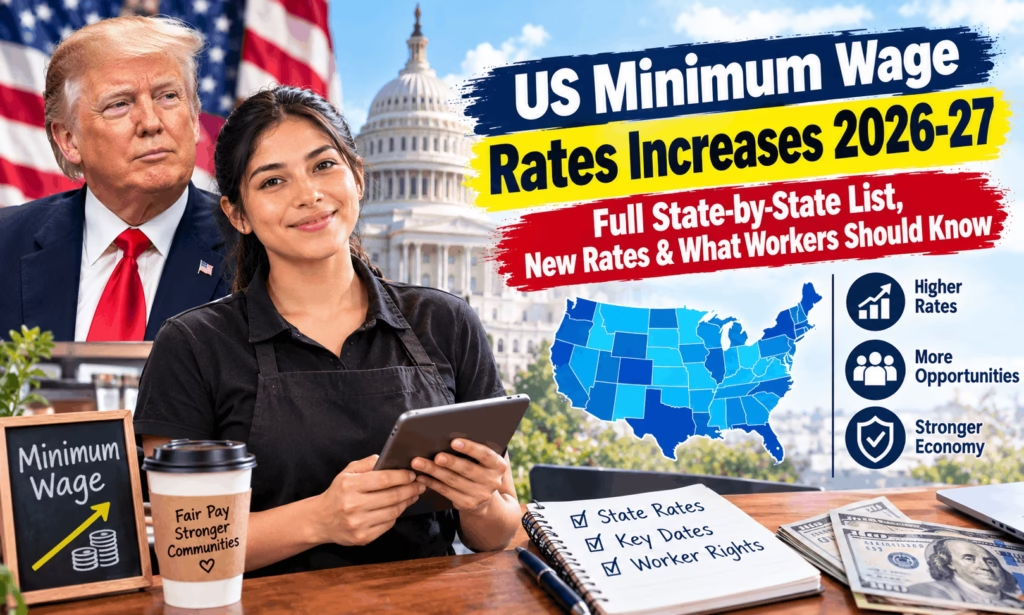
US Minimum Wage Rates increases 2026-27: A new wave of minimum wage increases has already reshaped paychecks for millions of American workers this year, and another round is lining up for 2027. As of this month, 22 states plus Washington, D.C. have pushed their minimum wage above where it stood in 2025, while the federal minimum wage sits untouched at 7.25 dollars an hour, a figure that has not moved since 2009.
Payroll teams, small business owners, and hourly workers are all watching the same question right now: which states are paying more, which ones are holding steady, and when does the next change land. We’ll be updating this article monthly as new state and city wage figures are confirmed.
The pattern this year is unmistakable. States that tie their minimum wage to inflation, like Colorado, Arizona, and Ohio, have already delivered their scheduled bump, usually a modest increase of a few dozen cents. States working through multi-year phased plans, including Missouri, Nebraska, and Michigan, are climbing toward the 15 dollar mark in set steps written into law years ago.
Meanwhile, a separate cluster of 20 states has not raised its rate at all, leaving hourly workers in places like Texas, Georgia, and Tennessee earning exactly what they earned back when the federal rate was last set. The result is a wage map more fractured than at any point in recent memory, and it is only getting wider heading into 2027.
Why the Federal Minimum Wage Hasn’t Budged Since 2009?
The federal minimum wage of 7.25 dollars an hour has now gone unchanged for the longest stretch since the Fair Labor Standards Act created a national wage floor back in 1938. Congress has to actually pass a bill, and the president has to sign it, for that number to move even a single cent. It does not adjust with inflation on its own. Several attempts have come close over the years, including a widely discussed 2026 proposal from Senator Chris Murphy that would have pushed the federal floor all the way to 25 dollars an hour, but none have cleared a divided Congress.
That gridlock is exactly why individual states have taken the wheel. Thirty states and the District of Columbia now pay above the federal minimum, and five states, Alabama, Louisiana, Mississippi, South Carolina, and Tennessee, have no minimum wage law of their own, meaning the federal rate applies there by default.
Full State-by-State Minimum Wage List 2026
| Rank | State | 2026 Minimum Wage | Change from 2025 |
|---|---|---|---|
| 1 | Washington, D.C. | 18.40 dollars | Raised from 17.95 |
| 2 | Washington State | 17.13 dollars | Raised from 16.66 |
| 3 | Connecticut | 16.94 dollars | Raised from 16.35 |
| 4 | California | 16.90 dollars | Raised from 16.50 |
| 5 | New York (NYC, Long Island, Westchester) | 17.00 dollars | Raised from 16.50 |
| 6 | Hawaii | 16.00 dollars | Raised from 14.00 |
| 6 | Rhode Island | 16.00 dollars | Raised from 15.00 |
| 6 | New York (rest of state) | 16.00 dollars | Raised from 15.50 |
| 9 | Oregon (Portland metro) | 16.30 dollars | Raised from 15.05 |
| 10 | New Jersey | 15.92 dollars | Raised from 15.49 |
| 11 | Colorado | 15.16 dollars | Raised from 14.81 |
| 12 | Arizona | 15.15 dollars | Raised from 14.70 |
| 13 | Maine | 15.10 dollars | Raised from 14.65 |
| 14 | Missouri | 15.00 dollars | Raised from 13.75 |
| 14 | Nebraska | 15.00 dollars | Raised from 13.50 |
| 14 | Delaware | 15.00 dollars | No change |
| 14 | Illinois | 15.00 dollars | No change |
| 14 | Maryland | 15.00 dollars | No change |
| 14 | Massachusetts | 15.00 dollars | No change |
| 14 | Florida | 15.00 dollars | Raised from 14.00, effective Sept 30 |
| 21 | Vermont | 14.42 dollars | Raised from 14.01 |
| 22 | Alaska | 14.00 dollars | Raised from 13.00, effective July 1 |
| 23 | Michigan | 13.73 dollars | Raised from 12.48 |
| 24 | Virginia | 12.77 dollars | Raised from 12.41 |
| 25 | Nevada | 12.00 dollars | No change |
| 25 | New Mexico | 12.00 dollars | No change |
| 27 | South Dakota | 11.85 dollars | Raised from 11.50 |
| 28 | Minnesota | 11.41 dollars | Raised from 11.13 |
| 29 | Arkansas | 11.00 dollars | No change |
| 29 | Ohio | 11.00 dollars | Raised from 10.70 |
| 31 | Montana | 10.85 dollars | Raised from 10.55 |
| 32 | West Virginia | 8.75 dollars | No change |
| 33 | Federal floor states | 7.25 dollars | No change since 2009 |
The federal floor row covers Alabama, Georgia, Idaho, Indiana, Iowa, Kansas, Kentucky, Louisiana, Mississippi, New Hampshire, North Carolina, North Dakota, Oklahoma, Pennsylvania, South Carolina, Tennessee, Texas, Utah, Wisconsin, and Wyoming. Georgia and Wyoming list a lower state figure of 5.15 dollars on paper, but federal law still guarantees covered workers the full 7.25 dollars.
SSDI Pay Chart: The Least Amount You Can Get Per Month and the Most Common Disabilities
Ohio SNAP Sugary Beverage Ban Delayed: What Happened and Why
Which States Are Getting Their Raise Later in 2026?
Not every increase landed on January 1. A handful of jurisdictions have their new rate scheduled for later in the year, which is one of the easiest details for multi-state employers to overlook.
| State or District | Old Rate | New Rate | When It Kicks In |
|---|---|---|---|
| Washington, D.C. | 17.95 dollars | 18.40 dollars | July 1, 2026 |
| Alaska | 13.00 dollars | 14.00 dollars | July 1, 2026 |
| Oregon (standard/Portland/non-urban) | 15.05 / 14.05 | 15.55 / 16.30 / 14.05 | July 1, 2026 |
| Florida | 14.00 dollars | 15.00 dollars | September 30, 2026 |
Florida’s climb to 15 dollars closes out a schedule voters approved back in 2020. After this final step, the state pauses before its next indexed adjustment arrives in 2028.
What Workers Actually Take Home at Different Wage Levels?
Turning the hourly numbers into real annual income makes the state-by-state gap much easier to picture. Figures below assume a standard 40 hour work week, 52 weeks a year.
| Hourly Rate | Weekly Earnings | Annual Earnings |
|---|---|---|
| 7.25 dollars | 290 dollars | 15,080 dollars |
| 11.41 dollars | 456.40 dollars | 23,732.80 dollars |
| 15.00 dollars | 600 dollars | 31,200 dollars |
| 16.90 dollars | 676 dollars | 35,152 dollars |
| 17.13 dollars | 685.20 dollars | 35,630.40 dollars |
| 18.40 dollars | 736 dollars | 38,272 dollars |
A full-time worker in Washington, D.C. now earns roughly 23,000 dollars more per year than a full-time worker paid the federal minimum, simply based on geography.
Tipped Employees Follow a Completely Different Rulebook
Tipped minimum wage rules are where a lot of confusion happens. Federally, an employer can pay a tipped worker as little as 2.13 dollars an hour as long as tips make up the rest of the 7.25 dollar minimum. States handle this very differently.
California, Washington, Minnesota, and Alaska require the full state minimum wage before any tips are counted, with zero tip credit allowed. Connecticut sets its tipped rate at 6.38 dollars for hotel and wait staff, and 8.23 dollars for bartenders. Most other states allow a tip credit, letting employers pay a lower cash wage as long as tips close the remaining gap.
How to Apply the Correct Minimum Wage to Your Paycheck?
Workers and small employers often assume the statewide number is the final word, but cities and counties frequently set their own, higher local minimum wage. Here is how to confirm the exact figure that legally applies to a specific job.
Start by checking your state’s official rate from the table above, then search separately for your city or county, since places such as Seattle and SeaTac in Washington set local minimums well above the state number. Next, confirm whether your state uses annual inflation indexing, because that means the number can shift again come January 1, 2027. Finally, check whether any tipped, training, or minor-worker exception applies to your specific role, since those categories often carry a different legal minimum than the standard rate.
UPS Tariff Refund: Who Is Eligible to Get One and How Can You Apply?
Ontario Minimum Wage Rises to $17.95 on Oct 1, 2026
SNAP Income Limits FY2027 Confirmed: Single Applicants Capped at $1,729, Family of Four at $3,575
Filing a Wage Complaint: Processing Time and Payment Schedule
Workers who suspect they are being underpaid do not have to accept it quietly. A complaint can be filed with either the state labor department or the federal Wage and Hour Division under the Department of Labor.
Processing time for a federal complaint generally runs anywhere from a few weeks up to several months, depending on how complex the case is and how backed up the regional office happens to be. State-level complaints for straightforward violations often move faster, sometimes resolving within 30 to 60 days.
Payment schedule for any back wages owed is determined once an investigation confirms a violation. Employers are typically required to issue back pay covering up to two years of underpayment, or three years if the violation is found to be willful, usually delivered as a lump sum correction through payroll rather than spread out over time.
Official Government Resources and Links
| Resource | What It’s For | Official Link |
|---|---|---|
| U.S. Department of Labor | Federal minimum wage rules and FLSA guidance | https://www.dol.gov/agencies/whd/minimum-wage |
| DOL Wage and Hour Complaint Portal | File a federal wage complaint online | https://www.dol.gov/agencies/whd/contact/complaints |
| National Conference of State Legislatures | State-by-state minimum wage tracker | https://www.ncsl.org/labor-and-employment/state-minimum-wages |
| Economic Policy Institute | Independent wage data and research | https://www.epi.org/minimum-wage-tracker/ |
| CareerOneStop | DOL-funded state and local wage lookup tool | https://www.careeronestop.org/toolkit/wages/minimum-wage.aspx |
Key Numbers to Remember This Year
| Data Point | Figure |
|---|---|
| Federal minimum wage | 7.25 dollars, unchanged since 2009 |
| States raising wages in 2026 | 22 states plus Washington, D.C. |
| Workers affected nationwide | More than 8.3 million |
| Combined pay increase this year | About 5 billion dollars |
| Highest rate anywhere | Washington, D.C. at 18.40 dollars |
| Highest among the 50 states | Washington State at 17.13 dollars |
| States still at the federal floor | Roughly 20 states |
| States with zero minimum wage law | Alabama, Louisiana, Mississippi, South Carolina, Tennessee |
What’s Already Locked In for 2027
Several states are not waiting for new legislation to plan their next move. Michigan, California, and Virginia already have new rates scheduled for January 1, 2027, since their laws build in automatic year-over-year steps. Florida, having just completed its climb to 15 dollars in September 2026, will hold that rate until its next indexed adjustment arrives in 2028. On the federal side, there is no indication of movement. With no bipartisan agreement in sight, most labor policy watchers expect states to keep leading on wage growth while the 7.25 dollar federal floor stays exactly where it has been for over a decade and a half.
How Employers Are Adjusting
Multi-state employers, particularly in retail, hospitality, and food service, are the ones feeling this shift most directly. A company running stores in both Texas and Washington State is now managing a gap of nearly 10 dollars an hour for the same entry-level role, which forces separate budgeting, scheduling, and staffing strategies by location. Some businesses in high-wage states have responded by trimming hours or slowing new hiring, while others report improved retention and lower turnover costs that offset the higher wage bill. The actual outcome tends to depend heavily on local market conditions, competition for workers, and how large the jump is relative to the area’s overall cost of living.
IRS Identity Protection PIN: How to Get One and Stop Tax Fraud
Express Entry Labour Shortage Categories 2027: What Canada May Tighten?
FAQs About US Minimum Wage Rates increases 2026-27
What is the current US minimum wage in 2026?
The federal minimum wage stays at 7.25 dollars an hour, but state minimum wages range anywhere from 7.25 dollars up to 18.40 dollars in Washington, D.C.
Which state pays the highest minimum wage right now?
Washington, D.C. pays the most at 18.40 dollars an hour, and Washington State leads all 50 states individually at 17.13 dollars an hour.
How many states raised their minimum wage this year?
Twenty-two states, along with Washington, D.C. and a large number of cities and counties, increased their minimum wage in 2026.
Why is the federal minimum wage still 7.25 dollars?
Raising it requires an act of Congress and a presidential signature. Several bills have been proposed in recent years, but none have gathered enough votes to pass.
Do tipped workers get paid the full minimum wage?
Not always. Federal law allows a tipped wage as low as 2.13 dollars an hour if tips make up the difference, though states like California and Washington do not allow that and require the full state minimum regardless of tips.
Which states are still paying only 7.25 dollars an hour?
About 20 states, including Texas, Georgia, Tennessee, Alabama, and Indiana, remain at the federal minimum with no scheduled increase.
Is my city’s minimum wage different from my state’s rate?
It can be. Cities like Seattle and SeaTac set their own local minimum wage above the statewide figure, so it’s worth checking your specific city or county rules.
What happens if my employer pays below the legal minimum wage?
You can file a complaint with your state labor department or the federal Wage and Hour Division. A confirmed violation can result in back pay covering up to two or three years of underpayment.
Will the minimum wage go up again in 2027?
Yes, in some states. Michigan, California, and Virginia already have new rates scheduled for January 1, 2027, though no federal increase is currently planned.
Does every state increase its minimum wage automatically each year?
No. Only states with inflation indexing, about 19 states plus D.C., adjust automatically. Others need new legislation or a voter-approved ballot measure for each change.
Conclusion
The gap between America’s highest and lowest paying states has never been wider, and 2026 has only accelerated that divide. While the federal minimum wage remains locked at 7.25 dollars for a seventeenth straight year, states representing the bulk of the country’s hourly workforce have pushed ahead on their own, whether through automatic inflation indexing, phased legislative plans, or voter-approved ballot measures. For a worker, the difference between a 7.25 dollar state and an 18.40 dollar jurisdiction now adds up to tens of thousands of dollars in annual income based purely on where they happen to live and work.
For employers operating across state lines, keeping track of each state’s exact rate and effective date has become a genuine compliance challenge rather than a once-a-year formality. With Michigan, California, Virginia, and Florida already locked into their next scheduled moves, and federal legislation still stalled, this state-driven wage landscape looks set to keep defining pay in America well into 2027 and beyond.
Is It Hard to Refinance Student Loan, and What Are the Pros and Cons of Doing It?
Tax Filing Season 2027: IRS Start Date, Deadlines and Refund Schedule
SNAP Maximum Benefits FY2027 Confirmed: Family of Four Gets Up to $1,023 (Effective Oct 1, 2026)
Cognizant Green Card Filings Frozen as US Labor Department Escalates Visa Fraud Crackdown