Student Loan Changes 2026: Millions of federal student loan borrowers are facing one of the biggest overhauls to repayment plans in over a decade, as the SAVE Plan officially ended following a March 2026 court order and a brand-new income-driven option called the Repayment Assistance Plan (RAP) went live on July 1, 2026. For borrowers currently enrolled in SAVE, loan servicers began sending mandatory transition notices between July 1 and August 15, 2026, giving affected borrowers just 90 days from the date of that notice to select a new plan before being automatically moved into a potentially more expensive option.
These student loan changes stem from the One Big Beautiful Bill Act (OBBBA), signed into law in July 2025, which eliminated several long-standing income-driven repayment plans and replaced them with just two primary paths for anyone borrowing new federal loans after July 1, 2026: the new RAP plan and a Tiered Standard Repayment Plan. With roughly 43 million Americans holding federal student debt, and more than half historically enrolled in an alternative repayment plan, understanding exactly how these changes affect monthly payments has become one of the most urgent financial questions of the year. We’ll be updating this article monthly as new repayment guidance is released.
Student Loan Repayment Changes Key Highlights
| Detail | Information |
|---|---|
| Law behind the changes | One Big Beautiful Bill Act (OBBBA), signed July 2025 |
| SAVE Plan officially ended | March 10, 2026 (court order) |
| New RAP plan launch date | July 1, 2026 |
| SAVE borrower notification window | July 1 – August 15, 2026 |
| Time to choose a new plan after notice | 90 days |
| Full IDR overhaul deadline | July 1, 2028 |
| Plans being phased out | SAVE, PAYE, ICR |
| Plans remaining for existing borrowers | Standard, Graduated, Extended, IBR, RAP |
| Plans for loans taken after July 1, 2026 | RAP or Tiered Standard Plan only |
| RAP minimum monthly payment | $10 |
| RAP maximum payment | Up to 10% of adjusted gross income (AGI) |
| RAP forgiveness timeline | Up to 30 years |
| Parent PLUS loan eligibility | Not eligible for RAP unless consolidated before July 1, 2026 |
What’s Changing With Student Loan Repayment in 2026?
The most significant of the new student loan changes is the shift away from multiple income-driven repayment options toward a simplified, but generally less generous, structure. Under the previous system, borrowers could choose from plans like SAVE, PAYE, ICR, and IBR, each with different formulas for calculating monthly payments based on income and family size. The new system introduced under the OBBBA narrows those choices considerably, especially for anyone taking out a new federal loan after July 1, 2026.
According to the U.S. Department of Education, “this once-in-a-generation law created a new IDR plan, the Repayment Assistance Plan (RAP), and a new Tiered Standard Plan,” both of which became available to borrowers starting July 1, 2026. Under RAP, a borrower’s monthly payment is based on income and number of dependents, but the formula and protections differ meaningfully from the plans it replaces.
$2400 Working Families Refund: Eligibility, Income Limits & Status
$1000 Trump Account Deposit 2026 Eligibility & Form 4547 Guide
Who Pays Deceased Person’s Credit Card Debt: Legal Rules Explained
New Canada Banking Rules 2026: How They Protect Your Money From Fraud
The End of the SAVE Plan: What Borrowers Need to Know
The Saving on a Valuable Education (SAVE) Plan, introduced during the Biden administration, was designed to tie monthly payments to income above 225% of the federal poverty line, with generous interest-growth protections and a $0 payment option for the lowest earners. That plan effectively ended following a federal court ruling, and interest began accruing again for roughly 8 million borrowers starting August 1, 2025. A subsequent court order on March 10, 2026 formally ended the SAVE Plan altogether.
Borrowers still enrolled in SAVE are now being notified by their loan servicers, with notifications sent out between July 1 and August 15, 2026. Once notified, borrowers have 90 days to actively choose a new repayment plan. Anyone who does not respond within that window will be automatically enrolled in the Standard Plan or the new Tiered Standard Repayment Plan, both of which typically carry higher monthly payments than income-driven alternatives.
How the New RAP Plan Works
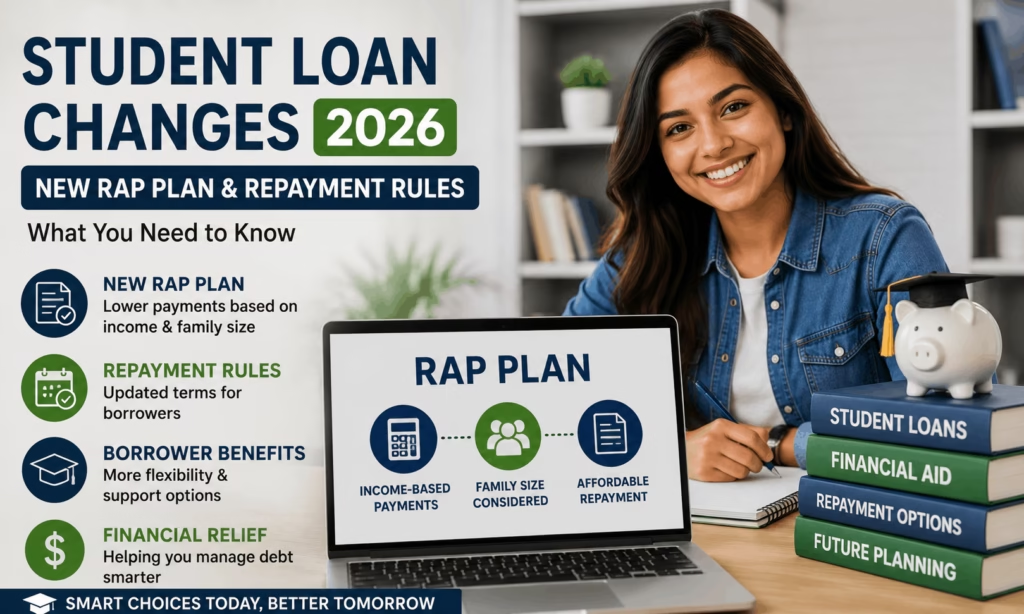
The Repayment Assistance Plan (RAP) is the centerpiece of the new system and will eventually become the only income-driven repayment option for most borrowers. Key features of RAP include:
- Minimum monthly payment of $10, even for borrowers with very low or no reported income.
- Payments scale gradually up to 10% of a borrower’s adjusted gross income (AGI), divided by 12 for a monthly figure.
- Payment amounts also factor in the borrower’s number of dependents.
- Borrowers must authorize the Department of Education to obtain tax information from the IRS to verify income and dependents, and payments are recalculated annually based on that data.
- Unlike some previous IDR plans, RAP is designed so that borrowers making full, on-time payments are shielded from runaway interest and can make steady progress on their principal balance.
- Loan forgiveness under RAP is generally available after up to 30 years of qualifying payments, a notably longer timeline than some previous plans.
Only borrowers with Direct Loans are eligible for RAP. Parent PLUS loans are not eligible for RAP unless they are consolidated into a Direct Consolidation Loan before July 1, 2026.
RAP vs. SAVE: How Monthly Payments Compare
For many borrowers, the shift from SAVE to RAP is expected to mean higher monthly payments and, in some cases, more total interest paid over the life of the loan. According to financial analysts, RAP generally offers lower income protection and higher payment percentages compared to SAVE, along with a longer timeline to forgiveness. For example, one comparison modeled a borrower with $35,000 in federal loans at 6.39% interest, earning $50,000 a year as a single filer with no dependents; while RAP could reduce that borrower’s monthly payment compared to the Standard Plan, it would not necessarily lower the total cost of the loan over time, since more of the loan term is spent accruing interest.
Timeline: Two Separate Repayment Tracks for Borrowers
The new rules create two distinct repayment tracks, depending on whether a borrower takes out any new federal loans, or consolidates existing ones, on or after July 1, 2026:
Track 1: No new loans after July 1, 2026 Borrowers who do not take out any new federal loans can generally keep their existing repayment options for now, including Standard, Graduated, Extended, and current IBR, while also having the option to voluntarily switch into the new RAP plan. However, borrowers currently on SAVE, PAYE, or ICR must transition to a different eligible plan, such as IBR or RAP, by July 1, 2028. If no choice is made by that deadline, the borrower will be automatically placed into IBR or RAP.
Track 2: New loans or consolidation after July 1, 2026 Borrowers who take out even one new loan, or who consolidate any existing loans on or after July 1, 2026, lose access to their previous repayment options entirely. For this group, the only choices going forward are the new RAP plan or the Tiered Standard Repayment Plan, and this restriction applies to the borrower’s entire loan balance, not just the newly disbursed portion.
The Tiered Standard Repayment Plan Explained
For borrowers who take out new loans after July 1, 2026, and do not actively choose RAP, the Tiered Standard Repayment Plan becomes the automatic default. This plan features fixed monthly payments, similar to a mortgage or auto loan, over a repayment term of 10 to 25 years, with the exact length determined by the total amount borrowed. Unlike RAP, this plan does not adjust based on income, meaning payments stay the same regardless of a borrower’s financial circumstances from year to year.
Public Service Loan Forgiveness (PSLF) Updates
Alongside the repayment plan overhaul, the Department of Education published final Public Service Loan Forgiveness (PSLF) regulations on October 30, 2025, which took effect July 1, 2026. According to loan servicers, these updated regulations currently have no direct impact on existing borrower payment counts or discharges, though borrowers pursuing PSLF are encouraged to monitor StudentAid.gov for further implementation updates as the new rules take hold.
How to Check Your Current Repayment Plan and Apply for RAP
Borrowers looking to understand their current status or apply for the new RAP plan can take the following steps:
- Log into your StudentAid.gov account and check the “Loan Details” section, which lists your current repayment plan.
- Review your servicer notifications, especially if you were previously enrolled in the SAVE Plan, as these will outline your specific 90-day deadline to choose a new plan.
- Apply for RAP through the income-driven repayment application on StudentAid.gov, which requires authorizing an IRS data transfer or manually uploading income documentation.
- Use the federal student loan repayment calculator at StudentAid.gov to compare estimated monthly payments across RAP, IBR, and the Standard and Tiered Standard plans before making a final decision.
- Avoid taking out new loans or consolidating before confirming how doing so could affect your eligibility for your current, potentially more favorable, repayment plan.
25 States Sue Trump Administration Over New Tariffs on Trading Partners
Trump Accounts Dell $250 Grant: Check State & ZIP Code Eligibility
Who Pays Deceased Person’s Credit Card Debt: Legal Rules Explained
Why These Student Loan Changes Matter for Borrowers
Because more than half of federal student loan borrowers have historically relied on an alternative, income-driven repayment plan, this overhaul touches a large share of the roughly 43 million Americans carrying federal education debt. Financial experts caution that borrowers should think carefully before voluntarily switching to RAP or taking out new loans after July 1, 2026, since doing so can permanently affect which repayment options remain available for their entire balance, not just new borrowing. For borrowers currently in SAVE, PAYE, or ICR, missing the 90-day transition window or the 2028 deadline could mean being automatically placed into a plan with a higher monthly payment than one they might have chosen deliberately.
Official Student Loan Resources
| Resource | Purpose | Official Link |
|---|---|---|
| StudentAid.gov | Check your repayment plan, apply for RAP, and use the repayment calculator | https://studentaid.gov |
| StudentAid.gov Court Actions Page | Updates on the SAVE Plan court ruling and borrower next steps | https://studentaid.gov/courtactions |
| U.S. Department of Education | Official press releases and program updates | https://www.ed.gov |
| Federal Student Aid Repayment Estimator | Compare monthly payments across all available plans | https://studentaid.gov/loan-simulator |
| Public Service Loan Forgiveness (PSLF) Help Tool | Track qualifying payments and employer certification | https://studentaid.gov/publicservice |
FAQs
Is the SAVE Plan still available in 2026?
No. The SAVE Plan officially ended following a March 10, 2026 court order, and borrowers previously enrolled must choose a new repayment plan within 90 days of receiving their servicer notification.
What is the RAP student loan plan?
The Repayment Assistance Plan (RAP) is a new income-driven repayment plan launched July 1, 2026, that calculates monthly payments based on income and number of dependents, starting at a $10 minimum and scaling up to 10% of adjusted gross income.
Will my monthly payment go up under the new rules?
For many borrowers switching from SAVE to RAP, monthly payments are likely to be higher, since RAP offers lower income protection and a longer path to forgiveness compared to SAVE.
Do I have to switch to RAP if I don’t take out new loans?
Not immediately. Borrowers with no new loans after July 1, 2026, can generally keep existing plans like IBR, Standard, Graduated, or Extended, but SAVE, PAYE, and ICR borrowers must choose an eligible plan by July 1, 2028.
What happens if I take out a new federal loan after July 1, 2026?
Your entire loan balance, not just the new loan, becomes limited to only the RAP or Tiered Standard Repayment Plan going forward.
How long does it take to get loan forgiveness under RAP?
Forgiveness under RAP is generally available after up to 30 years of qualifying payments, longer than several of the plans it replaces.
Are Parent PLUS loans eligible for RAP?
Only if they are consolidated into a Direct Consolidation Loan before July 1, 2026; otherwise, Parent PLUS loans are not eligible for RAP under any circumstance.
Where can I apply for the new RAP plan?
You can apply through the income-driven repayment application on StudentAid.gov, which requires income verification through an IRS data transfer or manual documentation.
Conclusion
The 2026 student loan repayment changes mark one of the most significant shifts in federal loan policy in years, replacing familiar plans like SAVE, PAYE, and ICR with the new Repayment Assistance Plan and a Tiered Standard Repayment Plan. While the transition is being phased in gradually through July 2028, borrowers who ignore servicer notifications or take out new loans without understanding the consequences risk being placed into repayment plans with higher monthly payments than necessary. Reviewing your current plan on StudentAid.gov, comparing options with the official repayment calculator, and acting before key deadlines remain the best ways to stay in control of your student debt as these changes continue to roll out. This article will be updated monthly as new Department of Education guidance becomes available.
Social Security Changes August 2026: SSA Announces Major Update for Retirees and Beneficiaries
Alaska PFD Payment 2026: It’s Actually $1,200, Not Just $1,000 – Here’s the Truth