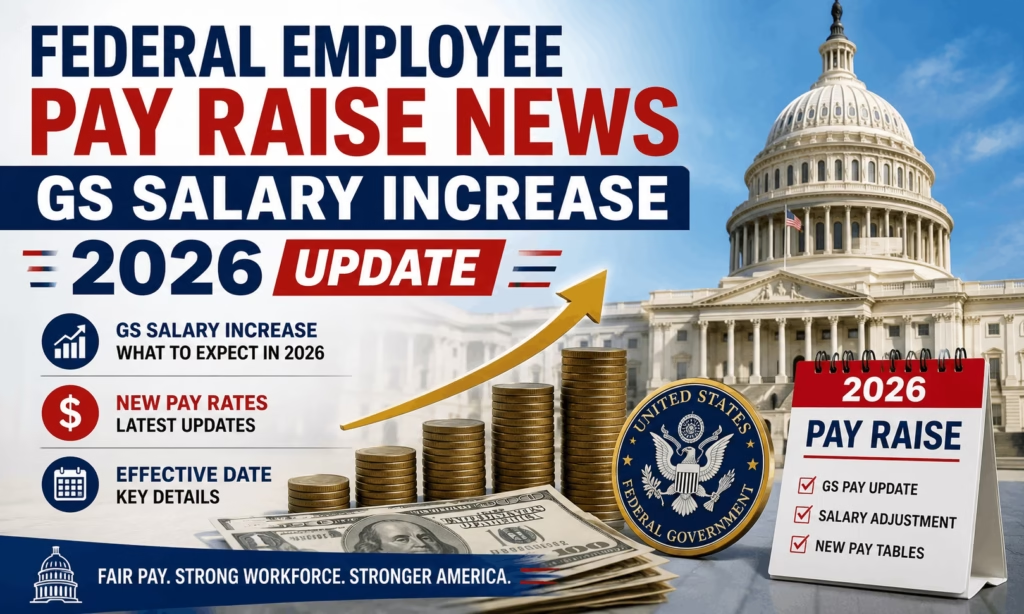
Federal Worker Pay Increase 2026: Federal workers finally have clarity on their paychecks, and the answer is smaller than many hoped for. Most civilian employees under the General Schedule are now receiving a 1% across-the-board pay raise, the smallest annual adjustment federal employees have seen since 2021, after President Donald Trump signed Executive Order 14368 on December 18, 2025. The order confirmed the numbers first floated in the White House’s alternative pay plan back in August, and it left one detail unchanged from 2025: locality pay. Employees in high-cost regions such as Washington, D.C., New York, and the Bay Area will not see any adjustment to their locality rates this year, which means take-home pay in expensive metro areas is rising only marginally even though the base pay table did move.
The raise officially took effect on January 11, 2026, the first full pay period of the new year, and it applies to General Schedule employees, the Foreign Service Schedule, and Executive Schedule levels I through V. One group did come out ahead: certain federal law enforcement officers are receiving a total pay increase of 3.8%, matching the 2026 military pay raise, after the Office of Personnel Management used its special salary rate authority to add 2.8 percentage points on top of the standard 1% base bump. We’ll be updating this article monthly as new federal pay data, OPM salary tables, and 2027 pay plan developments are confirmed, so bookmark this page if you want the latest numbers without digging through government press releases yourself.
Federal Employee Pay Raise 2026 Key Highlights
| Detail | Information |
|---|---|
| Authorizing document | Executive Order 14368, signed December 18, 2025 |
| Standard civilian raise | 1.0% base pay increase, General Schedule and related pay systems |
| Locality pay adjustment | 0%, frozen at 2025 rates |
| Effective date | January 11, 2026 (first full pay period of 2026) |
| Law enforcement officer raise | 3.8% total (1.0% base plus a 2.8% special salary rate add-on) |
| Military pay raise 2026 | 3.8%, set through the National Defense Authorization Act |
| Executive Schedule (EX I-V) | 1.0% increase, rounded to the nearest $100 |
| Federal pay cap for 2026 | $197,200 per year |
| 2025 comparison raise | Approximately 2% average increase |
| Proposed 2027 pay plan | 0% freeze for most civilians, 3.8% again for qualifying law enforcement, submitted August 26, 2026 |
Executive Order 14368 Explained
Under the Federal Employees Pay Comparability Act, the president has to send Congress an alternative pay plan by early September each year or let a much larger formula-driven raise take effect automatically. Without the administration’s intervention, the FEPCA formula would have produced an average locality increase near 18.88% on top of a 3.3% across-the-board raise, numbers the White House called fiscally unrealistic given current budget constraints. Instead, the alternative pay plan submitted on August 28, 2025, proposed the 1% figure, and Congress did not pass legislation to override it during the fall appropriations process. When no override materialized, Executive Order 14368 made the plan official in mid-December, and the Office of Personnel Management posted updated salary tables so payroll offices across every federal agency could apply the new rates starting with the first paycheck of 2026.
This is a process that repeats every year, and it explains why so many federal pay stories seem to run in cycles: a proposal in August, union pushback in the fall, a possible congressional override attempt, and a final executive order in December. Employees who track this cycle are rarely caught off guard, but this year’s outcome, the smallest raise since the first Trump administration’s 2021 pay freeze year, still landed as a disappointment for many career civil servants who had expected something closer to the 2% they received in 2025.
GS Pay Scale 2026: How Much More Will You Actually See?
The General Schedule pay table is built on 15 grades and ten steps, and the 1% increase applies uniformly to every base rate on the chart. Because locality pay stayed flat, the dollar impact for most employees is modest. A GS-7 Step 1 employee under the Rest of U.S. locality table, for example, moved from roughly $27,231 to around $27,708 in base pay before locality is added, while a GS-12 employee saw a comparable one percent bump on a higher base. The table below shows a simplified snapshot of the 2026 GS base pay scale for a few common grades before locality pay is applied.
| GS Grade | Step 1 (2026 Base) | Step 5 (2026 Base) | Step 10 (2026 Base) |
|---|---|---|---|
| GS-5 | $34,799 | $39,439 | $45,239 |
| GS-7 | $42,022 (approx.) | $47,655 (approx.) | $54,624 (approx.) |
| GS-9 | $51,559 (approx.) | $58,461 (approx.) | $67,020 (approx.) |
| GS-12 | $73,939 (approx.) | $83,830 (approx.) | $96,117 (approx.) |
| GS-13 | $87,924 (approx.) | $99,676 (approx.) | $114,306 (approx.) |
These figures are base General Schedule rates before locality pay is layered on, so an employee’s actual paycheck will be higher depending on where they are stationed. For the official, legally binding pay tables broken down by every locality pay area, always cross-check against the Office of Personnel Management’s published salary tables rather than relying on secondhand summaries, since OPM occasionally issues corrections after initial publication.
How Government Shutdown Affects VA Benefits, Will Your Payment Still Arrive?
Do I Qualify for ACA Subsidy 2027? The 400% FPL Cliff Explained
ACA Open Enrollment 2027 Dates: Deadlines, New Rates and Subsidy Calculator
Law Enforcement Officers Get a 3.8% Federal Pay Raise: Who Actually Qualifies?
The standout piece of the 2026 pay story is the carve-out for federal law enforcement. Rather than the flat 1% most civilian employees received, OPM used its special salary rate authority under Title 5 to deliver a total 3.8% raise, matching what service members received under the 2026 defense authorization. The agency published a memo detailing which roles qualify, and the list is heavily weighted toward front-line enforcement and protective positions. Confirmed categories include Forest Service law enforcement officers and criminal investigators, USDA Office of Safety, Security and Protection personnel who provide personal protection services, FBI special agents, Bureau of Prisons correctional officers, Drug Enforcement Administration special agents, and deputy United States marshals, among other Justice Department roles.
OPM framed the enhanced rate as a recruitment and retention tool, noting in its memo that the special rates support ongoing hiring for what it called mission-critical law enforcement positions tied to border security and public safety enforcement priorities. Agencies that believe additional positions should qualify can submit special salary rate requests to OPM at any time, so the list of covered roles could expand later in the year. The higher rate is still subject to the federal pay cap of $197,200 annually, meaning very senior law enforcement supervisors near the top of the pay scale may not see the full percentage increase reflected in their paycheck once the cap is applied.
Military Pay Raise 2026 vs. Civilian Federal Pay Raise: The Gap Explained
Active-duty service members received a 3.8% base pay raise for 2026, a figure set through the National Defense Authorization Act rather than the president’s alternative civilian pay plan. That 3.8% number became the benchmark the administration used when deciding how much extra to give qualifying law enforcement officers, effectively aligning uniformed protective federal roles with military compensation while leaving the broader civilian workforce, from GS analysts to program managers to administrative staff, at the much smaller 1% rate. Unions representing rank-and-file federal employees have repeatedly pointed to this gap as evidence that civilian pay is falling behind both inflation and comparable military compensation growth.
Locality Pay Frozen at 2025 Levels: What It Means for High-Cost Areas
Locality pay exists to help federal salaries stay competitive with private-sector wages in expensive labor markets, and it is calculated as a percentage on top of GS base pay. For 2026, that percentage did not move. An employee in the Washington, D.C., locality area, for example, still receives the same locality percentage that applied in 2025, just calculated against a very slightly higher base rate because of the 1% bump. The practical effect is that employees in major metro areas such as New York, San Francisco, Los Angeles, and the Washington metro region will see a smaller net percentage increase in their actual take-home pay compared with employees in lower-cost localities where the gap between base pay and locality-adjusted pay is narrower to begin with.
This freeze marks a departure from several recent years, when locality pay increases were folded in alongside the base raise. The administration has not indicated locality rates will be revisited mid-year, and the 2027 alternative pay plan proposes keeping locality pay frozen again, so employees in high-cost areas should not expect a locality catch-up adjustment in the near term.
Federal Pay Raise Calculator: Estimate Your New Salary
Use the calculator below to estimate how the 2026 federal pay raise affects your annual, biweekly, and monthly pay. Select whether you fall under the standard 1% civilian rate or the 3.8% law enforcement special rate, enter your current annual salary, and the calculator will do the math instantly. This tool is for general estimation only and does not account for locality pay changes, step increases, or the federal pay cap, so always confirm final figures against your agency’s payroll office or the official OPM salary tables.
Federal Employee Pay Raise Calculator
Federal Employee Pay Raise Calculator
Healthcare.gov Premiums Rising 2027: What Changed and What It Means for Your Coverage
ACA Subsidy Cliff 2027: Premiums Could Double, Calculator Inside
Diesel Prices Impact on Food Stamps: How $6-a-Gallon Fuel Is Quietly Shrinking SNAP Benefits
Payment Schedule: When the Raise Actually Showed Up in Paychecks
Federal payroll runs on a biweekly cycle, and pay raises take effect on the first day of the first full pay period beginning on or after January 1. For 2026, that date was January 11. Employees did not see the new rate reflected in a paycheck dated in early January because of how the biweekly lag works; most agencies processed the first paycheck showing the increased rate in late January, with retroactive adjustments applied automatically by payroll systems for the days worked between January 1 and January 11 where applicable. No employee needed to submit a request or update any paperwork for the raise to apply. It was processed automatically through each agency’s payroll provider, primarily the Defense Finance and Accounting Service for Defense Department civilians and the National Finance Center or other shared service providers for most other agencies.
How to Apply: No Action Needed From Employees
One of the most common questions federal employees ask every year is whether they need to apply for the raise. They do not. The General Schedule pay increase, the law enforcement special rate, and the Executive Schedule adjustment are all applied automatically by OPM and individual agency payroll systems once the executive order is signed. Employees can verify their new pay rate through their agency’s self-service payroll portal, their Standard Form 50 personnel action notice, or their Leave and Earnings Statement, which should reflect the updated base pay and, where applicable, the special law enforcement rate starting with the first applicable pay period.
2027 Federal Pay Freeze Proposal: What Comes Next
Just as the 2026 raise settled in, attention shifted to 2027, and the news was not encouraging for most civilian employees. On August 26, 2026, President Trump transmitted a new alternative pay plan letter to Congress proposing a 0% increase for most federal civilians in 2027, meaning both base pay and locality pay would stay frozen at 2026 levels if the proposal holds. The letter again carved out an exception for qualifying law enforcement personnel, who are expected to keep receiving the 3.8% special rate, while the broader military pay raise proposal for 2027 has been discussed in the 5% to 7% range depending on rank, a notably larger gap than in 2026.
Congress retains the authority to override the proposed freeze through the appropriations process, and the Federal Adjustment of Income Rates Act, known as the FAIR Act, has been reintroduced by some lawmakers proposing a 4.1% average raise for civilian employees instead. As of this writing, the FAIR Act has not been enacted, and past years show Congress rarely overrides an alternative pay plan once it has been submitted. The freeze becomes final when OPM issues the official year-end executive order, typically in December, so employees should treat the 0% figure as a strong likelihood rather than a locked-in certainty until that order is signed.
Impact on FERS and CSRS Retirement Annuities
A pay freeze does more than affect a single year’s paycheck. Both the Federal Employees Retirement System and the older Civil Service Retirement System calculate pension annuities using a High-3 average, the average of an employee’s highest three consecutive years of base pay. A flat or minimally increasing salary trajectory in 2026 and 2027 means that average grows more slowly, which can modestly reduce lifetime annuity payments for employees who retire in the years immediately following a freeze compared with employees who retired after several years of stronger raises. Financial planners who specialize in federal benefits generally recommend that employees close to retirement review their High-3 projections whenever a freeze or below-average raise is proposed, since even small changes compound over a 20- or 30-year retirement.
Union Reaction: NTEU and NARFE Push Back
Federal employee unions did not stay quiet after the 1% figure was finalized. The National Treasury Employees Union called the 2026 raise meager and inadequate, arguing that if law enforcement and military personnel warranted a 3.8% increase, the same treatment should extend to the rest of the federal workforce. NTEU has backed legislation calling for a 4.3% average raise for all federal employees. The National Active and Retired Federal Employees Association, NARFE, echoed similar concerns, with its national president noting that federal workers are facing rising health insurance premiums and other cost pressures even as their base pay grows at its slowest pace in years. Neither union’s alternative proposal has been enacted into law as of this update.
$994 SNAP Benefit for a Family of 4 in 2026 — Calculate Your Exact Amount
Social Security Government Shutdown 2026: Will Your Check Still Arrive?
Federal Employees Back Pay Shutdown 2026: Are You Guaranteed to Get Paid?
Official Resources: Where to Check Your Pay Status
| Resource | Purpose | Official Link |
|---|---|---|
| OPM Salary Tables | Official GS, locality, and special rate pay tables | opm.gov/salary-tables |
| OPM Pay and Leave Policy | General pay administration rules and fact sheets | opm.gov/pay-leave |
| Federal Register | Full text of executive orders, including EO 14368 | federalregister.gov |
| DFAS myPay | Login and pay statement access for DoD civilian and military pay | mypay.dfas.mil |
| OPM Retirement Center | FERS and CSRS annuity information and High-3 guidance | opm.gov/retirement-center |
| USAJOBS | Federal job listings and official pay grade information | usajobs.gov |
FAQs About Federal Employee Pay Increase 2026
What is the federal employee pay raise for 2026?
Most civilian federal employees are receiving a 1.0% across-the-board base pay increase, with locality pay frozen at 2025 levels, effective January 11, 2026.
Is the 2026 federal pay raise final, or could it still change?
It is final. President Trump signed Executive Order 14368 on December 18, 2025, and Congress did not pass legislation to override the figure before the deadline.
Do federal law enforcement officers get a bigger raise?
Yes. Qualifying law enforcement officers, including certain FBI, DEA, Bureau of Prisons, Forest Service, and U.S. Marshals Service personnel, receive a total 3.8% raise through OPM’s special salary rate authority.
Why is locality pay frozen in 2026?
The administration’s alternative pay plan set locality pay increases at 0% for 2026 to control federal payroll costs, meaning locality percentages stayed at their 2025 levels even though base pay rose 1%.
When did the 2026 pay raise start appearing in paychecks?
The raise took effect January 11, 2026, the first full pay period of the year, with most employees seeing the updated rate reflected in paychecks issued in late January.
Do employees need to apply for the pay raise?
No. The increase is applied automatically by agency payroll systems. No application, form, or request is required from individual employees.
What is being proposed for the 2027 federal pay raise?
On August 26, 2026, the administration proposed a 0% pay freeze for most civilian employees in 2027, while qualifying law enforcement personnel would again receive a 3.8% increase. This proposal is not yet finalized.
How does the federal pay raise affect retirement benefits?
Because FERS and CSRS pensions are based on an employee’s High-3 average salary, a small or frozen raise can slightly slow the growth of that average, which may modestly reduce future annuity payments for employees retiring in the affected years.
Where can I find the official 2026 GS pay tables?
The complete, legally binding pay tables are published directly on OPM’s salary tables page, broken down by locality pay area, grade, and step.
Did federal employees get a raise in 2026?
Yes, most received a 1% base pay increase effective January 11, 2026, though locality pay did not increase.
What percentage raise did federal employees get?
1.0% for most civilian General Schedule employees, and 3.8% for qualifying federal law enforcement officers.
Will there be a federal pay raise in 2027?
As proposed in August 2026, most civilians would see a 0% freeze in 2027, though this could still change before a final executive order is issued in December.
How is the GS pay scale calculated after a raise?
The percentage increase is applied to the existing base rate for each grade and step, and locality pay, when adjusted, is then calculated as a percentage on top of the new base.
Conclusion
The 2026 federal employee pay raise landed smaller than many in the workforce expected, with a flat 1% base increase, no locality pay bump, and a sharper divide between standard civilian employees and the law enforcement personnel who secured a 3.8% rate matching military pay. With a 2027 pay freeze now on the table and unions actively lobbying against it, federal employees have real reason to keep watching this issue closely over the coming months. The most reliable path forward is to monitor official OPM pay tables directly, keep an eye on whether Congress intervenes before the December deadline, and factor a possible freeze year into any near-term retirement planning. This page will continue tracking every confirmed update as the 2027 pay plan moves toward its final executive order.
Will SNAP Benefits Stop If the Government Shuts Down Again?
Republican Convention 2026: Trump’s Biggest Asset or Obstacle for the GOP?
Government Shutdown October 2026 Averted — Funding Runs to Dec 11