
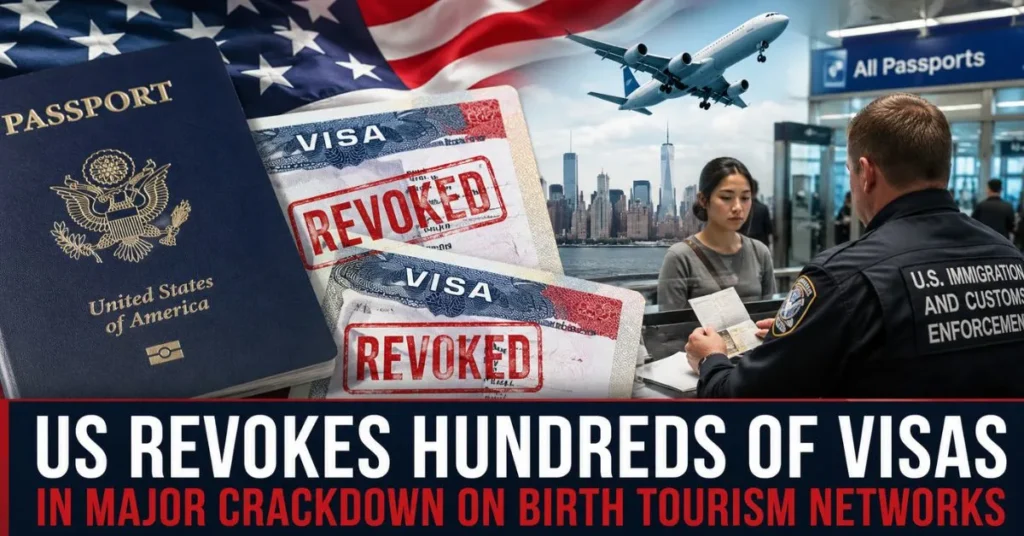
The United States government has launched a major crackdown on so-called “birth tourism” networks, leading to the revocation of hundreds of visas and renewed scrutiny of foreign visitors entering the country. Federal authorities say the effort is aimed at preventing the misuse of immigration and visa systems by individuals who travel to the U.S. primarily to give birth and secure American citizenship for their children.
The latest enforcement actions highlight growing concerns among policymakers and immigration officials regarding organized businesses that facilitate birth tourism by helping expectant mothers enter the United States under false pretenses. According to officials, investigations have uncovered networks operating in several countries that allegedly provide services ranging from travel arrangements and accommodation to coaching clients on how to avoid raising suspicions during visa interviews and customs inspections.
What Is Birth Tourism?
Birth tourism refers to the practice of traveling to another country with the primary purpose of giving birth there so that the child automatically acquires citizenship. In the United States, citizenship is granted to nearly all individuals born on American soil under the principle of birthright citizenship, which is protected by the Fourteenth Amendment of the U.S. Constitution.
While giving birth in the United States is not illegal in itself, authorities argue that problems arise when travelers misrepresent their intentions when applying for visas or entering the country. Immigration officials have repeatedly emphasized that visa fraud, false statements, and deliberate concealment of travel purposes violate U.S. immigration laws.
Over the years, specialized agencies have emerged in several parts of the world, marketing birth tourism packages to wealthy families seeking future educational, travel, and employment opportunities for their children through U.S. citizenship.
Visa Revocations Reach Hundreds
The recent enforcement campaign has reportedly resulted in hundreds of visa cancellations. Officials stated that individuals connected to birth tourism schemes were identified through detailed investigations involving immigration records, financial transactions, travel histories, and communications between facilitators and clients. Authorities noted that many visa holders allegedly obtained travel documents by providing misleading information regarding the purpose of their visits. In some cases, travelers reportedly claimed they were visiting for tourism, shopping, or family vacations while planning to remain in the country until childbirth.
The visa revocations serve as both a punishment and a deterrent, signaling that immigration authorities are taking a stricter stance on activities viewed as abuse of the visa system. Government representatives have warned that individuals found to have participated in fraudulent schemes may face future travel restrictions, visa denials, or other immigration consequences.
Organized Networks Under Investigation
Federal investigators have increasingly focused on organized birth tourism businesses rather than individual travelers alone. Authorities claim some companies have generated substantial profits by advertising U.S. citizenship as a valuable investment for future generations.
These businesses often promote comprehensive service packages that include:
- Visa application assistance
- Housing arrangements near hospitals
- Transportation services
- Medical appointment scheduling
- Legal consultations
- Guidance on interactions with immigration officers
Investigators allege that some operators instructed clients on how to conceal pregnancies, understate the expected duration of their stay, or avoid discussing childbirth plans during visa interviews. Law enforcement agencies have conducted searches, gathered evidence, and pursued legal action against facilitators accused of conspiracy, visa fraud, tax violations, and money laundering.
Why U.S. Authorities Are Taking Action
Officials argue that birth tourism creates several challenges for immigration enforcement and public resources. One concern involves the integrity of the visa system. Authorities maintain that tourist visas are intended for temporary visits and not for obtaining immigration-related benefits through deceptive means. Another concern centers on public confidence in immigration policies. Critics of birth tourism contend that organized networks exploit legal loopholes and undermine the fairness of immigration procedures.
Additionally, some policymakers have raised questions regarding unpaid medical expenses. Although many birth tourism clients reportedly pay for healthcare services privately, there have been instances where hospitals and healthcare providers faced difficulties recovering costs from foreign visitors. Authorities stress that their current enforcement efforts focus on fraudulent conduct rather than lawful travel or medical tourism.
Birthright Citizenship Remains Unchanged
Despite the crackdown on birth tourism operations, the legal principle of birthright citizenship remains intact in the United States. Children born in the country generally continue to receive U.S. citizenship regardless of their parents’ nationality or immigration status. Legal experts note that changing this constitutional framework would require significant legal and political action.
The current enforcement measures are directed primarily at individuals and organizations accused of violating visa regulations rather than challenging citizenship rights for children born in the United States. Immigration attorneys have emphasized that there is an important distinction between lawful childbirth during a legitimate visit and entering the country through deception specifically to obtain citizenship benefits.
International Impact of the Crackdown
The visa revocations are expected to have consequences beyond U.S. borders. Immigration experts believe the enforcement campaign may discourage prospective birth tourists from pursuing similar arrangements in the future. Travel agencies and consulting firms that previously marketed birth tourism services may also face increased scrutiny from both American and foreign authorities.
Some countries have already begun reviewing outbound travel patterns and visa-related activities connected to birth tourism. Governments around the world are paying closer attention to businesses that advertise citizenship-related services abroad. Industry observers predict that stricter enforcement may reduce demand for birth tourism packages, particularly if potential clients become concerned about visa denials or future travel restrictions.
Legal Consequences for Participants
Individuals involved in birth tourism schemes could face a range of legal consequences depending on the circumstances of each case.
Potential penalties may include:
- Visa cancellation
- Inadmissibility findings
- Future visa denials
- Deportation proceedings in certain situations
- Financial penalties
- Criminal charges related to fraud or false statements
Legal experts advise foreign travelers to provide accurate information throughout the visa application process and during interactions with immigration officials. Misrepresentation can have long-term consequences that affect future travel opportunities, educational plans, business activities, and immigration applications.
Supporters and Critics Debate the Issue
The crackdown has sparked debate among immigration advocates, legal scholars, and policymakers. Supporters of the enforcement effort argue that the government has a responsibility to protect the integrity of immigration laws and prevent organized fraud. They contend that visa holders should be transparent about their intentions and that fraudulent activity should carry meaningful consequences.
Critics, however, caution against broad enforcement measures that could inadvertently affect legitimate travelers. Some immigration advocates argue that authorities should carefully distinguish between deliberate fraud and lawful visitors who happen to give birth while in the United States. Others note that birthright citizenship has long been a foundational element of American law and should not become a target in broader immigration debates.
Economic and Social Dimensions
Birth tourism has evolved into a multimillion-dollar industry in certain regions. Service providers often market American citizenship as offering long-term advantages, including easier access to education, travel flexibility, and potential employment opportunities. Supporters of stricter enforcement argue that commercialization of citizenship-related benefits raises ethical concerns and creates incentives for fraudulent behavior.
At the same time, some economists note that birth tourism clients often spend significant amounts of money on housing, healthcare, transportation, and other services during their stay. The economic impact varies by location, with some communities experiencing increased demand for short-term rentals and maternity-related services. However, policymakers increasingly appear focused on regulatory compliance and immigration integrity rather than the economic benefits associated with the industry.
Future Enforcement Expected
Immigration experts believe the recent visa revocations represent only the beginning of broader enforcement efforts. Authorities have indicated that investigations into birth tourism networks remain ongoing and may expand further in the coming months. Federal agencies are reportedly enhancing cooperation with international partners, financial regulators, and law enforcement organizations to identify additional facilitators and participants.
Technology and data analytics are also playing a growing role in detecting suspicious travel patterns, visa applications, and financial transactions associated with organized birth tourism operations. Officials have urged travelers to ensure that all information provided during visa applications and border inspections is accurate and truthful.
Fact Check:
The U.S. government has taken enforcement actions against individuals and organizations involved in birth tourism schemes, particularly where visa fraud or misrepresentation is alleged. The U.S. Department of State has stated that using a tourist visa primarily to obtain U.S. citizenship for a child through birth tourism may lead to visa denial or revocation. Federal investigations in recent years have targeted companies accused of helping foreign nationals conceal the true purpose of their travel to the United States. Birthright citizenship under the Fourteenth Amendment remains in effect, meaning most children born on U.S. soil automatically acquire U.S. citizenship regardless of their parents’ nationality.
Disclaimer:
This article is intended for informational and news reporting purposes only. Information is based on publicly available reports, official statements, and ongoing developments at the time of publication. Immigration laws, visa policies, and enforcement actions may change over time. Readers should consult official U.S. government sources or qualified immigration professionals for the most current guidance regarding visa regulations, citizenship matters, and travel requirements. The article does not constitute legal, immigration, or professional advice.
Also Read:
New Canada Groceries and Essentials Benefit (CGEB) Payments coming in July 2026
2027 Social Security COLA Forecast: Higher Inflation Could Add Up to $95 Per Month to Benefits
How Much Will Social Security Retirees Receive on July 10? Maximum and Average Payment
$5280 CRA My Account Breach Claims 2026: How Affected Canadians Could Qualify for Compensation