
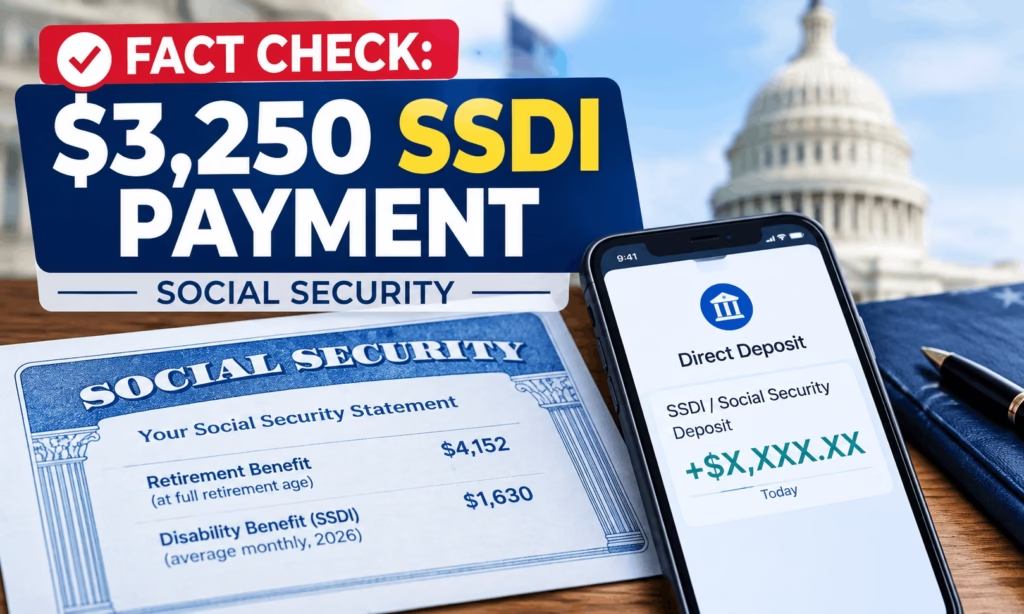
$3250 SSDI and Social Security Payment 2026 Fact Check: The $3,250 SSDI and Social Security payment claim circulating across social media and aggregator sites is not a real one-time check, and no such payment has ever been announced by the Social Security Administration. The figure is a mash-up of real numbers pulled out of context: it lands close to what a small slice of high-earning SSDI recipients receive monthly, and close to the combined average benefit for some retired couples, but it is not a bonus, stimulus payment or universal deposit. SSA has issued no announcement matching this description, and the agency’s own data shows the true 2026 averages are far lower than the viral number suggests. We’ll be updating this article monthly.
This kind of claim spreads easily because it borrows real, verifiable numbers and repackages them as a single dramatic figure. Search interest in phrases combining a dollar amount with “SSDI” or “Social Security” spikes every time a new cost-of-living adjustment is announced, and 2026 is no exception, especially with the 2027 COLA forecast now drawing fresh attention. Below is a full breakdown of where the $3,250 figure actually comes from, the real average and maximum SSDI and Social Security amounts for 2026, a calculator to check where your own benefit falls, and the official SSA resources to confirm your exact payment.
$3,250 SSDI and Social Security Payment Fact Check Summary
| Claim | Status | Reality |
|---|---|---|
| A one-time $3,250 payment is going out to SSDI and Social Security recipients | False | No such one-time payment has been announced by SSA; benefits are paid monthly, not as lump sums |
| $3,250 represents the average SSDI or Social Security check | Misleading | The 2026 average SSDI payment is about $1,630 and the average retirement benefit is about $2,071 |
| $3,250 is close to a real benefit figure for some recipients | Partly true | It sits near the combined average for retired couples ($3,208) and above the average SSDI benefit with dependents ($2,937), not a standalone figure |
| The number is tied to the 2026 COLA | Partly true | The 2.8% COLA that took effect in January 2026 raised monthly benefits, but did not create a new $3,250 payment |
FEHB 2026 Open Season: Which Plans Left and What It Means for Your Premium?
IRS 2027 Tax Brackets: How Much Can You Earn Before Hitting the 37% Rate
32-Hour Workweek Bill: What the Thirty-Two Hour Workweek Act Means for Your Paycheck
SSDI and Social Security Benefit Calculator: What Does the Average Person Actually Get?
SSDI & Social Security Benefit Calculator
Estimate your monthly payment using the SSA’s official 2026 benefit formula, then see how it compares to what the average person actually receives.
This stands in for your AIME (average indexed monthly earnings) — the average of your highest-earning 35 years, in today’s dollars. Find your actual AIME on your Social Security Statement at ssa.gov/myaccount. Earnings above the 2026 taxable maximum ($184,500/yr) don’t count.
How you compare to the average person
Figures reflect the SSA’s 2026 COLA (2.8%) and 2026 bend points ($1,286 / $7,749). Sources: Social Security Administration, ssa.gov/OACT.
Where Did the $3,250 Figure Actually Come From?
Tracing the number back to real SSA data shows how the myth was built. None of these real figures is $3,250 on its own, which is exactly why the claim falls apart under a direct fact check.
| Real SSA figure | 2026 amount | How it may have been misread |
|---|---|---|
| Average SSDI payment with dependents | $2,937 a month | Rounded up and confused with a higher, unrelated number |
| Average combined benefit for retired couples | $3,208 a month | Close to $3,250 but describes two people’s combined income, not one payment |
| Higher-earner SSDI benefit examples | Roughly $2,300 to $3,000+ for long, high-earning careers | Cited as if it were the typical or guaranteed amount |
| Maximum SSDI or retirement benefit at full retirement age | $4,152 a month | The true ceiling, well above $3,250, sometimes conflated with it |
Fact-checking sites that examined the same viral claim in late 2025 reached the same conclusion: no one-time $3,250 payment exists, and the number is best understood as a rough midpoint between an above-average individual benefit and a below-maximum household figure, not an actual line item in any SSA program.
Real SSDI and Social Security Payment Amounts 2026
These are the verified, SSA-sourced monthly figures for 2026, after the 2.8% cost-of-living adjustment that took effect in January.
| Benefit type | 2026 average | 2026 maximum |
|---|---|---|
| SSDI, disabled worker only | $1,630 | $4,152 |
| SSDI, disabled worker with dependents | $2,937 | Varies by family, capped by family maximum rules |
| Social Security retirement, individual | $2,071 | $5,181 (claiming at age 70) |
| Social Security retirement, married couple (both receiving) | $3,208 combined | Varies; can exceed $8,000 combined for two maximum earners |
| Survivor benefit (widow or widower) | $1,919 | Varies by deceased worker’s record |
| SSI, individual | $717 to $737 (varies by source, up to the $994 federal maximum) | $994 |
| SSI, eligible couple | Varies | $1,491 |
None of these individual categories lands exactly on $3,250. The closest real figures are the average combined benefit for two-income retired couples, at $3,208, and the average SSDI benefit with dependents, at $2,937, both of which describe household totals or family-inclusive averages rather than a single new payment type.
It helps to see the spread of individual benefits behind these averages, since a single average can hide wide variation. SSA’s own distribution data shows more than 17 million retirement beneficiaries collecting less than $2,000 a month, while nearly 7 million collect less than $1,000. A small number of long-career, high-earning workers push the maximum figures up toward $4,152 or $5,181, but they are a minority of the total recipient population, which is exactly why treating $3,250 as a typical or guaranteed amount misrepresents most people’s actual experience.
Why the $3,250 Claim Keeps Spreading
Viral benefit-amount claims tend to follow a predictable pattern. A real cost-of-living adjustment or a real high-earner example gets shared without context, headlines round the number to something catchy, and aggregator sites republish the figure without linking back to an actual SSA announcement. Search behavior amplifies this: people searching “$3,250 SSDI” or “$3,250 Social Security payment” generate demand that low-quality content farms are quick to fill with speculative or recycled articles, some acknowledging the number is a myth only after using it as clickbait in the headline.
SSA itself has repeatedly confirmed that benefits are paid monthly, based on an individual’s own earnings record or family relationship to a qualifying worker, never as a flat lump sum distributed to all recipients regardless of history. Any claim describing a fixed dollar amount going to “everyone on SSDI” or “everyone on Social Security” should be treated as a red flag, since SSA benefit formulas are inherently individualized.
Flat-Rate COLA: What the 2027 Social Security Proposal Really Means for Retirees
Hungary Poland Immigrant Visa Resumption: What Changed and Who Is Affected?
DHS LPR Rule for Foreign Government Employees’ Children: Eligibility, Fees and How to Apply
How Fact-Checkers Rated the $3,250 Claim?
Independent financial and news sites that examined versions of this claim in late 2025 and again in 2026 reached a consistent conclusion: the $3,250 figure is not tied to any SSA program, law or announcement. Several outlets found the number circulating in headlines promising a “$3,250 boost” or “$3,250 payment update,” only for the body text to clarify, sometimes many paragraphs in, that no such single payment exists and that the figure is really a loose approximation of certain benefit categories. This pattern, a dramatic headline followed by a walked-back explanation, is a hallmark of clickbait built around real government programs rather than outright invented ones.
This matters because half-true claims spread faster and last longer than fully invented ones. A reader who skims only the headline and image, without reading the clarifying paragraphs, comes away believing a new payment is coming. That is why fact-checking organizations classify this kind of claim as misleading rather than entirely false: the underlying numbers exist in SSA’s data, but the way they are combined and presented misrepresents what any individual recipient will actually receive.
How to Verify Your Real Social Security or SSDI Payment Amount?
- Sign in to your my Social Security account at ssa.gov and check your Benefit Verification Letter or Payment History, which shows your actual current and past amounts.
- If you do not have an account, register using Login.gov or ID.me, which takes a few minutes with identity verification.
- Compare your figure against the verified averages and maximums in the tables above, not against a number seen in a social media post or unofficial article.
- If a message, text or email claims you qualify for a special $3,250 payment and asks for personal information or a fee, treat it as a likely scam and do not click any links.
- Call SSA directly at 1-800-772-1213 (TTY 1-800-325-0778) if you are unsure whether a communication about your benefits is genuine.
How to Apply for SSDI or Social Security Benefits?
If you are not yet receiving either benefit, the application process is separate from this fact check but follows a clear path.
- Confirm which program fits: SSDI requires enough work credits and a qualifying disability; retirement benefits are based on your own work record and can start as early as 62.
- Create a my Social Security account and start your application online, or call to begin an SSDI claim, which usually requires a more detailed interview and medical documentation.
- Gather supporting documents: proof of age and identity, work and earnings history, and, for SSDI, complete medical records showing your condition and its impact on your ability to work.
- Submit the application and track its status through your online account.
- Respond promptly to any SSA request for additional medical or financial documentation to avoid delays.
Other Social Security Myths Worth Knowing
The $3,250 claim is part of a broader pattern of recurring Social Security misinformation. Similar viral posts have falsely claimed a $200 or $500 “stimulus-style” bonus for seniors, a guaranteed fourth-quarter payment boost unrelated to the COLA, or a special one-time payment tied to inflation relief that SSA never authorized. Each of these follows the same structure: a real, boring administrative fact, such as an annual COLA percentage or an average benefit figure, gets rounded, dramatized and stripped of context until it reads like breaking news.
The most reliable filter is the source. Genuine benefit changes are always traceable to an SSA press release, a Federal Register notice, or a direct statement from the agency, and they always describe a percentage adjustment or a specific program change rather than a flat bonus paid to everyone. If a claim cannot be traced to one of these sources, it should be treated as unverified until confirmed directly through ssa.gov.
SSDI and Social Security Processing Time in 2026
Retirement claims with complete records are typically the fastest, often finished within a few weeks when filed online. SSDI claims take considerably longer because each one requires a medical disability determination by a state agency. Disability decision data reported for mid-2026 showed initial decisions averaging around six months, with reconsiderations and hearings adding several more months when a claim is appealed. Applying online, keeping medical records current, and responding quickly to SSA requests remain the most effective ways to avoid extra delay.
What a Real SSA COLA Announcement Looks Like?
Understanding the format of a genuine SSA announcement helps distinguish real news from recycled viral claims. Official cost-of-living adjustments are announced once a year, typically in mid-October, based on a specific, publicly documented formula comparing the Consumer Price Index for Urban Wage Earners and Clerical Workers across a defined base period. The announcement names an exact percentage, not a flat dollar figure, and that percentage applies proportionally to each recipient’s own existing benefit, which is why two people on SSDI can see very different dollar increases from the same COLA.
A genuine SSA announcement is published on ssa.gov, referenced in the Federal Register, and distributed through mainstream news outlets citing the agency directly. It never arrives as an image-based social media post promising a specific dollar amount for every recipient, and it never asks the recipient to click a link, verify personal information, or pay a fee to receive it. The 2026 COLA of 2.8% and the forecasted 2027 COLA, expected in the 3.5% to 3.6% range, both follow this exact pattern, unlike the $3,250 claim, which has no matching announcement anywhere in SSA’s public record.
Social Security Payment Schedule 2026: When Real Deposits Arrive
Unlike the fictitious $3,250 payment, real Social Security and SSDI deposits follow a fixed, published schedule tied to birth date, while SSI is generally paid on the 1st of each month.
| Recipient group | Payment pattern |
|---|---|
| SSI | 1st of the month, shifted earlier when the 1st falls on a weekend or federal holiday |
| Social Security or SSDI, started before May 1997, or receiving both SSI and Social Security | 3rd of the month |
| Birthday 1st to 10th | Second Wednesday of the month |
| Birthday 11th to 20th | Third Wednesday of the month |
| Birthday 21st to 31st | Fourth Wednesday of the month |
Official Social Security Resources to Verify Payment Claims
Always confirm any benefit claim against these official government sources rather than social media posts or unofficial aggregator sites.
| Resource | Use it for | Link |
|---|---|---|
| my Social Security account | Login, registration and your actual verified benefit amount | ssa.gov/myaccount |
| SSA news and press releases | Official announcements, not third-party claims | ssa.gov/news |
| SSDI benefits overview | Eligibility rules and current payment amounts | ssa.gov/benefits/disability |
| Apply for retirement benefits | Starting an online retirement application | ssa.gov/benefits/retirement/apply |
| Cost-of-living adjustments | Official COLA history and calculations | ssa.gov/cola |
| Payment schedule | Official 2026-2027 payment calendar | ssa.gov/pubs/EN-05-10031.pdf |
| Report Social Security scams | Reporting suspicious messages about “special payments” | oig.ssa.gov/report |
| Office locator | Finding a local Social Security field office | secure.ssa.gov/ICON |
For phone verification, call 1-800-772-1213 (TTY 1-800-325-0778). SSA never asks for payment or gift cards to release a benefit, and it does not announce special one-time payments through social media posts or unofficial websites.
H-2B Visa Cap Reached: What It Means for 2027 Filings
Social Security COLA 2027 Projection: How Much Benefits Rise?
FAQs About the $3,250 SSDI Claim
Is the $3,250 SSDI and Social Security payment real?
No. There is no official one-time $3,250 payment from the Social Security Administration. The figure appears to combine real but unrelated numbers, such as the average combined benefit for retired couples and the average SSDI payment with dependents, into a single misleading headline.
What is the average SSDI payment in 2026?
The average SSDI payment for a disabled worker with no dependents is about $1,630 a month in 2026, after the 2.8% cost-of-living adjustment. With dependents included, the average rises to about $2,937.
What is the maximum SSDI or Social Security payment in 2026?
The maximum SSDI benefit in 2026 is $4,152 a month, the same ceiling as the maximum retirement benefit at full retirement age. Someone who delays retirement to age 70 with maximum lifetime earnings can receive up to $5,181 a month.
Where did the $3,250 figure come from?
It closely resembles two real SSA statistics: the average combined monthly benefit for retired couples, about $3,208, and the average SSDI benefit including dependents, about $2,937. Neither matches $3,250 exactly, and both describe household or family-inclusive figures, not a single new payment.
How can I check my real Social Security or SSDI payment amount?
Sign in to your my Social Security account at ssa.gov/myaccount to see your verified benefit amount and payment history. This is the only reliable way to confirm your actual monthly payment.
What should I do if I see a post claiming a special $3,250 payment?
Treat it skeptically, verify it against SSA’s official news page, and never click links or provide personal information in response to unofficial posts claiming a special one-time Social Security payment.
Is Social Security giving out a special payment in 2026?
No confirmed special one-time payment has been announced for 2026 beyond the regular 2.8% cost-of-living adjustment that raised monthly benefits starting in January.
How much is the average Social Security check in 2026?
The average retirement benefit is about $2,071 a month in 2026. Averages vary by benefit type: SSDI averages $1,630, survivor benefits average $1,919, and SSI averages roughly $717 to $737 for an individual.
Why do fake Social Security payment amounts go viral?
They usually combine a real statistic, such as a cost-of-living adjustment or a high-earner example, with vague or sensational headlines, then spread through social media and low-quality aggregator sites without linking to an actual SSA announcement.
What is the difference between SSDI and SSI payments?
SSDI is based on a worker’s own earnings record and work credits, with an average of $1,630 and a maximum of $4,152 in 2026. SSI is a needs-based program with a federal maximum of $994 for an individual, regardless of work history.
How do I know if a Social Security message is a scam?
SSA never demands payment, gift cards or personal information through unsolicited calls, texts or social media messages to release a benefit. Verify any claim through your my Social Security account or by calling SSA directly at 1-800-772-1213.
Conclusion: Trust SSA’s Numbers, Not Viral Screenshots
The $3,250 SSDI and Social Security payment claim is not an official SSA benefit. It is a rounded, out-of-context figure that resembles a couple of real averages, the combined income of retired couples and the SSDI average with dependents, without matching either exactly. The true 2026 numbers are lower for most individuals: about $1,630 for the average SSDI recipient and about $2,071 for the average retiree. Use the calculator above to compare your own situation, and confirm any benefit figure through your my Social Security account rather than a social media post. We will refresh this fact check every month and immediately if SSA announces any genuinely new payment.
HUD-VASH Housing Voucher New 2026 Eligibility Rules Explained
VA Disability Cancer Claims: New Conditions & Expedited Processing
FEHB Plans Leaving Open Season: What It Means for Your Premium