Adult Child Sponsorship in Canada 2026: Many Canadian citizens and permanent residents assume that reuniting with a grown son or daughter works the same way as sponsoring a spouse or a young child, but adult child sponsorship Canada 2026 rules tell a very different story. Under the current Family Class rules, a “dependent child” is defined as unmarried and under 22 years old, or 22 or older only if they have depended substantially on a parent for financial support since before turning 22 because of a physical or mental condition. This means a healthy adult child who does not fall into that narrow disability exception generally cannot be sponsored through the standard Family Class program at all in 2026. There are, however, a small number of legitimate exceptions, a notable new update out of Quebec this year, and several realistic alternative pathways that families are increasingly relying on instead. We’ll be updating this article monthly as sponsorship rules and provincial intake caps continue to change through 2026.
This article lays out exactly who can and cannot be sponsored as an adult child in Canada right now, the age lock-in protection that saves some applicants who turn 22 mid-process, the three narrow exceptions under federal rules, Quebec’s newly announced July 2026 intake change that specifically affects adult dependent children, and the practical alternative routes many families use when direct sponsorship is not available, including Express Entry, provincial nominee programs, work permits, study permits, and visitor visas. Every detail here reflects the current rules as confirmed by Immigration, Refugees and Citizenship Canada (IRCC) and Quebec’s Ministère de l’Immigration, de la Francisation et de l’Intégration (MIFI).
Adult Child Sponsorship in Canada 2026 Key Highlights
| Detail | Current Rule or Figure (2026) |
|---|---|
| Standard dependent child age limit | Under 22, unmarried, and without a spouse or partner |
| Disability exception age limit | None, if financially dependent since before age 22 due to a physical or mental condition |
| Age lock-in rule | Age is fixed on the date IRCC receives a complete application (IRPR Section 2) |
| General adult child sponsorship (no disability) | Not available under standard Family Class rules |
| Orphaned relative exception | Covers siblings, nieces, nephews, or grandchildren under 18 only, not adult children |
| “Lonely Canadian” exception | Sponsor with no other living relative may sponsor one relative of any age |
| Quebec family sponsorship reopening date | July 2, 2026 |
| Quebec intake cap (2026 to 2028) | 15,700 total undertakings: 13,300 for spouses, 2,400 for parents/grandparents |
| Quebec adult dependent children (18+) | Fully exempt from the intake cap as of the July 2026 reopening |
| Parents and Grandparents Program (PGP) status | Closed to new applications throughout 2026 |
| Family Class overall allocation (spouses, partners, dependent children) | Approximately 69,000 spots |
| Most common alternative pathways | Express Entry, Provincial Nominee Programs, work permits, study permits, Super Visa, visitor visa |
What Counts as a “Dependent Child” Under Canadian Immigration Law
The entire adult child sponsorship question comes down to a single legal definition. Since a rule change that took effect in October 2017, a dependent child under Canadian immigration law must be unmarried and not in a common-law or conjugal relationship, and must be under 22 years old. There is only one route past that age cutoff: if the child is 22 or older but has depended substantially on a parent for financial support since before turning 22 because of a physical or mental condition, they can still qualify as a dependent child with no upper age limit.
This means the label “adult child” in a Canadian immigration context almost always refers to someone who does not meet this dependent child definition, either because they are over 22 without a qualifying disability, or because they are married, in a common-law relationship, or otherwise financially independent. For these individuals, the standard Family Class sponsorship stream used for spouses and dependent children is simply not available.
The Age Lock-In Rule That Can Protect Your Application
One protection worth understanding before assuming your child is ineligible is the age lock-in rule found in Section 2 of the Immigration and Refugee Protection Regulations (IRPR). Under this rule, a child’s age is locked in on the date IRCC receives a complete sponsorship application, not the date a final decision is made.
In practice, this means that if your child was under 22 and otherwise eligible when you submitted a complete application, they generally retain dependent child status even if processing takes long enough that they turn 22, or older, before a decision is issued. Given that family sponsorship processing can take many months, this rule has become an important safeguard for families who apply while their child is still within the standard age limit but who expect a longer wait for a final decision.
Can You Sponsor an Adult Child in Canada in 2026?
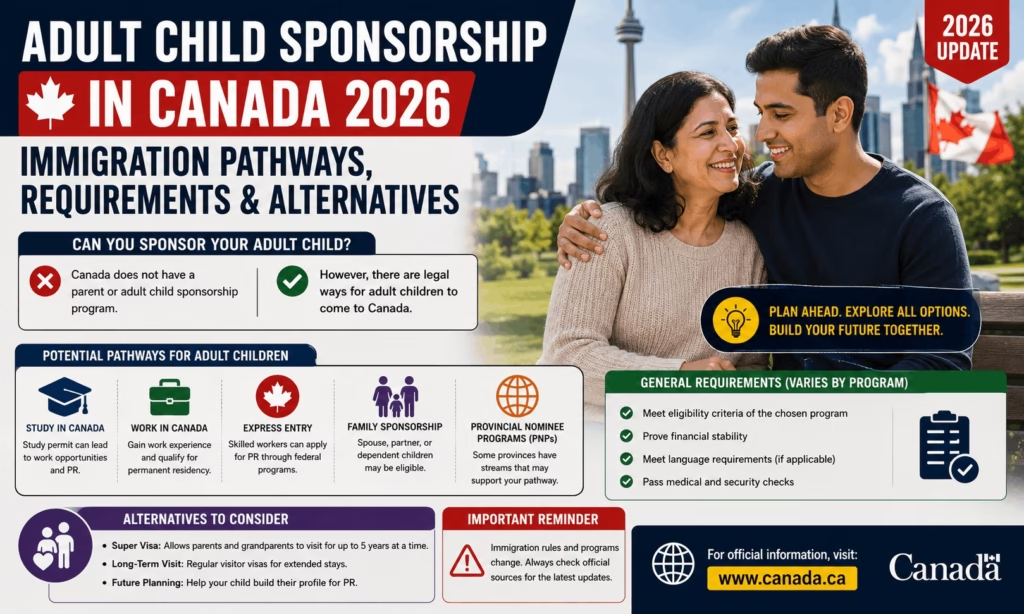
For most families, the direct answer is no, not through the standard Family Class sponsorship route, unless a specific exception applies. There are three narrow paths where an adult child, or a similarly situated adult relative, can be sponsored.
The first and most relevant is the disability dependency exception described above: an adult child of any age can qualify as a dependent child if they have relied substantially on a parent for financial support since before turning 22 due to a documented physical or mental condition.
The second is the orphaned relative rule, which allows a Canadian citizen or permanent resident to sponsor an orphaned brother, sister, niece, nephew, or grandchild who is under 18, unmarried, and whose parents have both died. This exception is specific to minors and generally does not apply to an adult child situation.
The third is the so-called “lonely Canadian” provision, which allows a sponsor who has no other living relative, including no spouse, partner, child, parent, grandparent, sibling, aunt, uncle, niece, or nephew who is a Canadian citizen or permanent resident, to sponsor one relative of any age, including an adult child, provided strict conditions are met. This exception is intentionally narrow and is meant only for sponsors who are genuinely without any other family connection in Canada.
Outside of these three scenarios, a healthy adult child who is over 22, financially independent, or otherwise outside the dependent child definition cannot currently be sponsored directly for permanent residence as a family member.
Quebec’s July 2026 Update for Adult Dependent Children
Quebec operates its own family sponsorship intake system separately from the rest of Canada, and this is where the most significant recent change has occurred. Quebec first introduced an intake cap on sponsorship undertakings in June 2024, and that cap included applications to sponsor dependent children aged 18 or older. That earlier cap was reached for spouses and adult dependent children by July 9, 2025, and for parents and grandparents by July 22, 2025, effectively closing new applications in those categories for the remainder of the intake period.
Quebec’s Ministère de l’Immigration, de la Francisation et de l’Intégration announced that a new intake period will reopen on July 2, 2026, running until either July 2028 or June 30, 2028 depending on the source, with a total cap of 15,700 undertaking applications: 13,300 reserved for spouses and common-law partners, and 2,400 reserved for parents and grandparents. The most important change for this topic is that dependent children aged 18 or older will no longer count toward this cap at all. Applications to sponsor dependent children, including those 18 and older, along with orphaned minor children and children being adopted, are now fully exempt from Quebec’s intake limits.
This is a meaningful shift specifically for families settling in Quebec with dependent children who are 18 or older but still meet the federal dependent child definition, since it removes a quota-based bottleneck that previously slowed or blocked their applications, even though it does not change eligibility rules for adult children who fall outside the dependent child definition entirely.
Why the Parents and Grandparents Program Is Not the Same Pathway
Families researching adult child sponsorship sometimes come across information about the Parents and Grandparents Program (PGP) and assume a similar lottery-based system might apply to adult children. It does not. The PGP is specifically for parents and grandparents of Canadian citizens and permanent residents, and as of January 1, 2026, IRCC has confirmed that no new applications are being accepted under the PGP for the year, continuing a pattern where the program has not consistently opened new Interest to Sponsor intakes since 2020.
There is no equivalent lottery-based or lottery-adjacent program for adult children. The Super Visa, similarly, is designed exclusively for parents and grandparents and allows stays of up to five years per entry over a validity period of up to ten years, but it is not an option available to sponsor an adult child.
Alternative Pathways for Adult Children Who Do Not Qualify
When direct sponsorship is not available, several legitimate alternative routes exist, and many families pursue these in parallel rather than waiting for a sponsorship pathway that may never open.
Express Entry is the most commonly used alternative for adult children with post-secondary education, skilled work experience, and reasonably strong language test scores. If an adult child is competitive under the Comprehensive Ranking System, they can apply for permanent residence independently of any family sponsorship, based on their own economic profile.
Provincial Nominee Programs (PNPs) offer another route, particularly for adult children with in-demand occupations or job offers in a specific province. Several provinces run PNP streams targeting skilled workers or international graduates, and a provincial nomination can significantly boost an Express Entry ranking or provide a standalone path to permanent residence.
A study permit is a common starting point for younger adult children, allowing them to complete a Canadian credential that later supports a post-graduation work permit and, eventually, permanent residence through Express Entry or a PNP.
A work permit, particularly one supported by a Canadian employer, can also lead toward permanent residence over time, especially when paired with in-demand skilled work experience.
A visitor visa offers a short-term option for reuniting with an adult child temporarily, though it does not lead to permanent status and is subject to standard visitor visa conditions and restrictions.
How to Apply Under an Eligible Exception
If your adult child does qualify under the disability dependency exception, the orphaned relative rule, or the lonely Canadian provision, the sponsor must still be a Canadian citizen or permanent resident, at least 18 years old, and able to meet minimum income requirements assessed using Notice of Assessment documents from the Canada Revenue Agency. Supporting evidence for a disability-based dependency claim typically needs to demonstrate both the medical condition and the financial dependency dating back to before the child turned 22.
Given how narrow and fact-specific these exceptions are, and how strictly IRCC assesses supporting documentation, families pursuing one of these routes are strongly encouraged to work with a licensed immigration consultant or lawyer to confirm eligibility before submitting an application, since an incomplete or poorly supported claim can result in refusal and lost application fees.
$2969 Social Security Benefit 2026 Eligibility, How to Apply & Fact Checked
[Fact Check] $3,250 SSDI and Social Security Payments 2026: Is This Real or Viral Misinformation?
Official Resources and Useful Links
| Resource | Purpose | Link |
|---|---|---|
| IRCC Secure Account (Login and Application Status) | Track a submitted sponsorship application | canada.ca (IRCC Secure Account sign-in) |
| IRCC, Sponsor Your Family Member | Official Family Class sponsorship overview and eligibility rules | canada.ca/en/immigration-refugees-citizenship/services/immigrate-canada/family-sponsorship |
| MIFI, Quebec Family Sponsorship | Quebec-specific sponsorship intake, caps, and undertaking rules | quebec.ca (Immigration, Francisation et Intégration, family sponsorship) |
| Express Entry Profile Registration | Register or check eligibility for economic immigration pathways | canada.ca (Express Entry: submit a profile) |
| Provincial Nominee Program Finder | Compare province-specific nomination streams | canada.ca (Provincial Nominee Program overview) |
People Also Ask
Can I sponsor my adult son or daughter to live in Canada? Generally no, unless your adult child depends substantially on you for financial support since before age 22 due to a documented physical or mental condition, or you qualify under Canada’s narrow orphaned relative or lonely Canadian exceptions.
What is the age limit for a dependent child in Canadian immigration? A dependent child must be under 22 and unmarried, with no upper age limit only if the child has been financially dependent on a parent since before turning 22 due to a disability.
Has Quebec changed its rules for sponsoring adult children? Yes, as of the July 2, 2026 reopening of Quebec’s family sponsorship intake, dependent children aged 18 or older are fully exempt from the province’s application cap, a change from the previous intake period where they were included.
What can I do if my adult child does not qualify for sponsorship? Common alternatives include applying through Express Entry, a Provincial Nominee Program, a study permit leading to a post-graduation work permit, an employer-supported work permit, or a temporary visitor visa.
Is the Parents and Grandparents Program open in 2026? No, IRCC confirmed that no new applications are being accepted under the Parents and Grandparents Program throughout 2026, continuing a pattern of limited or paused intakes since 2020.
FAQs
What does “adult child sponsorship” actually mean in Canadian immigration?
It refers to attempts to sponsor a son or daughter who does not meet Canada’s dependent child definition, meaning they are 22 or older without a qualifying disability-based dependency, or they are married or in a common-law relationship. Outside of narrow exceptions, this group cannot be sponsored through the standard Family Class program.
Are there any exceptions that allow sponsoring a healthy adult child with no disability?
Only the lonely Canadian provision, which applies exclusively to sponsors who have no other living relative who is a Canadian citizen or permanent resident, and even then only one relative of any age can be sponsored under this route.
Does Quebec’s 2026 update mean adult children with no disability can now be sponsored?
No. Quebec’s July 2026 change removes adult dependent children aged 18 or older from the province’s intake cap, but it does not change the underlying federal definition of who qualifies as a dependent child in the first place.
What is the fastest realistic pathway for an adult child who does not qualify for sponsorship?
For adult children with strong education, work experience, and language scores, Express Entry or a Provincial Nominee Program is typically the fastest legitimate route, since these do not depend on family sponsorship eligibility at all.
Can an adult child visit Canada while waiting for a longer-term immigration pathway?
Yes, a standard visitor visa allows temporary visits, though it does not lead to permanent residence and is subject to normal visitor visa conditions, including demonstrating an intention to leave Canada at the end of the authorized stay.
Conclusion
Adult child sponsorship in Canada in 2026 remains one of the most restrictive corners of the country’s family reunification system, since the standard Family Class program is built around a dependent child definition that excludes most healthy adults over 22. Real exceptions exist for documented disability-based financial dependency, orphaned minors, and sponsors with no other relatives in Canada, and Quebec has just made a meaningful improvement for adult dependent children aged 18 or older by removing them from its intake cap starting July 2, 2026. For families whose adult child falls outside every exception, Express Entry, provincial nominee programs, study permits, work permits, and visitor visas remain the realistic paths forward, often used in combination rather than as a single guaranteed route. This article will be updated monthly as sponsorship rules, provincial caps, and program intakes continue to evolve.
Also Read
State-by-State SNAP Food Ban 2026: What’s Banned, Status Update
Ontario Trillium Benefit Payment for 2026 Full Schedule: What’s the Reality Check About It?
SNAP Junk Food Ban 2026: Full State-by-State Waiver List, Court Update Aur Restricted Food List