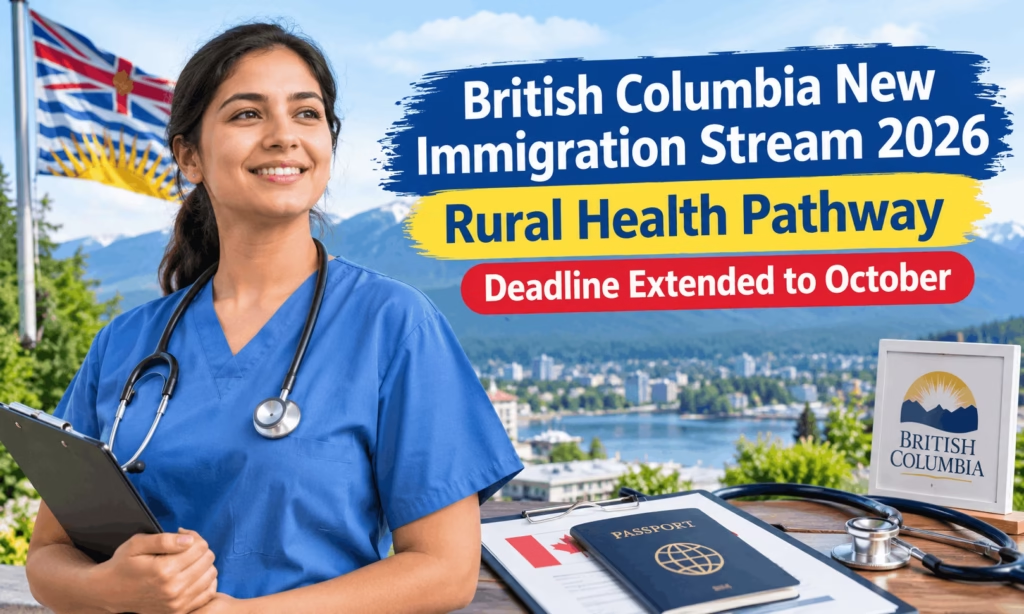
British Columbia New Immigration Stream 2026: British Columbia has extended the registration deadline for its newest immigration pathway, giving eligible health authority workers extra time to secure permanent residence. The Temporary Rural/Remote Health Support Initiative, introduced this year under the British Columbia New Immigration Stream 2026, will now accept registrations until 11:59 p.m. on October 7, 2026, instead of the original August 31 cutoff. The province announced the change on August 13, citing potential disruptions from wildfire activity across British Columbia, a factor that has repeatedly affected rural communities this summer. Since registration opened on June 15, 2026, only 60 candidates have been invited to apply for provincial nomination out of a hard cap of 250 spots, meaning the vast majority of this one-time pathway remains unclaimed with roughly a month left on the clock.
The initiative sits inside the British Columbia Provincial Nominee Program (BC PNP) and is aimed squarely at a group of workers who rarely get their own dedicated immigration pathway: janitors, caretakers, heavy-duty cleaners, light-duty cleaners, and security guards employed directly by one of BC’s public health authorities in a rural or remote community. It was first announced in April 2026 as part of a sweeping overhaul of the BC PNP built around three new priorities the province calls “Care,” “Build,” and “Innovate.” This guide breaks down exactly who qualifies for this new immigration stream, the eligibility rules, the extended timeline, and the wider 2026 changes reshaping how people can immigrate to British Columbia. We’ll be updating this article monthly as BC PNP releases new draw results and program updates.
What Is the Temporary Rural/Remote Health Support Initiative
The Temporary Rural/Remote Health Support Initiative, often shortened to TRHSI, is a one-time, time-limited stream within the BC PNP’s Skills Immigration category. Unlike the province’s standard skilled worker or international graduate streams, this pathway was built for a narrow group of essential support staff who keep rural health facilities running but who typically fall outside the scope of healthcare-specific immigration programs designed for nurses, physicians, and other clinical roles.
The BC PNP describes the initiative as sitting inside its broader “Care” objective, one of three strategic pillars the province introduced in its April 23, 2026 program update, alongside “Build” (construction and infrastructure trades) and “Innovate” (technology and knowledge-economy occupations). The initiative does not include an Express Entry BC (EEBC) option, meaning successful candidates go through the base BC PNP nomination process rather than the enhanced federal processing track tied to Express Entry.
BC’s New Immigration Stream Key Highlights
| Category | Details |
|---|---|
| Program name | Temporary Rural/Remote Health Support Initiative (TRHSI) |
| Governing framework | British Columbia Provincial Nominee Program (BC PNP), Skills Immigration category |
| Registration opened | June 15, 2026 |
| Original deadline | August 31, 2026, 11:59 p.m. |
| Extended deadline | October 7, 2026, 11:59 p.m. |
| Reason for extension | Wildfire-related disruptions across British Columbia |
| Maximum nominations available | 250 |
| Candidates invited so far | 60 (as of the extension announcement) |
| Eligible occupations | Janitors, caretakers, and heavy-duty cleaners (NOC 65312); light-duty cleaners (NOC 65310); security guards and related occupations (NOC 64410) |
| Minimum work history required | 9 consecutive months full-time with the same health authority employer |
| Express Entry BC option available | No |
| BC’s total 2026 PNP allocation | 5,254 nominations (province had requested 9,000) |
SSDI Pay Chart: The Least Amount You Can Get Per Month and the Most Common Disabilities
IRS Identity Protection PIN: How to Get One and Stop Tax Fraud
Who Qualifies for This New Immigration Stream
To register under the Temporary Rural/Remote Health Support Initiative, a candidate must meet all of the following requirements at the time of registration:
- Be a direct employee of one of British Columbia’s public health authorities, not a contractor or agency worker
- Hold a regular, indeterminate, full-time position in one of the three eligible occupations
- Work in a rural or remote part of British Columbia, specifically excluding Metro Vancouver, Central Okanagan, and most of the Capital Regional District, though certain Gulf Islands within the Capital Regional District are treated as rural or remote under this initiative
- Have completed at least nine consecutive months of full-time employment with the same health authority in an eligible occupation immediately before registering
- Continue working full-time in the same role through the application process
- Obtain a signed job offer letter on official letterhead from the health authority employer, along with the employer’s support for the BC PNP application
- Meet the general BC PNP Skills Immigration requirements outlined in the program guide
The three eligible occupation groups under National Occupational Classification (NOC) codes are janitors, caretakers, and heavy-duty cleaners (NOC 65312), light-duty cleaners (NOC 65310), and security guards and related security service occupations (NOC 64410). Candidates working in administrative, clerical, or clinical support roles are not eligible under this specific initiative, even if employed by the same health authority.
Why British Columbia Created This Pathway
Rural and remote health facilities across British Columbia have struggled for years to retain support staff, particularly in communities far from the province’s major urban centers. The Hospital Employees’ Union, which represents many of the affected workers, welcomed the initiative when registrations opened in June, noting that it gives health authorities a concrete tool to retain staff who might otherwise leave for jobs with a clearer path to permanent status. Health authorities have reported that turnover among cleaning and security staff in rural facilities creates operational strain that ripples outward, affecting everything from infection control to after-hours safety coverage.
By creating a narrowly targeted, capped pathway rather than a broad new stream, the province appears to be testing whether this kind of retention-focused immigration tool can address a specific labor gap without opening the door to unlimited applications. The hard cap of 250 nominations and the requirement that candidates already be working in the role for at least nine months reinforces that this is a retention mechanism, not a general recruitment pathway for new arrivals.
How the Registration and Invitation Process Works
Unlike a first-come, first-served intake, the BC PNP has confirmed that invitations under this initiative are not distributed purely in the order registrations are received. Instead, candidates who register are placed into a pool, and the province issues invitations to apply (ITAs) based on a points system that may target specific factors relevant to the initiative’s goals. This means two workers who register on the same day are not guaranteed the same outcome, and factors like specific work location, occupation, or other program-defined criteria can affect who receives an invitation first.
Since the June 15 opening, the BC PNP has issued invitations in batches, with 60 candidates invited as of mid-August 2026. With 190 spots still available and the deadline now extended to October 7, eligible workers who have not yet registered still have a realistic window to be considered, though the province has not indicated whether it will extend the deadline again or close the initiative early if it reaches capacity before October 7.
Overhaul of BC’s Immigration Streams
The Temporary Rural/Remote Health Support Initiative did not appear in isolation. It is one piece of the most significant restructuring of the BC PNP in recent years, formally introduced through the province’s April 23, 2026 announcement and further detailed in the updated Skills Immigration Program Guide released May 28, 2026.
As part of this overhaul, British Columbia formally eliminated its Entry Level and Semi-Skilled (ELSS) stream, which had previously offered a pathway to permanent residence for workers in select low-skilled tourism, hospitality, food processing, and Northeast Development Region occupations. Active registrations previously filed under ELSS were removed as part of the transition. The province also introduced a new list of occupations that became ineligible across all Skills Immigration streams, with applications submitted after June 13, 2026 no longer accepted for workers in twelve occupations, including administrative officers and assistants under NOC codes 12100 through 13112. BC PNP officials framed the change as part of a continued shift away from lower-skilled occupations and toward labor market priorities facing more acute shortages.
The province also updated its minimum income thresholds to align with 2024 Low Income Cut-Off (LICO) figures, a change that affects eligibility calculations for applicants across multiple Skills Immigration streams, particularly those relying on employer-supported applications where household income must meet a minimum standard tied to family size.
Express Entry Draw Update: CEC Cut-Off Falls To 521, Physicians Round Drops To 198 CRS
Canada Counter-Tariffs Worker Support Package: $7.5 Billion in Relief Confirmed
StayNJ Income Cap Drops From $500,000 to $200,000: Why Your Check Already Got Smaller
New York POWER Rebate Checks: $100 to $200 Payments Begin Landing in Mailboxes This Fall
BC PNP Draw Activity in 2026
Beyond the new health support pathway, the BC PNP has continued holding regular selection rounds throughout 2026 across its Skills Immigration and Entrepreneur Immigration categories. On July 16, 2026, the province held one of its largest rounds of the year, inviting 569 candidates to apply for provincial nomination, split between candidates selected based on wage or salary tied to a TEER 0 to 3 job offer and those selected based on registration score. That round marked the highest proportion of registration score-based invitations of any Skills Immigration round the BC PNP had held that year, a shift that suggests the province is placing growing weight on candidate profile strength rather than salary alone in at least some rounds.
The province’s Entrepreneur Immigration stream has also remained active, with a draw on August 25, 2026 issuing 16 invitations to apply. Meanwhile, BC’s overall federal nomination allocation for 2026 came in at 5,254 spots, well below the 9,000 the province had requested from Immigration, Refugees and Citizenship Canada (IRCC), a gap that helps explain why the BC PNP has become more selective and more targeted toward specific labor priorities like the Care, Build, and Innovate categories rather than expanding broadly.
Comparing BC PNP Streams: Where the Rural Health Initiative Fits
| Stream | Target Group | 2026 Status |
|---|---|---|
| Skilled Worker | General skilled workers with a qualifying job offer | Active, regular draws throughout 2026 |
| International Graduate | Recent graduates of eligible BC or Canadian institutions | Active, regular draws throughout 2026 |
| Healthcare Professional | Nurses, physicians, and other clinical roles | Active, expanded under the 2026 Care priority |
| Entrepreneur Immigration | Experienced business owners establishing a BC business | Active, biweekly draws continuing |
| Entry Level and Semi-Skilled (ELSS) | Lower-skilled tourism, hospitality, food processing workers | Eliminated as of the April/May 2026 overhaul |
| Temporary Rural/Remote Health Support Initiative | Cleaning and security staff at rural/remote health authorities | New for 2026, capped at 250, registration extended to October 7 |
How to Apply for the Temporary Rural/Remote Health Support Initiative
- Confirm eligibility against all criteria in Part 4.3 of the BC PNP Skills Immigration Program Guide, effective May 28, 2026, including the nine-month continuous employment requirement and rural or remote work location.
- Register online through the BC PNP’s registration system before the October 7, 2026 deadline, providing employment details, occupation, and work location.
- Secure employer support, since a signed job offer letter on official health authority letterhead is required and the employer must actively support the application.
- Wait for an invitation to apply. Registrations are pooled and evaluated using a points system rather than processed strictly in the order received.
- Submit a full BC PNP application once invited, following the requirements in the Skills Immigration Application Guide, including all supporting documentation for the nomination.
- Apply for permanent residence with IRCC after receiving a provincial nomination certificate from the BC PNP, since the nomination itself is not permanent residence but a required step toward it.
New Canada Prescription Drug Rules October 2026: What Every Patient and Pharmacy Needs to Know
October 15 Tax Deadline Is Final — What Happens If You Still Don’t File
VA Benefits Lawyer: For Which Claims Do You Need One, and How Much Can They Cost?
Green Card Sponsors Face New Scrutiny: USCIS Can Now Pull Your Credit Report
Processing Time for the Rural Health Support Initiative
The BC PNP has not published a fixed processing time specifically for this initiative, since it depends on registration pool volume and how quickly the province issues invitations relative to the 250-nomination cap. Historically, BC PNP nomination decisions for Skills Immigration applications, once a candidate is invited to apply, have taken several months from submission to a final nomination decision, followed by additional federal processing time once IRCC receives the permanent residence application. Candidates should expect the full journey, from initial registration to final permanent residence, to span well over a year given the layered provincial and federal steps involved.
What Happens After a Nomination
A BC PNP nomination is not the same as permanent residence. Once nominated, candidates must submit a separate application for permanent residence directly to IRCC. Because this initiative does not include the Express Entry BC option, nominated candidates apply through the non-Express Entry, paper-based federal process, which generally takes longer than an Express Entry-aligned application. Candidates should factor this longer federal timeline into their planning rather than assuming the provincial nomination alone secures their status quickly.
Official BC PNP Resources
| Resource | Official Link |
|---|---|
| WelcomeBC News and Updates | welcomebc.ca/immigrate-to-b-c/about-the-bc-provincial-nominee-program/news |
| Skills Immigration Program Guide | welcomebc.ca/immigrate-to-b-c/bc-pnp-si-program-guide-pdf |
| BC PNP Registration Portal | welcomebc.ca/immigrate-to-b-c |
| BC PNP Program Documents Page | welcomebc.ca/immigrate-to-b-c/about-the-bc-provincial-nominee-program/documents |
| BC PNP Program Inquiries | pnpinfo@gov.bc.ca |
| IRCC Provincial Nominee Program Overview | canada.ca/en/immigration-refugees-citizenship/services/immigrate-canada/provincial-nominees.html |
Common Mistakes Applicants Should Avoid
Many prospective applicants assume the nine-month employment requirement can include time spent with a different health authority or in a different eligible occupation, but the BC PNP requires the nine consecutive months to be with the same employer in the same eligible role immediately before registering. Others mistakenly believe they can use the Express Entry BC option to speed up federal processing, but this initiative explicitly excludes that pathway. Applicants working in Metro Vancouver, Central Okanagan, or most of the Capital Regional District should also confirm their specific work location carefully, since these areas are excluded from the rural or remote definition used by this initiative, with only certain Gulf Islands within the Capital Regional District treated as an exception.
FAQs About British Columbia New Immigration Stream 2026
What is British Columbia’s new immigration stream for 2026?
The Temporary Rural/Remote Health Support Initiative is a new, one-time BC PNP pathway for cleaning and security staff employed by a British Columbia public health authority in a rural or remote community, offering a route to permanent residence for up to 250 eligible workers.
When is the deadline to register for the BC rural health immigration stream?
The registration deadline was extended from August 31, 2026 to October 7, 2026 at 11:59 p.m., with British Columbia citing wildfire-related disruptions as the reason for the extension.
Who is eligible for the Temporary Rural/Remote Health Support Initiative?
Eligible candidates must be direct employees of a BC public health authority working full-time in an eligible cleaning or security occupation (NOC 65312, 65310, or 64410) in a rural or remote part of the province, with at least nine consecutive months of employment in that role before registering.
Does the BC rural health initiative include an Express Entry BC option?
No. This initiative does not offer the Express Entry BC option, so nominated candidates must apply for permanent residence through the standard, non-Express Entry federal process.
How many people can be nominated through this new BC immigration stream?
The initiative is capped at 250 nominations total, and as of mid-August 2026 only 60 candidates had been invited to apply, leaving the majority of spots still available.
Is the BC PNP’s Entry Level and Semi-Skilled stream still open?
No. British Columbia formally eliminated the Entry Level and Semi-Skilled (ELSS) stream as of the province’s 2026 Skills Immigration overhaul, and active registrations previously filed under that stream were removed.
How do I immigrate to British Columbia as a skilled worker?
Most skilled workers immigrate to British Columbia through the BC PNP’s Skilled Worker stream, which requires a qualifying full-time job offer from a BC employer and evaluates candidates based on wage, occupation skill level, and registration score before issuing an invitation to apply.
What is the difference between BC PNP and Express Entry?
The BC PNP is a provincial program that nominates candidates based on British Columbia’s specific labor market needs, while Express Entry is a federal system; a BC PNP nomination through the Express Entry BC option adds significant points to a candidate’s federal Express Entry profile, though not every BC PNP stream, including this rural health initiative, offers that option.
How many nominations does British Columbia get each year?
For 2026, British Columbia received an allocation of 5,254 nominations from Immigration, Refugees and Citizenship Canada, below the 9,000 nominations the province had requested to meet its labor market needs.
What jobs qualify for BC’s new rural health immigration pathway?
Only three occupation groups qualify: janitors, caretakers, and heavy-duty cleaners; light-duty cleaners; and security guards and related security service occupations, and only when the employer is a BC public health authority in a rural or remote location.
Conclusion
British Columbia’s Temporary Rural/Remote Health Support Initiative represents a narrowly targeted but meaningful new immigration stream for 2026, offering a rare, dedicated pathway to permanent residence for cleaning and security staff who keep the province’s rural and remote health facilities running. With the registration deadline now extended to October 7, 2026 because of wildfire disruptions, and only 60 of the available 250 nominations claimed so far, eligible workers still have a real window to apply, provided they meet the nine-month employment requirement and work in a qualifying rural or remote location. This initiative sits alongside a much broader restructuring of the BC PNP in 2026, including the elimination of the Entry Level and Semi-Skilled stream and a sharper focus on the province’s Care, Build, and Innovate priorities, signaling that British Columbia’s immigration system is becoming more targeted rather than broader as it works within a federal nomination allocation smaller than what the province originally requested.
Trump Accounts Dell $250 Grant: Did Deposits Actually Start Monday? Here’s Who’s Actually Been Paid
2027 Social Security COLA Forecast: Latest 3.6% Estimate and How Much Retirees Could Get
$2000 Stimulus Payment September 2026 Fact-Check: Is It Really Coming?