PM RAHAT Scheme Offers ₹1.5 Lakh Cashless Treatment Benefit: India has launched one of its most significant road safety healthcare initiatives in years. The Pradhan Mantri Road Accident Victims’ Hospitalisation and Assured Treatment (PM RAHAT) Scheme provides cashless treatment of up to ₹1.5 lakh for road accident victims across the country, regardless of which insurance company covers the vehicle involved, or whether the victim was insured at all. Approved by Prime Minister Narendra Modi and launched on February 13, 2026, the scheme directly targets one of India’s most persistent public health challenges: the thousands of preventable road accident deaths that occur each year simply because victims don’t reach a hospital in time.
What Is PM RAHAT Scheme?
PM RAHAT was notified under Section 162 of the Motor Vehicles Act, 1988, and developed by the Ministry of Road Transport and Highways (MoRTH). The scheme exists to address a sobering statistic that has driven road safety policy discussions for years: studies indicate that nearly 50% of road accident deaths could be prevented if victims receive hospital treatment within the first hour after a serious injury commonly referred to as the “Golden Hour.” Despite widespread awareness of this window’s importance, financial hesitation at the moment of admission hospitals requesting upfront deposits, families unsure whether insurance will cover costs, or victims having no insurance at all has historically delayed treatment for countless accident victims. PM RAHAT is specifically designed to eliminate that hesitation entirely.
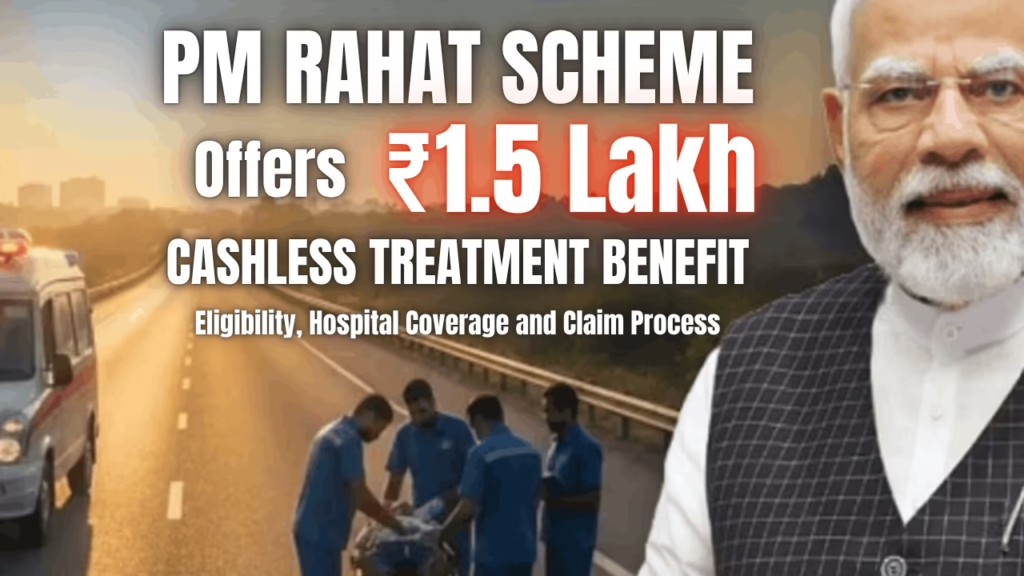
₹1.5 Lakh Cashless Treatment for 7 Days
Under the scheme, every eligible road accident victim, regardless of which type of road the accident occurred on national highways, state roads, or city streets is entitled to cashless treatment coverage of up to ₹1.5 lakh per victim, valid for a period of seven days from the date of the accident. This applies universally across road categories, meaning the protection isn’t limited to highway accidents or any specific jurisdiction.
Within that seven-day window, the scheme also guarantees specific stabilisation treatment timelines based on injury severity: victims facing non-life-threatening situations receive guaranteed stabilisation care for up to 24 hours, while those in life-threatening situations receive coverage for up to 48 hours. This stabilisation coverage is subject to police authentication through an integrated digital verification system, ensuring accountability while still allowing uninterrupted emergency care to proceed without delay.
Who Is Eligible Under PM RAHAT Scheme?
Eligibility under PM RAHAT is intentionally broad. All victims of road accidents involving motor vehicles qualify, irrespective of the category of road where the accident occurred, and importantly, the scheme covers both insured and uninsured victims, including those involved in hit-and-run cases. This universal coverage approach addresses a critical gap in India’s prior accident response framework, where uninsured victims or those in hit-and-run incidents often faced the greatest barriers to immediate treatment, precisely because no clear payer existed at the moment care was needed most.
How the Emergency Response System Works
PM RAHAT isn’t simply a financial coverage scheme it’s built around a coordinated emergency response framework. The scheme is fully integrated with the Emergency Response Support System (ERSS) 112 helpline, meaning a road accident victim, a designated emergency responder known as a “Rah-Veer” (Good Samaritan), or literally any bystander at the accident site can dial 112 to request ambulance services and obtain directions to the nearest designated hospital. This integration is specifically intended to minimize the delay between an accident occurring and the victim reaching appropriate medical care, directly targeting that critical Golden Hour window.
How Claims Get Verified and Paid?
One of PM RAHAT’s most significant innovations is its digital infrastructure, which links multiple government systems into a single coordinated pipeline. The scheme operates through integration between MoRTH’s Electronic Detailed Accident Report (eDAR) platform and the Transaction Management System (TMS 2.0) maintained by the National Health Authority. This linkage enables digital tracking across the entire treatment journey from initial accident reporting, through hospital admission, police authentication, treatment administration, claim processing, and final payment to the hospital.
Police confirmation through this integrated digital system is required within the same timelines as the stabilisation coverage windows: 24 hours for non-life-threatening cases and 48 hours for life-threatening cases. This requirement ensures a layer of accountability and fraud prevention within the system, without creating a bottleneck that delays actual emergency treatment, since care begins immediately while verification proceeds in parallel.
How Hospitals Get Reimbursed?
A central design goal of PM RAHAT is providing financial certainty to hospitals, encouraging uninterrupted treatment without hospitals needing to assess payment risk before admitting a patient. Reimbursement flows through the Motor Vehicle Accident Fund (MVAF), with the payment source depending on the specific circumstances of the accident. If the vehicle involved is insured, payments are drawn from contributions made by general insurance companies. In uninsured or hit-and-run cases, expenses are instead covered through budgetary allocation by the Government of India, ensuring hospitals are reimbursed regardless of the offending vehicle’s insurance status.
Claims approved by the State Health Agency are processed and paid within 10 days, providing hospitals with a predictable, time-bound settlement timeline rather than the prolonged reimbursement delays that have historically discouraged some hospitals from readily admitting accident victims without upfront payment guarantees.
What to Do If You Witness or Are Involved in an Accident?
Understanding the practical steps under PM RAHAT Scheme can make a genuine difference in an emergency. If you witness a road accident or are involved in one yourself, call 112 immediately to request ambulance services and identify the nearest designated hospital participating in the scheme. There’s no need to assess insurance status, calculate potential costs, or hesitate over payment concerns before seeking help — the entire structure of PM RAHAT is designed specifically to remove that hesitation from the equation. Upon arrival at a designated hospital, treatment can begin immediately, with the police authentication and claims process running in parallel through the integrated digital system rather than serving as a precondition for care.
Grievance Redressal
PM RAHAT also includes a formal grievance mechanism for situations where victims, families, or hospitals encounter issues with the claims or treatment process. Each district maintains a Grievance Redressal Officer, operating under the District Road Safety Committee, which is chaired by the District Collector, District Magistrate, or Deputy Commissioner, depending on local administrative structure. This officer is tasked with addressing complaints and ensuring timely resolution, providing an accessible escalation path for anyone who experiences difficulty accessing the scheme’s intended benefits.
Why This Scheme Represents a Significant Policy Shift
India has historically struggled with extremely high road accident fatality numbers, and policy experts have long pointed to delayed hospital admission as one of the most addressable contributing factors — unlike many other causes of road accident deaths, this is a problem that coordinated emergency response and financial certainty can directly solve. By guaranteeing cashless treatment regardless of insurance status, road category, or fault determination at the scene, PM RAHAT removes what was previously one of the most common reasons for treatment delay: financial uncertainty at the exact moment when minutes determine survival outcomes.
The scheme’s emphasis on technology-driven coordination — linking police, hospitals, insurers, and the National Health Authority into a single digital pipeline — also represents a broader shift in how India is approaching public health emergency response, moving away from fragmented, paperwork-heavy processes toward real-time digital verification that doesn’t slow down actual patient care.
What This Means for Indian Families?
For ordinary families, the practical significance of PM RAHAT is straightforward: a road accident no longer needs to become an immediate financial crisis on top of a medical emergency. Whether the accident occurs on a national highway, a state road, or a city street, and whether or not the responsible vehicle carries valid insurance, victims are now entitled to cashless treatment up to ₹1.5 lakh for the first seven critical days following an accident.
Given how recently the scheme launched, awareness remains a key challenge, families and bystanders alike should familiarize themselves with the 112 emergency helpline and the concept of designated PM RAHAT hospitals, since knowing to act immediately, without payment hesitation, is precisely the behavior change this scheme is designed to encourage. PM RAHAT scheme announced by the Ministry of Road Transport and Highways. Scheme rules, designated hospital networks, and claim procedures are determined by the Government of India and may be updated, so readers should confirm current details directly through official MoRTH or PIB government sources.