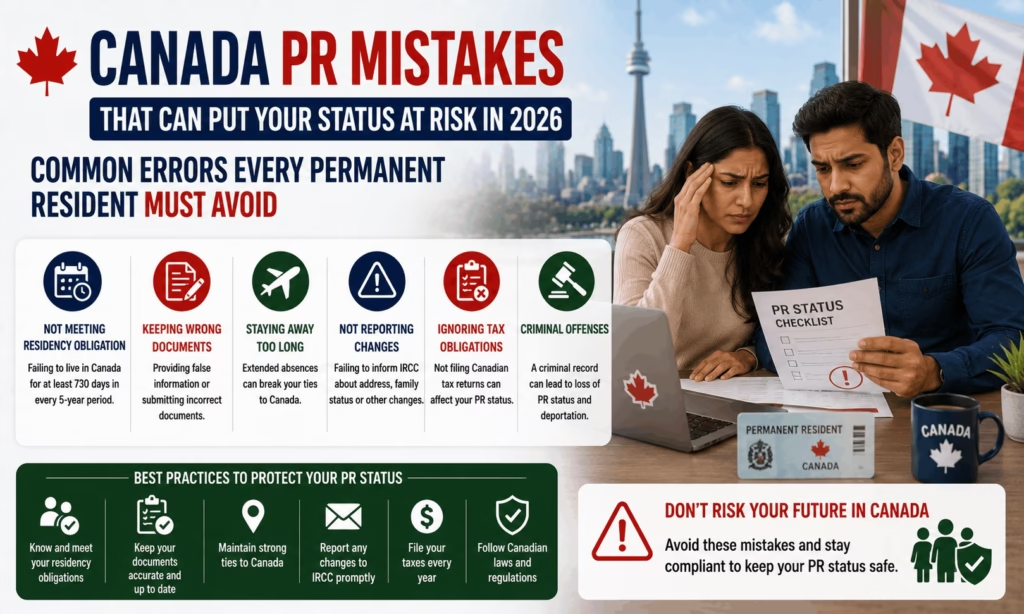
Canada PR Mistakes: Thousands of Canadian permanent residents unknowingly put their status in jeopardy every year, and 2026 has already brought fresh reasons to be careful. Canada PR mistakes are rarely dramatic — most people don’t lose their status because of one big error, but because of small oversights that quietly stack up: forgetting to update an address with IRCC, misunderstanding the 730-day residency obligation, letting a PR card expire while traveling, or failing to respond to a government letter within its deadline. With permanent resident fees rising, citizenship rules shifting under Bill C-3, and IRCC tightening enforcement around the residency obligation in 2026, understanding exactly where PRs go wrong has never been more important. This article breaks down the most common, real-world mistakes that put PR status at risk this year, along with the official steps to fix or avoid each one. We’ll be updating this article monthly to reflect new IRCC policy changes, fee updates, and enforcement trends affecting permanent residents across Canada.
Losing permanent resident status in Canada isn’t usually sudden it typically follows a pattern of avoidable errors that build up over months or years. Whether it’s misunderstanding how the rolling five-year window for residency actually works, assuming a PR card renewal can happen from outside the country, or not realizing that a misrepresentation on an old application can resurface years later, the consequences can include losing the right to re-enter Canada or facing a formal removal order. This guide walks through each major risk area — residency obligation traps, PR card and PR Travel Document issues, criminal inadmissibility, sponsorship breakdowns, tax and address mistakes and explains the exact IRCC processes, current 2026 fees, and official government resources every permanent resident should bookmark. Below, you’ll also find a full table of key rules, a step-by-step risk checklist, and answers to the questions permanent residents search most often.
Canada PR Mistakes 2026 Highlights
| Key Detail | Information |
|---|---|
| Core Rule at Risk | Residency Obligation — 730 days physically present in Canada within a rolling 5-year period |
| Governing Law | Section 28, Immigration and Refugee Protection Act (IRPA) |
| Who Assesses Compliance | IRCC officers (PR card renewal, PR TD applications) and CBSA officers (at ports of entry) |
| PR Card Standard Validity | 5 years (sometimes 1 year in special circumstances) |
| PR Card Renewal Fee (2026) | $50 CAD |
| Right of Permanent Residence Fee (2026) | Increased from $575 to $600, effective April 30, 2026 |
| PR Card Renewal Processing Time (2026) | Roughly 10 weeks under standard processing |
| PR Travel Document (PRTD) | Required to board a flight, train, bus, or boat to Canada if your PR card has expired abroad |
| Settlement Services Access Limit | 6 years from landing date for economic class PRs |
| Recent Legislative Update | Bill C-3 passed July 14, 2026, expanding citizenship eligibility rules |
| Common Triggers for Status Review | PR card renewal, PRTD application, port-of-entry questioning, citizenship application |
Mistake #1: Misunderstanding the Residency Obligation Window
The single biggest source of Canada PR mistakes is misunderstanding how the residency obligation actually works. Many new permanent residents assume the five-year clock starts on their landing date and runs forward, giving them a fixed period to plan around. In reality, the five-year window is rolling — IRCC and CBSA always look backward from whatever date your status is being assessed, whether that’s a PR card renewal application, a PR Travel Document request, or a question at a Canadian port of entry. This means a permanent resident who spent three full years in Canada followed by two years abroad can suddenly fall out of compliance the moment they cross into a sixth year outside the country, even though they technically met the requirement earlier in their PR journey.
The core standard is simple to state but easy to miscalculate: permanent residents must be physically present in Canada for at least 730 days within every rolling five-year period. Only days actually spent on Canadian soil count — time in the United States, on a cruise, or anywhere else outside Canada does not count toward the 730 days unless one of a small number of exceptions applies (such as accompanying a Canadian citizen spouse abroad, or working outside Canada for a Canadian business under qualifying conditions). New PRs who leave the country shortly after landing are especially vulnerable to this trap, since they may not realize how quickly the clock can turn against them.
Mistake #2: Letting Your PR Card Expire Without a Renewal Plan
A surprisingly common mistake is treating the PR card as just a formality rather than a critical travel document. Your permanent resident status itself does not expire when your card does — but without a valid card, you cannot board a commercial flight, train, bus, or boat back to Canada from abroad. IRCC recommends starting the renewal process well before your card’s expiry date, and generally prefers that applicants renew when their existing card has less than nine months of validity remaining (exceptions apply for legal name or gender marker changes). As of 2026, standard PR card renewal costs $50 CAD and typically takes about 10 weeks to process, though this can vary based on application volume and completeness.
One trap that catches many PRs off guard: you cannot renew your PR card while physically outside Canada. If your card has already expired and you’re overseas, you’ll instead need to apply for a Permanent Resident Travel Document (PRTD) at a Canadian embassy, high commission, or consulate to prove your status and be allowed to board your flight home. PRTD processing can take significantly longer than a routine card renewal, so travelers should never assume they can simply fly home and sort out paperwork later.
Mistake #3: Not Updating Your Address and Contact Details With IRCC
Failing to keep your address, phone number, and email updated with IRCC is a quiet but serious mistake. Important correspondence — including requests for additional documents, notices about residency obligation reviews, or deadlines to respond to a concern about your file — is sent to whatever contact information IRCC has on record. If you miss a response deadline because a letter went to an old address, you may lose the opportunity to explain your situation before a decision is made about your status. Permanent residents should update their information promptly through their IRCC secure account any time they move, change phone numbers, or switch email addresses, even temporarily.
Missouri SNAP Food Ban Delayed: What’s Banned & Latest Status
Hawaii SNAP Soda Ban Delayed to 2027: What Will Be Banned & Status
Florida SNAP Junk Food Ban 2026: What’s Banned, Court Update, EBT Rules & Latest Status
Nevada SNAP Food Ban: What’s Banned & Start Date Explained
Mistake #4: Assuming a Few “Humanitarian and Compassionate” Days Will Automatically Save You
Some permanent residents who fall short of the 730-day requirement assume that having a good reason for their absence — caring for a sick relative, a job posting abroad, a family emergency — will automatically excuse the shortfall. In reality, humanitarian and compassionate (H&C) considerations are assessed case by case and are not guaranteed, even for sympathetic circumstances. Relying on H&C relief as a backup plan, rather than actively tracking and managing your physical presence in Canada, is one of the riskier assumptions a PR can make. If you know you’re falling short, it’s far safer to adjust your travel plans early and return to Canada well before your five-year window closes, rather than hoping a later appeal will fix things.
Mistake #5: Ignoring Criminal Inadmissibility Risks
Permanent resident status is not automatically protected from the consequences of criminal activity, and this is one of the most serious mistakes PRs can make: assuming their status is “settled” once they’ve lived in Canada for years. Under Canadian immigration law, a PR who is convicted of a serious criminal offense in Canada, or who is found inadmissible for offenses committed outside Canada, can face loss of permanent resident status and even removal from the country. This applies regardless of how long someone has held PR status, how established their life is in Canada, or whether they have Canadian-citizen family members. Any permanent resident facing criminal charges should seek qualified immigration legal advice immediately, since criminal proceedings can directly affect immigration status in ways that are easy to overlook in the middle of a criminal case.
Mistake #6: Errors or Omissions Going Back to Your Original PR Application
Misrepresentation is another underappreciated risk. Many permanent residents assume that once their PR application is approved, any small errors or omissions in the original paperwork are behind them. In fact, IRCC can revisit misrepresentation concerns years later, including omitting information (even unintentionally), submitting altered or false documents, or providing inaccurate details about health, employment, or education history at the time of the original application. If misrepresentation is confirmed, it can lead directly to the loss of permanent resident status, regardless of how much time has passed. Keeping copies of everything submitted during your original application, and being scrupulously accurate in any future dealings with IRCC, is one of the simplest ways to avoid this risk entirely.
Mistake #7: Not Understanding What Happens If a Sponsorship Relationship Ends
Permanent residents who came to Canada through family sponsorship — particularly spousal or partner sponsorship — sometimes mistakenly believe their status becomes conditional or automatically at risk if the relationship ends. While Canada eliminated most conditional PR requirements for spousal sponsorship years ago, sponsored PRs should still be aware that misrepresentation concerns can arise if a relationship is later found to have been entered into primarily for immigration purposes (“bad faith” marriage), which is a separate and more serious issue than a genuine relationship simply not working out. Sponsored PRs going through a relationship breakdown should keep documentation of the genuine nature of their relationship and seek advice if there’s any uncertainty about how a separation might be viewed.
Mistake #8: Overlooking the Six-Year Limit on Federally Funded Settlement Services
A newer and less-known pitfall in 2026 involves access to federally funded settlement services. Economic class permanent residents only have access to these services for six years from their landing date, regardless of when they actually land in Canada — this isn’t limited to PRs who landed after a specific 2026 cutoff. Permanent residents who assume these services (language training, employment support, settlement counseling) remain available indefinitely may find themselves without access exactly when they need it most, particularly if they delayed using these resources during their early years in Canada.
Mistake #9: Missing the Rising Cost of Fees and Deadlines Tied to Fee Changes
Fee changes are easy to overlook but can create real financial and procedural risk. On April 30, 2026, the federal government increased fees across every PR category, including raising the Right of Permanent Residence Fee from $575 to $600. Importantly, this fee is based on the amount in effect when you pay it, not when you originally applied — so applicants who delayed paying this fee after submitting their application were still required to pay the higher $600 amount once the increase took effect. Separately, the Right of Citizenship fee rose from $119.75 to $123.00 for adult applicants as of March 31, 2026. Permanent residents planning major applications, including citizenship, should always confirm current fees directly on the official IRCC fee schedule rather than relying on older figures.
Mistake #10: Assuming PR Card Renewal or Citizenship Rules Never Change
2026 has already brought significant legal changes that catch permanent residents off guard if they aren’t paying attention. Bill C-3, which expands citizenship eligibility for certain individuals, passed on July 14, 2026 and took effect immediately. Meanwhile, Express Entry reform consultations are actively shaping future permanent residence pathways, and processing times for common applications have shifted throughout the year. Treating your PR journey as a “set it and forget it” process, rather than periodically checking official IRCC updates, is itself one of the most common — and most avoidable — mistakes permanent residents make.
Canada Grocery Rebate 2026 Full Schedule: Confirmed Payment Dates, Amounts & Status Check!
How IRCC Processing Times Currently Look in 2026
Understanding realistic timelines helps permanent residents plan ahead and avoid last-minute mistakes. As of 2026, general IRCC processing benchmarks include:
- Express Entry-based permanent residence: approximately 5–6 months
- Provincial Nominee Program (PNP) applications: approximately 6–18 months
- Spousal sponsorship applications: approximately 10–14 months
- Citizenship applications: approximately 7–9 months
Background checks and paper-based PNP queues remain among the biggest sources of delay, which is another reason permanent residents should never wait until the last minute to start a renewal, sponsorship, or citizenship application.
A Practical Checklist to Protect Your PR Status
- Track every day spent inside and outside Canada, and recalculate your rolling 730-day total regularly
- Renew your PR card as soon as it has less than nine months of validity remaining
- Never assume you can renew a PR card from outside Canada — apply for a PRTD instead if your card has expired abroad
- Keep your address, phone number, and email current in your IRCC secure account
- Retain copies of every document submitted with your original PR application
- Seek immigration legal advice immediately if facing criminal charges of any kind
- Confirm current IRCC fees before submitting any application or payment
- Check official IRCC processing times before planning travel or major life decisions
Official Canada PR Resources: Login, Registration & Status Check
| Purpose | Resource |
|---|---|
| IRCC Secure Account (GCKey / Sign-In Partner) | canada.ca/en/immigration-refugees-citizenship/services/application/account.html |
| Renew Your PR Card | canada.ca/en/immigration-refugees-citizenship/services/new-immigrants/pr-card/apply-renew.html |
| Apply for a PR Travel Document (PRTD) | canada.ca/en/immigration-refugees-citizenship/services/new-immigrants/pr-card/prtd.html |
| Check Application Processing Times | canada.ca/en/immigration-refugees-citizenship/services/application/check-processing-times.html |
| Residency Obligation Information | canada.ca/en/immigration-refugees-citizenship/services/new-immigrants/pr-card/understand-pr-status/residency-obligation.html |
| Current IRCC Fee Schedule | canada.ca/en/immigration-refugees-citizenship/services/fees.html |
| Report a Change of Address | canada.ca/en/immigration-refugees-citizenship/services/application/change-information.html |
| IRCC General Contact / Client Support Centre | 1-888-242-2100 (within Canada) |
Always confirm current requirements, fees, and forms directly through the official canada.ca IRCC pages listed above, since immigration rules, processing times, and fee amounts have already changed multiple times in 2026 and can be updated again without extensive advance notice.
FAQs
Can I lose my Canadian PR status if I travel too much?
Yes. If you fail to spend at least 730 days physically present in Canada within any rolling five-year period, you can be found non-compliant with the residency obligation, which can lead to a loss of permanent resident status.
Does my PR card expiring mean I lose my permanent resident status?
No. Your PR status does not expire when your card does, but without a valid PR card you cannot board a commercial flight, train, bus, or boat to return to Canada from abroad — you would need a PR Travel Document instead.
Can I renew my PR card while living outside Canada?
No. PR card renewal generally must be done from within Canada. If your card has expired while you’re abroad, you need to apply for a Permanent Resident Travel Document (PRTD) at a Canadian embassy or consulate instead.
What happens if I don’t update my address with IRCC?
You risk missing critical correspondence, including requests for documents or deadlines related to your status, which can result in decisions being made about your case without your input.
Can old mistakes on my original PR application affect me years later?
Yes. If IRCC later determines there was misrepresentation in your original application — even an unintentional omission — it can lead to loss of permanent resident status regardless of how much time has passed.
Does a criminal charge automatically end my PR status?
Not automatically, but a conviction for a serious offense can make you criminally inadmissible, which can lead to loss of status and removal proceedings. Immigration legal advice should be sought immediately if you’re facing charges.
How much does PR card renewal cost in 2026?
Standard PR card renewal costs $50 CAD as of 2026, with typical processing times of around 10 weeks, though this can vary based on application completeness and current volumes.
Is there a time limit on using federally funded settlement services as a PR?
Yes. Economic class permanent residents have access to federally funded settlement services for six years from their landing date, regardless of when they landed.
Conclusion
Most Canada PR mistakes that put permanent resident status at risk in 2026 aren’t dramatic single events — they’re small, avoidable oversights that compound over time: misunderstanding the rolling residency obligation, letting a PR card lapse without a renewal plan, missing an IRCC letter because of an outdated address, or assuming an old application error will never resurface. With fee increases, processing time shifts, and legislative changes like Bill C-3 already reshaping the landscape this year, permanent residents need to stay proactive rather than reactive. Tracking your physical presence, renewing documents early, keeping accurate records, and checking official IRCC resources regularly are the simplest ways to protect the status you worked hard to earn. For anything uncertain, especially around residency obligation calculations or misrepresentation concerns, consulting a licensed immigration consultant or lawyer is always the safest path forward. We’ll be updating this article monthly to reflect new IRCC policy changes, fee adjustments, and enforcement trends affecting Canadian permanent residents.
No SSI Payment in August 2026: SSI August 2026 “no payment” confusion Fact-Checked
State-by-State SNAP Food Ban 2026: What’s Banned, Status Update
Arkansas SNAP Junk Food Ban 2026: What’s Banned, Court Update, EBT Rules & Latest Status
Canada Immigration Absorption Index 2026: What the Numbers Show