Canada Bail and Sentencing Laws July 2026: Canada’s most sweeping overhaul of its bail and sentencing framework in years is now law and taking effect next month. The Bail and Sentencing Reform Act (Bill C-14) received Royal Assent on June 15, 2026, and the main bail and sentencing provisions come into force on July 15, 2026, exactly 30 days later. With over 80 targeted changes to the Criminal Code, the Youth Criminal Justice Act, and the National Defence Act taking effect simultaneously, everyone connected to Canada’s justice system from police and prosecutors to accused persons, immigrants, and community organizations needs to understand what’s actually changing and why it matters.
Bill C-14 doesn’t stand alone. Since fall 2025, the federal government has introduced four interconnected pieces of legislation to strengthen Canada’s criminal laws: the Combatting Hate Act, the Bail and Sentencing Reform Act, the Protecting Victims Act, and the Lawful Access Act. Together, these bills represent what Minister of Justice Sean Fraser described as a comprehensive commitment to public safety: “Canada’s new government promised stricter bail laws and tougher sentencing laws. Today, that promise is now law.”
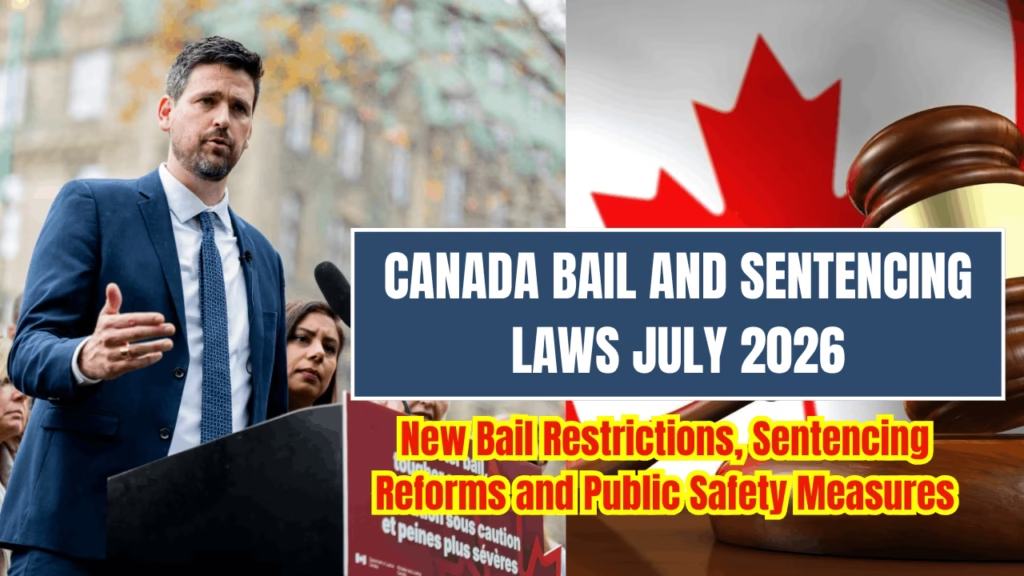
The Bail and Sentencing Reform Act was specifically shaped through extensive consultations with provinces, territories, mayors, police chiefs, and victim advocates. Notably, the reforms were backed by premiers from every province and territory, as well as mayors, and law enforcement who called for the bill’s swift passage an unusually unified national consensus for legislation of this scope.
What Changes on July 15: The Six Major Bail Reforms
The bail provisions of Bill C-14 fundamentally alter how courts assess release decisions for accused persons in specific circumstances. Here are the six most consequential changes taking effect July 15:
1. New Reverse Onus Provisions for Serious Offences
The most structurally significant bail change is the expansion of reverse onus provisions for certain offences. Under Canada’s standard bail framework, the Crown bears the onus of demonstrating why an accused should be detained. Under a reverse onus, that burden shifts the accused must be detained unless they can demonstrate why they should be released on bail. Bill C-14 creates new reverse onus requirements specifically for violent auto theft, home invasion, human trafficking, human smuggling, choking-related assaults, and extortion involving violence. It also expands the prior-conviction lookback window from 5 to 10 years for offences involving weapons, meaning a weapons-related conviction from a decade ago can now trigger a reverse onus that was previously only available for more recent history.
2. Police Detention Authority Expanded
The new law directs police to detain an accused for a bail hearing when it is necessary to protect the public, including victims and witnesses. This is a meaningful operational change, since it gives frontline officers clearer authority — and in some circumstances, a clearer obligation — to hold an accused person before a hearing rather than releasing them on an undertaking at the scene.
3. Courts Must Now Consider More Factors at Bail Hearings
Beyond reverse onus situations, courts conducting bail hearings are now required to consider an expanded set of factors when evaluating release. These include whether the allegations involve violence that was random or unprovoked, whether the accused has numerous or serious outstanding charges, and whether to impose weapons bans — considerations that were previously discretionary rather than mandatory inputs into the bail analysis.
4. Surety Rules Tightened
The law prohibits courts from naming anyone as a surety — someone who supervises a person who is out on bail — who was convicted of a serious criminal offence in the past 10 years, unless no other suitable surety is available. This change directly addresses concerns that supervision arrangements under existing bail were sometimes formalized with individuals who themselves had serious criminal histories, undermining the oversight function the surety role is supposed to serve.
5. Annual Bail Reporting to Parliament Required
In an accountability measure with long-term policy implications, the Minister of Justice is now required to table an annual report in Parliament on the state of bail in Canada that includes data on bail outcomes, such as compliance and recidivism, analysis of the effectiveness of release conditions, and data on the accessibility of bail to identify gaps between different groups. This reporting requirement doesn’t change outcomes immediately, but it creates a structured mechanism for evaluating whether the reforms are achieving their intended public safety goals — or disproportionately affecting specific communities.
6. Youth Criminal Justice Act Amendments: Public Identification Authority
Amendments to the Youth Criminal Justice Act include new provisions giving police the power to publicly identify a young person in cases where there is a threat to public safety. These youth-justice provisions are among those that will come into force later, at a date set by order in council, rather than automatically on July 15.
What Changes on July 15: The Sentencing Reforms
Alongside the bail changes, Bill C-14 introduces a series of mandatory consecutive sentencing requirements and new aggravating factors that courts must weigh when sentencing offenders in targeted categories.
Mandatory consecutive sentences are now required for violent auto theft and break and enter, for extortion and arson, and courts are directed to consider consecutive sentences for repeat violent offending more broadly. The purpose of consecutive rather than concurrent sentencing is straightforward: it prevents the “sentencing discount” that can otherwise occur when multiple serious offences are effectively merged into a single combined sentence, reducing the total time served below what any individual offence would warrant on its own.
New aggravating factors — circumstances courts must now explicitly consider when determining sentence severity — have been added for offences involving: attacks on first responders and public transit workers, organized retail theft, theft or mischief damaging essential infrastructure, and repeat violent offending. These additions reflect specific crime patterns that have generated significant public concern and law enforcement pressure in recent years, particularly organized retail theft and violence against transit workers.
Conditional sentence restrictions are also being tightened. The legislation restricts the circumstances under which a court can impose a conditional sentence — where certain sentences can be served in the community — for someone convicted of sexual assault or other sex crimes involving a minor. This means certain offenders previously eligible to serve their sentence under house arrest will now be required to serve that time in a custodial setting.
Driving bans have been reinstated for those convicted of manslaughter and criminal negligence causing bodily harm or death, and the legislation also enhances fine enforcement measures to improve compliance with financial penalties already imposed by courts.
Immigration Consequences: What Non-Citizens Must Know
While Bill C-14 is a criminal law reform, its consequences extend significantly into immigration law. Permanent residents convicted of serious offences could face removal proceedings. International students and work permit holders may risk deportation after certain convictions. Longer prison sentences could increase the likelihood of criminal inadmissibility. Because a serious indictable offence conviction under the Criminal Code can trigger criminal inadmissibility under the Immigration and Refugee Protection Act, any non-citizen facing charges under Bill C-14’s expanded framework should be particularly alert to this intersection both because the underlying offences now carry higher sentencing exposure, and because longer sentences make inadmissibility findings more likely.
Civil Liberties and Implementation Concerns
The legislation has not passed without criticism from the legal community. Civil-liberties groups warned that Bill C-14 risks expanding pretrial detention without clear public-safety gains. The Canadian Civil Liberties Association said expanded reverse-onus provisions raise constitutional and policy concerns, arguing they could detain legally innocent people and worsen disproportionate imprisonment of Indigenous, Black, and other racialized communities. The Canadian Bar Association also raised concerns about removing conditional sentence options for some sexual offences.
The government has acknowledged these concerns indirectly by building in the mandatory annual reporting requirement and a five-year parliamentary review of the legislation’s effectiveness creating structured accountability mechanisms, though critics argue these are insufficient safeguards against near-term harm.
On the implementation side, the Department of Justice has been direct about a fundamental limitation: the Justice Department itself says the changes “will only be effective” if provinces and territories support implementation, including resources for police, prosecutors, bail courts, bail supervision, provincial courts, jails, and victim services. Federal criminal law reform is, by design, only the first layer it establishes what courts and police must do, but the day-to-day administration of policing, prosecution, and incarceration is a provincial and territorial responsibility. To support that implementation, the Government of Canada is making available up to $250,000 to each jurisdiction to support more standardized and consistent national bail data collection, reporting, and analysis.
What This Means in Practice After July 15?
For individuals currently facing charges or bail hearings, the most urgent practical implication of this timeline is that bail hearings held after July 15 may be assessed under the new, stricter rules, even if the underlying alleged offence occurred before that date. The transition rules for sentencing are somewhat more complex — courts will need to interpret how the new aggravating factors and consecutive sentencing requirements apply to proceedings at different stages. Anyone navigating the criminal justice system around this implementation date should consult a criminal defence lawyer promptly, since timing can directly affect bail outcomes, sentencing exposure, and, for immigrants, potential immigration consequences.
This article is intended for general informational purposes only and does not constitute legal advice. The application of criminal law is highly fact-specific and the full implications of Bill C-14 are still being assessed across Canada’s justice system. Anyone facing criminal charges or immigration consequences related to these changes should consult a licensed criminal lawyer or immigration professional.