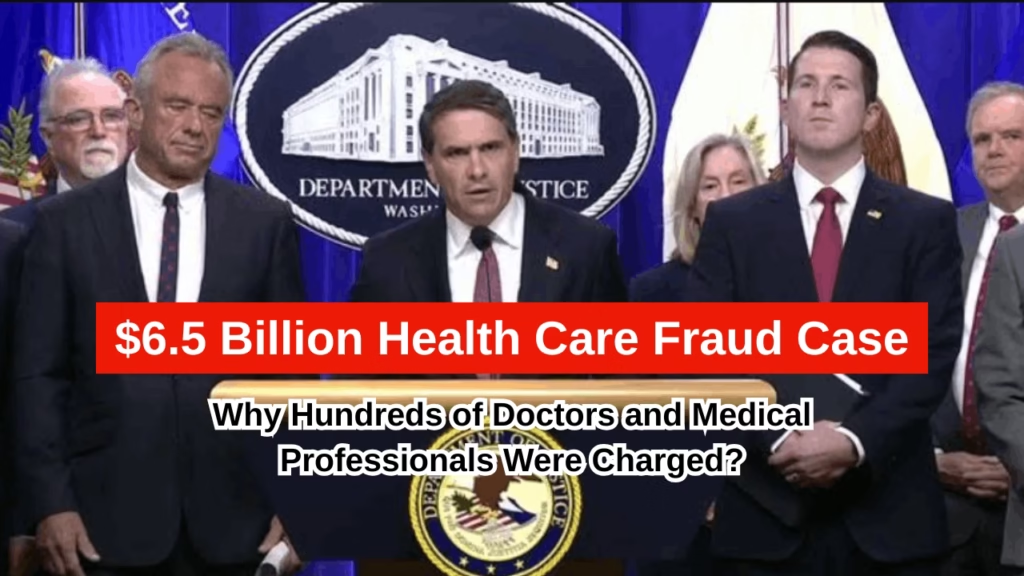
$6.5 Billion Health Care Fraud Case: In one of the largest coordinated law enforcement actions in U.S. history, the Department of Justice has announced charges against 455 defendants including 90 doctors and other licensed medical professionals in connection with more than $6.5 billion in alleged false claims submitted to Medicare, Medicaid, and other federal health programs. The 2026 National Health Care Fraud Takedown, unveiled at a Washington press conference, represents what officials are calling the broadest combined federal and state enforcement effort in Department history. For patients, taxpayers, and healthcare professionals alike, this case offers a sobering look at the scale and sophistication of modern healthcare fraud schemes and the unprecedented government response now being deployed to stop them.
The 2026 Takedown spanned an extraordinary geographic and institutional footprint. According to the Justice Department, the operation involved cases across 56 federal districts and 45 U.S. states and territories, with 50 state Medicaid Fraud Control Units participating the most in Department history. Acting Attorney General Todd Blanche called the announcement “the greatest combined federal and state effort in combating health care fraud in history.”
$6.5 Billion Health Care Fraud Case
The charges detailed at the press conference covered fraud and abuse occurring since June 8, 2026, with hundreds of defendants charged in that window alone. FBI Director Kash Patel, HHS Secretary Robert F. Kennedy Jr., and CMS Administrator Dr. Mehmet Oz all joined Blanche at the announcement, underscoring the whole-of-government nature of this enforcement push.
| Metric | Total |
|---|---|
| Total defendants charged | 455 |
| Doctors and licensed medical professionals charged | 90 |
| Total alleged false claims | Over $6.5 billion |
| Federal districts involved | 56 |
| States and territories involved | 45 |
| State Medicaid Fraud Control Units participating | 50 |
| Cash, vehicles, jewelry, and assets seized | Over $182 million |
| Providers suspended by CMS | 1,079 |
| Providers with revoked billing privileges | 1,403 |
What Were the Defendants Actually Accused Of?
The fraud schemes uncovered in this takedown span a wide range of healthcare billing categories, but officials highlighted several particularly large and damaging operations.
The Arizona Wound Care Scheme: Over $2 Billion
One of the most dramatic cases involved a wound care fraud scheme in Arizona, where prosecutors allege a corporate executive orchestrated a scheme that funneled approximately $1 billion in taxpayer funds through fraudulent billing for wound grafts, charging more than $1 million per patient in some instances. According to Blanche, the proceeds were allegedly used to purchase multi-million dollar homes, luxury vehicles, jewelry, and even fund construction of a hotel in the Philippines. Separately, officials noted that wound care billing abuses tied to one Arizona company alone resulted in $2 billion in fraudulent Medicare payments.
The Texas Scheme: $906 Million
A second major case centered on Texas, where a separate fraud scheme allegedly generated $906 million in fraudulent claims, contributing significantly to the overall total uncovered in this year’s takedown.
A Record Number of Medicaid Fraud Cases
This year’s takedown also set a new record for Medicaid-specific fraud prosecutions, with 295 defendants charged in connection with more than $518 million in false claims submitted to Medicaid the highest number of Medicaid fraud defendants and the largest associated dollar figure in the operation’s history.
International Fugitives Brought Back to the U.S.
In an unusual twist, the two-week takedown also resulted in international cooperation that led to the apprehension and return of several fraud suspects who had fled the country, including:
- One defendant apprehended in Kyrenia, connected to a scheme exceeding $3.7 billion
- Two defendants apprehended in Estonia, tied to a previously charged $10.6 billion scheme
- One of the FBI’s “Most Wanted Fraudsters,” apprehended in the Philippines, in connection with a previously charged $1.2 billion telemedicine fraud scheme
How the Allograft Billing Spike Triggered Investigations
A particularly notable thread running through this year’s takedown involves allografts donated tissue grafts used in wound care treatment. According to the DOJ, the Health Care Fraud Unit’s Data Analytics Team detected an unusual spike in payments for allografts, which became a key lead in uncovering several of the largest fraud schemes in this year’s operation.
In direct response, CMS separately realigned its payment structure, reducing Medicare’s payment rate for allografts to $127 per square centimeter, effective January 1, 2026. According to CMS Administrator Dr. Mehmet Oz, had the agency not taken this corrective action, the resulting Medicare Part B premium increase caused by unchecked allograft spending alone would have cost every Medicare beneficiary in the country an extra $11 per month.
Oz framed the broader strategy as a shift from reactive enforcement to proactive fraud prevention, stating that prosecuting criminals after the fact is necessary, but stopping fraudulent payments before a single dollar leaves the building is the smarter long-term approach. He added that CMS is now deploying advanced data analytics specifically to expose fraud networks, freeze suspicious payments, and shut down bad actors before harm occurs.
The Government’s Broader Enforcement Toolkit
Beyond criminal charges, this year’s takedown deployed a wide range of civil and administrative enforcement tools aimed at preventing future fraud and recovering taxpayer funds already at risk:
- 48 Civil Monetary Payment settlements, totaling more than $73 million
- Over 1,400 provider exclusions from federal health programs
- 25 separate HHS-OIG actions under the Civil Monetary Penalties Law, seeking more than $10 billion in payments to the Medicare Trust Fund representing fraudulent payments that CMS caught and froze before the money was ever disbursed
- Civil charges against 13 defendants for an additional $14.8 million in alleged fraud schemes
- Civil settlements with 31 defendants, totaling $23 million
- 928 administrative actions by the DEA, seeking to revoke the authority of providers to handle or prescribe controlled substances since October 1, 2025
This combination of criminal prosecution, civil penalties, and administrative license revocation reflects what officials describe as “full-spectrum accountability” targeting bad actors at every level, from individual doctor’s offices to corporate boardrooms.
Opioid Abuse: A Central Theme of This Year’s Takedown
Unlike some past enforcement actions focused narrowly on billing fraud, this year’s takedown placed significant emphasis on schemes involving opioid abuse alongside financial fraud. Officials specifically noted that several of the charged schemes resulted in significant patient harm, including death, tying fraudulent billing practices directly to real-world medical consequences rather than purely financial crimes.
HHS Secretary Robert F. Kennedy Jr. emphasized this dual harm in his statement, noting that healthcare fraud steals from taxpayers, exploits vulnerable patients, and puts lives directly at risk a framing that underscores why this year’s enforcement effort treated fraud not merely as a financial crime, but as a public health and safety issue.
Local Impact: Cases Reaching Smaller Communities
While headlines focused on billion-dollar schemes in Arizona and Texas, the 2026 Takedown also reached far smaller communities across the country. In Bridgeport, West Virginia, for example, a local pharmacy owner agreed to a $325,000 civil settlement resolving allegations tied to Medicare and Medicaid billing practices and prescribing conduct while the individual was reportedly traveling internationally. Similarly, in Puerto Rico, federal prosecutors secured a 21-count indictment against six individuals on charges including conspiracy to commit identity theft, wire fraud, and bank fraud, while separate Puerto Rico pharmacies agreed to pay a combined $4.6 million to resolve Medicare and Medicaid fraud allegations.
These smaller, localized cases illustrate that this year’s enforcement effort wasn’t limited to headline-grabbing billion-dollar schemes it reached pharmacies, individual practitioners, and regional healthcare businesses across dozens of jurisdictions simultaneously.
What This Means Going Forward
Officials were explicit that this takedown should be viewed as the beginning of an intensified enforcement era, not an isolated event. Assistant Attorney General Colin M. McDonald of the Department’s National Fraud Enforcement Division stated plainly that the government is “aggressively scaling” its offensive against anyone using healthcare as cover to steal from the American people, adding that no scheme is too complex and no hiding place too remote for ongoing federal investigation.
Blanche echoed this sentiment, stating directly: “This is just the beginning. Fraudsters can no longer rip off American taxpayers.”
What Healthcare Providers Should Take Away
For legitimate healthcare providers, several practical implications emerge from this year’s enforcement action:
- Billing irregularities, especially in high-cost categories like wound care and allografts, are now subject to advanced data analytics monitoring that can flag suspicious patterns in near real-time.
- CMS is shifting toward pre-payment fraud prevention, meaning suspicious claims may be frozen before payment rather than recovered after the fact.
- Provider exclusions, suspensions, and billing privilege revocations are being issued at a historically high volume, separate from criminal prosecution.
- International fugitives are not beyond reach this year’s coordinated apprehensions in Cyprus, Estonia, and the Philippines demonstrate expanding international cooperation in fraud enforcement.
The 2026 National Health Care Fraud Takedown stands as a landmark moment in federal healthcare enforcement, combining record-setting interagency cooperation, cutting-edge data analytics, and a clear willingness to pursue fraud across borders. With $6.5 billion in alleged false claims, 90 charged medical professionals, and over $182 million in seized assets, this case sends an unmistakable signal to the healthcare industry: as officials made clear, putting profit over patients is now a path that leads directly toward federal prosecution.