Trump Accounts Launch July 4: A new federal savings program for American children officially goes live on July 4, 2026 — deliberately timed to the 250th anniversary of the Declaration of Independence. Known as “Trump Accounts” (and formally as 530A accounts), the program hands eligible newborns a $1,000 head start invested in the stock market, with the goal of giving kids a financial cushion by the time they become adults. Here’s exactly who qualifies, how much money is involved, and how the accounts work.
What Trump Accounts (Federal Savings Program?) Actually Are?
Trump Accounts are a new type of tax-advantaged individual retirement account created for minors under the One, Big, Beautiful Bill Act, the sweeping tax-and-spending package President Trump signed into law on July 4, 2025. They function similarly to a traditional IRA: money is invested in U.S. stock market index funds, grows tax-deferred, and can’t be freely withdrawn early. When the child turns 18, the account under Federal Savings Program automatically converts into a standard traditional IRA, and ordinary IRA withdrawal rules apply from that point on.
Before age 18, though, these accounts operate under special restrictions. Funds must be invested in low-cost mutual funds or ETFs that track a broad U.S. stock index, and the Treasury Department has capped management fees on qualifying investments at 0.10% annually. Bank of New York Mellon has been named as a key custodian for the program, though multiple banks and brokerages are participating in offering the accounts.
Who Gets the $1000 Government Contribution?
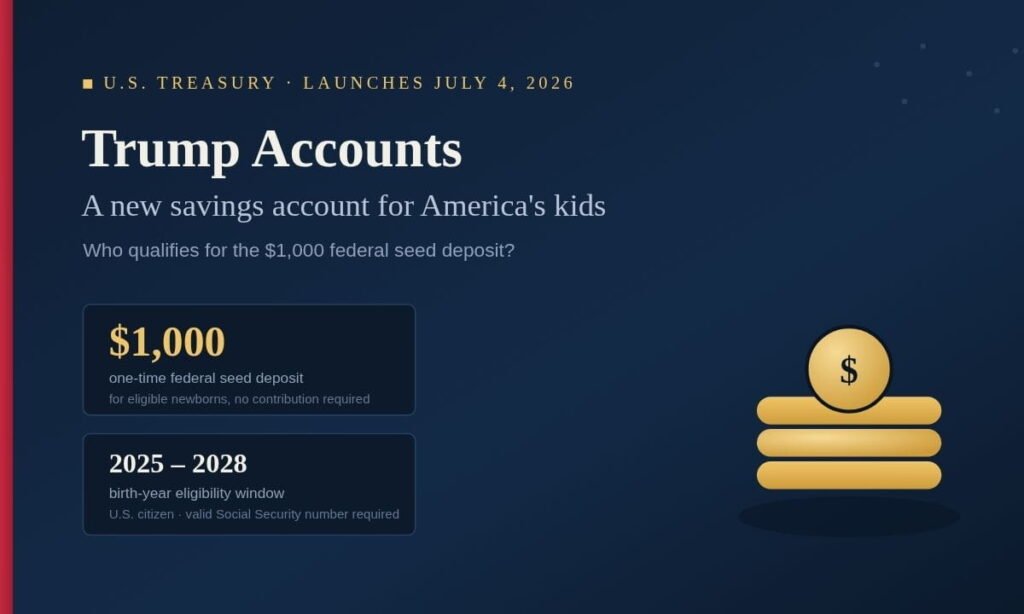
This is the detail causing the most confusion, because not every child with a Trump Account will actually receive government money. According to guidance published by both the IRS and Investor.gov, the one-time $1,000 federal “pilot program” contribution is limited to children who meet all of the following:
- Were born between January 1, 2025, and December 31, 2028.
- Are U.S. citizens.
- Have a valid, work-authorized Social Security number.
- Have a Trump Account opened on their behalf by a parent, guardian, or other authorized adult.
Children born before January 1, 2025 do not qualify for the $1,000 seed deposit, even though a Trump Account can still be opened in their name. Any child under 18 with a valid Social Security number can have an account under Federal Savings Program opened and receive private contributions — they simply won’t get the government’s $1,000 unless they fall within the 2025–2028 birth window.
There’s also a separate, smaller benefit worth knowing about: children born between 2016 and 2024 who don’t qualify for the $1,000 federal deposit may still be eligible for a $250 contribution funded by the Dell Technologies Foundation, provided they live in a ZIP code where the median household income is $150,000 or less — a threshold broad enough to cover the large majority of the country. This is a private philanthropic contribution, not a government payment, and is expected to be deposited shortly after accounts are processed following the July 4 launch.
How Big Is This Federal Savings Program?
The Federal Savings Program scale is substantial. Roughly 14.3 million babies are expected to be born in the U.S. between 2025 and 2028, meaning the federal government’s $1,000-per-child commitment could ultimately cost around $14.3 billion. As of early June 2026, the Treasury Department reported that more than 6 million children had already been signed up for accounts, though only a portion of those — reported at around 1.5 million in one estimate and roughly 1 million in a separate IRS accounting — were confirmed as eligible to actually claim the $1,000 seed money under Federal Savings Program at that point. The gap reflects how enrollment has been rolling in ahead of the formal contribution launch date, with eligibility verification still catching up.
How to Open an Account and Contribute?
Families can sign up now at the official government portal, trumpaccounts.gov, or through the Trump Accounts mobile app that Treasury launched on May 28, 2026. Parents filing a 2025 tax return can also formally elect to establish an account and enroll in the pilot program using IRS Form 4547, Trump Account Election(s).
Once an account is open, contributions from multiple sources are allowed:
- Parents/guardians can contribute up to $2,500 per year in pre-tax income, similar to a traditional retirement account contribution.
- Total annual contributions from all private sources — parents, relatives, friends, and employers — are capped at $5,000 per beneficiary per year (a figure expected to be indexed for inflation in future years).
- Contributions from state or local governments and philanthropic/charitable organizations do not count toward that $5,000 cap, meaning total money going into an account in a given year can exceed $5,000 if government or charitable sources are involved.
A number of employers have already announced they’ll match employee contributions to their children’s Trump Accounts, including Charles Schwab, Uber, JPMorgan Chase, and Chipotle — effectively free additional money for families who work at participating companies and choose to contribute themselves.
What the Money Can Be Used For?
Funds in a Trump Account are largely locked until the beneficiary turns 18. After that age, the account converts into a traditional IRA, and standard IRA taxation applies — meaning withdrawals are generally taxed as ordinary income unless used for a handful of exempted purposes. Reporting on the program indicates the money is intended to eventually support goals like higher education costs, starting a business, or making a down payment on a first home, though as with any IRA-style account, non-qualifying early withdrawals can trigger taxes and penalties.
What Supporters and Critics Are Saying?
Treasury Secretary Scott Bessent has framed the launch as a way to broaden participation in financial markets, saying the new mobile app gives households an easy way to start building long-term financial strength “from day one.” Supporters argue the program could help narrow the wealth gap by giving every eligible child a stake in the stock market regardless of family income, since the $1,000 seed deposit itself requires no contribution from the family to receive.
Critics, however, have raised concernsthat the accounts primarily benefit families who can already afford to add the extra $2,500–$5,000 in yearly contributions, and some policy analysts have argued that the billions being spent on the $1,000 seed deposits might do more to reduce financial hardship if redirected toward existing, more targeted social safety net programs. That debate is likely to continue as enrollment data and account performance become clearer over the coming years.
Bottom Line
If your child was born between January 1, 2025 and December 31, 2028, holds a valid Social Security number, and is a U.S. citizen, opening a Trump Account entitles them to a $1,000 federal deposit starting July 4, 2026 — no family contribution required to get that initial amount. Older children can still have accounts opened for them and receive private contributions, and some may qualify for a smaller $250 philanthropic deposit, but they won’t receive the government’s $1,000. From here, it’s a long-term, IRA-style account: contributions are capped annually, investments are restricted to low-cost broad market funds, and the money stays largely inaccessible until the child turns 18.
Most Asked Doubts :-
What are Trump Accounts?
Trump Accounts are a new savings and investment account initiative launched by the U.S. government to help eligible children begin building long-term financial savings from an early age.
When Trump Accounts launched?
The Trump Accounts officially launched on July 4, aligning with U.S. Independence Day celebrations and the enactment of the legislation that created the accounts.
Who is eligible for a Trump Accounts?
Eligibility generally depends on the child’s birth date, U.S. citizenship or qualifying residency status, and other requirements established under the law. Parents or guardians should review the official eligibility criteria.
Is every eligible child automatically enrolled?
Eligible children may receive an account automatically if they meet the program requirements, though some families may need to complete additional steps depending on how the program is administered.
How much money is deposited into a Trump Accounts?
Eligible children receive an initial government-funded contribution, with families and other approved contributors able to add more funds subject to annual contribution limits.
Can parents contribute additional money?
Yes. Parents, guardians, relatives, and other eligible contributors can generally make additional contributions up to the annual limit established by the program.