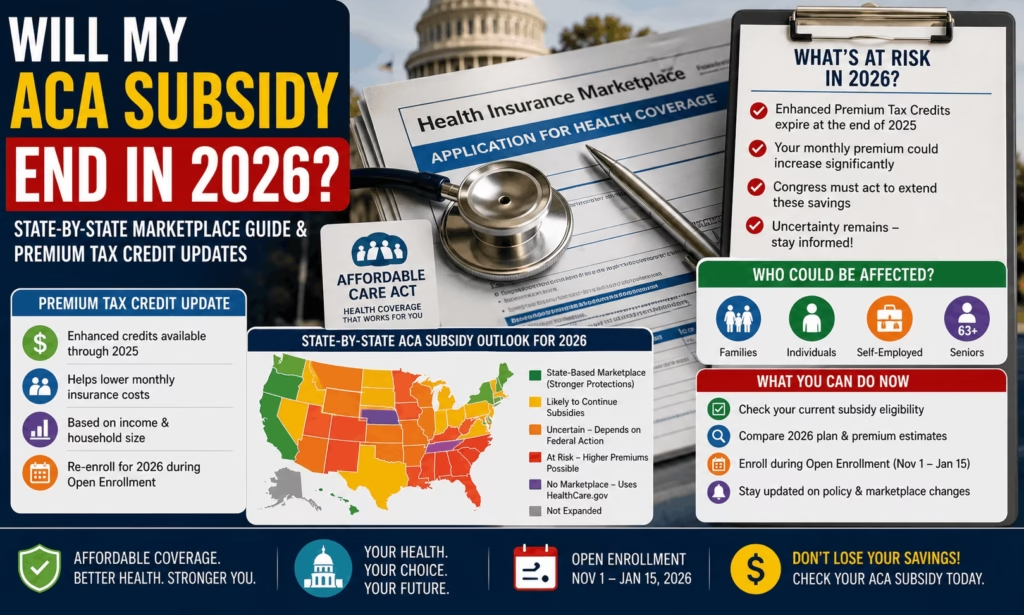
ACA Subsidy 2026 questions have surged because something did actually change on January 1, 2026 but it’s not a total end to subsidies, and it’s important to separate what’s already happened from what’s still being fought over in Congress. Here is the confirmed part: the enhanced Premium Tax Credit (ePTC), the COVID-era boost that made ACA Marketplace plans free or nearly free for millions of people, expired on December 31, 2025 after Congress failed to pass an extension before year-end. That reversion is now in effect for 2026 coverage. Here is the pending part: the U.S. House passed a three-year extension bill on January 8, 2026 (230–196, with 17 Republicans joining Democrats), but as of this writing the Senate has not passed that bill or any alternative, and negotiations remain unresolved. So the honest answer to “will my ACA subsidy end in 2026” is: the enhanced boost has already ended under current law, base-level ACA premium tax credits still exist for everyone who qualifies, and whether the enhanced version comes back depends on a Senate vote that has not yet happened.
This guide walks through what the Premium Tax Credit actually is, who is most likely to feel the change, your state’s Marketplace type (HealthCare.gov vs. your own state exchange), Medicaid expansion status, and what to do to protect your coverage during renewal. We’ll be updating this article monthly as Congress continues to debate an extension and as states finalize their 2026 responses.
Will ACA Subsidies End in 2026?
Current, confirmed law: The ACA’s base Premium Tax Credit (PTC) established in 2010 has not been repealed and remains available in 2026 to eligible households earning 100%–400% of the Federal Poverty Level (FPL). What ended is the temporary enhancement added by the American Rescue Plan Act (2021) and extended through 2025 by the Inflation Reduction Act. That enhancement had removed the 400% FPL income cap and lowered how much of their income enrollees had to contribute toward premiums. With its expiration, the 400% FPL “subsidy cliff” is back, and required premium contributions at every income level have risen.
What’s proposed, not law: A three-year restoration of the enhanced credit passed the House in January 2026. It has not passed the Senate. A Senate vote on a similar measure failed in December 2025, and as of mid-2026 talks between the two chambers have stalled without a clear path forward though pressure to reach a deal continues ahead of the November 2026 midterms. Nothing is guaranteed to change until the Senate acts.
What Is the ACA Premium Tax Credit?
- Advance Premium Tax Credit (APTC): The subsidy paid directly to your insurer each month to lower your premium, based on your estimated income.
- Premium reduction: The APTC reduces what you owe out-of-pocket for a Marketplace plan; the size of the reduction depends on income, family size, and the cost of the benchmark (“second-lowest-cost Silver”) plan in your area.
- Monthly subsidy: Delivered automatically each month if you take it in advance, rather than waiting for your tax refund.
- Tax reconciliation: When you file taxes, you reconcile the APTC you received against the credit you actually qualified for based on your final income — you may owe money back or receive an additional credit.
Who Could Lose ACA Subsidies in 2026?
- Higher-income households: With the 400% FPL cap restored, households above that threshold — for example, a family of four earning roughly more than $128,600 — are no longer eligible for any premium tax credit, even a partial one, unless a Senate extension changes this.
- Income verification issues: Failing to confirm income or respond to a data-matching request can pause or end your subsidy.
- Immigration eligibility: Only lawfully present individuals are eligible for Marketplace subsidies; status changes can affect eligibility.
- Employer coverage offers: If you’re offered “affordable” employer coverage that meets minimum value standards, you generally can’t also claim a Marketplace subsidy.
- Medicaid eligibility changes: Losing Medicaid eligibility (or gaining it) shifts which program you qualify for.
- Failure to renew Marketplace coverage: Missing your renewal deadline or failing to update your application can result in auto-enrollment at the wrong subsidy amount or a coverage gap.
State-by-State ACA Marketplace Guide
The table below reflects official CMS data on which platform each state uses for 2026 coverage, current Medicaid expansion status, and whether the state provides additional state-funded financial assistance on top of the federal credit. Every state follows the same federal premium tax credit rules described above what differs state to state is the marketplace platform, Medicaid expansion status, and whether extra state money is available.
| State | Marketplace Type (2026) | Medicaid Expansion | Extra State-Funded Subsidy | Official Marketplace |
|---|---|---|---|---|
| Alabama | HealthCare.gov | Not expanded | No | healthcare.gov |
| Alaska | HealthCare.gov | Expanded | No | healthcare.gov |
| Arizona | HealthCare.gov | Expanded | No | healthcare.gov |
| Arkansas | HealthCare.gov | Expanded | No | healthcare.gov |
| California | State Exchange (Covered California) | Expanded | Yes | coveredca.com |
| Colorado | State Exchange (Connect for Health Colorado) | Expanded | Yes | connectforhealthco.com |
| Connecticut | State Exchange (Access Health CT) | Expanded | Yes | accesshealthct.com |
| Delaware | HealthCare.gov | Expanded | No | healthcare.gov |
| Florida | HealthCare.gov | Not expanded | No | healthcare.gov |
| Georgia | State Exchange (Georgia Access) | Partial only (Pathways to Coverage) | No | georgiaaccess.gov |
| Hawaii | HealthCare.gov | Expanded | No | healthcare.gov |
| Idaho | State Exchange (Your Health Idaho) | Expanded | No | yourhealthidaho.org |
| Illinois | State Exchange (new for 2026) | Expanded | No | getcovered.illinois.gov |
| Indiana | HealthCare.gov | Expanded | No | healthcare.gov |
| Iowa | HealthCare.gov | Expanded | No | healthcare.gov |
| Kansas | HealthCare.gov | Not expanded | No | healthcare.gov |
| Kentucky | State Exchange (kynect) | Expanded | No | kynect.ky.gov |
| Louisiana | HealthCare.gov | Expanded | No | healthcare.gov |
| Maine | State Exchange (CoverME.gov) | Expanded | No | coverme.gov |
| Maryland | State Exchange (Maryland Health Connection) | Expanded | Yes | marylandhealthconnection.gov |
| Massachusetts | State Exchange (Health Connector) | Expanded | Yes | mahealthconnector.org |
| Michigan | HealthCare.gov | Expanded | No | healthcare.gov |
| Minnesota | State Exchange (MNsure) | Expanded | No | mnsure.org |
| Mississippi | HealthCare.gov | Not expanded | No | healthcare.gov |
| Missouri | HealthCare.gov | Expanded | No | healthcare.gov |
| Montana | HealthCare.gov | Expanded | No | healthcare.gov |
| Nebraska | HealthCare.gov | Expanded | No | healthcare.gov |
| Nevada | State Exchange (Nevada Health Link) | Expanded | No | nevadahealthlink.com |
| New Hampshire | HealthCare.gov | Expanded | No | healthcare.gov |
| New Jersey | State Exchange (GetCoveredNJ) | Expanded | Yes | getcovered.nj.gov |
| New Mexico | State Exchange (BeWellnm) | Expanded | Yes | bewellnm.com |
| New York | State Exchange (NY State of Health) | Expanded | Yes | nystateofhealth.ny.gov |
| North Carolina | HealthCare.gov | Expanded | No | healthcare.gov |
| North Dakota | HealthCare.gov | Expanded | No | healthcare.gov |
| Ohio | HealthCare.gov | Expanded | No | healthcare.gov |
| Oklahoma | HealthCare.gov | Expanded | No | healthcare.gov |
| Oregon | HealthCare.gov (transitioning to own exchange for 2027) | Expanded | No | healthcare.gov |
| Pennsylvania | State Exchange (Pennie) | Expanded | No | pennie.com |
| Rhode Island | State Exchange (HealthSource RI) | Expanded | No | healthsourceri.com |
| South Carolina | HealthCare.gov | Not expanded | No | healthcare.gov |
| South Dakota | HealthCare.gov | Expanded | No | healthcare.gov |
| Tennessee | HealthCare.gov | Not expanded | No | healthcare.gov |
| Texas | HealthCare.gov | Not expanded | No | healthcare.gov |
| Utah | HealthCare.gov | Expanded | No | healthcare.gov |
| Vermont | State Exchange (Vermont Health Connect) | Expanded | Yes | vermonthealthconnect.gov |
| Virginia | State Exchange | Expanded | No | marketplace.virginia.gov |
| Washington | State Exchange (Washington Healthplanfinder) | Expanded | Yes | wahealthplanfinder.org |
| West Virginia | HealthCare.gov | Expanded | No | healthcare.gov |
| Wisconsin | HealthCare.gov | Partial only | No | healthcare.gov |
| Wyoming | HealthCare.gov | Not expanded | No | healthcare.gov |
| District of Columbia | State Exchange (DC Health Link) | Expanded | No | dchealthlink.com |
Income verification and renewal steps are largely the same nationwide: confirm your household income and size, report any changes since your last application, and actively re-select or confirm your plan rather than relying only on auto-renewal, since your subsidy amount can change significantly year to year.
States With Their Own Health Insurance Marketplace
Twenty states plus DC run a State-Based Exchange (SBE) for 2026: California, Colorado, Connecticut, DC, Georgia, Idaho, Illinois, Kentucky, Maine, Maryland, Massachusetts, Minnesota, Nevada, New Jersey, New Mexico, New York, Pennsylvania, Rhode Island, Vermont, Virginia, and Washington. Illinois is new to this list for the 2026 plan year. State-run exchanges can set their own enrollment deadlines, offer local navigator/assister support, and in ten of these states layer additional state-funded subsidies on top of the federal credit.
States Using HealthCare.gov
The remaining 30 states use the federal HealthCare.gov platform for 2026: Alabama, Alaska, Arizona, Arkansas, Delaware, Florida, Hawaii, Indiana, Iowa, Kansas, Louisiana, Michigan, Mississippi, Missouri, Montana, Nebraska, New Hampshire, North Carolina, North Dakota, Ohio, Oklahoma, Oregon, South Carolina, South Dakota, Tennessee, Texas, Utah, West Virginia, Wisconsin, and Wyoming. These states follow the same federal subsidy rules and enrollment window, without a state-run alternative platform (Oregon is set to launch its own exchange for 2027 coverage).
States Offering Additional Financial Assistance
Per KFF, ten states currently provide their own subsidies on top of federal assistance: California, Colorado, Connecticut, Maryland, Massachusetts, New Jersey, New Mexico, New York, Vermont, and Washington. Several of these increased their state funding specifically in response to the enhanced federal credit’s expiration — for example, New Mexico fully replaced the lost federal enhancement for households under 400% FPL, Massachusetts added $250 million to its ConnectorCare program, and California allocated $190 million to fully offset costs for enrollees up to 150% FPL. Other states, including Washington and New York, had state-funded assistance in place well before the federal enhancement expired, independent of this year’s changes.
Income Limits for ACA Subsidies in 2026
- Household income: Calculated using Modified Adjusted Gross Income (MAGI) for everyone in your tax household.
- Federal Poverty Level (FPL): Eligibility is measured against the FPL for your household size; base ACA credits apply between 100% and 400% of FPL.
- Family size: Larger households have a higher dollar-based FPL threshold at every percentage level.
- Income estimation: Marketplace applications ask you to estimate your current-year income; being significantly off can mean owing money back — or being owed more — at tax time.
How Much Could Premiums Increase If Subsidies End?
According to KFF’s subsidy calculator, the expiration of the enhanced credit is estimated to increase what enrollees pay out-of-pocket for Marketplace premiums by an average of about 114%, or roughly $1,016 a year, nationally. Illustrative examples reported by health-policy analysts include:
- A family of four earning around 140% of FPL (about $45,000/year) who paid $0 in premiums in 2025 could see costs rise to roughly $1,600/year in 2026.
- A 60-year-old couple earning about 402% of FPL (just above the cap, roughly $85,000/year) could go from paying about 8.5% of income toward premiums to paying the full, unsubsidized premium — cited in one analysis as over $22,000/year.
- Older adults generally see the largest dollar increases because Marketplace premiums are age-rated and rise significantly for enrollees in their 50s and early 60s.
- Rural counties, which often have fewer insurers and higher benchmark premiums, tend to see sharper percentage increases than urban areas.
These are illustrative examples, not guarantees — your actual premium and subsidy depend on your specific plan, age, location, income, and whether Congress changes the law before you enroll.
How to Keep Your ACA Subsidy
- Update your income as soon as it changes during the year.
- Report household changes — marriage, divorce, new dependents, moving states — promptly.
- Complete your renewal actively each year rather than relying solely on auto-renewal.
- Verify documents requested for income or immigration-status data matching.
- Compare plans every year, since your benchmark plan and subsidy amount can shift even if your income doesn’t.
Open Enrollment for 2026 Coverage
| Marketplace Type | 2026 Open Enrollment Window | Special Enrollment |
|---|---|---|
| HealthCare.gov (30 states) | November 1, 2025 – January 15, 2026 (enroll by Dec. 15 for Jan. 1 start) | Available for 60 days after a qualifying life event |
| State-Based Exchanges (20 states + DC) | Varies by state; many ran through late December 2025, some with extended deadlines | Available for 60 days after a qualifying life event; timing may vary by state |
Note: Federal guidance calls for a shorter standard Open Enrollment window (Nov. 1 – Dec. 15) starting with coverage year 2027; state exchanges may set their own extended deadlines.
What Happens If You Lose Your Subsidy?
- Higher premiums: You’d pay the full, unsubsidized cost of your plan going forward.
- Plan changes: You may want to switch to a lower-premium plan (like Bronze) to manage costs without a subsidy.
- Medicaid eligibility: If your income drops, you may newly qualify for Medicaid, especially in expansion states.
- Special Enrollment options: Losing subsidy eligibility alone typically isn’t a qualifying event, but a related income or household change might be — check with your marketplace.
Can You Appeal an ACA Subsidy Decision?
Yes. Both HealthCare.gov and state-based exchanges offer an appeal (fair hearing) process if you believe your eligibility determination, subsidy amount, or enrollment decision was wrong. You’ll generally need to file within a set window (commonly 90 days) and provide supporting documents such as pay stubs, tax returns, or immigration documentation. State-based marketplaces run their own appeals process separately from HealthCare.gov’s federal appeals process — check your specific exchange’s website for its timeline and required forms.
How to Check Your ACA Subsidy Status
- Marketplace account: Log into your HealthCare.gov or state exchange account to see your current eligibility determination and subsidy amount.
- IRS Form 1095-A: Sent each year, this shows the premium tax credit you actually received — used to reconcile on your tax return.
- State Marketplace portal: If you’re in a state-based exchange, use that state’s specific website (listed in the table above).
- Customer support: Both HealthCare.gov and state exchanges have call centers and, in many states, in-person navigator assistance.
Key Takeaways
- The enhanced ACA premium tax credit expired December 31, 2025 — this is confirmed, current law.
- Base ACA premium tax credits still exist for households between 100–400% of FPL; the enhancement’s removal of the 400% cap is gone unless Congress acts.
- The House passed a three-year extension in January 2026; the Senate has not passed it, and the outcome remains genuinely uncertain.
- Average estimated premium increase without an extension: about 114% ($1,016/year), per KFF.
- 10 states provide extra state-funded subsidies on top of the federal credit: CA, CO, CT, MD, MA, NJ, NM, NY, VT, WA.
- 10 states have not adopted full Medicaid expansion: AL, FL, GA (partial), KS, MS, SC, TN, TX, WI (partial), WY.
- 30 states use HealthCare.gov; 20 states plus DC run their own exchange for 2026.
Official Resources
| HealthCare.gov (federal Marketplace): | https://www.healthcare.gov |
| CMS Marketplace 2026 Open Enrollment National Snapshot: | https://www.cms.gov/newsroom/fact-sheets/marketplace-2026-open-enrollment-period-report-national-snapshot-0 |
| KFF ACA Subsidy Calculator: | https://www.kff.org/interactive/calculator-aca-enhanced-premium-tax-credit/ |
| Home Page | https://govtschemes.org/ |
FAQs
Will ACA subsidies end in 2026?
The enhanced version already ended as of January 1, 2026, under current law. Base ACA subsidies remain available. Whether the enhanced credit returns depends on a Senate vote that has not yet happened.
Will my health insurance premium increase?
Likely yes, unless you live in one of the states offering full state-funded replacement subsidies (like New Mexico) or Congress passes an extension. KFF estimates an average 114% increase in out-of-pocket premium costs without an extension.
Which states offer extra ACA subsidies?
California, Colorado, Connecticut, Maryland, Massachusetts, New Jersey, New Mexico, New York, Vermont, and Washington, per KFF.
Can I keep my Premium Tax Credit?
Yes, if your income falls within 100–400% of FPL under current law. If you’re above 400% FPL, you won’t qualify for any credit unless Congress restores the enhanced version.
How do I renew my ACA plan?
Log into your Marketplace account (HealthCare.gov or your state exchange), update your income and household information, and actively select or confirm your plan rather than relying only on auto-renewal.
What income qualifies for ACA subsidies in 2026?
Generally 100–400% of the Federal Poverty Level for your household size under current law.
Which states have their own Marketplace?
20 states plus DC: California, Colorado, Connecticut, DC, Georgia, Idaho, Illinois, Kentucky, Maine, Maryland, Massachusetts, Minnesota, Nevada, New Jersey, New Mexico, New York, Pennsylvania, Rhode Island, Vermont, Virginia, and Washington.
What happens if I miss Open Enrollment?
You generally can’t enroll in a Marketplace plan until the next Open Enrollment period unless you qualify for a Special Enrollment Period due to a qualifying life event.
Can I switch plans?
Yes, during Open Enrollment or a qualifying Special Enrollment Period.
How do I check my subsidy status?
Through your Marketplace account, your IRS Form 1095-A, or your marketplace’s customer service line.
People Also Ask
Did Congress extend ACA subsidies?
Not yet, as of this writing. The House passed a three-year extension in January 2026, but the Senate has not passed it or any alternative.
Why did my ACA premium go up in 2026?
Because the enhanced premium tax credit expired December 31, 2025, restoring the original ACA income cap and contribution percentages — unless you live in a state that fully replaced the lost assistance.
Is Obamacare still active in 2026?
Yes. The ACA Marketplace, base premium tax credits, and Medicaid expansion are all still in effect; what changed is the temporary enhancement to the tax credit.
What is the ACA subsidy cliff?
The point at which households earning just over 400% of FPL become ineligible for any premium tax credit — reinstated for 2026 after being suspended from 2021–2025.