SNAP Work Requirements 2026 have changed more this year than in almost any year since the program began, and millions of recipients are seeing letters in the mail asking them to prove they are working, training, or volunteering to keep their food assistance. The One Big Beautiful Bill Act (OBBBA), signed into law on July 4, 2025, raised the ABAWD (Able-Bodied Adults Without Dependents) age ceiling from 54 all the way to 64, narrowed the caregiver exemption to parents of children under 14 (down from under 18), and removed the blanket exemptions that previously covered veterans, people experiencing homelessness, and young adults aging out of foster care. States began phasing in these changes between November 2025 and June 2026, so the exact start date for your household depends on where you live and when your case is due for recertification. This guide breaks down exactly who is exempt from SNAP work requirements, who now falls under the stricter ABAWD rules, and what proof you need to protect your benefits.
Because SNAP is administered jointly by the USDA Food and Nutrition Administration (FNA) formerly the Food and Nutrition Service (FNS) and each state’s own social services agency, the fine print differs from state to state, especially around ABAWD waivers for high-unemployment areas. Below you’ll find the federal baseline rules that apply everywhere, a full exemption checklist, a 50-state comparison table, the documents caseworkers accept as proof, and answers to the most commonly searched questions about SNAP eligibility 2026. We’ll be updating this article monthly as states finish rolling out the new rules and as USDA releases further implementation guidance.
What Are SNAP Work Requirements?
SNAP work requirements are federal rules that tie continued food assistance to proof of work, job training, or job search activity. There are two separate layers, and confusing them is one of the most common mistakes people make:
- General Work Requirements (GWR): Apply broadly to most SNAP recipients age 16–59 who are physically and mentally able to work. Recipients must register for work, accept suitable job offers, and not voluntarily quit a job or reduce hours without good cause.
- ABAWD Work Requirements: A stricter, narrower rule for Able-Bodied Adults Without Dependents. Under the 2025–2026 changes, this now applies to adults age 18 through 64 who do not have a dependent child under 14 in the household and do not otherwise qualify for an exemption. ABAWDs must complete 80 hours per month of work, work training, or an approved combination of the two, or they lose SNAP eligibility after three months in a 36-month period.
The USDA Food and Nutrition Administration sets the national framework, but each state SNAP agency (such as a Department of Human Services or Department of Health and Human Services) handles verification, exemptions, and local Employment & Training (E&T) programs.
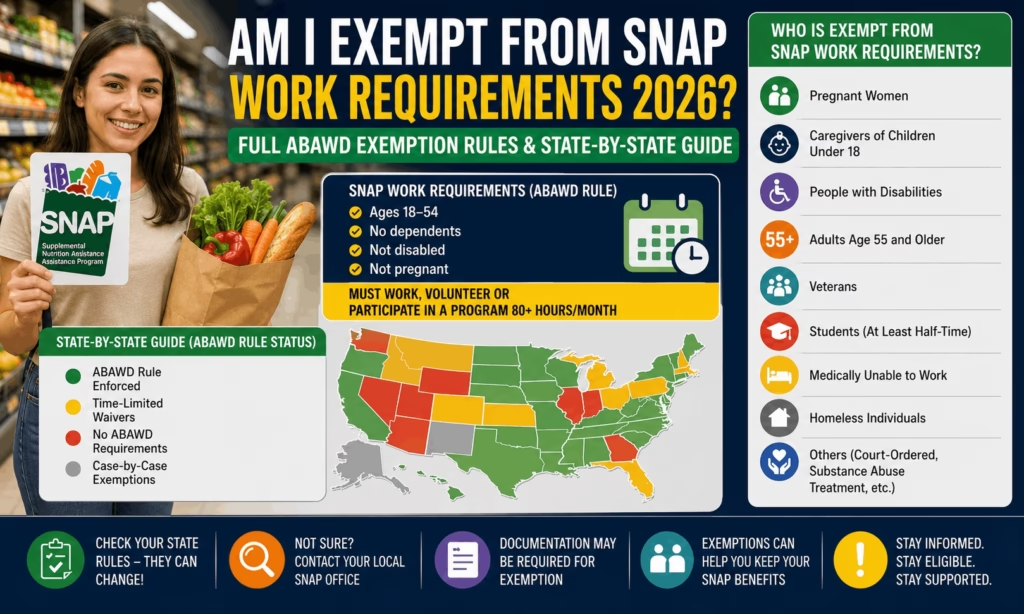
Who Is Exempt From SNAP Work Requirements?
Age-Based Exemptions
Children and teens under 16 are automatically exempt from the general work requirement. On the other end, adults 60 and older remain exempt from the general work requirement, though under the new law, adults 55–64 are no longer automatically exempt from the ABAWD time limit unless another exemption applies. Required proof: birth certificate, driver’s license, or state ID. Common mistake: assuming that turning 55 or 60 automatically removes you from all SNAP work rules — under the 2026 rules it does not fully do so anymore.
Disability Exemptions
People with a physical or mental disability that limits their ability to work are exempt. This includes anyone receiving SSI, SSDI, or VA disability compensation, as well as people the state determines are “physically or mentally unfit for employment.” Required proof: SSI/SSDI award letter, VA disability rating letter, or a medical certification from a doctor or licensed practitioner. Common mistake: not renewing the medical certification when it expires, which can suddenly reclassify someone as an ABAWD.
Pregnancy Exemption
Pregnant SNAP recipients are exempt from both general and ABAWD work requirements. Required proof: a doctor’s note or medical record confirming pregnancy. Common mistake: waiting too long into recertification to submit updated pregnancy documentation.
Parent/Caregiver Exemption
Under the OBBBA, this exemption now covers only parents or caretakers responsible for a child under age 14 (previously under 18). Adults caring for a disabled family member of any age also qualify. Required proof: child’s birth certificate plus proof of household residence, or documentation of caregiving responsibility for a disabled relative. Common mistake: parents of 14–17-year-olds assuming the old “any minor child” rule still applies — it no longer does.
Student Exemptions
Students enrolled at least half-time in a recognized school, training program, or institution of higher education are generally exempt. Required proof: enrollment verification letter or class schedule. Common mistake: dropping below half-time enrollment mid-semester without reporting the change.
Veteran Exemptions
This is one of the biggest changes for 2026: the temporary blanket exemption for veterans (added in 2023) was eliminated by the OBBBA. Veterans now must meet the same ABAWD rules as any other adult 18–64 unless they qualify through disability, caregiving, or another exemption. Common mistake: veterans assuming their status alone still protects their SNAP benefits.
Homeless Exemptions
Similarly, the temporary exemption for individuals experiencing homelessness was also removed. Homeless SNAP recipients without another qualifying exemption are now subject to ABAWD rules, though many states offer flexible options for documenting work hours and identity when someone lacks stable housing.
Foster Youth Exemptions
The exemption for young adults who aged out of foster care (previously available up to age 24) has likewise been repealed. This population now falls back under standard ABAWD rules unless they qualify for a student, disability, or caregiver exemption.
Tribal Member Exemptions
A new exemption created under the OBBBA covers individuals defined as “an Indian,” “an Urban Indian,” or “a California Indian” under the Indian Health Care Improvement Act. This is a genuinely new protection added in the 2025–2026 rule changes, not a holdover exemption.
Already Working Required Hours / Receiving Unemployment or Training
Anyone already working 30+ hours a week (or earning the equivalent of 30 hours at federal minimum wage, about $217.50/week), participating in TANF work activities, or receiving/applying for unemployment insurance is generally exempt from needing additional proof. Required proof: recent pay stubs, employer verification letter, or unemployment benefit confirmation.
Who Must Meet SNAP Work Requirements?
Adults who don’t fit any exemption above — generally able-bodied adults 18 to 64 without dependents under 14 — fall into the ABAWD category and must document 80 hours per month of qualifying activity. This can include paid work, unpaid work experience, vocational training, education tied to employment, or an approved workfare/E&T placement. Anyone in this category who fails to document the hours can only receive SNAP for three months within a 36-month window before benefits stop.
ABAWD Rules 2026
| Rule Element | Pre-2025 Rule | 2026 Rule (Post-OBBBA) |
|---|---|---|
| Age range | 18–54 | 18–64 |
| Dependent-child exemption | Child under 18 | Child under 14 |
| Veteran exemption | Exempt | No longer exempt |
| Homeless exemption | Exempt | No longer exempt |
| Former foster youth exemption | Exempt to age 24 | No longer exempt |
| Tribal member exemption | Not specified | New exemption added |
| Monthly work/training requirement | 80 hours | 80 hours (unchanged) |
| Time limit | 3 months in 36 months | 3 months in 36 months (unchanged) |
| Area waiver threshold | High unemployment or insufficient jobs | Unemployment rate over 10% only; “insufficient jobs” basis removed |
Extensions and exceptions: States may still grant a limited number of individual discretionary exemptions each year, and Alaska and Hawaii have been given the ability to request temporary good-faith exemptions through 2028 due to unique labor-market conditions.
State-by-State SNAP Work Requirement Status 2026
Federal ABAWD rules (age 18–64, 80-hour requirement, 3/36 time limit) now apply nationwide. The main thing that varies by state is whether an area-wide waiver is currently active and when the state began enforcing the new age range and caregiver rules. As of mid-2026, only a small number of states have an active statewide waiver, and even those are set to expire June 30, 2026 unless renewed. Because waiver status can change quarterly, always confirm current status through your state SNAP agency or the USDA FNA waiver page before relying on it.
| State/Territory | Federal ABAWD Age Range | Statewide Waiver Status (2026) | E&T Program | Notes |
|---|---|---|---|---|
| Alabama | 18–64 | No active statewide waiver | Yes | Check county-level enforcement start date |
| Alaska | 18–64 | Temporary good-faith exemption eligible through 2028 | Yes | Remote-area rules may affect verification |
| Arizona | 18–64 | No active statewide waiver | Yes | — |
| Arkansas | 18–64 | No active statewide waiver | Yes | — |
| California | 18–64 | No active statewide waiver | Yes (CalFresh E&T) | County-level rollout varies |
| Colorado | 18–64 | No active statewide waiver | Yes | — |
| Connecticut | 18–64 | No active statewide waiver | Yes | — |
| Delaware | 18–64 | No active statewide waiver | Yes | — |
| Florida | 18–64 | No active statewide waiver | Yes | — |
| Georgia | 18–64 | No active statewide waiver | Yes | — |
| Hawaii | 18–64 | Temporary good-faith exemption eligible through 2028 | Yes | — |
| Idaho | 18–64 | No active statewide waiver | Yes | — |
| Illinois | 18–64 | No active statewide waiver | Yes | — |
| Indiana | 18–64 | No active statewide waiver | Yes | — |
| Iowa | 18–64 | No active statewide waiver | Yes | — |
| Kansas | 18–64 | No active statewide waiver | Yes | — |
| Kentucky | 18–64 | No active statewide waiver | Yes | — |
| Louisiana | 18–64 | No active statewide waiver | Yes | — |
| Maine | 18–64 | No active statewide waiver | Yes | — |
| Maryland | 18–64 | No active statewide waiver | Yes | — |
| Massachusetts | 18–64 | No active statewide waiver | Yes | — |
| Michigan | 18–64 | No active statewide waiver | Yes | — |
| Minnesota | 18–64 | Active statewide waiver through June 30, 2026 | Yes | Confirm renewal status after June 2026 |
| Mississippi | 18–64 | No active statewide waiver | Yes | — |
| Missouri | 18–64 | No active statewide waiver | Yes | — |
| Montana | 18–64 | Active statewide waiver through June 30, 2026 | Yes | Confirm renewal status after June 2026 |
| Nebraska | 18–64 | No active statewide waiver | Yes | — |
| Nevada | 18–64 | No active statewide waiver | Yes | — |
| New Hampshire | 18–64 | No active statewide waiver | Yes | — |
| New Jersey | 18–64 | No active statewide waiver | Yes | — |
| New Mexico | 18–64 | No active statewide waiver | Yes | — |
| New York | 18–64 | No active statewide waiver | Yes | NYC enforcement began March 2026 |
| North Carolina | 18–64 | No active statewide waiver | Yes | — |
| North Dakota | 18–64 | Active statewide waiver through June 30, 2026 | Yes | Confirm renewal status after June 2026 |
| Ohio | 18–64 | No active statewide waiver | Yes | — |
| Oklahoma | 18–64 | No active statewide waiver | Yes | — |
| Oregon | 18–64 | No active statewide waiver | Yes | — |
| Pennsylvania | 18–64 | No statewide waiver; local exceptions reported | Yes | Some cities’ enforcement delayed to Sept. 2026 — confirm locally |
| Rhode Island | 18–64 | No active statewide waiver | Yes | — |
| South Carolina | 18–64 | No active statewide waiver | Yes | — |
| South Dakota | 18–64 | No active statewide waiver | Yes | — |
| Tennessee | 18–64 | No active statewide waiver | Yes | — |
| Texas | 18–64 | No active statewide waiver | Yes | — |
| Utah | 18–64 | No active statewide waiver | Yes | — |
| Vermont | 18–64 | No active statewide waiver | Yes | — |
| Virginia | 18–64 | No active statewide waiver | Yes | — |
| Washington | 18–64 | No active statewide waiver | Yes | — |
| West Virginia | 18–64 | No active statewide waiver | Yes | — |
| Wisconsin | 18–64 | No active statewide waiver | Yes | — |
| Wyoming | 18–64 | No active statewide waiver | Yes | — |
| Washington, D.C. | 18–64 | No active statewide waiver | Yes | Enforcement began June 1, 2026 |
Waiver status changes frequently and is often set at the county or metro level rather than statewide — always verify current status through your state SNAP office or the official USDA ABAWD waivers page linked below before making decisions about work hours.
States With Additional Employment & Training Programs
Every state runs a SNAP Employment & Training (E&T) program, but participation can be mandatory (for ABAWDs who need to satisfy the 80-hour rule) or voluntary (for anyone who wants extra job support). E&T services typically include job placement assistance, resume and interview coaching, skills and vocational training, and adult education such as GED preparation.
States With ABAWD Waivers
As of mid-2026, Minnesota, Montana, and North Dakota are the primary states holding an active statewide ABAWD waiver, each set to expire June 30, 2026. These waivers exist because the area met the federal threshold of an unemployment rate above 10% — the only basis now allowed after OBBBA eliminated the older “insufficient jobs” standard. A federal court order in late 2025 also temporarily reinstated some previously terminated waivers through their original expiration dates, but most of those have since lapsed. Because this list shifts quarterly, confirm current status directly with USDA or your state agency rather than relying on any single article.
How to Know If You’re Exempt: Quick Checklist
Answer these questions honestly:
- Are you pregnant?
- Do you have a documented physical or mental disability, or receive SSI/SSDI/VA disability?
- Are you a veteran? (Note: no longer an automatic exemption in 2026)
- Are you experiencing homelessness? (Note: no longer an automatic exemption in 2026)
- Do you care for a child under 14, or a disabled family member?
- Are you already working 30+ hours/week?
- Are you a student enrolled at least half-time?
- Are you 60 or older? (Exempt from general rules; ABAWD rules may still apply between 55–64)
- Are you receiving or applying for unemployment benefits?
If you answered “yes” to any of these, you likely qualify for an exemption — but you still need to submit proof to your caseworker.
Documents Needed to Prove Exemption
- Doctor’s medical certification of disability
- SSI award/benefit letter
- SSDI approval letter
- VA disability rating decision
- Pregnancy confirmation from a medical provider
- Child’s birth certificate (to prove caregiver status)
- Recent pay stubs or employer verification letter
- School enrollment or class schedule verification
- Documentation of caregiving responsibility for a disabled relative
- Tribal enrollment documentation (if applying under the new tribal exemption)
What Happens If You Don’t Meet Work Requirements?
If you’re classified as an ABAWD and don’t document 80 hours a month, SNAP benefits are limited to three months within a 36-month period. After that, benefits are suspended, and if the situation isn’t resolved, the case can move to termination at recertification. You can requalify at any point by meeting the work hours, enrolling in an approved training program, or newly qualifying for an exemption.
Can You Appeal a SNAP Work Requirement Decision?
Yes. Every state offers a fair hearing process if you believe your SNAP case was wrongly classified as an ABAWD or your exemption wasn’t applied. You generally have a limited window (often 90 days, but this varies by state) to request a hearing, and you should gather supporting documents — exemption proof, pay stubs, medical letters — before the hearing date. Benefits may continue during the appeal in some circumstances if you request a hearing before the effective date of the decision.
How to Regain SNAP Benefits
You can regain eligibility after a suspension by:
- Meeting the 80-hour monthly work/training requirement going forward
- Enrolling in an approved E&T or vocational program
- Newly qualifying for an exemption (disability, pregnancy, caregiving, etc.)
- Reapplying for SNAP once you meet one of the above
SNAP Employment & Training (E&T) Programs
State E&T programs commonly include job search assistance, resume and interview help, skills and vocational training, GED/adult education, and in many states transportation or childcare assistance to help participants meet their required hours. These support services can also count toward the 80-hour requirement in many states.
Common Reasons People Lose Their Exemption
- A dependent child turns 14 and the caregiver exemption no longer applies
- Disability status changes or medical certification expires
- Household income or work hours change and aren’t reported
- A veteran, homeless, or former-foster-youth exemption that existed before 2025 is no longer recognized
- Failure to report a status change to the caseworker
- Missing or expired paperwork at recertification
Key Takeaways
- SNAP Work Requirements 2026 now apply to ABAWDs age 18–64, up from 18–54.
- The caregiver exemption now covers only children under 14, not under 18.
- Veterans, homeless individuals, and former foster youth lost their automatic exemption under OBBBA.
- A new exemption was added for Tribal members.
- Most states have no active statewide ABAWD waiver in 2026; Minnesota, Montana, and North Dakota are exceptions through June 30, 2026.
- ABAWDs must complete 80 hours/month of work or training or face a 3-month benefit limit in 36 months.
- You can appeal through a fair hearing if you believe your case was misclassified.
Official Resources
| USDA Food and Nutrition Administration — SNAP Work Requirements | https://www.fna.usda.gov/snap/work-requirements |
| USDA Food and Nutrition Administration — ABAWD Waivers | https://www.fna.usda.gov/snap/abawd/waivers |
| Find Your State SNAP Agency (USDA directory) | https://www.fna.usda.gov/snap/state-directory |
| SNAP Fair Hearing/Appeal Information: | available through your state SNAP agency’s website listed above |
| Home Page | https://govtschemes.org/ |
FAQs
Am I exempt from SNAP work requirements?
You’re exempt if you’re pregnant, have a qualifying disability, receive SSI/SSDI/VA disability, care for a child under 14 or a disabled family member, are a student enrolled at least half-time, already work 30+ hours a week, or are 60 or older (for general work rules).
Who is exempt from ABAWD rules in 2026?
The same core exemptions apply — disability, pregnancy, caregiving for a child under 14, being a student, or already meeting work hours — plus the new Tribal member exemption. Veterans, homeless individuals, and former foster youth are no longer automatically exempt.
Do seniors have to work for SNAP?
Adults 60 and older are exempt from general work requirements. However, adults 55–64 are no longer automatically exempt from ABAWD rules unless another exemption applies.
Are veterans exempt from SNAP work requirements?
Not automatically anymore. The veteran exemption was removed by the OBBBA in 2025; veterans must qualify through disability, caregiving, or another standard exemption.
Are disabled people exempt from SNAP work requirements?
Yes. Anyone with a documented physical or mental disability, or who receives SSI, SSDI, or VA disability benefits, remains exempt.
Do students have SNAP work requirements?
Students enrolled at least half-time in a recognized school or training program are generally exempt from the ABAWD requirement.
Which states have SNAP ABAWD waivers in 2026?
As of mid-2026, Minnesota, Montana, and North Dakota hold active statewide waivers through June 30, 2026. Most other states have no active statewide waiver after the 2025 tightening of waiver criteria.
How many hours must I work for SNAP?
ABAWDs must complete 80 hours per month of work, training, or an approved combination.
Can I lose SNAP if I don’t meet work requirements?
Yes. ABAWDs who don’t meet the requirement can only receive SNAP for three months within a 36-month period before benefits are suspended.
How do I prove my SNAP exemption?
Submit documentation such as a medical certification, SSI/SSDI/VA award letter, pregnancy confirmation, birth certificate, pay stubs, or school enrollment verification to your caseworker.
People Also Ask
What is the new SNAP work requirement age limit for 2026?
The ABAWD age range was raised from 18–54 to 18–64 under the One Big Beautiful Bill Act.
Does having a child exempt you from SNAP work requirements?
Only if the child is under 14. The exemption previously applied for children under 18.
What counts as work for SNAP ABAWD purposes?
Paid employment, unpaid work experience, vocational training, education connected to employment, and approved E&T or workfare placements can all count toward the 80-hour requirement.
Is SNAP the same as food stamps?
Yes, SNAP (Supplemental Nutrition Assistance Program) is the current name for what was historically called food stamps.