For students and families preparing to pay for college, student loans and FAFSA are becoming especially important in 2026. The Free Application for Federal Student Aid, better known as the FAFSA, remains the main application for federal financial aid. But the federal student-aid system is also undergoing major changes this year. New rules affecting federal student loans, repayment plans, graduate borrowing and Parent PLUS Loans are taking effect alongside the 2026–27 FAFSA cycle.
That means students who are entering college, returning to school or beginning graduate programs need to understand more than just how to fill out the FAFSA. The FAFSA can determine eligibility for federal grants, work-study and federal student loans. After the application is processed, students receive a FAFSA Submission Summary containing information such as the Student Aid Index and estimated federal aid eligibility. The school ultimately determines the student’s financial aid offer.
At the same time, federal loan rules changed beginning July 1, 2026, including new limits for certain graduate and professional students and changes to repayment options. Here’s what students and families need to know.
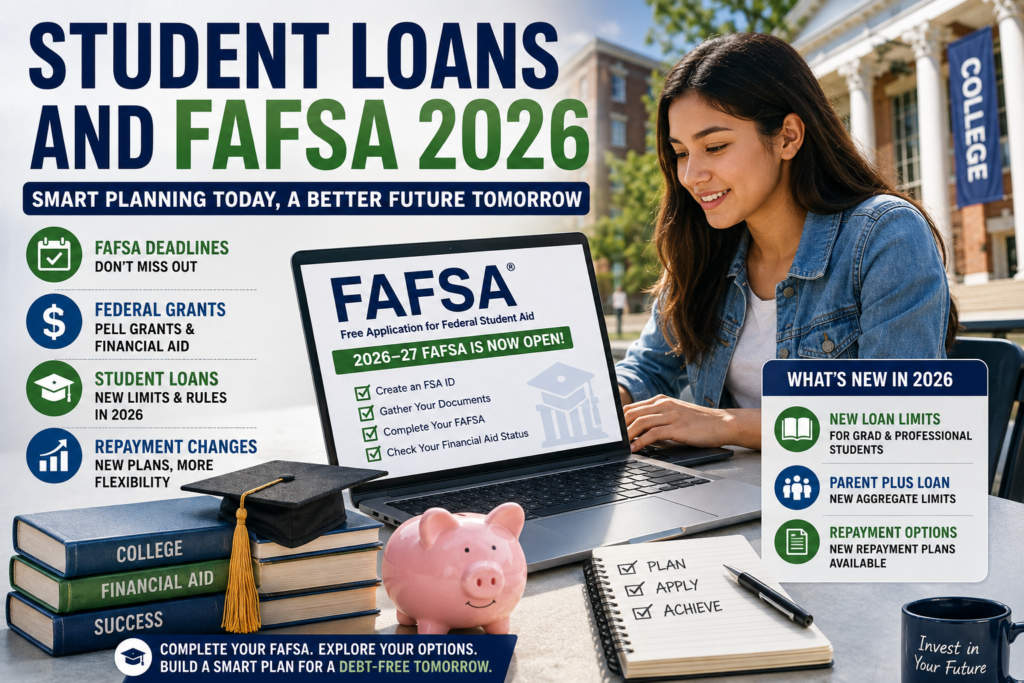
What Is the FAFSA and Why Does It Matter?
The FAFSA is the federal application used to determine eligibility for federal student aid. Submitting the form can provide access to several types of financial assistance, including Federal Pell Grants, Federal Work-Study and federal student loans. The application can also be used by states and schools when determining eligibility for their own financial aid programs.
One of the biggest misconceptions about the FAFSA is that completing it automatically means a student will receive a particular amount of money. It does not. The FAFSA provides information that schools use to determine financial need and build an aid package. The FAFSA Submission Summary includes estimated federal aid information, but the final financial aid offer comes from the school after the student is admitted. This distinction is especially important when comparing student loans and FAFSA options because loans are only one part of a broader financial aid package.
FAFSA 2026–27: When Should Students Apply?
The 2026–27 FAFSA covers the award year from July 1, 2026, through June 30, 2027. The federal FAFSA deadline is generally June 30, 2027, but waiting until the federal deadline can be a mistake. Federal Student Aid explains that colleges and states can have earlier deadlines, particularly for priority consideration. Some state programs also require separate applications or have limited funding.
The 2026–27 FAFSA became available beginning October 1, 2025. For students seeking the most financial aid possible, the safest strategy is to submit the FAFSA as early as practical and then check both the school’s deadline and the relevant state deadline.
FAFSA Deadlines
| FAFSA deadline | What it means |
|---|---|
| October 1, 2025 | 2026–27 FAFSA became available |
| State deadline | Varies by state and financial aid program |
| College deadline | Varies by school and may be earlier |
| June 30, 2027 | Federal FAFSA deadline for 2026–27 |
Federal Student Aid specifically warns that submitting close to the federal deadline may limit aid because the academic year could already be well underway.
What Happens After You Submit the FAFSA?
After submitting the FAFSA, students should not simply wait for a college to contact them. The FAFSA is processed, and students can access their FAFSA Submission Summary through their StudentAid.gov account.
The summary includes four major sections:
- Eligibility Overview
- FAFSA Form Answers
- School Information
- Next Steps
Students should carefully review the information for errors. If something is incorrect, Federal Student Aid allows students to make corrections through their FAFSA process. The Submission Summary can also identify additional actions or documentation that may be required. This step matters because incorrect FAFSA information can affect a student’s eligibility calculation.
ACA Subsidy Cliff 2026: What Is It, Who Is Affected and Why Health Insurance Costs Are Rising
2027 HSA Contribution Limits Announced: IRS Confirms $4,500 and $9,000 Caps
Understanding the Student Aid Index
One of the most important changes students encounter when completing the FAFSA is the Student Aid Index, or SAI. The SAI is a formula-based index used by schools to assess a student’s financial need. It is not a bill, not the amount a family is expected to pay and not the amount of financial aid the student will receive. The SAI can range from -1,500 to 999,999.
A lower SAI generally indicates greater financial need, while a higher SAI generally indicates lower financial need. Schools use the SAI along with the cost of attendance and other financial-aid information when building an aid offer. For families researching student loans and FAFSA, understanding the SAI is important because it helps explain why two students attending the same college may receive different financial aid packages.
Federal Pell Grants Remain an Important Alternative to Student Loans
Not all financial aid has to be repaid. The Federal Pell Grant is a need-based federal grant for eligible students. Unlike a student loan, a Pell Grant generally does not have to be repaid. For the 2026–27 award year, the maximum Federal Pell Grant award is $7,395, according to Federal Student Aid. This makes completing the FAFSA particularly important for students who may qualify for need-based assistance.
The FAFSA Submission Summary can show an estimate of a student’s potential Pell Grant eligibility. However, the final aid offer comes from the school. Students should therefore look at grants and scholarships before deciding how much they need to borrow.
What’s Changing With Federal Student Loans in 2026?
One of the biggest developments in student loans and FAFSA is the implementation of federal student-loan changes created by the One Big Beautiful Bill Act. The Department of Education says several provisions affecting federal student loans take effect July 1, 2026. These changes include new loan limits for graduate and professional students, changes involving Parent PLUS Loans and changes to repayment options. The changes are especially important for students entering graduate or professional programs because the federal government is placing new limits on borrowing.
New Federal Loan Limits for Graduate Students
Beginning with the 2026–27 award year, new federal borrowing limits apply to graduate and professional students. According to the Department of Education, new graduate students can borrow up to $20,500 per year, with a $100,000 aggregate limit. New professional students can borrow up to $50,000 per year, with a $200,000 aggregate limit. This is a major change from the previous system in which eligible graduate students could use Direct Unsubsidized Loans and, where eligible, Graduate PLUS Loans to borrow additional amounts up to their cost of attendance.
The new rules make it particularly important for prospective graduate students to understand the total cost of a program before enrolling. A student whose program costs substantially more than the new federal borrowing limits may need to consider scholarships, institutional aid, savings or other financing options.
Graduate PLUS Loans Are Being Eliminated for New Borrowers
Another major change is the elimination of the Graduate PLUS Loan for new borrowers beginning under the new rules. Federal Student Aid’s 2026–27 handbook states that the One Big Beautiful Bill Act eliminated Graduate PLUS Loans for new borrowers and introduced new annual and aggregate borrowing limits for graduate and professional students.
This could have a particularly noticeable effect on graduate programs with high tuition and other costs. Students considering law school, graduate programs, medical education and other professional programs should carefully review their school’s estimated cost of attendance and available aid before deciding how to finance the remaining amount.
$2400 Working Families Refund: Eligibility, Income Limits & Status
Parent PLUS Loans Also Have New Limits
Parent PLUS borrowing is changing as well. Federal Student Aid states that beginning with the 2026–27 award year, the Parent PLUS aggregate loan limit is $65,000 per dependent student and applies per dependent student rather than separately to each parent. This is important for families that previously relied heavily on Parent PLUS borrowing to cover college costs. Parents should therefore review the complete financial aid package before assuming that a federal Parent PLUS Loan will cover any remaining amount.
Federal Student Loan Repayment Is Also Changing
The changes in 2026 are not limited to students who are taking out new loans. Borrowers already dealing with federal student debt also need to pay attention to repayment changes. The Department of Education announced two new repayment plans effective July 1, 2026:
- Repayment Assistance Plan (RAP)
- Tiered Standard Repayment Plan
The Department describes RAP as a new income-driven repayment option. The Department has also said that the new RAP is designed to avoid negative amortization, meaning the structure is intended to prevent a borrower’s loan balance from growing because unpaid interest is continually added to the principal under the plan’s rules. Borrowers should review their individual loan information before selecting a repayment plan because eligibility depends on the borrower’s loans and circumstances.
What Happened to the SAVE Plan?
The federal student-loan repayment landscape has also changed following developments involving the Saving on a Valuable Education, or SAVE, Plan. The Department of Education announced in 2025 that SAVE borrowers would need to transition as new repayment options became available. Federal student-loan servicer information currently states that the SAVE Plan is ending and borrowers who were enrolled in or applied for SAVE should select another repayment plan after receiving the appropriate notice. For borrowers who have been waiting for clarity about repayment, this means checking their StudentAid.gov account and official communications is especially important.
Why FAFSA Still Matters Even If You Don’t Want a Student Loan
Some students avoid the FAFSA because they assume they will not qualify for need-based aid or because they do not want to borrow money. That can be a costly mistake. The FAFSA is not simply a student-loan application. It can provide access to grants, work-study and other forms of financial aid. Federal Student Aid also notes that FAFSA information can be used by states and schools when awarding financial assistance. A student can complete the FAFSA, receive an aid offer and then decide whether accepting a federal student loan makes sense. Completing the form does not force a student to borrow.
What Students Should Know Before Accepting Federal Student Loans
A financial aid offer can contain several different forms of assistance. Students should distinguish between:
Grants: Generally do not have to be repaid if eligibility requirements are satisfied.
Scholarships: Usually do not have to be repaid, although specific conditions may apply.
Work-Study: Allows eligible students to earn money through approved employment.
Federal student loans: Must generally be repaid with interest.
Federal Student Aid’s FAFSA Submission Summary specifically separates estimated grants, work-study and loans so students can see the different types of potential aid. Before accepting a loan, students should calculate how much they actually need rather than automatically accepting the maximum offered.
The FAFSA is free for students
The name itself provides an important warning. FAFSA stands for Free Application for Federal Student Aid. Federal Student Aid says completing and submitting the FAFSA is free. Students should be cautious about websites or services asking them to pay simply to submit the FAFSA. Students and parents should use official government resources, particularly StudentAid.gov, when completing the form or managing federal aid. Each contributor who needs to complete part of the FAFSA generally needs their own StudentAid.gov account.
What is a StudentAid.gov account used for?
A StudentAid.gov account is more than a login for FAFSA. Federal Student Aid says students and borrowers can use their account to:
- Complete and submit the FAFSA
- Check FAFSA status
- Review Pell Grant and federal loan information
- Access loan records
- Complete loan counseling
- Manage federal student aid
- Track federal student loan payments
- Access repayment tools and forms
- Electronically sign federal aid documents
Students should protect their account information and avoid sharing login credentials.
A Simple FAFSA and Student Loan Checklist
For the 2026–27 school year, students can make the process easier by following a few basic steps.
Complete the FAFSA
Submit the 2026–27 FAFSA as early as possible rather than waiting for the federal deadline.
Check your FAFSA Submission Summary
Review the answers and look for corrections or additional documentation requests.
Review your SAI
Remember that the SAI is an index used by schools and is not a dollar amount you owe.
Compare your aid offer
Separate grants and scholarships from loans.
Borrow only what you need
Federal loans are debt and generally must be repaid with interest.
Review new 2026 loan limits
Graduate and professional students should pay particular attention to the new federal borrowing limits.
Check repayment options
Existing borrowers should review their repayment status and determine whether they need to select a new repayment plan.
What does Student Loans and FAFSA Mean for Students in 2026?
The biggest lesson is that student loans and FAFSA rules are no longer something students can treat as separate issues. The FAFSA remains the gateway to federal financial aid, while changes to federal loan rules determine how much some students can borrow and how borrowers repay their debt. For undergraduate students, completing the FAFSA remains essential because it can open the door to grants, work-study and federal loans.
For graduate and professional students, the changes are even more significant because new federal borrowing limits and the elimination of Graduate PLUS Loans for new borrowers can change how programs are financed. For existing borrowers, the introduction of new repayment options means that repayment decisions also deserve attention in 2026.
The Student Loans and FAFSA is changing significantly in 2026
The FAFSA remains the primary federal financial-aid application and continues to connect students with potential grants, work-study and federal student loans. The 2026–27 FAFSA covers July 1, 2026, through June 30, 2027, and the federal submission deadline is June 30, 2027, although college and state deadlines can come much earlier. The biggest changes are on the federal student-loan side.
Beginning July 1, 2026, new graduate and professional students face new annual and aggregate federal loan limits, while Graduate PLUS Loans are eliminated for new borrowers. Parent PLUS Loans also receive a new aggregate limit. Repayment is changing as well, with the new Repayment Assistance Plan and Tiered Standard plan becoming available July 1, 2026.
For students and families, the smartest approach is to complete the FAFSA early, review the FAFSA Submission Summary carefully, compare grants and scholarships before loans, understand the amount of debt being considered and stay informed about federal repayment rules. The FAFSA itself is still free, and completing it does not require a student to accept every loan offered.
FAQ’s About Student Loans and FAFSA 2026
What is FAFSA?
FAFSA stands for Free Application for Federal Student Aid. It is the federal application used to determine eligibility for federal financial aid, including Pell Grants, Federal Work-Study and federal student loans.
When does the 2026–27 FAFSA open?
The 2026–27 FAFSA became available October 1, 2025, for the award year beginning July 1, 2026.
What is the FAFSA deadline for 2026–27?
The federal deadline is June 30, 2027. However, state and college deadlines can be earlier, so students should check those deadlines rather than waiting for the federal deadline.
Does FAFSA give you a student loan?
No. FAFSA is an application for federal financial aid. A student’s aid package can include grants, work-study and loans. The school determines the final financial aid offer.
What is the Student Aid Index?
The Student Aid Index, or SAI, is a formula-based index used by schools to assess financial need. It is not the amount a student must pay and is not the amount of financial aid a student will receive.
How much is the maximum Pell Grant for 2026–27?
The maximum Federal Pell Grant award for the 2026–27 award year is $7,395. Individual eligibility and award amounts depend on the applicable federal rules and the student’s circumstances.
Are student loan limits changing in 2026?
Yes. Beginning July 1, 2026, new federal loan limits apply to graduate and professional students. New graduate students can borrow up to $20,500 annually with a $100,000 aggregate limit, while new professional students can borrow up to $50,000 annually with a $200,000 aggregate limit.
Are Graduate PLUS Loans ending?
Graduate PLUS Loans are being eliminated for new borrowers under the 2026 federal student-loan changes. Existing borrowers may have different rules depending on when their loans were first disbursed and their circumstances.
What are the new student loan repayment plans for 2026?
The Department of Education announced the Repayment Assistance Plan and Tiered Standard Repayment Plan, which became available July 1, 2026.
Is FAFSA really free?
Yes. Federal Student Aid states that completing and submitting the FAFSA is free. Students should use official Federal Student Aid resources and be cautious about websites charging fees to complete the application.
Should I complete FAFSA if I don’t want student loans?
Yes. FAFSA can also provide access to grants and work-study, and states and colleges may use FAFSA information when determining financial aid eligibility. Completing FAFSA does not require you to accept a student loan.
Official Sources
- Federal Student Aid — FAFSA and Financial Aid Information
- 2026–27 FAFSA Form and Deadlines
- Federal Student Aid — FAFSA Submission Summary
- Federal Student Aid — Student Aid Index Explained
- Federal Student Aid — 2026–27 Pell Grant Information
- Federal Student Aid — 2026–27 Federal Student Aid Handbook
- Federal Student Aid — One Big Beautiful Bill Act Student Loan Changes
- U.S. Department of Education — New Student Loan Repayment Plans
- Federal Student Aid — New Parent PLUS Loan Limit