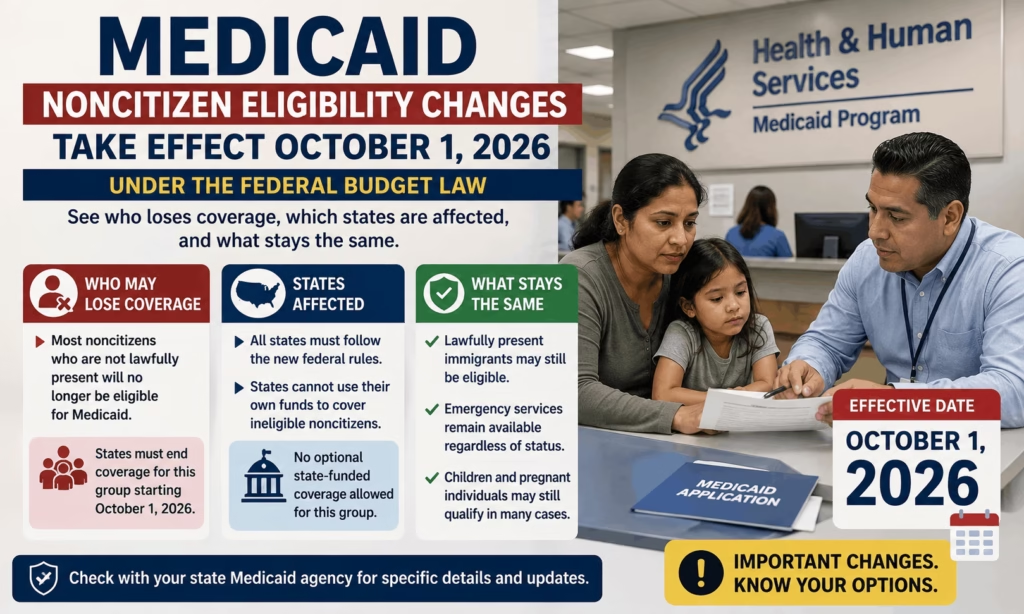
The Medicaid noncitizen eligibility changes written into last year’s federal budget law are no longer a distant policy debate. They become real for hundreds of thousands of people on October 1, 2026, when refugees, asylees, people granted humanitarian parole, trafficking victims, and certain abused spouses and children lose access to full Medicaid coverage nationwide. The change comes from Section 71109 of the One Big Beautiful Bill Act, or OBBBA, which President Trump signed into law on July 4, 2025, and it rewrites the federal definition of which noncitizens count as qualified immigrants for Medicaid purposes. Going forward, federal Medicaid funding will only reach U.S. citizens, U.S. nationals, lawful permanent residents holding a green card, Cuban and Haitian entrants, and citizens of the Compact of Free Association nations, meaning the Marshall Islands, Micronesia, and Palau.
States are already sending advance notices. Maine’s health department mailed letters to 426 households, covering 627 individuals, on June 26, 2026, warning that their MaineCare coverage will shift to emergency services only starting in October. Illinois has been running a public webinar series since May 2026 to walk Medicaid customers through the coming loss of coverage. Michigan officials point to roughly 90,000 refugees who settled in the state as one measure of who stands to lose comprehensive health coverage under the new rule. We’ll be updating this article monthly as CMS issues further guidance and as more states confirm their transition plans.
What Changed and When It Takes Effect?
For most of the past three decades, federal law under the 1996 Personal Responsibility and Work Opportunity Reconciliation Act allowed a broader group of lawfully present immigrants to access Medicaid, including refugees, people granted asylum, individuals paroled into the country for at least a year, and certain victims of trafficking or domestic abuse. OBBBA’s Section 71109, titled Alien Medicaid Eligibility, narrows that list substantially. Effective October 1, 2026, the only noncitizens who remain eligible for federally funded Medicaid are lawful permanent residents, Cuban and Haitian entrants, and COFA migrants, alongside a state option to continue covering lawfully residing children and pregnant women under the existing Medicaid and CHIP income-eligible immigrant option.
This is a hard cutoff date built directly into the statute, not a target or a rolling deadline. Every state Medicaid agency, regardless of how it is currently structured, must apply the narrower federal eligibility definition to anyone in the excluded categories starting that day, or lose the associated federal matching funds for their coverage.
Who Loses Coverage Under the Medicaid Noncitizen Eligibility Changes?
The groups losing federally funded Medicaid access are specific and, in most cases, people who were previously eligible precisely because of the difficulty of their immigration circumstances. They include refugees who have not yet obtained a green card, individuals granted asylum or asylum-related relief, people granted humanitarian parole for one year or more, Compact of Free Association residents are actually preserved under the new rule, and certain abused spouses, children, and parents who qualified under earlier trafficking and domestic violence protections. Trafficking victims themselves also lose the broader Medicaid eligibility they previously had, though other victim protections outside Medicaid remain unaffected by this specific provision.
Importantly, undocumented immigrants were never eligible for comprehensive federal Medicaid and are not newly affected by this rule in that respect, since that restriction predates OBBBA. What changes is that a meaningfully wider group of lawfully present immigrants, people who followed every legal process available to them, now falls into the same funding category as those without legal status for Medicaid purposes.
Emergency Medicaid Still Applies
One detail that has caused confusion in early coverage is what happens to emergency care. Emergency Medicaid, the federally required coverage for emergency medical treatment regardless of immigration status, is not eliminated by this provision. Anyone who would otherwise qualify for Medicaid except for their immigration status, including the groups losing full coverage on October 1, can still receive coverage for genuine medical emergencies. What does change, under a related provision, Section 71110, is the federal reimbursement rate states receive for that emergency care. Previously, states that expanded Medicaid under the Affordable Care Act received an enhanced federal match for emergency services provided to immigrants who would qualify for Medicaid but for their status. Starting October 1, 2026, that enhanced rate disappears, and states are reimbursed only at their regular, lower Medicaid matching rate for those emergency claims, shifting more of the cost onto state budgets.
California Climate Credit 2026: Payment Timing Just Changed, Here Is What to Expect on Your Bill
H-1B Visa Ban Texas Schools: Abbott Wants Exactly Zero Foreign Workers, What Indians Should Know
Trump Halts 50 Percent Tariffs Canada: What the Last Minute Deal With Ottawa Means
Green Card Rule Changes: New Public Charge Test to Assess Age, Health, Family Status and Finances
Key Highlights: Medicaid Noncitizen Eligibility Changes 2026
| Category | Detail |
|---|---|
| Governing law | One Big Beautiful Bill Act (OBBBA), Section 71109, signed July 4, 2025 |
| Effective date | October 1, 2026 |
| Still eligible for federal Medicaid | U.S. citizens, U.S. nationals, lawful permanent residents, Cuban and Haitian entrants, COFA migrants |
| Lose full Medicaid eligibility | Refugees, asylees, humanitarian parolees, certain abused spouses and children, trafficking victims |
| Emergency Medicaid status | Continues for all groups, regardless of immigration status |
| Emergency Medicaid federal match | Reduced to regular state FMAP rate starting Oct 1, 2026, ending the enhanced ACA expansion rate |
| Related ACA marketplace change | Premium tax credit eligibility for lawfully present noncitizens narrowed starting Jan 1, 2026 |
| CBO coverage loss estimate | 11.8 million people losing Medicaid nationally by 2034 under all OBBBA provisions combined |
| State advance notices | Maine (627 individuals notified June 2026), Illinois (webinar series since May 2026), Michigan (approx. 90,000 refugees affected statewide) |
State by State: How the Impact Differs
The federal eligibility change applies nationwide, but its practical effect depends heavily on how each state has structured its own Medicaid program and whether it is layering additional state-funded coverage on top of the federal floor.
Maine’s Department of Health and Human Services has already begun outreach, sending informational letters in late June 2026 to nearly 630 individuals expected to transition from full MaineCare to emergency-only coverage, with translated versions available in the state’s most commonly spoken languages among the affected population.
Illinois has treated this as a major administrative undertaking, launching a multi-part webinar series in May 2026 covering the Medicaid overview, the specific noncitizen eligibility changes, and alternative resources for people who will lose coverage, with the state emphasizing that the change originates from federal law rather than a state policy decision.
Michigan’s Healthy Michigan expansion program is directly affected as well, and state advocates have pointed to the roughly 90,000 refugees the state has welcomed in recent years as context for the scale of the population that could lose comprehensive coverage, along with people previously protected under abused spouse and trafficking victim provisions.
Colorado has confirmed it will continue exercising its state option to cover lawfully residing children and pregnant adults under Medicaid and CHIP, a choice each state must make individually, meaning children in immigrant families in Colorado are not automatically cut off even as their parents may be, depending on individual status.
Several states are separately tightening their own state-funded coverage for undocumented immigrants, which is a distinct policy layer from the federal OBBBA change. Minnesota ended MinnesotaCare eligibility for noncitizen adults age 18 and older effective January 1, 2026, under state legislation passed in mid-2025. California is pausing new Medi-Cal enrollment for undocumented adults ages 19 to 59 starting in 2026, introducing monthly premiums by 2027, and reducing dental benefits, changes driven by the state’s own budget deficit rather than federal law. Maryland continues offering some state-funded emergency and Healthy Babies coverage for undocumented immigrants, but under the new federal rule, any state program continuing to serve populations excluded from federal funding after October 1, 2026 must now be financed entirely with state dollars.
How This Connects to the Broader OBBBA Medicaid Overhaul
The noncitizen eligibility change is one piece of a much larger set of Medicaid provisions phasing in between 2026 and 2029. Community engagement requirements, commonly called work requirements, apply separately to the ACA expansion population and require most adults aged 19 to 64 to document 80 hours a month of work, training, or community engagement, with federal guidance finalized June 1, 2026 and enforcement beginning July 31, 2026, though states have until January 1, 2027 to implement, with possible extensions to 2028. More frequent eligibility redeterminations, moving from annual to every six months for the expansion population, take effect for renewals on or after December 31, 2026. None of these other provisions change the immigration status rules directly, but together they represent the same underlying policy direction, tighter eligibility verification and a narrower pool of federally funded beneficiaries across the entire program.
The Congressional Budget Office projects that OBBBA’s Medicaid provisions overall will result in roughly 11.8 million people losing Medicaid coverage over the next decade, with several million more losing Medicaid-adjacent marketplace coverage through related changes. Congressional supporters of the law have countered that federal Medicaid spending still grows by more than 30 percent over the decade even after these changes, arguing the reforms target waste and ineligible enrollment rather than reducing the program’s overall size. A separate change eliminating the enhanced federal match for ACA expansion states begins January 1, 2026, shifting more of the cost of Medicaid expansion coverage onto state budgets independent of the noncitizen eligibility rule, adding another layer of financial pressure state governments are weighing at the same time.
Related ACA Marketplace Changes Affecting the Same Population
Immigrants losing Medicaid eligibility under this rule do not automatically gain an easy alternative through the ACA Marketplace. A related OBBBA provision eliminates premium tax credit eligibility, starting January 1, 2026, for lawfully present noncitizens who fall below 100 percent of the federal poverty line and are subject to Medicaid’s five-year waiting period bar, closing a pathway that previously let some low-income immigrants access subsidized marketplace coverage even while excluded from Medicaid. Marketplace premium tax credits generally now track the same narrower eligible-immigrant categories as Medicaid itself: citizens, lawful permanent residents, Cuban and Haitian entrants, and COFA migrants.
State Farm Dividend: Who Qualifies to Receive Part of the $5 Billion Payout
Social Security Phone Claims New Process in 2026: What Changed and New Process Explained
Trump Accounts Dell $250 Grant: Check State & ZIP Code Eligibility
What Affected Individuals Should Do Before October 1?
Anyone currently enrolled in Medicaid through a refugee, asylee, parolee, trafficking victim, or related humanitarian status should expect a notice from their state Medicaid agency in the coming weeks if they have not already received one, and should not assume silence means no change is coming, since some states are still finalizing outreach. Checking current coverage status through the state Medicaid portal, confirming whether children or pregnant household members remain covered under a state’s continued coverage option, and asking a caseworker directly whether a case will transition to emergency-only coverage are all reasonable steps before the effective date. For anyone who has already obtained or is close to obtaining lawful permanent resident status, confirming that status is fully reflected in state Medicaid records before October 1 could prevent an unnecessary lapse in coverage.
Community health centers and hospital financial counselors are also bracing for the transition. Federally qualified health centers, which are required by federal law to serve patients regardless of ability to pay, are expected to absorb a larger share of uncompensated care once comprehensive Medicaid ends for the affected groups, since these clinics remain a common point of contact for refugee and immigrant communities even after insurance coverage changes. Advocates working directly with refugee resettlement agencies note that many affected individuals arrived in the country specifically because of humanitarian circumstances and, unlike people who choose to migrate for other reasons, often have limited financial cushion to absorb a sudden gap in health coverage, making early awareness of the October 1 deadline especially important for this population.
How Hospitals and State Budgets Are Preparing
Beyond the individual impact, state Medicaid agencies and hospital systems are actively adjusting their financial planning around the October 1 transition. Because the enhanced federal emergency Medicaid match disappears on the same date the eligibility restriction begins, states with larger refugee and asylee populations are modeling a two part financial impact, higher uncompensated care costs from people who lose coverage entirely and a lower federal reimbursement rate for the emergency treatment that remains available. Hospital association groups in several states have flagged this combined effect as a bigger budget risk than either change would represent on its own. States that expanded Medicaid under the Affordable Care Act, and therefore previously qualified for the enhanced emergency match, are expected to feel this shift most directly, since non-expansion states were never eligible for the higher reimbursement rate in the first place.
Official Resources and Links
| Resource | What It’s For | Official Link |
|---|---|---|
| Medicaid eligibility overview | Federal rules on Medicaid eligibility categories | medicaid.gov |
| HHS OBBBA public benefit guidance | Federal interpretation notices on noncitizen eligibility | hhs.gov |
| CMS Medicaid and CHIP eligibility | Official state-by-state eligibility and enrollment tool | medicaid.gov/state-overviews |
| Find your state Medicaid agency | State-specific notices and coverage status | medicaid.gov/about-us/beneficiary-resources |
| HealthCare.gov Marketplace | Compare alternative subsidized coverage options | healthcare.gov |
| National Immigration Law Center | Independent tracking of noncitizen benefit rules | nilc.org |
FAQs About Medicaid Noncitizen Eligibility Changes 2026
When do the Medicaid noncitizen eligibility changes take effect?
The new eligibility rules take effect October 1, 2026, under Section 71109 of the One Big Beautiful Bill Act. States must apply the narrower federal definition starting that date.
Who still qualifies for Medicaid after October 1, 2026?
U.S. citizens, U.S. nationals, lawful permanent residents with a green card, Cuban and Haitian entrants, and Compact of Free Association migrants from the Marshall Islands, Micronesia, and Palau remain eligible for federally funded Medicaid.
Do refugees lose Medicaid coverage entirely?
Refugees who have not yet obtained lawful permanent resident status lose eligibility for comprehensive Medicaid starting October 1, 2026, but remain eligible for Emergency Medicaid, which covers emergency medical treatment regardless of immigration status.
Will children of noncitizen parents lose Medicaid?
It depends on the state. States can choose to continue covering lawfully residing children and pregnant adults under an existing Medicaid and CHIP option. Colorado, for example, has confirmed it will keep covering these groups even as adult eligibility narrows elsewhere.
Is this the same as work requirements for Medicaid?
No. Work requirements, formally called community engagement requirements, are a separate OBBBA provision affecting the ACA expansion population broadly, with enforcement beginning July 31, 2026, and state implementation required by January 1, 2027. Noncitizen eligibility changes are a distinct provision with their own October 1, 2026 deadline.
Does this affect undocumented immigrants differently than before?
Undocumented immigrants were already ineligible for comprehensive federal Medicaid before OBBBA and are not newly restricted by this specific provision. The change primarily affects lawfully present immigrants, including refugees, asylees, and parolees, who previously qualified.
Can states keep covering excluded groups using their own money?
Yes, but any state program continuing to serve populations no longer eligible for federal Medicaid funding after October 1, 2026 must be financed entirely with state dollars, since federal matching funds will no longer apply to those beneficiaries.
What happens to premium tax credits for noncitizens who lose Medicaid?
A related OBBBA provision eliminated ACA Marketplace premium tax credit eligibility, starting January 1, 2026, for lawfully present noncitizens below the poverty line who are subject to Medicaid’s five-year waiting bar, so many people losing Medicaid will not have an easy subsidized marketplace alternative either.
People Also Ask
Does OBBBA cut Medicaid for legal immigrants? Yes, for specific categories. Lawful permanent residents, or green card holders, keep their eligibility. But refugees, asylees, humanitarian parolees, and certain trafficking and abuse victims lose federally funded Medicaid eligibility starting October 1, 2026, even though they are lawfully present in the country.
How many people will lose Medicaid because of the noncitizen rule? Exact noncitizen-specific figures vary by state and have not been centrally published by CMS, but the change is one component of the Congressional Budget Office’s broader estimate that 11.8 million people will lose Medicaid coverage nationally over the next decade under all OBBBA provisions combined.
Is emergency Medicaid ending for immigrants? No. Emergency Medicaid remains available to anyone who would otherwise qualify for Medicaid but for their immigration status, including groups losing full coverage under this rule. What changes is the federal reimbursement rate states receive for that emergency care, not whether the care itself is covered.
Why is the Medicaid noncitizen eligibility change happening now? The provision was written into the One Big Beautiful Bill Act, signed into law on July 4, 2025, as part of a broader federal effort to reduce Medicaid spending and narrow the population of federally funded beneficiaries. Congress built in a delayed effective date of October 1, 2026 to give states time to prepare their systems and notify affected enrollees.
Conclusion
The Medicaid noncitizen eligibility changes taking effect October 1, 2026 mark one of the most consequential shifts in immigrant health coverage in nearly three decades, narrowing federal Medicaid access to a smaller group of lawfully present immigrants while leaving Emergency Medicaid intact for everyone regardless of status. States are handling the transition differently, with some, like Maine and Illinois, already notifying affected households and running public education campaigns, while others are layering their own separate state-funded coverage decisions on top of the federal change. Anyone currently covered under a refugee, asylee, parolee, or related humanitarian status should confirm their coverage status directly with their state Medicaid agency well before the October deadline. This article will be updated monthly as CMS guidance, state transition plans, and enrollment data continue to develop.
Chapter 33 VA Benefits Housing Allowance: How Much Can You Get Per Month
Colorado TABOR Refund and PTC Rebate 2026: Who Qualifies and How Much You Can Get
2027 Social Security COLA: 3.6% Estimate Beats Medicare Hike