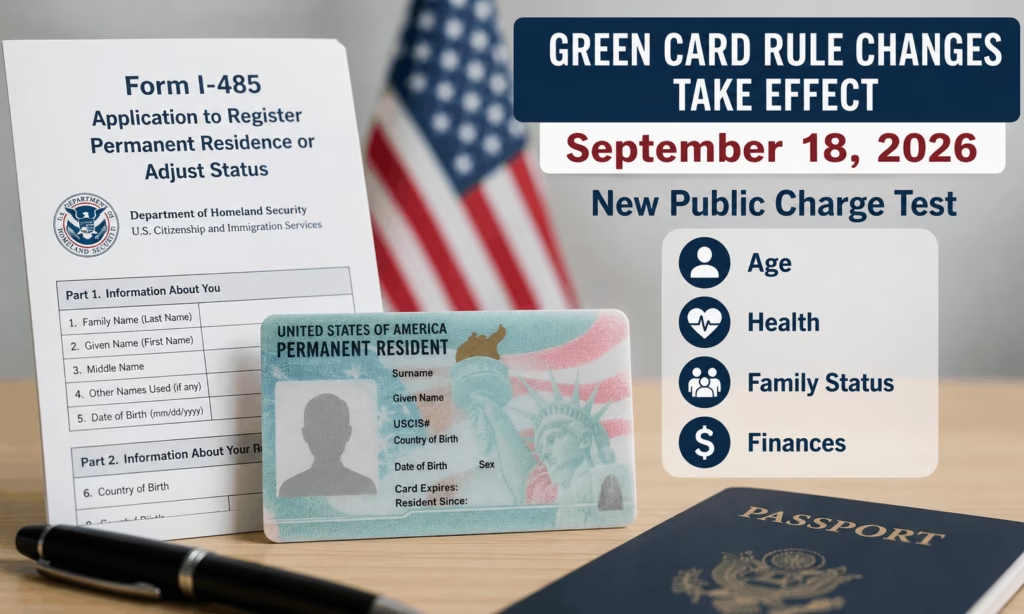
Green Card Rule Changes: Millions of green card hopefuls across the United States now face a hard deadline that could decide which rulebook applies to their case. Sweeping green card rule changes from the Department of Homeland Security take effect on September 18, 2026, rewriting the public charge test that decides whether an applicant’s age, health, family status, assets and overall financial condition are strong enough to support lawful permanent residence. For anyone filing Form I-485, the timing of that filing now carries more weight than it has in years.
These green card rule changes were announced on July 16, 2026, when DHS placed its final rule on public inspection, followed by formal publication in the Federal Register on July 20, 2026. The rule rescinds the narrower 2022 public charge framework and hands USCIS and CBP officers broader discretion to weigh the totality of an applicant’s circumstances. Anyone with a pending or upcoming adjustment of status case should understand exactly what is changing, who it affects and what steps can still be taken before the new standard takes hold. We’ll be updating this article monthly as USCIS releases further guidance and as the revised Form I-485 rolls out.
What Is the Public Charge Test?
The public charge test comes from Section 212(a)(4) of the Immigration and Nationality Act. It asks whether a person applying for a visa, admission at a port of entry, or adjustment of status is likely at any time to become primarily dependent on the government for subsistence. If an officer decides someone is likely to become a public charge, that person can be found inadmissible and denied a green card. This is not a new law. What is new is how officers are allowed to measure it.
Why These Green Card Rule Changes Are Happening Now
Since 1999, three different frameworks have shaped how this test gets applied. The 1999 field guidance kept the definition narrow, counting mainly cash assistance and long-term institutional care paid for by the government. The 2019 rule under the first Trump administration widened that definition considerably. The 2022 rule under the Biden administration then narrowed it back, limiting officers to a defined list of benefits and setting out detailed terms for how each factor should be weighed.
DHS has now labeled the 2022 approach overly restrictive, arguing it prevented officers from making individualized, fact based decisions. The new rule does not replace that framework with another detailed checklist. Instead, it removes most of the 2022 regulatory language and restores officer discretion to review a case on the totality of the circumstances, guided directly by the statute rather than a fixed list of countable benefits.
Colorado TABOR Refund and PTC Rebate 2026: Who Qualifies and How Much You Can Get
The Core Factors Officers Must Weigh
Under federal law, officers are required to consider several statutory factors before making a public charge determination. These factors are not new, but with the 2022 guardrails removed, officers now have far more latitude in how heavily each one is weighed. The core factors include:
- Age of the applicant, since very young or older applicants may face different employment prospects
- Health, including any medical condition that could affect the ability to work or that would require extensive, uncompensated care
- Family status, meaning household size and the number of dependents relying on the applicant
- Assets, resources and financial condition, covering income, savings, debts and overall financial stability
- Education and skills, since stronger qualifications suggest a higher likelihood of steady employment
- The Affidavit of Support, a binding pledge from a financial sponsor that is required for most family based green card cases
Officers may also now weigh an applicant’s use of means tested public benefits, along with other case specific facts such as credit history, insurance status and employment record, when forming their overall judgment.
Green Card Rule Changes Key Dates and Details
| Detail | Information |
|---|---|
| Rule announced | July 16, 2026 |
| Published in Federal Register | July 20, 2026 |
| Effective date | September 18, 2026 |
| What is being rescinded | 2022 public charge final rule (8 CFR 212.20 to 212.23) |
| What stays in place | The statutory public charge ground under INA Section 212(a)(4) |
| Applies to | Form I-485 adjustment of status applications postmarked or filed electronically on or after September 18, 2026, and applications for admission on or after that date |
| Benefits received before September 18, 2026 | Assessed under the older, narrower 2022 rule |
| Form I-485 requirement | Older editions of the form will be rejected once the new edition is required after the effective date |
| Public charge bonds | Bond terms revised; a bond posted on or after September 18, 2026 can be breached by receiving a means tested benefit before death, permanent departure or naturalization |
Who Is Affected by This Change
The revised standard reaches a wide group of people. It applies to family based and employment based green card applicants filing adjustment of status from within the United States, as well as people applying for admission at a port of entry or through consular processing overseas. It does not apply retroactively to benefits received before the effective date, and it does not apply to categories that are statutorily exempt from the public charge ground, such as refugees, asylees and certain other humanitarian categories.
For applicants with a green card case already pending, the filing date is the factor that decides which framework applies. An adjustment of status application properly postmarked or submitted electronically and accepted by USCIS before September 18, 2026 continues to be evaluated under the current, more limited 2022 rule, even if a decision comes after that date. Anyone who plans to file soon should factor this deadline into their timeline.
What This Means If You File Before September 18
Filing before the effective date keeps a case under the narrower definition, where only two categories generally count against an applicant, namely cash assistance for income maintenance and long term institutional care paid for by the government. Health, nutrition and housing benefits generally are not counted under this older approach unless they fall into those two narrow categories.
What Changes If You File On or After September 18
Once the new rule takes effect, officers gain the authority to look at a broader range of an applicant’s circumstances, including receipt of means tested public benefits beyond the old narrow list, and to weigh the statutory factors more heavily against a self sufficiency standard. DHS describes the review as individualized and fact specific rather than governed by a rigid checklist, which means two applicants with similar financial profiles could see different outcomes depending on their health history, employment record, household size and how their sponsor’s Affidavit of Support holds up under review.
USCIS has said it intends to issue additional policy guidance before the effective date to help officers apply the standard consistently, though DHS has been clear that any such guidance will inform rather than strictly control individual decisions.
Denaturalization Cases Surge As DOJ Files Record 25 Complaints In Just Two Weeks
Backdoor Roth IRA 2027: What’s Actually Changing For High Earners As Two Separate Rules Collide
How to Strengthen a Green Card Application Under the New Standard
Immigration attorneys are advising applicants to treat documentation as the strongest defense against an unfavorable public charge finding. Steps commonly recommended include:
- Gather recent pay stubs, tax transcripts and bank statements to demonstrate steady income and savings
- Collect proof of private health insurance or employer sponsored coverage
- Include diplomas, certifications and professional licenses that support employability
- Prepare a complete and well documented Affidavit of Support from the financial sponsor
- Keep records of any public benefits received, including the dates, since benefits used before September 18, 2026 are judged under the older rule
- File a complete adjustment of status package as early as possible if the goal is to remain under the current framework
Official Resources for Green Card Applicants
| Resource | Purpose | Official Link |
|---|---|---|
| USCIS Public Charge page | Official policy updates and guidance | uscis.gov/green-card/green-card-processes-and-procedures/public-charge |
| Form I-485 | Application to Register Permanent Residence or Adjust Status | uscis.gov/i-485 |
| USCIS Case Status Online | Track a pending green card application | egov.uscis.gov/casestatus/landing.do |
| USCIS Online Account Registration | Create an account to file and manage forms | myaccount.uscis.gov |
| Federal Register final rule | Full legal text of the September 2026 rule | federalregister.gov |
| Form I-864 Affidavit of Support | Sponsor’s financial support document | uscis.gov/i-864 |
FAQs
Does using Medicaid or SNAP automatically make me a public charge?
No. Benefit use is one factor among several that officers weigh, not an automatic disqualifier. Benefits received before September 18, 2026 continue to be judged under the older, narrower rule, and several categories of immigrants are exempt from the public charge test altogether.
Is it too late to file before the new rule takes effect?
Not yet, but the window is closing. Applications that are properly postmarked or submitted electronically and accepted by USCIS before September 18, 2026 remain under the current framework even if a final decision comes later.
Will USCIS reject my Form I-485 if I use an old version after the deadline?
Yes. USCIS has said it will require the revised edition of Form I-485 once the new rule is in effect, and older editions postmarked or submitted on or after that date will be rejected.
Who is exempt from the public charge test?
Refugees, asylees and several other humanitarian based categories are statutorily exempt and should not be penalized for benefit use under either the old or new framework.
Does this rule change who qualifies for public benefits?
No. The rule does not change eligibility for federal, state or local benefit programs. It changes only how benefit use and other personal factors can be weighed in an immigration officer’s public charge decision.
Conclusion
These green card rule changes mark one of the most significant shifts in green card adjudication in recent years, not because the underlying law has changed, but because the guardrails that limited officer discretion have been removed. Applicants filing before September 18, 2026 keep the benefit of the narrower, more predictable 2022 standard. Those filing on or after that date should expect a broader, more individualized review of their age, health, family status, education, skills and financial condition. Strong documentation, an early filing where possible and close attention to the revised Form I-485 will matter more than ever in the months ahead.
2027 Social Security COLA: 3.6% Estimate Beats Medicare Hike
2027 HSA Contribution Limits Announced: IRS Confirms $4,500 and $9,000 Caps