New York DBL and PFL Benefits guide: New York workers may face financial pressure when an illness, injury, childbirth, or family emergency prevents them from following their normal work schedule. To provide support during these situations, New York State operates two important workplace benefit programs. Disability Benefits Law (DBL) and Paid Family Leave (PFL). Although both programs provide financial assistance during time away from work, they cover different circumstances.
DBL generally helps eligible employees who cannot work because of an off-the-job illness, injury, or pregnancy-related disability. PFL allows eligible employees to take paid, job-protected time off to bond with a new child, care for a seriously ill family member, or handle certain military family responsibilities. In 2026, New York’s PFL program offers a maximum weekly benefit of $1,228.53, while the maximum DBL payment remains $170 per week. The contribution rules, eligibility requirements, claim deadlines, and benefit periods are different for each program.
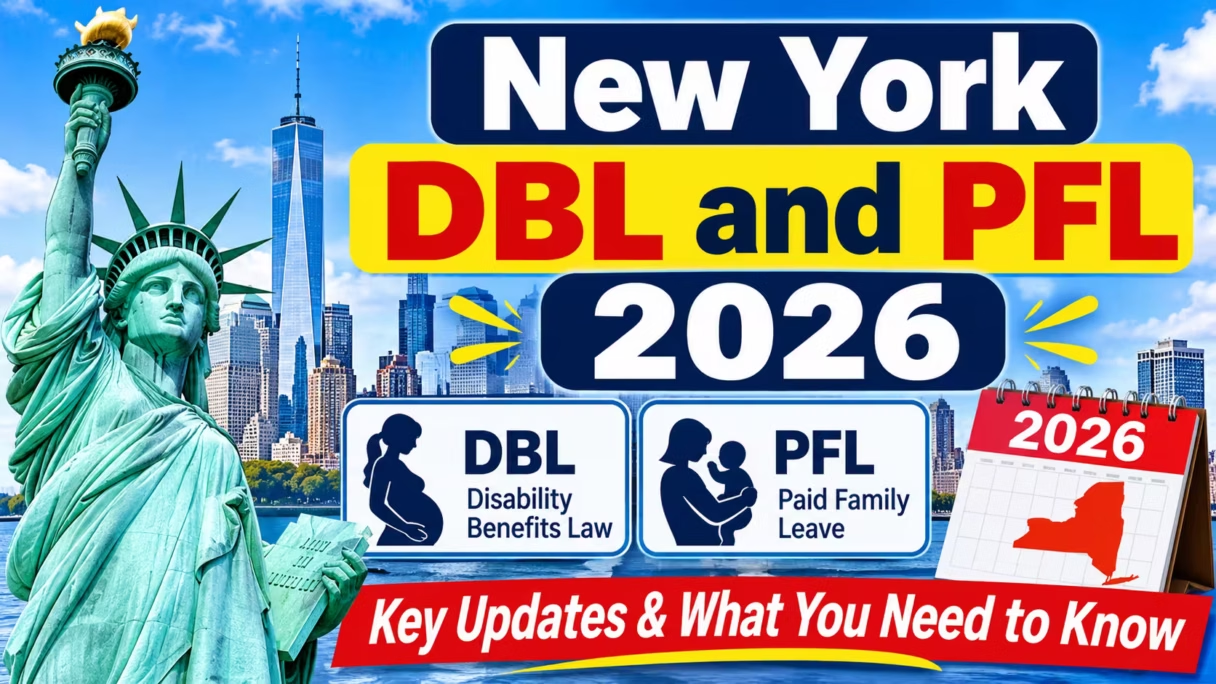
New York DBL and PFL 2026 Key Highlights
| Detail | Disability Benefits Law (DBL) | Paid Family Leave (PFL) |
|---|---|---|
| Purpose | Off-the-job injury, illness, or pregnancy | Bonding, family care, military exigency |
| 2026 maximum weekly benefit | $170/week | $1,228.53/week |
| Benefit calculation | 50% of average weekly wage, capped | 67% of average weekly wage, capped |
| 2026 employee contribution rate | 0.5% of wages, capped at $0.60/week | 0.432% of gross wages |
| 2026 maximum annual employee contribution | $31.20/year (approx.) | $411.91/year |
| Maximum duration | 26 weeks in a 52-week period | 12 weeks per year |
| Combined DBL + PFL cap | 26 weeks combined in any 52-week period | Same combined cap applies |
| State Average Weekly Wage (SAWW) used for 2026 | $1,833.63 | $1,833.63 |
| Can they run together? | No, benefits cannot be paid concurrently | No, same rule applies |
| Administering agency | New York Workers’ Compensation Board (WCB) | New York Workers’ Compensation Board (WCB) |
What Is New York Disability Benefits Law (DBL) 2026?
New York Disability Benefits Law provides partial wage replacement to eligible employees who become unable to work because of an illness or injury that is not connected to their job. For example, an employee who develops a medical condition outside work, suffers an injury at home, or needs time away because of a qualifying pregnancy-related disability may be able to apply for DBL benefits.
DBL is not the same as workers’ compensation. Workers’ compensation generally covers qualifying injuries and illnesses arising out of employment, while DBL is designed for qualifying disabilities that occur outside the course of employment. According to the New York State Workers’ Compensation Board, DBL payments are calculated using 50% of the employee’s average weekly wage over the last eight weeks worked, subject to the legal maximum of $170 per week.
New York DBL & PFL Calculator — 2026
Disability Benefits Law (DBL) and Paid Family Leave (PFL) benefits and employee contributions, effective 1 January 2026.
What Is New York Paid Family Leave (PFL) 2026?
Paid Family Leave was added onto the Disability Benefits Law framework starting January 1, 2018, and it works very differently from DBL. Rather than replacing income lost to a worker’s own illness, PFL replaces income when an employee needs time away from work to bond with a new child, care for a family member with a serious health condition, or handle a qualifying military exigency involving a spouse, domestic partner, child, or parent on active duty.
For 2026, the PFL benefit rate stays at 67% of an employee’s average weekly wage, but the dollar cap tied to that percentage moves up because it is pegged to the statewide average wage. The maximum PFL weekly benefit for 2026 is $1,228.53, calculated as 67% of the new $1,833.63 State Average Weekly Wage. An employee earning at or above the SAWW receives the full maximum; someone earning less receives 67% of their own actual average weekly wage. Eligible workers can take up to 12 weeks of PFL in a 52-week period, and the leave is job-protected, meaning the employer must reinstate the employee to the same or a comparable position afterward.
Since 2023, the definition of “family member” under PFL has included siblings, in addition to spouses, domestic partners, children, parents, parents-in-law, grandparents, and grandchildren. That broader definition remains in place for 2026, and it is worth double-checking against your specific relationship before assuming you don’t qualify.
Weekly Benefits For 2026
New Weekly Benefit Rates for 2026
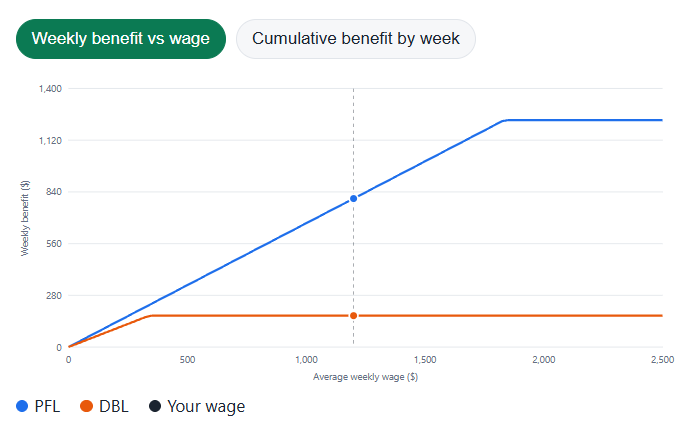
PFL pays two-thirds of your average weekly wage, but never more than two-thirds of the statewide average weekly wage (SAWW). For 2026, the SAWW rose from $1,757.19 to $1,833.63. That pushed the maximum PFL weekly payment up to $1,228.53, which is about $51 higher than the 2025 cap of $1,177.32.
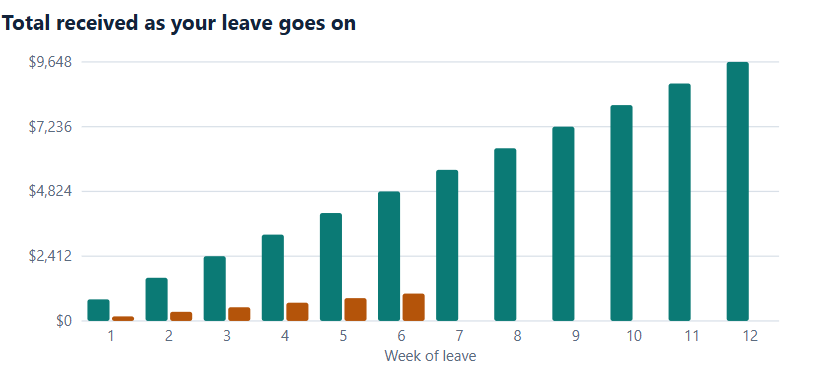
Over a full 12-week leave, the most an employee can receive is $14,742.36.
- Weekly wage of $800: 67% gives $536 per week.
- Weekly wage of $1,500: 67% gives $1,005 per week.
- Weekly wage of $2,500: 67% would be $1,675, but the cap applies, so the payment is $1,228.53.
DBL Payment Amount in 2026
The maximum weekly DBL benefit in 2026 is $170. However, not every employee will receive this amount. The actual payment depends on the worker’s average weekly wages before the disability began.
The standard calculation is:
DBL weekly benefit = 50% of the average weekly wage, up to $170.
| Average weekly wage | 50% calculation | Weekly DBL payment |
|---|---|---|
| $200 | $100 | $100 |
| $300 | $150 | $150 |
| $400 | $200 | $170 |
| $600 | $300 | $170 |
| $1,000 | $500 | $170 |
Eligibility Criteria for NY DBL and PFL 2026
Eligibility for both programs depends heavily on how long an employee has been working and how many hours per week they typically put in.
For PFL eligibility, an employee who regularly works 20 or more hours per week becomes eligible after 26 consecutive weeks of employment with a covered employer. An employee who works fewer than 20 hours per week becomes eligible after working 175 days, and those days do not need to be consecutive. Part-time and seasonal workers are not automatically excluded; they simply need to meet the applicable day or week threshold.
For DBL eligibility, most employees working for a covered employer in New York State are eligible from their first day of employment for injuries or illnesses that are not job-related, though the specific waiting period before benefits begin is seven consecutive days of disability.
A few groups sit outside standard coverage rules. Government employees, some non-profit workers, and certain independent contractors may not be automatically covered unless their employer has opted in. Self-employed individuals and sole proprietors can choose to purchase optional DBL and PFL coverage for themselves, which is worth knowing if you run your own small business in New York and want the same protection your employees would receive.
2026 Contribution and Benefit Rate Changes
The most important shift for 2026 sits in the PFL contribution rate. New York’s Department of Financial Services confirmed the rate employees pay through payroll deduction is increasing from 0.388% of gross wages in 2025 to 0.432% in 2026. Because PFL is funded entirely by employee payroll deductions (employers may voluntarily cover the cost but are not required to), this increase directly affects take-home pay for nearly every private-sector employee in the state.
The new annual cap on what an employee can be required to contribute toward PFL in 2026 is $411.91, up from $354.53 the year before. This is deducted incrementally from each paycheck throughout the year rather than in one lump sum, and once an employee hits the annual cap, no further PFL deductions are taken for the rest of that calendar year.
DBL contribution rules have not changed for 2026. Employers may still deduct up to half a percent of wages from employees, capped at 60 cents per week, which works out to roughly $31.20 annually if an employer chooses to pass along the maximum allowable share.
| Program | 2025 Rate/Cap | 2026 Rate/Cap | Change |
|---|---|---|---|
| PFL contribution rate | 0.388% of gross wages | 0.432% of gross wages | Increased |
| PFL annual max contribution | $354.53 | $411.91 | Increased |
| PFL maximum weekly benefit | $1,177.32 | $1,228.53 | Increased |
| DBL employee contribution | 0.5%, capped at $0.60/week | 0.5%, capped at $0.60/week | Unchanged |
| DBL maximum weekly benefit | $170/week | $170/week | Unchanged |
| State Average Weekly Wage (SAWW) | Lower base | $1,833.63 | Increased |
How to Apply for NY DBL and PFL in 2026
Filing a claim for either benefit follows a fairly structured process, though the exact paperwork depends on whether your employer uses the New York State Insurance Fund, a private carrier, or a self-insured plan.
- Notify your employer first. Before filing any paperwork, let your employer or HR department know you need disability or family leave, since they will need to provide the name of the insurance carrier handling your claim.
- Get the correct claim form. For DBL, this is typically Form DB-450 (Statement of Rights) paired with a claim form from your specific carrier. For PFL, most carriers use the standard PFL-1 Request for Paid Family Leave form, supported by the appropriate certification form depending on your reason for leave (bonding, caregiving, or military exigency).
- Attach supporting documentation. This means a healthcare provider’s certification for a medical disability, a birth certificate or adoption record for bonding leave, or a healthcare provider’s certification for a family member’s serious health condition.
- Submit within the filing window. Claims generally need to be filed within 30 days of the start of leave to avoid delays or denial on procedural grounds.
- Send the completed claim to your carrier. This could be the New York State Insurance Fund, a private insurer such as MetLife, The Hartford, Sun Life, or Prudential, or your employer’s self-insured plan administrator, depending on who provides your company’s coverage.
- Track your claim status. Most carriers offer an online portal or claimant login where you can check the status of a submitted claim, upload additional documents, or see payment history.
NY PFL and DBL Processing Time 2026
Once a complete claim is submitted, New York law requires the carrier to make a decision within 18 calendar days of receiving the completed claim with all required documentation. If the carrier needs additional information, that clock can be affected, so submitting a fully documented claim the first time is the fastest way to avoid delays.
For DBL, payments are also expected to begin promptly once approved, generally following the standard first-payment timeline set by the Workers’ Compensation Board. Missing information, an incomplete healthcare certification, or an employer failing to confirm employment details are the most common reasons claims stall past the standard processing window. If you haven’t heard back close to the 18-day mark, contacting your carrier directly and confirming your claim was received is the most effective next step.
PFL Payment Amount in 2026
The 2026 PFL benefit rate is 67% of an employee’s average weekly wage, subject to a maximum based on the New York State Average Weekly Wage. For 2026, the state average weekly wage used for the calculation is $1,833.63. Therefore, the maximum weekly PFL payment is $1,228.53.
An eligible employee may receive up to 12 weeks of benefits, making the maximum possible total benefit $14,742.36 for a full 12-week period at the maximum rate.
| Average weekly wage | Estimated weekly PFL benefit |
|---|---|
| $600 | $402 |
| $1,000 | $670 |
| $1,500 | $1,005 |
| $1,833.63 | $1,228.53 |
| $2,000 | $1,228.53 |
DBL Employee Contribution Rules in 2026
DBL contributions work differently from PFL contributions.
- Under the standard New York rule, an employer may deduct up to 0.5% of an employee’s wages to help cover the cost of disability benefits. The ordinary deduction is capped at $0.60 per week.
- Employers are allowed, but not required, to collect this contribution from employees. Some approved plans may have different contribution arrangements when the applicable legal conditions and employee agreements are satisfied.
- This means that an employee may see a DBL deduction, a PFL deduction, both deductions, or a different arrangement depending on the employer’s coverage and payroll setup.
- Workers should not assume that the DBL deduction is calculated using the same percentage as the 2026 PFL contribution.
VA Benefits 2026: How Much Will Your Payment Increase?
$5181 Social Security Check Payment Date Nov 25, Who Gets Paid?
Difference Between DBL and PFL: What Should Employees Know?
Although DBL and PFL are part of New York’s worker-benefit system, their purpose and payment rules are different.
| Feature | DBL | PFL |
|---|---|---|
| Main reason for leave | Employee’s own qualifying disability | Family care, bonding, or military-related needs |
| Wage replacement | 50% of average weekly wage | 67% of average weekly wage |
| Maximum weekly benefit in 2026 | $170 | $1,228.53 |
| Maximum duration | 26 weeks in a 52-week period | 12 weeks |
| Medical certification | Generally required | Required for qualifying family-care claims |
| Payroll contribution | Up to $0.60 weekly under standard rules | 0.432% of gross wages, up to annual cap |
| Can both be collected simultaneously? | No | No |
FAQs About NY DBL and PFL 2026
What is the maximum PFL weekly benefit in New York for 2026?
The maximum is $1,228.53 per week, based on 67% of the statewide average weekly wage of $1,833.63.
Did the DBL weekly benefit change in 2026?
No. DBL remains capped at $170 per week, with a minimum of $20 per week.
Can I receive DBL and PFL benefits at the same time?
No. New York does not allow DBL and PFL benefits to be paid concurrently for the same period, though an employee may use one after the other, such as DBL for pregnancy recovery followed by PFL for bonding.
How long can I take PFL in New York in 2026?
Eligible employees can take up to 12 weeks of Paid Family Leave in a 52-week period, and DBL plus PFL combined cannot exceed 26 weeks in any rolling 52-week window.
Who pays for PFL in New York?
PFL is funded entirely through employee payroll deductions unless an employer voluntarily chooses to cover some or all of the cost, and the 2026 employee contribution rate is 0.432% of gross wages, capped at $411.91 annually.
Is New York Paid Family Leave taxable?
Yes, PFL benefits are subject to federal income tax, but they are exempt from New York State income tax, and recipients typically get a 1099 form for tax filing purposes.
How do I check the status of my NY DBL or PFL claim?
Claim status is typically checked through your specific insurance carrier’s online claimant portal, which your employer or HR department can direct you to based on who administers your company’s coverage.
Does a part-time employee qualify for PFL in New York?
Yes. Part-time employees working fewer than 20 hours per week become eligible for PFL after working 175 days, while those working 20 or more hours weekly qualify after 26 consecutive weeks.
How long does it take to get approved for PFL in New York?
Insurance carriers are required to make a decision on a complete PFL claim within 18 calendar days of receiving all necessary documentation.