Ontario Workforce Priority Stream 2026: Ontario’s Expression of Interest portal for permanent residence opened on August 4, 2026, giving foreign nationals their first real chance to apply under a completely rebuilt provincial immigration system. This is not a minor update. Ontario shut down all eight of its previous Ontario Immigrant Nominee Program streams and replaced them with a single new framework called the Ontario Workforce Priority Stream, effective June 26, 2026. For weeks after that shutdown, there was no working intake system at all, leaving employers and candidates unable to submit new applications even though the new rules were technically already in force. That gap has now closed, and the province is moving fast.
If you have a job offer in Ontario, or you are an employer trying to sponsor a foreign worker for provincial nomination, the details of this new system matter far more than the old streams did, because the eligibility rules, required wages, and scoring criteria have all changed at once. This article breaks down exactly who qualifies under the three new pathways, how the points system works, and the fastest way to actually get your Expression of Interest submitted. We will be updating this article monthly as Ontario releases invitation rounds, updates its scoring cutoffs, and rolls out the second phase of streams still to come.
Ontario Workforce Priority Stream Key Highlights
| Detail | Information |
|---|---|
| New stream name | Ontario Workforce Priority Stream (OWPS) |
| Regulatory effective date | June 26, 2026 (Ontario Regulation 422/17 amendments) |
| Former streams closed | All 8 previous OINP streams, sunset May 30, 2026 |
| EOI portal opening date | August 4, 2026 |
| Number of pathways | 3: TEER 0-3, TEER 4-5, Self-Employed Physicians |
| Scoring system published | July 20, 2026 (130-point grid) |
| 2026 provincial nominee target | 91,500 admissions under the 2026-2028 Immigration Levels Plan |
| EOI validity period | 12 months from submission |
| Express Entry alignment | +600 CRS points on nomination (TEER 0-3 and physicians only) |
| Time to submit PR application after nomination | 60 days |
| Second phase streams expected | Priority healthcare, entrepreneurs, exceptional talent |
Why Ontario Overhauled Its Entire Immigrant Nominee Program
The scale of this change is worth understanding before diving into eligibility. On May 30, 2026, Ontario sunset every existing OINP pathway without a replacement ready to go, an unusual move that left the province with no active nomination stream for nearly a month. The Ministry of Labour, Immigration, Training and Skills Development then introduced the Ontario Workforce Priority Stream through amendments to Ontario Regulation 422/17 under the Ontario Immigration Act, 2015, consolidating everything into one unified, employer-driven framework built around three distinct tracks. Ontario officials describe this as the single largest structural overhaul in OINP’s history.
Applicants who had already submitted an Expression of Interest under the old streams and had not yet received an invitation to apply saw those EOIs automatically withdrawn once the new regulation took effect. Anyone already mid-application under the previous rules continues to be processed under the requirements in place when their application was originally received, so existing applications were not retroactively affected. For everyone else, this is a genuinely fresh start, built around a bigger admissions target too, since the 2026 to 2028 Immigration Levels Plan raised Ontario’s provincial nominee allocation to 91,500 for 2026 alone.
SSDI Fast-Track Approval 2026: Compassionate Allowances, QDD
Quebec Experience Program 2026: PEQ Reopening Dates, Eligibility
$5000 CRA Data Breach Settlement 2026: Who Qualifies and How to Claim
The Three New Pathways: Who Actually Qualifies
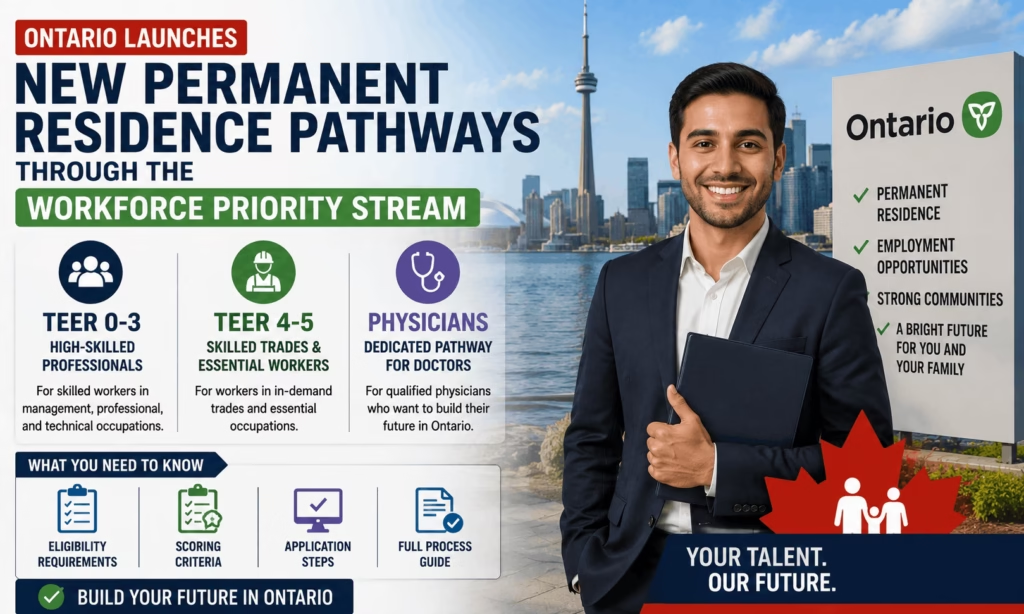
The Ontario Workforce Priority Stream sorts every applicant into one of three tracks based on the National Occupational Classification TEER category of their job offer, or, for physicians, their professional registration status.
TEER 0-3 Pathway for Higher-Skilled Workers
This pathway targets occupations that typically require post-secondary education, training, or significant management responsibility. To qualify, applicants generally need a full-time, permanent job offer from an eligible Ontario employer in a TEER 0, 1, 2, or 3 occupation, along with either six consecutive months of paid full-time experience with that employer in the offered position within the previous 12 months, or a longer qualifying work history depending on circumstances. Most applicants need a minimum Canadian Language Benchmark of CLB 6 across all four language skills, listening, reading, writing, and speaking, though eligible skilled trades occupations can qualify at CLB 5. Education requirements call for at least a one-year Canadian post-secondary credential or an equivalent foreign qualification supported by an Educational Credential Assessment no more than five years old. The job offer wage must meet or exceed the regional median wage for that occupation, though recent graduates of eligible Ontario post-secondary institutions may qualify at a lower wage threshold and, in some cases, receive an exemption from language testing altogether.
TEER 4-5 Pathway for Essential and Intermediate Workers
This second pathway is built for essential and intermediate roles across sectors like healthcare support, transport, food services, agriculture, and manufacturing. Applicants need at least nine months of cumulative, paid, full-time work experience in the specific job-offer position, completed within the two years before applying, and that experience must have been gained while lawfully residing and working in Ontario. There is no education-based exemption available for this pathway. Applicants need a minimum CLB 4 across all four language skills, demonstrated through an approved test taken within two years of applying, and a Canadian secondary school diploma or an ECA confirming equivalency for a foreign credential. As with the TEER 0-3 pathway, wages must meet or exceed the applicable median wage for the occupation in that Ontario region.
Self-Employed Physicians Pathway
The physicians pathway stands apart from the other two because it is the only track in the entire redesigned OINP that does not require a job offer. To qualify, a physician must simultaneously be a member in good standing with the College of Physicians and Surgeons of Ontario, hold a valid certificate of registration in one of three eligible classes, independent, academic, or provisional, and be eligible to bill through the Ontario Health Insurance Plan. Ontario has been actively courting physicians through targeted OINP activity throughout 2026, reflecting how central this pathway is to the province’s ongoing healthcare workforce strategy.
Employer Eligibility Requirements Employers Need to Meet
Because the entire redesigned stream is employer-driven, business eligibility matters just as much as candidate eligibility. Employers generally need to have been in active business for at least three years and meet minimum gross annual revenue thresholds, though those thresholds are lower for employers located in rural census divisions with populations under 150,000, a deliberate incentive to spread nominations outside the Greater Toronto Area. Employers must also employ a minimum number of Canadian citizens or permanent residents, generally five permanent full-time staff, or three outside the GTA, and the job offer itself must be full-time, either permanent or fixed-term for two years or more, unrelated to any active labour dispute, and located primarily in Ontario. Critically, the position cannot involve majority ownership by the applicant, closing off a route some previous applicants used to effectively sponsor themselves.
Employers must first register their business and the specific job offer through the OINP Employer Portal before the applicant can register their own Expression of Interest, so the employer step has to happen first in the sequence.
How the New 130-Point Scoring Grid Works
Unlike some of Ontario’s older streams, which operated closer to first-come, first-served or fixed criteria, the redesigned Ontario Workforce Priority Stream ranks every job-offer candidate against a published scoring grid worth a maximum of 130 points, released on July 20, 2026. Points are awarded across ten factors, including NOC TEER category, NOC broad occupational category, hourly wage, Ontario work experience, historical Canadian work earnings, highest level of education, official language ability, and regionalization, meaning where in Ontario the job is located.
Higher TEER categories are worth more points on paper, with 9 points awarded for TEER 0 or 1 roles and 6 points for TEER 2 or 3 roles, while TEER 4 and 5 roles receive 0 points in that specific factor. Interestingly, the separate broad occupational category factor appears weighted toward labour market shortage and demand rather than skill level or education, meaning a candidate in a genuinely in-demand occupation can still score competitively even without a high TEER classification. Jobs located outside Toronto, particularly in Northern, Eastern, Central, or Southwestern Ontario, earn additional regionalization points, giving candidates with job offers outside the GTA a real scoring advantage. Ontario has not yet published what score is likely to be competitive for an actual invitation, since this is the first intake cycle under the new grid, so early applicants are effectively operating without historical cutoff data to benchmark against.
Canada Set to Finalize LNG Agreement With Germany’s SEFE for Ksi Lisims LNG Project
New UK Immigration Rules 2026: What Changes for Visa Applicants?
How to Apply: Step by Step Through the New EOI Portal
The application sequence under the redesigned system runs in a specific order that both employers and candidates need to follow correctly. First, the employer registers their business in the OINP Employer Portal and submits the specific job offer tied to the position, confirming it meets all wage, duration, and staffing requirements. Second, once the employer registration and job offer are confirmed, the candidate creates a profile in the OINP’s online Expression of Interest system and enters their information against the ten scoring factors. Third, Ontario periodically reviews the pool of active EOIs and selects top-ranked candidates, issuing invitations to apply for provincial nomination. Fourth, invited candidates submit a full nomination application with supporting documentation, including language test results, ECA if applicable, employer forms, proof of legal status if applying from within Canada, and CRA Notices of Assessment where relevant. Finally, once nominated, TEER 0-3 and physician candidates have the option to request nomination through IRCC’s Express Entry system, which adds 600 points to their Comprehensive Ranking System score and virtually guarantees an Invitation to Apply in the next Express Entry draw, after which they have 60 days to submit their federal permanent residence application. TEER 4-5 candidates do not have this Express Entry option and instead proceed through the standard, non-Express Entry provincial nomination process directly to permanent residence.
Given that this is the very first intake window under the new framework, and that Ontario has signalled remaining nomination capacity for the rest of 2026 may be limited, immigration lawyers are advising eligible candidates and their employers to move quickly rather than wait, since later invitation rounds may face significantly more competition once word spreads.
What Comes Next: Phase 2 of Ontario’s Immigration Overhaul
The Workforce Priority Stream represents only the first phase of Ontario’s broader redesign. The province has confirmed that a second phase is planned, expected to introduce three additional streams focused on priority healthcare workers, entrepreneurs, and exceptional talent. No firm launch date has been announced for these additional streams, but based on the phased rollout pattern seen with the Workforce Priority Stream itself, from regulatory change in June to scoring grid in July to portal opening in August, later phases are likely to follow a similarly staged introduction rather than a single simultaneous launch.
Official Resources: Registration, Status Check and Application Links
| Resource | Purpose | Official Link |
|---|---|---|
| OINP Employer Portal | Register your business and submit job offers | ontario.ca/page/ontario-immigrant-nominee-program |
| OINP e-Filing Portal | Submit Expression of Interest and nomination applications | oinp.gov.on.ca |
| OINP Workforce Priority Stream Page | Full eligibility criteria and scoring grid | ontario.ca/page/ontario-workforce-priority-stream |
| IRCC Express Entry | Federal permanent residence application after PNP nomination | canada.ca/en/immigration-refugees-citizenship/services/immigrate-canada/express-entry.html |
| Educational Credential Assessment (WES) | ECA for foreign education credentials | wes.org/ca |
| College of Physicians and Surgeons of Ontario | Registration status for the physician pathway | cpso.on.ca |
FAQs
When did the Ontario Workforce Priority Stream open for applications?
The EOI portal opened on August 4, 2026, though the regulatory changes creating the stream took effect on June 26, 2026. There was a gap of several weeks where the rules were in force but no application portal existed.
What are the three new pathways to permanent residence in Ontario?
The three pathways are the TEER 0-3 pathway for higher-skilled workers, the TEER 4-5 pathway for essential and intermediate workers, and the Self-Employed Physicians pathway for doctors registered with the College of Physicians and Surgeons of Ontario.
Do I need a job offer to qualify for Ontario’s new PR pathway?
Yes, for the TEER 0-3 and TEER 4-5 pathways a full-time, permanent Ontario job offer meeting wage and employer eligibility rules is required. The Self-Employed Physicians pathway is the only track that does not require a job offer.
How does the new 130-point scoring grid work?
Candidates with a job offer are scored across ten factors including NOC TEER category, occupational category, wage, Ontario work experience, education, language ability, and job location, with a maximum possible score of 130 points. Higher scores are prioritized for invitations to apply.
Can Ontario’s provincial nomination help with Express Entry?
Yes, for TEER 0-3 and physician candidates. Accepting an Express Entry-aligned nomination adds 600 points to your Comprehensive Ranking System score, which effectively guarantees an Invitation to Apply in the next Express Entry round, followed by 60 days to submit your federal application.
What happened to applicants who had EOIs under the old OINP streams?
EOIs submitted under the previous eight streams that had not yet resulted in an invitation to apply were automatically withdrawn when the new regulation took effect. Applicants already at the full application stage continue to be processed under the older rules that applied when they submitted.
People Also Ask
Is the Ontario Workforce Priority Stream the same as Express Entry?
No, they are separate systems. The Workforce Priority Stream is a provincial nomination pathway, but candidates in the TEER 0-3 and physician pathways can request their nomination be aligned with Express Entry to speed up the federal permanent residence process.
What is the minimum wage requirement for Ontario’s new PR pathways?
The job offer wage must meet or exceed the regional median wage for that specific occupation, though recent graduates of eligible Ontario institutions applying under the TEER 0-3 pathway may qualify at a separate, lower wage threshold.
How long does the Ontario EOI stay valid?
An Expression of Interest submitted under the Workforce Priority Stream remains valid for up to 12 months from the date it is submitted, or until the candidate is invited to apply, whichever comes first.
Can international students in Ontario apply through the new pathways?
Recent graduates from eligible Ontario post-secondary institutions may qualify for the TEER 0-3 pathway, and in some cases benefit from a lower wage threshold or exemption from language testing, provided they secure a qualifying Ontario job offer.
Conclusion
Ontario’s decision to eliminate all eight of its former immigrant nominee streams in favour of a single, employer-anchored Ontario Workforce Priority Stream marks the most significant change to provincial immigration in the province in years, and the August 4, 2026 portal opening finally lets employers and candidates act on rules that had already been in force for weeks. With a published scoring grid, a larger 2026 admissions target, and Express Entry alignment built into two of the three pathways, this system rewards candidates and employers who move early and understand exactly how the ten scoring factors work. A second phase covering healthcare, entrepreneurs, and exceptional talent is still to come, so this is very much the opening chapter of a broader overhaul rather than the finished picture. We will keep updating this article every month as Ontario releases invitation data, scoring cutoffs, and details on the streams still ahead.
EITC Refund 2026: IRS Confirms Up To $4,427 for Taxpayers With One Child