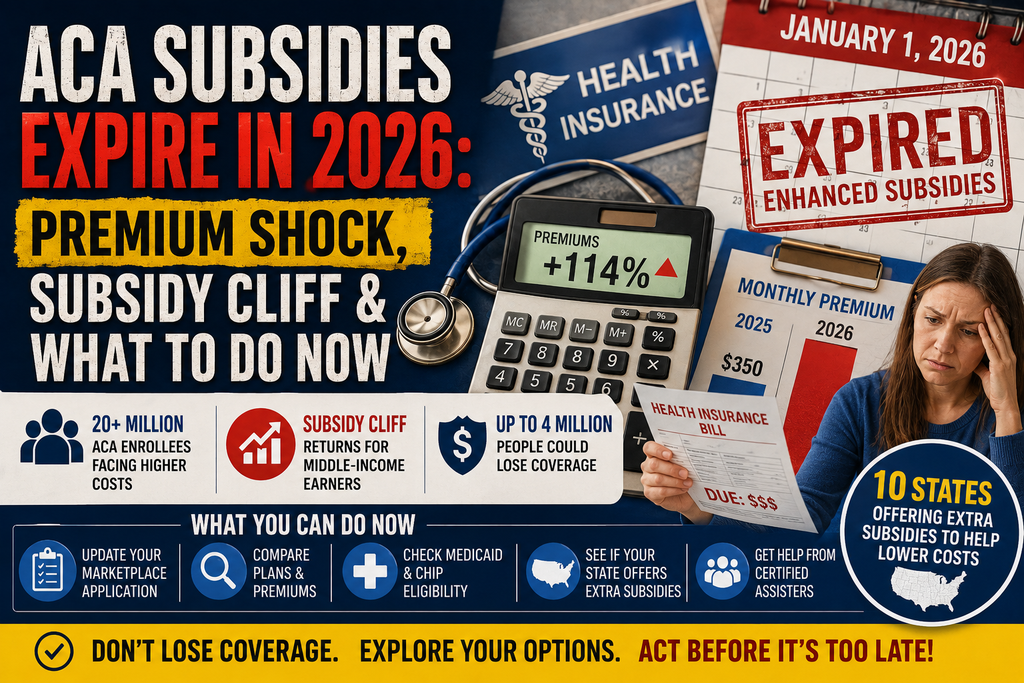
Millions of Americans entered 2026 facing a major change in the cost of Affordable Care Act health insurance. The enhanced ACA subsidies that had expanded financial assistance under the Affordable Care Act expired at the end of 2025. As a result, the federal Marketplace returned to the pre-2021 rules for calculating premium tax credits beginning with the 2026 coverage year.
That change does not mean that every Marketplace customer suddenly lost all financial assistance. Federal premium tax credits still exist for eligible consumers. But the enhanced assistance that had made coverage substantially cheaper for many people is gone, and households with income above 400% of the federal poverty level can once again be excluded from the federal premium tax credit altogether.
The scale of the Marketplace remains enormous. CMS reported that 23.1 million consumers selected or were automatically re-enrolled in Marketplace coverage for 2026, including millions of people who had active coverage in 2025. But the loss of enhanced assistance has changed the affordability calculation for many households.
Some states are responding with their own financial assistance programs. CMS identifies 10 states that provide a state subsidy “wrap” in addition to federal premium tax credits and/or cost-sharing reductions for consumers at specific income levels: California, Colorado, Connecticut, Maryland, Massachusetts, New Jersey, New Mexico, New York, Vermont and Washington. For consumers who are struggling with higher premiums in 2026, understanding the new rules is critical.
What Happened to ACA Subsidies in 2026?
The enhanced ACA premium tax credits were created by the American Rescue Plan Act and later extended through 2025 by the Inflation Reduction Act. Those enhanced provisions expired on December 31, 2025. Beginning in 2026, the Marketplace returned to the pre-enhancement framework. CMS says consumers generally must have household income between 100% and 400% of the federal poverty level to qualify for advance premium tax credits under the restored rules.
The IRS confirms the change as well. For 2026, households with income above 400% of the federal poverty line are no longer eligible for the federal Premium Tax Credit. This is the key reason the ACA subsidy cliff has returned.
What Is the ACA Subsidy Cliff?
The ACA subsidy cliff refers to the sharp eligibility cutoff for federal premium tax credits at 400% of the federal poverty level under the original ACA rules. During the enhanced-subsidy period, the federal government temporarily removed that income ceiling. That allowed some households earning more than 400% of the federal poverty level to qualify for assistance if the applicable benchmark premium exceeded a specified percentage of household income.
That protection ended with the expiration of the enhanced credits. For 2026, the federal Premium Tax Credit again has an income ceiling of 400% of the federal poverty level. This can create a significant difference between two households with only a small difference in annual income. A household just below the applicable threshold may qualify for federal assistance, while a household just above it may receive no federal premium tax credit. That is why the phrase subsidy cliff has returned to the ACA conversation.
$400 Inflation Refund Checks 2026: New York’s Real Program, Fact-Checked
Social Security COLA 2026: How Much Extra Will You Receive in Your Aug 2026 Benefit Payment?
The 8.5% Premium Cap Is Also Gone
Another important change concerns the percentage of household income used in calculating Marketplace affordability. During the enhanced-credit period, the ACA subsidy structure protected eligible households from having to pay more than 8.5% of household income toward the benchmark premium. That enhanced protection expired with the enhanced credits.
For 2026, the IRS lists the applicable percentage used in the Premium Tax Credit calculation at 9.96%. This does not mean every Marketplace customer will automatically pay 9.96% of income. The Premium Tax Credit is calculated using household income, family size, the benchmark plan and other eligibility rules. But the change is important for households that had benefited from the enhanced affordability formula.
How Much Are ACA Premiums Rising in 2026?
This is where headlines can become misleading. There is no single nationwide percentage increase that applies to every Marketplace consumer.
Premium changes vary according to:
- Age
- Location
- Household income
- Household size
- Plan selected
- Eligibility for financial assistance
- Whether the consumer qualifies for a state subsidy
- Whether the consumer receives cost-sharing reductions
CMS’s official 2026 Marketplace report provides a more useful nationwide picture. For all Marketplace plan selections during the 2026 Open Enrollment Period, the average monthly premium was $619 before advance premium tax credits and $178 after APTC. CMS also found that the average premium after APTC for comparable consumers increased by $15 on HealthCare.gov from 2025 to 2026 and by $36 in state-based marketplaces. Importantly, state subsidies are not fully reflected in those figures. CMS specifically notes that state subsidies available in some state-based marketplaces can further reduce consumer premiums.
Some Consumers Still Have Very Low Premiums
The expiration of enhanced ACA subsidies does not mean Marketplace coverage is unaffordable for everyone. CMS reported that 34% of consumers selected a Marketplace plan for $10 or less per month after APTC during the 2026 Open Enrollment Period. CMS also projected before Open Enrollment that the average HealthCare.gov premium after tax credits for the lowest-cost plan available to eligible consumers would be approximately $50 per month in 2026.
These figures show why consumers should not assume that they have to pay the full sticker price. The only reliable way to know your actual 2026 cost is to update your Marketplace application and compare the plans and financial assistance available to your household. HealthCare.gov specifically advises consumers to update their application because income and household changes can affect the amount of premium tax credit they receive.
Who Is Most Exposed to Higher ACA Costs?
- The impact is not uniform. Consumers who received enhanced federal assistance in 2025 but no longer qualify for the same level of help can see their monthly premiums increase.
- Households with income above 400% of the federal poverty level face another important change: they are generally no longer eligible for the federal Premium Tax Credit under the restored rules.
- Older adults can also face larger dollar increases because Marketplace premiums vary by age.
However, the actual impact depends on the person’s location, income, plan and access to state assistance. It is therefore better to compare the net premium after all available financial assistance rather than comparing a plan’s full premium with last year’s full premium.
10 States Providing Additional ACA Financial Assistance in 2026
One of the most important developments is that some states are using their own programs to soften the impact of the federal subsidy changes. CMS identifies 10 state-based marketplaces that provide a state subsidy wrap in addition to federal assistance for consumers at specified income levels.
| State | State assistance in 2026 |
|---|---|
| California | State premium subsidies |
| Colorado | Colorado Premium Assistance |
| Connecticut | State premium assistance |
| Maryland | Maryland Premium Assistance |
| Massachusetts | ConnectorCare/state assistance |
| New Jersey | New Jersey Health Plan Savings |
| New Mexico | State affordability assistance |
| New York | State-funded cost-sharing assistance |
| Vermont | State premium and cost-sharing assistance |
| Washington | Cascade Care Savings |
CMS confirms these 10 states in its 2026 Marketplace data documentation. Eligibility and the amount of assistance vary by state. Consumers should therefore use their state’s official Marketplace rather than assuming that a program available in one state is available elsewhere.
California’s $190 Million State Subsidy Program
California is one of the states that has attempted to cushion the loss of federal enhanced assistance. For 2026, California allocated $190 million for state-funded tax credits aimed at lower-income Covered California consumers. Covered California reported that the state subsidies were helping hundreds of thousands of enrollees.
By the end of the 2026 Open Enrollment period, 389,590 Californians were enrolled in plans receiving state subsidies, with an average of $45 per month in state assistance. Covered California also reported a significant difference in cancellation rates between lower-income consumers receiving state assistance and middle-income consumers who lost all enhanced federal credits. This demonstrates how state assistance can make a meaningful difference even after the federal enhanced credits expire.
Colorado Is Also Providing Premium Assistance
Colorado implemented Colorado Premium Assistance for the 2026 plan year. Connect for Health Colorado reported that the federal enhanced-credit expiration reduced or eliminated federal financial assistance for approximately 78,000 Coloradans. The state responded with its own premium assistance program.
According to the state’s official Marketplace, Colorado Premium Assistance was providing approximately $10.6 million per month to help more than 176,000 customers with premium costs. The program illustrates the different ways states are responding to the same federal policy change.
New Jersey Has One of the Broadest State Subsidy Programs
New Jersey is another state where residents can receive state-funded assistance. The New Jersey Health Plan Savings program provides state subsidies based on household income. For 2026, New Jersey says individuals with annual income up to $93,900 and families of four with income up to $192,900 can qualify for state assistance.
The state’s 2026 Open Enrollment data show that qualified New Jersey consumers received an average of $604 per person per month in combined federal and state financial assistance. That assistance can make a major difference for households that would otherwise face substantially higher premiums.
Maryland Created a New Premium Assistance Program
Maryland also responded to the loss of enhanced federal assistance. The Maryland Premium Assistance Program began January 1, 2026. State legislative documents say the program was designed to partially replace the enhanced federal premium tax credits.
For 2026, the state program provides:
- 100% replacement of the lost enhanced assistance for eligible consumers below 200% of the federal poverty level
- A phased level of assistance between 200% and 250% of the poverty level
- Partial replacement for some households between 250% and 400% of the poverty level
The program is funded through a state assessment on health insurance premiums.
Connecticut Added Temporary Premium Assistance
Connecticut also created additional help for certain residents. Access Health CT launched a Special Enrollment Period in February 2026 for consumers eligible for its new state subsidy. The state later reported that its Temporary Premium Assistance program had generated more than $1.6 million in savings for 10,580 Connecticut residents as of June 2026. The program was specifically created after the enhanced federal Premium Tax Credits expired.
Washington’s Cascade Care Savings
Washington has its own state-funded program called Cascade Care Savings. For 2026, the Washington Health Benefit Exchange says the program provides state premium assistance to residents with income up to 250% of the federal poverty level who enroll in eligible Cascade Care Silver or Gold plans.
The published 2026 assistance amounts include:
- $55 per member per month for customers who receive federal subsidies
- $250 per member per month for customers who do not receive federal subsidies
Washington therefore provides an example of how a state can continue offering financial support even when federal assistance is reduced.
What If You Cannot Afford Your ACA Plan?
If your 2026 premium is too high, don’t immediately cancel your coverage.
There are several steps to take first.
1. Update Your Marketplace Application
Your premium tax credit is based partly on your estimated household income. HealthCare.gov says consumers should update their application with expected income and household changes to ensure they receive the correct financial assistance. A change in income or household size can affect eligibility.
2. Compare Every Available Plan
Do not assume your automatically renewed plan is the cheapest option. HealthCare.gov recommends reviewing available plans and comparing costs. A different Bronze, Silver or Gold plan may have a lower premium, although the cheapest premium is not necessarily the lowest total cost once deductibles, copayments, coinsurance and out-of-pocket maximums are considered.
3. Check Medicaid and CHIP
If your income has fallen, you may qualify for Medicaid or CHIP. HealthCare.gov says consumers can apply for Medicaid and CHIP at any time during the year. A Marketplace application can also determine whether someone in the household qualifies for Medicaid or CHIP. This can be especially important for families whose income changed during the year.
What About Federally Qualified Health Centers?
If you cannot afford insurance or need medical care while you are uninsured, federally funded health centers can provide another option. The Health Resources and Services Administration says community health centers provide care to people with or without health insurance and charge based on a sliding fee scale. Health Center Program recipients are required to provide services using a sliding fee scale based on the patient’s ability to pay.
This does not replace comprehensive health insurance. But for someone who is uninsured or struggling to pay for care, an HRSA-supported health center can provide an affordable source of primary care.
What About Short Term Health Insurance?
Short-term, limited-duration insurance is another product consumers may encounter when shopping for coverage. However, consumers should understand that it is not the same thing as an ACA Marketplace plan. CMS describes short-term limited-duration insurance as coverage primarily intended to fill temporary gaps in insurance.
Federal rules finalized in 2024 limit new short-term policies to an initial term of no more than three months and a maximum coverage period of no more than four months, including renewals or extensions, subject to applicable law. State laws can impose additional restrictions. Consumers should carefully review what a short-term plan covers before choosing it as an alternative to comprehensive Marketplace insurance.
Be Careful With Plans Bought Outside the Marketplace
Another common mistake is buying a private health plan outside the Marketplace without checking whether financial assistance is available. HealthCare.gov says that if you buy a plan outside the Marketplace, you cannot receive premium tax credits or other income-based Marketplace savings for that plan. That can make an apparently cheaper plan less attractive once the available federal or state assistance is considered. If you believe you qualify for financial help, start with the official Marketplace.
What Happens If You Stop Paying Your Premium?
Canceling coverage or allowing a plan to terminate for nonpayment can create problems. HealthCare.gov says Marketplace plans using premium tax credits generally provide a grace period of three months when at least one full month’s premium has been paid. But consumers should not assume that a grace period means coverage will continue indefinitely.
If a plan terminates because of nonpayment, HealthCare.gov says the person generally does not qualify for a Special Enrollment Period based solely on that termination. This is one reason consumers should contact the Marketplace or their insurer before allowing coverage to lapse.
What If You Need ACA Coverage Right Now?
The 2026 Open Enrollment Period has already ended. For the federal Marketplace, the 2026 Open Enrollment Period ran from November 1, 2025, through January 15, 2026. Outside Open Enrollment, you generally need a qualifying event to enroll in Marketplace coverage.
Examples include:
- Losing other health coverage
- Getting married
- Having a baby
- Adopting a child
- Moving
- Certain other qualifying life events
HealthCare.gov says people can also enroll in Medicaid or CHIP at any time if they qualify.
Get Ready for the 2027 ACA Open Enrollment Period
There is another important deadline change to know. Beginning with the 2027 plan year, CMS is changing the annual Open Enrollment Period for the federal Marketplace.
For exchanges using the federal platform, Open Enrollment will run from: November 1 through December 15, 2026.
State-based marketplaces have flexibility within federal parameters but must end their annual Open Enrollment Periods by December 31.
This means consumers should not assume that the January 15 deadline used for 2026 will remain the standard federal deadline.
If you expect to need Marketplace coverage for 2027, begin comparing your options and estimating your household income before November.
ACA Subsidies 2026: What Consumers Should Do Now
The most important steps are relatively simple.
1. Check your current premium
Look at the amount you are actually paying after all federal and state assistance.
2. Update your income
Make sure your Marketplace application reflects your expected household income for the year.
3. Check your state Marketplace
If you live in one of the states offering additional assistance, your state subsidy could significantly reduce your premium.
4. Check Medicaid or CHIP
A lower income could make you eligible for public coverage.
5. Compare plans
Do not automatically remain in the same plan without checking the alternatives.
6. Use official assistance
HealthCare.gov offers free help from certified assisters and agents or brokers.
7. Don’t cancel coverage before finding another option
A gap in coverage can leave you exposed to medical bills and may make it difficult to enroll again outside Open Enrollment.
ACA Subsidies 2026: Key Numbers
| Item | 2026 information |
|---|---|
| Enhanced federal ACA subsidies | Expired Dec. 31, 2025 |
| Federal PTC income ceiling | Generally 400% FPL |
| 2026 IRS applicable percentage | 9.96% |
| 2026 Marketplace plan selections | 23.1 million |
| Average Marketplace premium before APTC | $619/month |
| Average after APTC | $178/month |
| Average increase after APTC, HealthCare.gov | $15 |
| Average increase after APTC, state-based exchanges | $36 |
| Consumers selecting plans at $10 or less after APTC | 34% |
| States with state subsidy wrap identified by CMS | 10 |
Why the 2026 ACA Subsidy Changes Matter
The end of enhanced ACA subsidies represents a return to the original federal subsidy structure, but the consequences vary dramatically from one household to another. Some people continue to receive substantial federal assistance. Others qualify for state-funded support. Some households have lost all federal premium tax credits because their income is above 400% of the federal poverty level. And some consumers may find that a different Marketplace plan is significantly cheaper than the plan they previously selected.
The official numbers also show why broad claims that “everyone’s premiums doubled” are misleading. CMS’s national data show a wide range of outcomes, including millions of consumers obtaining plans for $10 or less after APTC. At the same time, the average premium after APTC increased for comparable consumers, and the expiration of enhanced assistance has created substantially higher costs for some households.
The expiration of enhanced ACA subsidies has fundamentally changed the Marketplace landscape for 2026.
The enhanced federal Premium Tax Credits expired at the end of 2025, restoring the 400% federal poverty-level income ceiling for the federal Premium Tax Credit and ending the temporary enhanced affordability rules. The IRS confirms that households with income above 400% of the federal poverty level are no longer eligible for the federal credit under the 2026 rules.
But the impact is not the same for everyone. CMS reports that 23.1 million people selected or were automatically re-enrolled in Marketplace coverage for 2026, while the average premium after APTC was $178 per month. About 34% of consumers selected plans costing $10 or less per month after APTC. At the same time, 10 states — California, Colorado, Connecticut, Maryland, Massachusetts, New Jersey, New Mexico, New York, Vermont and Washington are providing state-funded assistance at specified income levels to reduce the impact of the federal changes.
For people struggling with their 2026 premium, the answer is not necessarily to go uninsured. Update your Marketplace application, check your income eligibility, compare every available plan, investigate state assistance and check Medicaid or CHIP eligibility. If you need care while uninsured, HRSA-supported health centers can provide services on a sliding fee scale based on ability to pay. And if you are planning ahead, mark November 1, 2026 on your calendar. For the federal Marketplace, the 2027 Open Enrollment Period will run through December 15, 2026, rather than January 15 as it did for 2026.
The most important lesson for 2026 is simple: don’t assume your old ACA premium is your only option. Compare your current assistance, check your state’s programs and review your coverage before deciding to go without insurance.
FAQ’s About ACA Subsidies
Did ACA subsidies expire in 2026?
The enhanced federal Premium Tax Credits expired on December 31, 2025. The underlying ACA Premium Tax Credit remains available to eligible consumers under the 2026 rules.
What happened to Obamacare subsidies in 2026?
The temporary enhanced subsidies ended, returning the federal Marketplace to the pre-2021 income eligibility structure. Generally, households above 400% of the federal poverty level are no longer eligible for the federal Premium Tax Credit.
What is the ACA subsidy cliff?
The ACA subsidy cliff is the sharp cutoff created when federal Premium Tax Credit eligibility ends above 400% of the federal poverty level under the original ACA rules. The enhanced subsidies temporarily removed that cutoff, but it returned for 2026.
Is the 8.5% ACA premium cap still available in 2026?
The temporary enhanced rule that capped the applicable household contribution at 8.5% of income expired. For 2026, the IRS lists the applicable percentage at 9.96%.
How much did ACA premiums increase in 2026?
There is no single nationwide increase that applies to everyone. CMS reports that the average premium after APTC was $178 in 2026. For comparable APTC consumers, the average increase was $15 on HealthCare.gov and $36 in state-based marketplaces.
Are ACA subsidies still available in 2026?
Yes. Eligible consumers can still receive the federal Premium Tax Credit under the 2026 rules. Some states also provide additional state-funded assistance.
Which states offer additional ACA subsidies in 2026?
CMS identifies California, Colorado, Connecticut, Maryland, Massachusetts, New Jersey, New Mexico, New York, Vermont and Washington as states providing a state subsidy wrap at specified income levels.
Can I still get ACA coverage in 2026?
If Open Enrollment has ended, you generally need to qualify for a Special Enrollment Period. Medicaid and CHIP applications can be made year-round.
What if I cannot afford my ACA premium?
Update your Marketplace application, compare plans, check whether you qualify for Medicaid or CHIP and determine whether your state offers additional financial assistance. You can also seek care from an HRSA-supported health center, which charges based on ability to pay.
Can I buy a short-term health plan instead?
Short-term, limited-duration insurance is available in some circumstances, but it is not the same as comprehensive ACA Marketplace coverage. Federal rules limit new policies to an initial term of no more than three months and a maximum duration of four months, subject to applicable state law.
When is ACA Open Enrollment for 2027?
For the federal Marketplace, the 2027 Open Enrollment Period will run from November 1 through December 15, 2026. State-based exchanges can have different dates within federal requirements.
Official Sources
- CMS — 2026 Marketplace Open Enrollment Report
- CMS — 2026 Marketplace Plans and Prices
- IRS — Premium Tax Credit Rules for 2026
- IRS — 2026 Tax Changes and Premium Tax Credit Changes
- HealthCare.gov — Update or Change Your Marketplace Plan
- HealthCare.gov — Medicaid and CHIP Eligibility
- HealthCare.gov — Special Enrollment Periods
- CMS — 2027 Marketplace Open Enrollment Changes
- HRSA — Affordable Health Centers and Sliding-Scale Care
- Covered California — 2026 State Subsidies and Enrollment
- Connect for Health Colorado — 2026 Premium Assistance
- Get Covered New Jersey — 2026 State Subsidies
- Maryland — 2026 Premium Assistance Program
- Access Health CT — 2026 Temporary Premium Assistance
- Washington Health Benefit Exchange — 2026 Cascade Care Savings