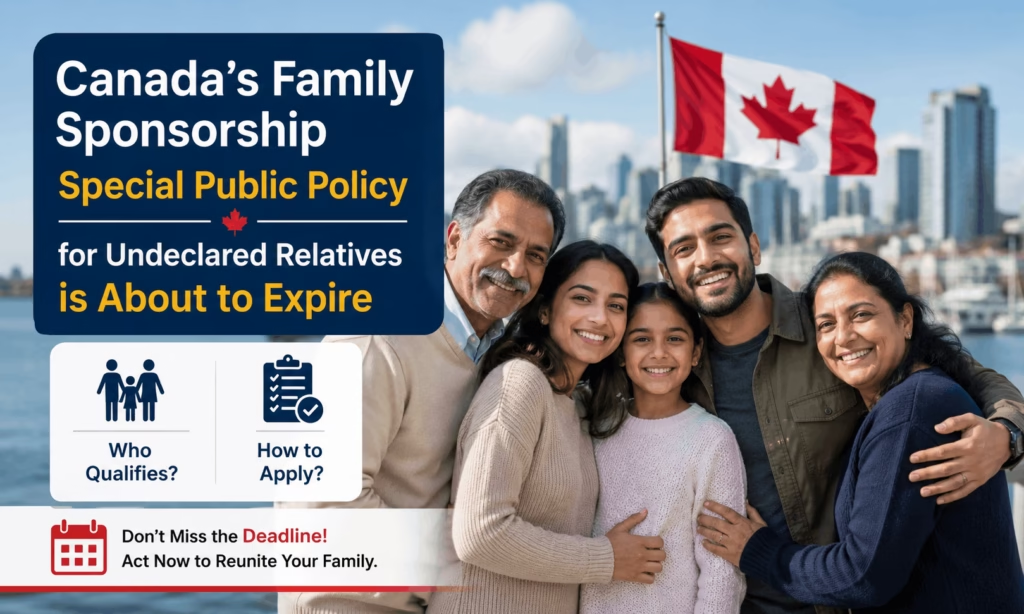
Canada’s Family Sponsorship Special Public Policy: Canadian permanent residents who never declared a spouse, partner, or child on their original immigration application have roughly three weeks left to act before a critical exemption disappears. Immigration, Refugees and Citizenship Canada has confirmed that the special public policy for undeclared family members, which has protected eligible sponsors from a lifetime sponsorship ban since 2019, is set to expire on September 10, 2026, and the department has given no indication that a fourth extension is coming. We’ll be updating this article monthly, so check back here for any last-minute extension announcements or changes to this deadline.
For thousands of permanent residents across Canada, this is not a minor administrative date, it is the closing of a narrow legal window that has let families reunite despite an earlier mistake or omission on paper. Once September 10, 2026 passes, anyone who did not declare a spouse, common-law partner, or dependent child at the time of their own immigration application faces the return of a permanent, lifetime bar on ever sponsoring that person through the family class, with no built-in appeal process to undo it. Immigration, Refugees and Citizenship Canada, commonly known as IRCC, has processed applications under this policy since 2019, and the current version has been in place since September 2023, but officials have signaled that broader immigration priorities for 2026 through 2028 are shifting away from this kind of temporary exemption.
What is Canada’s Family Sponsorship Special Public Policy?
Under Canada’s Immigration and Refugee Protection Regulations, every person applying for permanent residence is legally required to declare all of their family members at the time of that application, including a spouse, common-law partner, or dependent children, even if those relatives have no intention of ever coming to Canada. This declaration requirement exists so that immigration officers can run the necessary medical, background, and security checks on every family member connected to an applicant, whether or not they plan to immigrate at the same time.
When a person fails to declare a spouse, partner, or child during that original process, paragraphs 117(9)(d) and 125(1)(d) of the Immigration and Refugee Protection Regulations impose a lifetime ban that permanently blocks that person from ever being sponsored through the family class, regardless of how much time has passed or how the sponsor’s circumstances have changed. Advocacy groups and members of the House of Commons Standing Committee on Citizenship and Immigration argued for years that this rule was disproportionately harsh, particularly for children who had no say in a parent’s original application decisions.
IRCC’s response was to create a temporary carve-out through a public policy under section 25.2 of the Immigration and Refugee Protection Act, first launched as a pilot in September 2019, extended a second time in September 2021 to cover the pandemic period, and renewed a third and current time on September 10, 2023. Each version of the policy has used the same eligibility criteria, and together the three consecutive policies cover any application IRCC received between May 31, 2019 and the current September 10, 2026 cutoff.
Employment Insurance (EI) 2026 Rule Changes: What Every Canadian Worker Needs to Know
Empire State Child Credit 2026: $1,000 Per Child Under 4, Full Eligibility & Payment Guide
Oregon Kicker Tax Credit 2026: How To Claim Your Share Of The $1.41 Billion Surplus
California Climate Credit 2026: Payment Timing Just Changed, Here Is What to Expect on Your Bill
$145.83 BC Family Benefit First Child Payment Confirmed as Income Phase-Out Shifts to $96,562
Key Facts and Deadline Highlights
| Detail | Information |
|---|---|
| Policy name | Public policy exempting certain sponsored foreign nationals from sponsorship bar |
| Administered by | Immigration, Refugees and Citizenship Canada (IRCC) |
| Legal authority | Section 25.2 of the Immigration and Refugee Protection Act |
| Current expiry date | September 10, 2026 |
| Original pilot launch | September 9, 2019 |
| Second extension | September 2021 |
| Current consecutive policy took effect | September 10, 2023 |
| Applications covered | Received between May 31, 2019 and September 10, 2026 |
| Who can be sponsored under this policy | Spouse, common-law partner, conjugal partner, or dependent child |
| Regulation creating the lifetime bar | Paragraphs 117(9)(d) and 125(1)(d), Immigration and Refugee Protection Regulations |
| Confirmed extension beyond September 10, 2026 | None announced as of this update |
| Right of Permanent Residence Fee (as of April 30, 2026) | $600, with dependent children exempt |
| Spousal sponsorship processing time (outland, outside Quebec) | Approximately 17 months |
| Spousal sponsorship processing time (inland, outside Quebec) | Approximately 27 months |
Who Is Actually Eligible to Use This Policy
Not every permanent resident who failed to declare a family member automatically qualifies for this exemption. The public policy is narrowly targeted at sponsors who obtained their own permanent residence through one of four specific pathways.
The first eligible group includes sponsors who came to Canada as government-assisted or privately sponsored refugees, or through similar resettlement programs recognizing Convention refugee status. The second group covers sponsors who were granted permanent residence after being determined to be a protected person through Canada’s in-Canada asylum system. The third group applies to sponsors who themselves were sponsored to Canada as a spouse, common-law partner, conjugal partner, or dependent child under the family class. The fourth group covers sponsors who arrived in Canada as a sponsored spouse or common-law partner specifically under the spouse or common-law partner in Canada class.
IRCC selected these four categories deliberately, reasoning that undeclared family members connected to sponsors in these groups generally would not have triggered excessive demand provisions related to health or social services, and typically were not subject to the kind of income requirements that apply to other immigration streams. In other words, the department’s position is that had these family members been properly declared originally, they likely would not have changed whether the sponsor’s own application succeeded.
Who Is Excluded From the Exemption
The policy draws a firm line in situations where declaring the undeclared family member at the time of the original application would have made the sponsor ineligible to immigrate under the program they actually used. A sponsor who was admitted as someone else’s spouse, but who was secretly already married to or in a common-law relationship with a different, undeclared person at that time, cannot rely on this policy. Similarly, a sponsor who was admitted as a dependent child on a parent’s application, but was actually married or in a common-law relationship at the time, is excluded, since being married would have disqualified them from being classified as a dependent child in the first place.
Sponsors who immigrated through a program specifically requiring them to be single with no dependents are also excluded from using this exemption for any later-discovered undeclared family member. Beyond these carve-outs, every applicant sponsored under this policy still needs to pass all of the standard admissibility requirements not specifically waived by the exemption, including criminal inadmissibility screening, medical inadmissibility assessment, and full security checks, meaning the policy waives the lifetime sponsorship bar itself but does not waive any other requirement of Canadian immigration law.
How to Apply for Canada’s Family Sponsorship Special Public Policy ?
IRCC has been clear that there is no separate or specially labeled application form for sponsoring an undeclared family member under this policy. Eligible sponsors go through the standard application process used for sponsoring a spouse, partner, or dependent child, and immigration officers determine during processing whether the application also qualifies for the public policy exemption from the lifetime bar.
The single detail that matters most for this deadline is the date IRCC receives the application, not the date it is submitted or postmarked, and not the date a final decision is issued. To benefit from the exemption, IRCC must receive a complete application on or before September 10, 2026. These applications are generally required to be submitted online through the Permanent Residence Portal, with paper applications available only in limited cases where IRCC has approved an alternate format for accessibility reasons.
Standard family sponsorship fees apply on top of this process, including the Right of Permanent Residence Fee, which rose to $600 as of April 30, 2026 for applicants required to pay it, though dependent children remain exempt from that particular fee. Sponsors residing in Quebec face an additional layer, since they must also obtain a separate sponsorship undertaking from the provincial government, a requirement that operates on its own timeline and is not waived or accelerated by this federal public policy.
Trump Halts 50 Percent Tariffs Canada: What the Last Minute Deal With Ottawa Means
Green Card Rule Changes: New Public Charge Test to Assess Age, Health, Family Status and Finances
Georgia Flat Income Tax Rate Cut to 4.99%: What the New Law Actually Means for Your Paycheck
What Happens to Applications Already Submitted
Sponsors who have already filed an application to sponsor an undeclared family member under this policy do not need to take any further action before the deadline. IRCC has confirmed that any application received before September 10, 2026 will continue to be assessed under the public policy’s provisions, regardless of whether a final decision is actually issued before or after that date.
Given current spousal sponsorship processing times sitting at roughly 17 months for outland applications and 27 months for inland applications outside Quebec, many applications submitted even now will not reach a final decision until sometime in 2028. Because pending applications are effectively grandfathered under the policy, the real pressure point for sponsors is not getting a decision before the deadline, it is simply making sure IRCC receives a complete, eligible application before the cutoff date arrives.
There is also a specific second-chance provision built into the current policy for a narrower group of sponsors. Anyone whose earlier attempt to sponsor an undeclared family member was refused before the very first version of this policy took effect on May 31, 2019 is permitted to submit a brand new application under the current rules. That opportunity, however, is bound by the same hard deadline, meaning any such new application must still be received by IRCC no later than September 10, 2026.
Why IRCC May Not Extend the Policy Again
This exemption has already been renewed twice since its original 2019 launch, but nothing in IRCC’s public communications or the current immigration minister’s statements points toward a fourth consecutive version. According to the department’s own policy documentation, the intent behind the current version was to use the 2023 to 2026 period to gather data on the population actually using the exemption, information that would help the government decide whether to pursue a permanent regulatory amendment instead of continuing to rely on temporary policy renewals.
Canada’s broader 2026 to 2028 Immigration Levels Plan is also weighted heavily toward economic immigration, with a target of 380,000 new permanent residents and officials emphasizing tighter management of temporary resident volumes and asylum processing under recently passed legislation. Family sponsorship overall still represents a meaningful share of total admissions, but the policy landscape surrounding it has grown noticeably more restrictive in 2026, including a separate, unrelated pause on new Parent and Grandparent Program applications that took effect at the start of the year. If the federal government ultimately decides a formal regulatory change to paragraphs 117(9)(d) and 125(1)(d) is warranted, the lifetime bar could eventually be modified or removed permanently through legislation rather than through another temporary public policy. But absent such a change, or an unexpected fourth extension, the lifetime ban on sponsoring undeclared family members returns automatically the day after the deadline passes.
What Happens After September 10, 2026 If You Miss It
Once the deadline lapses without a new extension, IRCC will stop accepting new applications from sponsors seeking to use this exemption. Practically speaking, that means the underlying regulatory bar, the automatic lifetime prohibition on ever sponsoring a family member who was not declared during a sponsor’s own original immigration process, snaps back into full effect with no temporary carve-out available. There is no formal appeal mechanism built into this specific bar the way there might be for a standard sponsorship refusal, which is part of why immigration professionals have been urging affected sponsors to treat this deadline with real urgency rather than assuming another extension is likely.
It is also worth noting that the original policy documentation includes a standard clause permitting the government to cancel the public policy earlier than its scheduled expiry date at any time, at the minister’s discretion. While there is no indication that an early cancellation is imminent, that clause underscores that the September 10, 2026 date should be treated as a firm outer limit rather than a soft target.
Steps Sponsors Should Take Right Now
For any permanent resident who has an undeclared spouse, partner, or dependent child and believes they may fall within one of the four eligible sponsor categories, the priority right now is confirming eligibility and assembling a complete application as quickly as possible. This includes gathering documentation proving the sponsor’s own original pathway to permanent residence, whether that was through refugee resettlement, protected person status, or a prior family class sponsorship, along with evidence establishing the genuine relationship with the family member now being sponsored.
Because an incomplete or clearly ineligible application risks being returned rather than processed, and there may not be enough time left to correct and resubmit before the deadline, sponsors who are uncertain about their specific circumstances are generally advised to consult a licensed, regulated Canadian immigration consultant or an immigration lawyer rather than attempting a complex or borderline case without professional guidance. Sponsors based in Quebec should start the separate provincial sponsorship undertaking process immediately as well, since that step runs on an independent timeline that will not automatically speed up simply because the federal exemption deadline is approaching.
Chapter 33 VA Benefits Housing Allowance: How Much Can You Get Per Month
State Farm Dividend: Who Qualifies to Receive Part of the $5 Billion Payout
H-1B Visa Ban Texas Schools: Abbott Wants Exactly Zero Foreign Workers, What Indians Should Know
Official Resources and Links
FAQs About Canada’s Family Sponsorship Special Public Policy
What is the deadline to sponsor an undeclared family member in Canada?
Immigration, Refugees and Citizenship Canada must receive a complete, eligible application by September 10, 2026 for it to be considered under this specific public policy exemption from the lifetime sponsorship bar.
Will Canada extend this public policy again after September 2026?
There is no official confirmation from IRCC or the immigration minister that a fourth consecutive version of this policy will be introduced, so sponsors are advised to treat September 10, 2026 as a firm deadline rather than assume another extension will follow.
Who qualifies to sponsor an undeclared family member under this policy?
Eligible sponsors generally must have obtained their own permanent residence as a Convention refugee or resettled protected person, as a determined protected person through the asylum system, or through a prior family class sponsorship as a spouse, partner, or dependent child.
What happens if my application is still being processed after the deadline passes?
Applications received by IRCC before September 10, 2026 continue to be assessed under the public policy’s provisions even if a final decision is not reached until after that date, since only the receipt date, not the decision date, determines eligibility.
Do I need a special form to sponsor an undeclared family member?
No, there is no separate application form specifically for this policy. Sponsors apply through the standard spousal, partner, or dependent child sponsorship process, and IRCC officers determine eligibility for the exemption during their normal review.
What is the lifetime sponsorship ban this policy protects against?
Under paragraphs 117(9)(d) and 125(1)(d) of the Immigration and Refugee Protection Regulations, failing to declare a spouse, partner, or dependent child during an original immigration application permanently bars that person from ever being sponsored through the family class, unless a valid exemption applies.
People Also Ask
Can I sponsor a family member I did not declare on my original application? Only if you meet the specific eligibility criteria of this temporary public policy and submit your application before it expires on September 10, 2026, since outside of this exemption, the standard rule imposes a permanent lifetime sponsorship ban on undeclared family members.
How long does spousal sponsorship take in Canada? Current processing times outside Quebec run approximately 17 months for outland applications, where the sponsored spouse applies from outside Canada, and approximately 27 months for inland applications, where the sponsored spouse applies from within Canada.
What documents do I need to sponsor an undeclared spouse or child? Sponsors generally need proof of their own original pathway to permanent residence, evidence of a genuine relationship with the family member being sponsored, and documentation supporting eligibility under the specific category of the public policy, in addition to the standard sponsorship application package.
Does this policy apply to sponsors who came to Canada through Express Entry? No, this particular exemption is limited to sponsors who obtained permanent residence as refugees, protected persons, or through a prior family class sponsorship, and does not extend to sponsors who immigrated through Express Entry or the Federal Skilled Worker Program.
What is the Right of Permanent Residence Fee for family sponsorship in 2026? The Right of Permanent Residence Fee rose to $600 as of April 30, 2026 for applicants required to pay it, though dependent children being sponsored are exempt from this particular fee.
Conclusion
The clock is now running on one of the more consequential temporary exemptions in Canada’s family sponsorship system, with Immigration, Refugees and Citizenship Canada set to stop accepting applications under this undeclared family members policy on September 10, 2026 and no confirmed extension in sight. For eligible sponsors who have not yet applied, the most important action is submitting a complete application well before that date, since only the date IRCC actually receives the application, not the date a final decision is reached, determines whether the lifetime sponsorship bar can be avoided. As the deadline approaches and IRCC potentially signals further updates, whether that means a surprise extension, an early cancellation, or a permanent regulatory change to the underlying rule, this article will be updated every month with the latest confirmed details.
Premium Tax Credit Expiration Hits Millions of Taxpayers as Filing Season Rules Change
My Safe Florida Home Grant Program 2026: Current Status, $10,000 Funding, and How to Apply
Colorado TABOR Refund and PTC Rebate 2026: Who Qualifies and How Much You Can Get
USCIS E-Filing Mandate: New DHS Rule Gives Agency Power To Retire Paper Immigration Forms
Denaturalization Cases Surge As DOJ Files Record 25 Complaints In Just Two Weeks