The IRS extends tax deadline for taxpayers affected by the conflict in Israel, and the new date is September 30, 2027. The agency announced the relief on September 30, 2026 in news release IR-2026-116 and Notice 2026-63, which postpones a wide range of federal filing and payment deadlines for eligible individuals and businesses. Anyone covered now has until the end of next September to file returns, pay taxes and handle many other time-sensitive tax acts that would otherwise fall due between September 30, 2026 and September 30, 2027. For many people in Israel, the West Bank and Gaza, that includes the October 15, 2026 deadline for 2025 returns on extension, which was only about two weeks away. We’ll be updating this article monthly.
The news matters because the relief does not reach everyone with a link to the region. The IRS says it applies relief automatically when prior returns show a principal residence or principal place of business in the covered area. Other eligible taxpayers, including some whose filing address is in the United States, have to call the IRS disaster hotline and ask. This guide explains who qualifies for the IRS Israel tax relief, which deadlines move, how to claim the postponement, what the notice does not cover and what to do before you rely on it. It also links to the official IRS pages and includes a checker that estimates your postponed date.
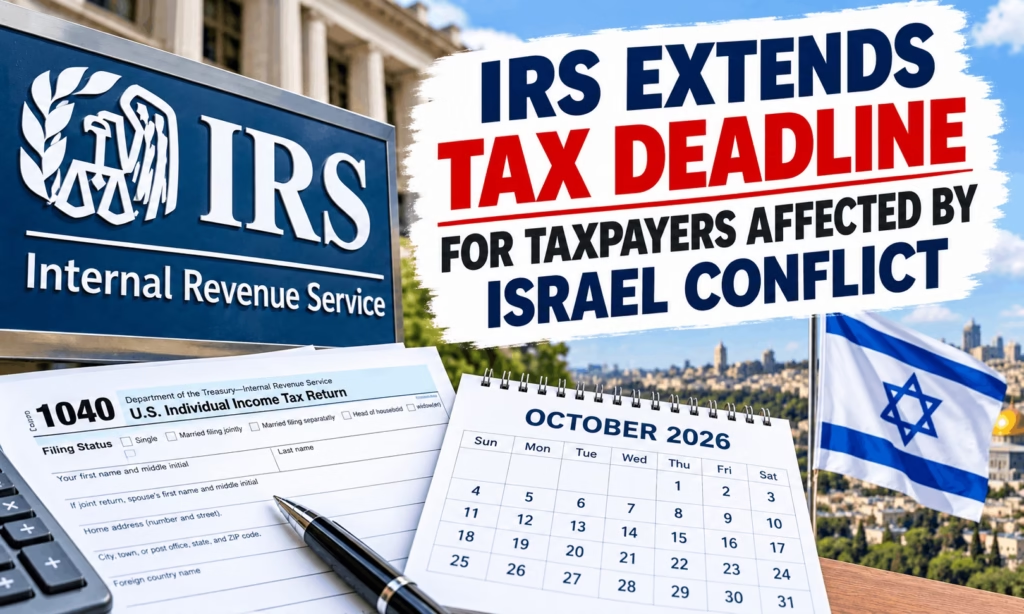
IRS Israel Tax Relief Highlights
| Detail | What to know |
|---|---|
| Announcement | September 30, 2026 (IR-2026-116) |
| Guidance | Notice 2026-63 |
| New deadline | September 30, 2027 |
| Acts covered | Those due on or after September 30, 2026 and before September 30, 2027 |
| Legal authority | Internal Revenue Code section 7508A |
| Covered area | Israel, the West Bank and Gaza |
| Automatic for | Taxpayers whose residence or business is in the covered area, based on prior returns |
| Everyone else eligible | Call 866-562-5227 (international 267-941-1000) |
| Relief window since original notice | October 7, 2023 through September 30, 2027 |
| Applies to | Federal tax only |
What the IRS Announced on September 30, 2026?
The IRS issued Notice 2026-63 under section 7508A, which lets the Treasury Secretary postpone certain deadlines by up to one year for people affected by a terroristic or military action. On the same day, the Secretary determined that terrorist activity against Israel throughout 2025 and 2026 counts as terroristic action under the tax code. That determination followed the process in Revenue Procedure 2004-26, which requires the Department of State and the Department of Justice to weigh in first.
The notice picks up where Notice 2025-53 left off. That earlier guidance protected eligible taxpayers through September 30, 2026. Because that date was the first day of the new window, acts that were already postponed are now pushed again to September 30, 2027 for taxpayers who qualify under both notices.
One point deserves attention. A taxpayer who was covered by Notice 2025-53 but does not qualify under the new notice only had until September 30, 2026. That date has passed, so anyone in that position should check their situation quickly.
The IRS also stresses that the relief is separate but overlapping across four notices: 2023-71, 2024-72, 2025-53 and 2026-63. For people eligible under each one, deadlines that arose from October 7, 2023 through September 30, 2027 may be postponed.
2027 COLA Countdown: Retirees Should Mark October 14
TSCL COLA Prediction of 3.5% for 2027: Why the Final Number Could Still Land at 3.6%
Who Qualifies for IRS Tax Relief Tied to the Conflict in Israel?
| Group | Who it covers |
|---|---|
| Residents and businesses | Individuals whose principal residence, and entities or sole proprietors whose principal place of business, is in Israel, the West Bank or Gaza |
| Relief workers | Individuals affiliated with a recognized government or philanthropic organization who are assisting in the covered area |
| Records or preparer in the area | Individuals, businesses, sole proprietors, estates or trusts whose tax return preparer or necessary records are located in the covered area |
| Spouses | The spouse of an affected taxpayer, solely for a joint return |
| Visitors | Individuals visiting the covered area who were killed, injured or taken hostage because of the terroristic action |
The third group is easy to miss. A taxpayer who lives in the United States can qualify if the accountant who prepares the return, or the records needed to meet a deadline, are in Israel. The spouse rule is narrow. It protects the joint return, not a separate return the spouse might file for another reason.
Eligibility does not depend on citizenship alone. A U.S. citizen living in Tel Aviv, a green card holder with a business in Jerusalem and a nonprofit worker based in the West Bank can each fall into a covered category if the facts match.
Which Federal Tax Deadlines Are Postponed Until September 30, 2027?
The notice postpones taxpayer acts listed in the Treasury regulations and Revenue Procedure 2018-58, and it names several of them.
| Postponed taxpayer act | Examples |
|---|---|
| Filing returns | Income, estate, gift, generation-skipping transfer, excise (other than firearms), harbor maintenance and employment tax returns |
| Paying tax | Any of those taxes, including installments |
| Retirement plan | Contributions to a qualified retirement plan |
| Tax Court | Filing a petition |
| Refunds | Filing a claim for credit or refund |
| Lawsuits | Bringing suit on a refund claim |
The list is not exhaustive. The notice says to see the regulation and the revenue procedure for the rest.
The IRS is also postponing its own actions for affected taxpayers. Government acts that are due on or after September 30, 2026 and before September 30, 2027 move to the same date. Those include assessing tax, sending notices and demands for payment, collecting by levy or otherwise, bringing suit and allowing a credit or refund. For a taxpayer with an open balance, the pause on collection can matter as much as the filing relief.
IRS Israel Tax Relief Payment Schedule: Common Dates Moved to September 30, 2027
Here is how typical deadlines line up for someone who qualifies. The first column is the usual due date, and the second is the date that applies under the notice.
| Usual due date | Obligation | Date for eligible taxpayers |
|---|---|---|
| October 15, 2026 | 2025 individual return on extension | September 30, 2027 |
| October 31, 2026 | Quarterly payroll and excise returns | September 30, 2027 |
| January 15, 2027 | Fourth quarter 2026 estimated tax payment | September 30, 2027 |
| April 15, 2027 | 2026 individual return and balance due | September 30, 2027 |
| June 15, 2027 | Second quarter 2027 estimated payment | September 30, 2027 |
| September 15, 2027 | Third quarter 2027 estimated payment | September 30, 2027 |
Notice that every date collapses into one. A taxpayer could end up with a return, an estimated payment and a payroll filing all due on the same day in 2027. That convenience cuts both ways. A single deadline simplifies planning, but it can also create a large bill all at once, so a savings plan helps.
The notice also warns that in the absence of another separate determination before September 30, 2027, every postponed act must be completed by that date. Another round of relief is possible, but nothing guarantees it, and the IRS has not promised one.
How the IRS Israel Relief Timeline Evolved?
| Notice | Covered period | Deadline it provided |
|---|---|---|
| Notice 2023-71 | After the October 7, 2023 attacks | Earlier postponement, since extended |
| Notice 2024-72 | Terroristic action throughout 2023 and 2024 | Earlier postponement, since extended |
| Notice 2025-53 | Throughout 2024 and 2025 | September 30, 2026 |
| Notice 2026-63 | Throughout 2025 and 2026 | September 30, 2027 |
Each notice was issued near the end of the prior window, which suggests the IRS tends to act close to the deadline. That pattern is a reason to plan for September 30, 2027 rather than assume another extension.
How to Get IRS Relief 2026?
Most people need to do very little, but a few steps protect you.
First, find out whether you are identified automatically. If your last filed return shows a home or business address in Israel, the West Bank or Gaza, the IRS should apply relief on its own. You can confirm by checking your online account or your notices.
Second, if you qualify through another route, call the disaster hotline. The number is 866-562-5227, or 267-941-1000 for international callers. Tell the representative which category fits you and the date you qualified. That includes a preparer or records in the covered area, a relief worker or someone affected as a visitor.
Third, ask what the system shows. After the call, check your account or ask the representative to note the postponement on your file. Write down the date, the name or ID number of the person you spoke to and what they said.
Fourth, collect support. Keep a short record of how you qualify, such as a lease, utility bill, business registration or a letter from your preparer.
Fifth, calendar the new dates. Set reminders for September 30, 2027 and for any earlier internal deadline, such as the date your preparer needs documents.
Sixth, file or pay sooner if you can. Nothing prevents you from filing or paying earlier than the postponed date, and doing so avoids a crunch.
IRS Israel Tax Relief Processing Time: How Fast Does It Apply?
For taxpayers with a covered-area address, the IRS says it applies relief automatically using prior-year return data. There is no application form and no approval letter that you wait for.
For everyone else, the timing is the length of a phone call. The representative notes the postponement based on your answers. Hold times can vary, especially around busy deadlines, so call early rather than the week a payment is due.
Some taxpayers may still receive an automated notice or balance due letter if systems have not caught up. If that happens, respond in writing, cite Notice 2026-63 and the date you qualified, and ask for the notice to be corrected. If a payment or filing is already on the way, keep proof of the mailing or electronic submission.
What Is Not Covered by the Israel Conflict Tax Relief
Relief has limits, and it is easy to assume it covers more than it does.
It is not an extension of time to file beyond the postponed date. The notice says plainly that the postponement period is not the same as an extension to file. Different extension rules apply depending on the return, and an extension to file is not an extension to pay, so interest or penalties can arise.
It applies only to federal tax. State and local deadlines are separate, so check with your state or local agency.
It excludes firearms excise tax. The notice carves that out of the excise tax relief.
It does not clearly cover filings made with other agencies. The FBAR, for example, is filed with FinCEN, not with the IRS, so this notice does not address it. Anyone with foreign accounts should ask a tax professional about any separate guidance.
It does not erase the tax. The postponement moves the due date. You still owe what the law says you owe.
Americans Living in Israel: Practical Tax Points
Many affected taxpayers are U.S. citizens or residents who live and work abroad. A few points come up often.
U.S. citizens and resident aliens who live outside the United States generally get an automatic extension to June 15 to file and pay, with interest accruing on any tax paid after April 15. The Israel relief goes further for people who qualify, because it moves the date to September 30, 2027 for acts in the window.
Taxpayers who claim the foreign earned income exclusion or the foreign tax credit still need to meet the underlying rules on residency, income and documentation. The relief changes timing, not eligibility for those benefits.
Self-employed taxpayers have estimated tax payments due on several dates. Under the notice, those payments, including the January 2027 and April 2027 installments, move to September 30, 2027 for eligible people.
Dual citizens who file in both countries should check how a delayed U.S. payment interacts with local tax deadlines. The IRS notice does not alter Israeli requirements.
What Businesses and Employers Should Know
For a business whose principal place of business is in the covered area, the postponement reaches employment tax returns and payments. That includes quarterly payroll returns that would otherwise be due October 31, 2026 and January 31, 2027.
Employers should keep careful records of wages paid and taxes withheld, because the postponement does not change what is owed. A late catch-up payment can be large if several quarters stack up.
Tax professionals with clients in the region should identify who is eligible, confirm whether relief is automatic, document the hotline call for others and tell clients about the shared September 30, 2027 date. It also helps to plan cash flow so a client does not face several liabilities at once.
Paying Smart When Relief Ends
Postponed does not mean forgiven. If you expect to owe tax in 2027, consider these steps.
Set aside money monthly in a separate account so the payment does not surprise you. Make voluntary payments toward the 2025 or 2026 balance when you can, using IRS Direct Pay or your online account. If you still cannot pay in full by the new date, you can apply for a payment plan through the IRS online payment agreement tool. The Taxpayer Advocate Service can help if you are facing hardship or your case is stuck.
Keep in mind that extending the time to file does not stop interest or late payment penalties on tax that is due. Ask your preparer for an estimate of what you owe so you can plan.
How to Use the IRS Israel Tax Relief Checker
The checker in this article asks which of the five affected groups applies to you, what you need to do and the original due date. It then shows whether the act falls inside the window and what your postponed date could be. It also flags items the notice does not cover, such as state returns, firearms excise tax and FinCEN filings, and it reminds you when a hotline call is likely needed. The result is a general guide, not tax advice. The notice and the IRS decide your actual status.
IRS Israel Tax Relief Checker
Based on IRS Notice 2026-63 (IR-2026-116, September 30, 2026). Check whether you may be an affected taxpayer and what your postponed date could be.
Common deadlines moved to September 30, 2027 for eligible taxpayers
| Normal due date | What is due | New date if eligible |
|---|---|---|
| October 15, 2026 | 2025 individual returns on extension | September 30, 2027 |
| October 31, 2026 | Q3 payroll and excise returns | September 30, 2027 |
| January 15, 2027 | Q4 2026 estimated tax payment | September 30, 2027 |
| April 15, 2027 | 2026 individual returns and payments | September 30, 2027 |
| June 15, 2027 | Q2 2027 estimated tax payment | September 30, 2027 |
| September 15, 2027 | Q3 2027 estimated tax payment | September 30, 2027 |
This tool is a general guide and is not legal or tax advice. Notice 2026-63 postpones acts due on or after September 30, 2026 and before September 30, 2027. It is not an extension of time to file beyond the postponed date, and it applies to federal tax only. Confirm your situation with the IRS disaster hotline at 866-562-5227 (international 267-941-1000) or a qualified tax professional.
Scam Warning: Fake IRS Israel Relief Messages
Whenever the IRS announces relief, scammers follow with fake messages. Be cautious if someone asks for a fee to claim the postponement, requests your bank login or Social Security number by text, or threatens arrest. The IRS does not charge to apply this relief. Use only the hotline numbers in the official notice, and type irs.gov directly into your browser rather than clicking links in unexpected messages. You can report fake messages through the IRS fraud reporting page.
Official IRS Websites and Resources
IRS Israel Tax Deadline FAQs
What is the new IRS deadline for taxpayers affected by the conflict in Israel?
It is September 30, 2027 for acts due on or after September 30, 2026 and before that date.
Who qualifies for the IRS Israel tax relief?
People whose principal residence or business is in Israel, the West Bank or Gaza, relief workers, taxpayers whose preparer or records are in the covered area, spouses on joint returns and certain visitors who were killed, injured or taken hostage.
Do I have to apply for the relief?
Not if your address in the covered area shows on prior returns. Others should call 866-562-5227.
Does the postponement cover state taxes?
No. State and local deadlines are separate.
Is this an extension to pay?
It postpones the due date for covered acts. It is not the same as a general extension of time to file, and an extension to file is not an extension to pay.
Can I still file early?
Yes. You can file and pay at any time before the postponed date.
Will there be more relief after September 30, 2027?
The IRS has not announced any. Without a new determination, covered acts must be done by that date.
Does the IRS extend tax deadlines for Americans living in Israel?
Yes, if they fall within an affected group, such as having a principal residence in Israel. The IRS applies the relief automatically based on prior returns.
What number do I call to request IRS disaster relief?
The disaster hotline is 866-562-5227. International callers can use 267-941-1000.
What is Notice 2026-63?
It is the IRS guidance issued September 30, 2026 that postpones many federal tax deadlines to September 30, 2027 for taxpayers affected by terroristic action in Israel in 2025 and 2026.
Does the IRS extension apply to quarterly estimated taxes?
Yes. Estimated payments due in the window move to September 30, 2027 for eligible taxpayers.
Can I get penalty relief if I paid late because of the conflict?
Postponed deadlines generally mean the postponed period is disregarded for penalties. If you received a penalty notice, respond in writing and cite the notice. A tax professional can help.
Does the relief cover my 2025 tax return due October 15, 2026?
For eligible taxpayers, yes. A return due on or after September 30, 2026 falls inside the postponement window.
Do I still owe tax if the deadline is postponed?
Yes. The relief moves the due date but does not cancel the liability.
How do I prove I qualify for IRS Israel relief?
Keep documents such as a lease, utility bills, business registration or a letter from your preparer showing your records are in the covered area.
Conclusion
The IRS extends tax deadline for taxpayers affected by the conflict in Israel to September 30, 2027, and the guidance is now official in Notice 2026-63. For people in Israel, the West Bank and Gaza, the IRS should apply the relief automatically. For others who qualify, such as relief workers, taxpayers with records or a preparer in the area, and certain spouses or visitors, one phone call to 866-562-5227 can secure the postponement.
Use the extra time carefully. Postponed does not mean forgiven, state deadlines are separate and an extension to file is not an extension to pay. Keep records, mark September 30, 2027 on your calendar and plan for the possibility that several obligations arrive on one date. Because the IRS has renewed this relief each year near the deadline, new guidance is possible, but no one should count on it. Check the official links above, and we’ll be updating this article monthly as the IRS issues anything new.
Social Security Changes October 2026: SSA Announces Major Update for Retirees and Beneficiaries
New York HEAP Program 2026: Current Status, Who Qualifies & When to Apply