
Who will get the ACA payments in 30 states? Nearly 1 million Americans who buy Obamacare coverage through the federal marketplace and receive no premium subsidy. The Treasury Department began issuing $500 refund checks on September 30, 2026, and the White House says more than 950,000 people will be paid. No application is needed. Checks go out automatically to people living in the 30 states that use the federal exchange, and the administration describes the money as a return of surplus marketplace user fees. The payments were first announced on September 10 and are scheduled to continue through October, with mail delivery expected over the following weeks. We’ll be updating this article monthly.
The announcement lands at a politically charged moment. The enhanced federal premium tax credits expired at the end of 2025, and many middle-income households now pay thousands of dollars more for the same coverage. About 19 million people are enrolled in ACA coverage, so the refunds reach roughly 5 percent of the market. Health policy experts at KFF say the money will mostly go to middle-income people who lost subsidies. The midterm elections are in November, which is why critics see the timing as deliberate. This guide explains who qualifies, which states are covered, when money arrives and how to avoid scams.
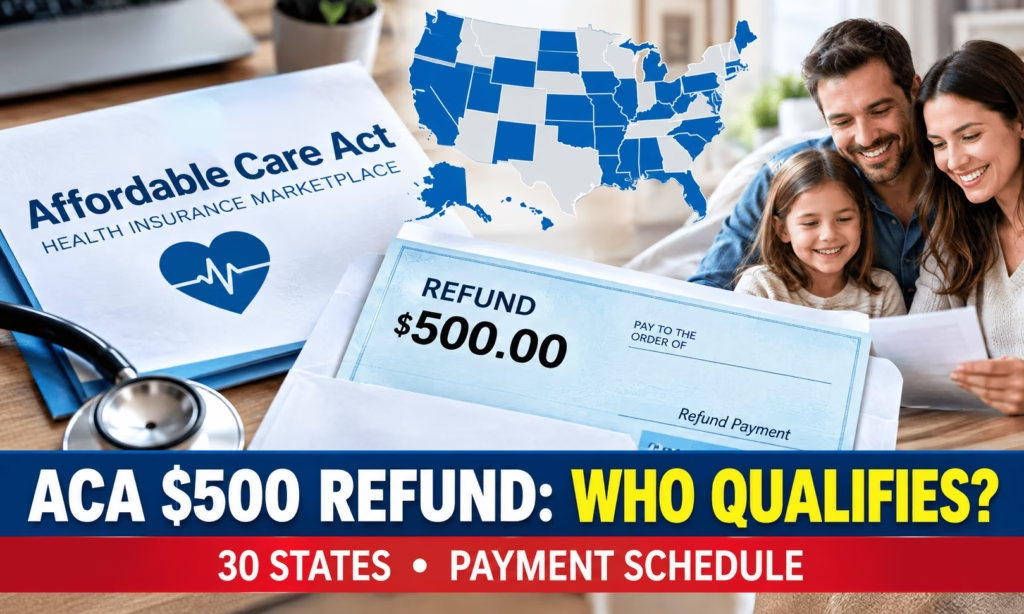
ACA Payments Key Highlights: $500 ACA Refund
| Detail | Latest Information |
|---|---|
| Payment amount | $500 per person |
| Number of recipients | More than 950,000 people |
| States covered | 30 states using the federal exchange |
| Who qualifies | Marketplace enrollees who get no premium assistance |
| Application required | No, payments are automatic |
| Paying agency | U.S. Treasury Department |
| Announcement date | September 10, 2026 |
| First checks issued | September 30, 2026 |
| Payment window | October 2026 onward |
| Share of ACA market covered | About 5 percent of roughly 19 million enrollees |
| Stated source of funds | Surplus exchange user fees |
Who Will Get the ACA Payments in 30 States?
The White House fact sheet draws a narrow line around eligibility. The refunds go to Americans who do not receive premium assistance under the Affordable Care Act and who live in a state that uses the federal exchange to operate its marketplace. The administration argues that these people paid the full cost of exchange user fees because no subsidy softened the price.
Reporting from several outlets says most recipients earn above about 400 percent of the federal poverty line. The White House puts that at roughly $64,000 for a single person and $132,000 for a family of four. Since the enhanced credits expired, households above that line no longer qualify for any premium tax credit, which is how they end up in the refund group.
People who do receive a premium tax credit are generally outside the program. Roughly 18 million marketplace enrollees will get nothing from this round.
Child Tax Credit 2026 Eligibility: Are You Getting the Full $2,200?
Full List of the 30 ACA Refund States
According to the White House fact sheet, these are the states covered.
| State | State | State |
|---|---|---|
| Alabama | Alaska | Arizona |
| Arkansas | Delaware | Florida |
| Hawaii | Indiana | Iowa |
| Kansas | Louisiana | Michigan |
| Mississippi | Missouri | Montana |
| Nebraska | New Hampshire | North Carolina |
| North Dakota | Ohio | Oklahoma |
| Oregon | South Carolina | South Dakota |
| Tennessee | Texas | Utah |
| West Virginia | Wisconsin | Wyoming |
Residents of every other state are not covered in this round, including people in states that run their own exchanges. One caution applies. Several of the listed states have been moving toward their own platforms in recent years, so a few readers may be confused about which exchange they used. Treat the White House list as the authoritative source for this program and check the fact sheet if you are unsure.
ACA Refund Eligibility Calculator
Use the calculator below to get a quick estimate. It asks for your state, whether you receive a subsidy, how many people on your plan get no subsidy and your household income. It then tells you whether you are likely eligible and what your household might receive.
ACA $500 Refund Eligibility Calculator
Estimate only, based on White House guidance from September 2026. The Treasury Department makes the final decision. Income shown against 2026 federal poverty guidelines for the 48 states.
The tool gives an estimate only. The Treasury Department decides who receives a check, and the announcement did not publish a full rulebook on edge cases such as mid-year plan changes or partial-year coverage.
Why the White House Says It Is Sending the Money
The administration says the federal exchange collected user fees far above what it needed to operate. Those fees are built into premiums, so enrollees effectively paid them. The White House claims the surplus piled up during the previous administration and is now being returned directly to consumers instead of staying in government accounts or flowing to insurers.
Critics raise three questions. First, how was the $500 figure chosen, and does it match what any individual actually overpaid? Second, why are subsidized enrollees excluded, when their plans also carried user fees? Third, does a one-time check offset premium jumps that run into the thousands? Those points appear in coverage from several news organizations, and the administration has not published a line-by-line calculation in its fact sheet.
The White House also frames the refunds inside a broader healthcare message. It cites price transparency rules, drug pricing deals with manufacturers and a call for Congress to pass what it calls the Great Healthcare Plan. Those are policy claims from the administration, and readers should weigh them as such.
SSI vs SSDI vs Social Security: What’s the Difference and Who Qualifies?
How to Apply for the $500 ACA Refund
You do not apply. That is the simplest and most important fact in this story. Checks are being issued automatically to people the government has identified as eligible.
Here is what you can do to put yourself in the best position.
- Confirm your state is on the list above.
- Check your marketplace account at HealthCare.gov to see whether you received a premium tax credit for 2025 or 2026.
- Make sure your mailing address on the marketplace is current, because checks are being mailed.
- Watch your mail over the coming weeks for a check with a letter signed by President Trump.
- Ignore any email, text or phone call that asks you to sign up, pay a fee or confirm a bank account.
The announcement did not describe a claims portal, a helpline or a tracker for this payment. If you read about one, verify it on a .gov site before entering any personal information.
ACA Refund Processing Time: How Long Will It Take?
Official guidance is thin on exact timing. The White House said checks would be sent beginning in October 2026. Reporting indicates the Treasury Department started issuing them on September 30, and that they will arrive over the next several weeks.
Mail checks do not land all at once. Nearly 1 million payments have to be printed and mailed, so neighbors in the same state may receive theirs days or even a couple of weeks apart. A reasonable expectation is that most eligible people will see their check sometime in October, with stragglers possible into November. That is an estimate based on the stated schedule rather than a government guarantee.
If your check has not arrived by mid-November, contact the Treasury Department or HealthCare.gov support and ask how to confirm whether a payment was issued to you.
ACA Refund Payment Schedule and Key Dates
| Date | What Happened or Happens |
|---|---|
| End of 2025 | Enhanced ACA premium tax credits expired |
| September 10, 2026 | White House announced the Working Families Obamacare Refunds |
| September 11, 2026 | Coverage noted the plan would reach nearly 1 million people |
| September 30, 2026 | Treasury began issuing $500 checks |
| October 2026 | Main payment window, checks arriving by mail |
| November 2026 | Midterm elections; late deliveries possible |
| Monthly | This article is reviewed and updated |
What Changed After the Enhanced Subsidies Expired
The refunds make more sense against the backdrop of the last year. Congress did not extend the enhanced premium tax credits that had been in place since the pandemic era. Premiums rose for millions of households. A KFF survey fielded between February and March found that 80 percent of returning marketplace participants said their premiums, deductibles or cost sharing were higher than the year before.
Enrollment has also fallen. CBS News reported that marketplace enrollment dropped by nearly 3 million people as costs rose. Some consumers moved to cheaper, higher-deductible plans. Others dropped coverage altogether. Against that backdrop, a $500 check is meaningful for some households but small compared with the premium increases many faced.
Larry Levitt, executive vice president for health policy at KFF, said the payments will mostly go to middle-income people who lost subsidies when Congress did not extend the tax credits. That description matches the White House framing, even though the two sides draw opposite conclusions about what it means.
Is the ACA Refund Taxable?
The announcement did not say how the $500 will be treated for federal income tax purposes. Because it is described as a refund of fees rather than a stimulus payment, some readers assume it is not income, but that has not been confirmed in the material reviewed for this article. Keep the check and the accompanying letter with your records. When the IRS or Treasury publishes guidance, it will appear on IRS.gov, and a qualified tax professional can help you decide how to report it once guidance exists.
Is This the Same as the $5,000 Dividend?
No. The $500 ACA refund is a separate, narrower program. President Trump has also said he would send a $5,000 dividend to every American adult if Republicans keep control of Congress after the midterms. That is a campaign promise tied to an election outcome. It is not law, and it has no bearing on the ACA refund checks already being mailed.
How to Spot ACA Refund Scams
Large government payments attract fraud. Scammers already use the phrase “Obamacare refund” to bait people. Keep these rules in mind.
Government agencies do not charge a fee to release a refund. They do not ask you to confirm your Social Security number by text. They do not demand gift cards or cryptocurrency. A real check arrives in the mail with a letter, and you never need to click a link to claim it.
If you receive a suspicious message, do not reply. Report it to the Federal Trade Commission at ReportFraud.ftc.gov and forward suspicious emails that claim to be from the IRS to the agency’s phishing address listed on IRS.gov.
What If You Live in One of the 30 States but Did Not Get a Check?
Several situations can leave a person out even inside the covered states.
You may have received a subsidy at some point in the plan year, which would put you outside the stated group. Your coverage may have ended before the eligibility window. Your address on file may be outdated, which could delay delivery or send the check to the wrong place. Or you may simply not have been identified yet, since issuance is staggered.
Start by logging in to your marketplace account and reviewing your subsidy status and mailing address. Then wait until the end of October before assuming you were skipped. If nothing arrives, contact marketplace support and ask whether a payment was assigned to your account.
2027 Social Security COLA Could Be Lower Than Expected: Latest Estimates
SNAP Payment Dates by State: When Your EBT Card Gets Deposited
What If You Live in a Different State?
If you live outside the 30 states, this round does not apply to you. The White House said the refunds are limited to states that use the federal exchange for their marketplace operations. State-run exchanges collect their own fees, so the federal surplus argument does not reach them.
Some state governments may take their own action on premiums or fees. That would be announced by your state insurance department or exchange, not by the federal government.
Official Websites and Resources
| Resource | What You Can Do There | Link |
|---|---|---|
| White House fact sheet | Read the official announcement and state list | whitehouse.gov/fact-sheets/2026/09/fact-sheet-president-donald-j-trump-announces-the-working-families-obamacare-refunds |
| HealthCare.gov | Log in, check subsidy status, update address | healthcare.gov |
| HealthCare.gov login | Sign in to your marketplace account | healthcare.gov (use the Log in option) |
| CMS | Federal marketplace policy and updates | cms.gov |
| U.S. Treasury | Payment and disbursement information | treasury.gov |
| IRS | Tax guidance and scam alerts | irs.gov |
| FTC | Report refund scams | reportfraud.ftc.gov |
| KFF | Independent ACA analysis and polling | kff.org |
There is no separate registration page for this refund, because nothing needs to be registered. There is also no official status tracker that has been announced. Treat any site claiming to offer one with caution.
Why This Story Matters Beyond the $500
The payments are small in budget terms but large in political and policy terms. They reveal how the administration wants to frame health costs. It is emphasizing overpayment by the prior administration, fraud reduction on the exchanges and direct payments to consumers. Opponents emphasize the expiration of the enhanced subsidies and the premium increases that followed.
For families, the practical question is simpler. Are they getting a check, and does it change what they should do about coverage for 2027? Open enrollment for the next plan year is approaching. Anyone who lost subsidies this year should compare plans carefully, look at out-of-pocket maximums and consider whether a health savings account makes sense. The administration notes that recent tax legislation expanded HSA access for people on marketplace plans, and that is worth reviewing with an advisor.
FAQs
Who will get the ACA payments in 30 states?
Marketplace enrollees in the 30 federal-exchange states who receive no premium assistance. The White House says that adds up to nearly 1 million people, with a payment of $500 each.
How much is the ACA refund check?
The amount is $500 per person. A household with several eligible enrollees could receive more than one check.
Do I need to apply for the $500 Obamacare refund?
No. Payments are automatic and no application, form or sign-up is required.
When will the ACA refund checks arrive?
The Treasury Department started issuing them on September 30, 2026, and the White House says they go out beginning in October. Expect delivery over several weeks.
Which states are included in the ACA refund?
Alabama, Alaska, Arizona, Arkansas, Delaware, Florida, Hawaii, Indiana, Iowa, Kansas, Louisiana, Michigan, Mississippi, Missouri, Montana, Nebraska, New Hampshire, North Carolina, North Dakota, Ohio, Oklahoma, Oregon, South Carolina, South Dakota, Tennessee, Texas, Utah, West Virginia, Wisconsin and Wyoming.
Can I get the refund if I receive ACA subsidies?
Generally no. The program is aimed at enrollees who do not get premium tax credits.
Is the ACA refund the same as a stimulus check?
No. It is presented as a return of surplus exchange user fees, not as economic stimulus.
How can I check the status of my ACA refund?
No official tracker has been announced. Keep an eye on your mail, review your HealthCare.gov account and watch the White House and Treasury websites for updates.
Will the ACA refund affect my other benefits?
The announcement did not address this. Ask your benefits office or a qualified adviser if you receive income-based assistance.
Who qualifies for the $500 ACA refund check?
Residents of the 30 listed states who bought marketplace coverage without premium assistance. Most are households above about 400 percent of the federal poverty line.
Why is Trump sending $500 checks to Obamacare enrollees?
The White House says the money returns excess user fees that were passed on to consumers through higher premiums. Critics point to the political timing ahead of the midterm elections.
How many people will receive the ACA payment?
More than 950,000 people, according to an administration official. That is roughly 5 percent of the 19 million people with marketplace coverage.
Is the $500 ACA payment real or a scam?
The program is real and was announced in an official White House fact sheet. Scams, however, are common, and no legitimate agency will ask you to pay a fee or share banking details to claim it.
Will people in state-run exchange states get the refund?
No. The refunds are limited to states that use the federal exchange.
Is the ACA refund separate from the $5,000 dividend?
Yes. The $5,000 dividend is a campaign pledge tied to the November election and is not part of this program.
What should I do if I moved recently?
Update your mailing address in your HealthCare.gov account as soon as possible, since checks are being mailed.
Conclusion
So, who will get the ACA payments in 30 states? The answer is people in those states who buy federal marketplace coverage without a subsidy, which the White House says is nearly 1 million Americans receiving $500 each. No application is needed, the Treasury Department has started issuing checks and most people should see them in October. The refunds are modest compared with the premium increases that followed the expiration of the enhanced tax credits, and supporters and critics disagree sharply about what they represent.
For readers, the practical steps are simple. Check your state, confirm your subsidy status, update your address and avoid anyone promising to speed up a refund for a fee. We’ll keep this page current as the Treasury Department and CMS release more details, so check back for changes to the schedule, eligibility rules or tax guidance.
Social Security and SSI Payment Schedule by Birthday
Social Security COLA 2027 Date, Expected Increase, and What It Means for Your Check