The Social Security earnings limit for 2026 is $24,480 if you collect retirement benefits and have not reached full retirement age, and it jumps to $65,160 in the year you hit that milestone. Earn more and the Social Security Administration holds back $1 of benefits for every $2 above the first number, or $1 for every $3 above the second. Anything you earn from a paycheck or your own business counts. Pensions, investment income and interest do not. With the 2027 cost-of-living adjustment due on October 14, new limits for next year are expected to follow shortly after, so workers planning their last stretch on the job are watching closely. We’ll be updating this article monthly.
The rule trips up more people than almost any other in the program, mostly because of a common misunderstanding. Money withheld under the retirement earnings test is not gone for good. Once you reach full retirement age, the agency recalculates your monthly benefit to give you credit for the months it held back checks. Even so, a withheld check hurts when you are counting on it, and some workers claim early without knowing the test exists. Below you will find the exact limits, what counts as earnings, worked examples, a free Social Security earnings limit calculator, rules for disability and SSI recipients, and the official links you need.
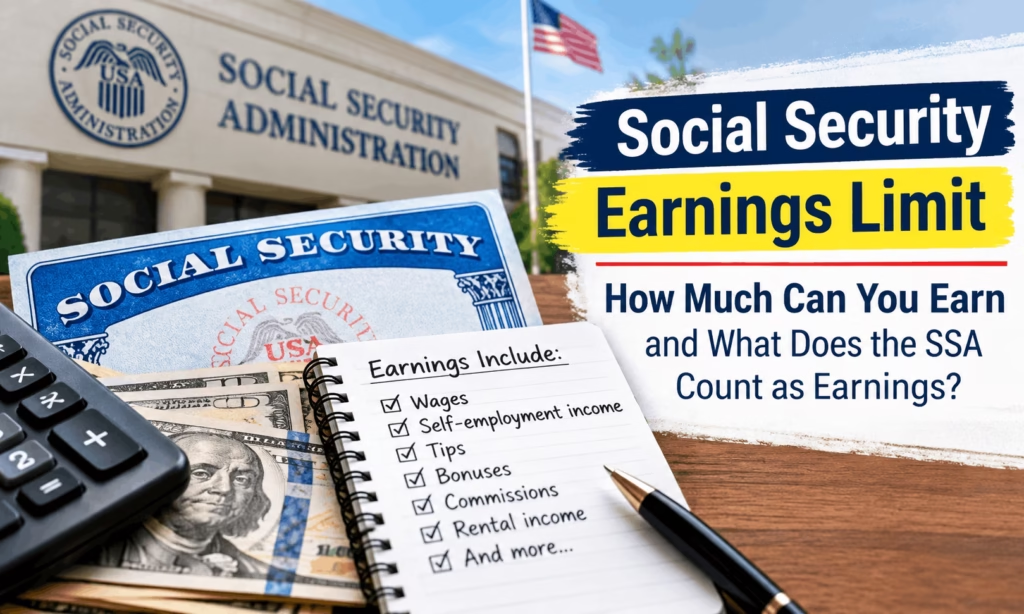
Social Security Earnings Limit 2026 Key Highlights
The test only applies to people who collect benefits before full retirement age. For anyone born in 1960 or later, that age is 67. Here are the key figures for this year, along with last year’s amounts for comparison.
| Situation | 2025 limit | 2026 limit | What SSA withholds |
|---|---|---|---|
| Under full retirement age all year | $23,400 | $24,480 | $1 for every $2 over the limit |
| Reaching full retirement age this year | $62,160 | $65,160 | $1 for every $3 over the limit |
| At or past full retirement age | No limit | No limit | Nothing |
Two details matter here. First, the higher $65,160 limit counts only the money you earn in the months before the month of your birthday that marks full retirement age. Second, once that month arrives, the test disappears for the rest of your life, and you can earn any amount without losing a dollar of benefits.
What Does the SSA Count as Earnings?
This is the question behind most searches, and the answer is narrower than people expect. The agency looks at income from work, not at all income.
Counted as earnings:
- Wages from a job, including bonuses, commissions and vacation pay
- Net earnings from self-employment, which means profit after business expenses
- Pay earned before you retire but received later, in many cases
Not counted as earnings:
- Pensions and annuities
- Investment income, dividends and capital gains
- Interest from savings accounts
- Veterans benefits
- Other government or military retirement benefits
- Your spouse’s earnings, or anyone else’s in your household
That last point surprises some couples. The test looks only at your own work income. A spouse earning $150,000 does not trigger a reduction in your benefit, and neither does a live-in adult child’s paycheck.
The agency generally counts wages when you earn them, not when the money lands in your account. If you work in December and your employer pays you in January, that pay belongs to the earlier year for the test. This matters when you are close to the limit and trying to time a bonus.
Self-employed workers face an extra wrinkle. Only net profit counts, so legitimate business deductions can lower the figure. In your first year of retirement, a special monthly rule can also help if your business is small. The agency can treat a month as a non-service month when you earn less than one twelfth of the annual limit and do not perform substantial services in your business.
Social Security COLA Increase 2027: How Much Your Check Could Rise and the Catch for Retirees
Medicare Premium Hike 2026: New Part B Rate, IRMAA Brackets & Calculator
How Much Will Social Security Withhold? Three Worked Examples
Numbers are easier to understand than rules, so here are three realistic cases using the 2026 limits.
Example one: a 63 year old receives $1,800 a month and earns $40,000 from a part time consulting job. The excess over $24,480 is $15,520. Half of that, $7,760, is withheld. Over a year the person would have received $21,600, so about 4.3 monthly checks are held back and $13,840 still arrives.
Example two: a 61 year old widow receiving a survivor benefit of $1,400 a month earns $22,000. That is below the limit, so nothing is withheld, and she keeps every dollar.
Example three: a 66 year old will turn 67 in September and expects to make $80,000 before that month. The excess over $65,160 is $14,840. One third, about $4,947, is withheld. Starting in September, all of the withholding stops.
Here are the examples in table form.
| Case | Annual counted earnings | Excess over limit | Estimated withholding |
|---|---|---|---|
| Under full retirement age, $1,800 benefit | $40,000 | $15,520 | $7,760 |
| Under full retirement age, survivor benefit | $22,000 | $0 | $0 |
| Reaching full retirement age this year | $80,000 | $14,840 | About $4,947 |
Try your own numbers in the calculator below.
Social Security Earnings Limit Calculator
Choose your situation, enter your monthly benefit and your counted earnings, and the tool estimates how much would be held back and how many monthly checks that equals. The limits are filled in with the 2026 amounts, and you can edit them when new figures are announced.
Social Security Earnings Limit Calculator
Estimate how much of your benefit could be withheld if you work before full retirement age.
| Earnings limit used | $0 |
| Earnings above the limit | $0 |
| Withholding rate | None |
| Months of benefits withheld | 0 |
| Benefits you still receive this year | $0 |
Estimate only. Limits shown are the 2026 amounts, and you can change them when new limits are announced. Pensions, annuities, investment income and interest do not count as earnings. Withheld money is not lost: the Social Security Administration recalculates your benefit when you reach full retirement age. Special monthly rules can apply in your first year of retirement.
Do You Get Withheld Social Security Benefits Back?
Yes, though not in the way many people imagine. The agency does not mail a lump sum when you reach full retirement age. Instead, it recalculates your monthly benefit and treats you as if you had claimed later, which raises your payment going forward. The months in which benefits were withheld are credited, and your reduction for claiming early shrinks.
Think of it as an adjustment rather than a refund. If your benefit was reduced because you claimed at 62, and eight monthly checks were withheld over the years, the agency removes eight months from that early claiming reduction at full retirement age. The result is a permanently higher check, and over a long retirement the extra money can come close to what was withheld.
This is why planners often say the test is a timing cost and not a tax. Even so, if you need every dollar now, a withheld check can create a real gap.
Working While Collecting Social Security: Other Rules That Apply
The earnings test is only one part of the picture. Several other rules affect workers who also collect benefits.
Payroll taxes still apply. Employees keep paying Social Security and Medicare tax of 7.65% on wages, and self-employed workers pay 15.3% on net earnings, even while they collect benefits. The 2026 cap on earnings subject to Social Security tax is $184,500.
Your benefit can go up because you work. The agency checks your record every year and uses your highest 35 years of indexed earnings. If your current wages are higher than one of those past years, your benefit is recalculated automatically, and the increase arrives the following year.
Your benefits can still be taxed. Up to 85% of benefits can be taxable at the federal level once your combined income passes certain levels, which start at $25,000 for single filers and $32,000 for joint filers. Those thresholds were set decades ago and are not adjusted for inflation. Workers age 65 and older may also qualify for an extra federal deduction under current law, which phases out at higher incomes. A tax professional or the IRS can tell you how it applies to your return.
SSI Payment Gap Alert: October 2 Deposits, November 0, December 2 (Full Calendar)
SSDI Earnings Limits in 2026: SGA and the Trial Work Period
People on disability face a different test. Social Security Disability Insurance does not use the retirement formula. Instead, it looks at whether you can do substantial gainful activity, usually shortened to SGA.
| Disability work rule | 2026 amount |
|---|---|
| SGA limit, non-blind | $1,690 per month |
| SGA limit, statutorily blind | $2,830 per month |
| Trial work month threshold | $1,210 per month |
| Trial work period | 9 months within a 60 month window |
| Extended period of eligibility | 36 months after the trial period |
Here is how it works in practice. During the trial work period, you can earn any amount in a month above $1,210 and still receive your full SSDI check. Once you have used nine trial months, the 36 month extended period starts. In that window, you receive a check for any month your earnings stay at or below $1,690 and no check for months above it. SSDI is an all or nothing benefit, so there is no gradual reduction, which makes careful tracking important.
Disability recipients who reach full retirement age are switched over to retirement benefits, and from that point the earnings test no longer applies.
SSI and Work: How Earnings Change Your Payment
Supplemental Security Income works differently again, because it is based on need. The 2026 federal benefit rate is $994 a month for an individual and $1,491 for a couple. The agency does not count the first $20 of monthly income from most sources, and it ignores the first $65 of earned income plus half of the remainder. In practice, each $2 you earn above that cuts your check by roughly $1.
Students under 22 get extra room. In 2026 the student earned income exclusion lets up to $2,410 a month, with a yearly maximum of $9,730, be ignored. SSI recipients must report wages to the agency, usually every month, and late reports can cause overpayments that are later collected.
How to Report Your Earnings to the Social Security Administration
Getting the estimate right matters because the agency uses it to set your withholding. If you are under full retirement age and working, you should tell the agency what you expect to earn this year.
You can report by logging into your my Social Security account, by calling the national number at 1-800-772-1213, or by visiting a local office. Have your most recent pay stubs or your profit and loss statement ready. If your income changes during the year, update the estimate right away. Reporting a lower number than you will really earn can lead to an overpayment you must repay, and reporting a higher number can lead to checks being held unnecessarily.
After the year ends, the agency compares your estimate with the wages your employer reported on your W-2 and with your self-employment tax return. It then adjusts the withholding. If too much was held back, you get the difference. If too little was held back, it deducts the balance from future payments.
How to Apply for Social Security Benefits and Plan Around the Earnings Limit
Before you claim, decide whether you will keep working. If you plan to earn more than the limit, waiting until full retirement age avoids the test entirely.
To apply, go to ssa.gov and use the online application, or call the national number to book an appointment. You will need your Social Security number, your birth certificate, your bank account details for direct deposit, and your most recent W-2 or self-employment return. You can apply up to four months before you want benefits to begin. The online retirement application takes around 30 minutes and lets you save your progress.
Claiming at 62 gives you the smallest permanent benefit. Claiming at 67 gives you your full benefit, and delaying to 70 raises it further. Because the maximum benefit at full retirement age in 2026 is $4,152, and the average retired worker check was about $2,071 at the start of the year, many people find that waiting even a few years adds meaningful income.
Social Security Processing Time: How Long Does It Take?
Processing time depends on the type of claim and how complete your paperwork is. Many retirement claims are decided within roughly one to three months. Disability claims take much longer, often several months, and appeals can add a year or more. The agency posts current average processing times on its website, and they change often, so check there before you plan around a start date.
To avoid delays, apply online, upload documents when asked, and respond quickly to any request for more information. If you are close to the earnings limit, ask the representative how your estimated wages will affect your first checks.
Social Security Payment Schedule for November and December 2026
Most beneficiaries are paid on a Wednesday based on their birth date. People who began benefits before May 1997 are paid on the 3rd, and SSI recipients are paid on the first of the month. When a payment date lands on a weekend or holiday, the agency pays on the previous business day.
| Group | November 2026 | December 2026 |
|---|---|---|
| SSI recipients | October 30 | December 1 |
| Started benefits before May 1997 | November 3 | December 3 |
| Birthday on the 1st to 10th | November 10 (Veterans Day shift) | December 9 |
| Birthday on the 11th to 20th | November 18 | December 16 |
| Birthday on the 21st to 31st | November 25 | December 23 |
Check your personal date in your my Social Security account, since special rules can apply to people who receive both retirement and SSI, and to people whose benefits began under certain older programs.
Scam Alert: Fake “Extra SSI Payment” Texts Are Spreading, Here’s What’s Real in October 2026
Who Gets 3 Deposits in October 2026? SSI and Social Security Recipients Explained
What Changes Next: 2027 Limits and the COLA Announcement
The agency announces the cost-of-living adjustment and the new yearly figures together, usually the same morning the September inflation report comes out. This year that date is October 14. Forecasters currently see an increase of roughly 3.5% to 3.6%, and the earnings test limits, the taxable wage cap, the work credit amount and the SSI payment rates are all updated with the same formula.
The earnings limits are not guaranteed to rise by the exact COLA percentage, because they are tied to growth in average national wages. They normally go up each year, though, and they were raised by about 4.6% for 2026. Check back after the announcement for the new numbers. If you earn near the limit, even a modest increase can change how much of your check is held.
Official Social Security Earnings Resources and Links
Use official sources for your account, your claim and your benefit estimate. The agency does not charge for any of these services.
| Resource | What it is for | Link |
|---|---|---|
| my Social Security login and registration | Check benefits, report earnings, see your record | https://www.ssa.gov/myaccount |
| How Work Affects Your Benefits | Official earnings test explanation | https://www.ssa.gov/benefits/retirement/planner/whilework.html |
| Retirement earnings test exempt amounts | Yearly limits | https://www.ssa.gov/oact/cola/rtea.html |
| Substantial gainful activity amounts | SGA and trial work figures | https://www.ssa.gov/oact/cola/sga.html |
| What is new for 2026 | Yearly changes for SSDI and SSI | https://www.ssa.gov/redbook/newfor2026.htm |
| Apply for benefits | Start a claim online | https://www.ssa.gov/apply |
| Supplemental Security Income | SSI rules and rates | https://www.ssa.gov/ssi |
| IRS | Tax rules for Social Security benefits | https://www.irs.gov |
| National phone line | Questions and appointments | 1-800-772-1213 (TTY 1-800-325-0778) |
Conclusion
The Social Security earnings limit is a timing rule, not a penalty, but it can shrink your checks if you claim early and keep working. The 2026 figures are $24,480 and $65,160, and only wages and net self-employment income count. Use the calculator to estimate your own withholding, report your expected earnings accurately, and check back after October 14 for the 2027 numbers. If you are unsure, the national phone line and your my Social Security account are the safest places to confirm your situation.
Social Security Earnings Limit FAQs
How much can you earn while on Social Security in 2026?
If you are under full retirement age all year, you can earn up to $24,480 without a reduction. In the year you reach full retirement age, the limit is $65,160 for the months before your birthday month.
What happens if you earn over the Social Security limit?
The agency withholds $1 of benefits for every $2 you earn above $24,480, or $1 for every $3 above $65,160 in the year you reach full retirement age.
Is there an earnings limit after full retirement age?
No. Once you reach full retirement age, you can earn any amount with no effect on your retirement benefit.
Does the SSA count investment income as earnings?
No. Investment income, interest, pensions and annuities do not count toward the earnings test.
Will I get my withheld benefits back?
Yes, in the form of a higher monthly benefit. The agency recalculates your payment when you reach full retirement age.
What is the full retirement age in 2026?
It is 67 for anyone born in 1960 or later. People born earlier have a slightly lower age, between 66 and 67.
Can I work and collect Social Security at 62?
Yes, but if you earn more than $24,480 in 2026, part of your benefit will be withheld until you reach full retirement age.
Do I have to pay taxes on Social Security if I work?
You pay payroll taxes on your wages, and up to 85% of your benefits can be taxable depending on your combined income.
Does self-employment income count against Social Security?
Yes. Net profit from self-employment counts, though business expenses can reduce the amount.
Does my spouse’s income affect my Social Security benefit?
Not for the earnings test. Only your own work income counts.
How do I report my income to Social Security?
You can use your my Social Security account, call 1-800-772-1213, or visit a local office.
Can I work while on Social Security disability?
Yes. In 2026, SSDI recipients can earn up to $1,690 a month ($2,830 if blind) in most cases, and the trial work period lets you test working for nine months.
Does the earnings limit change every year?
Yes. It rises with national average wage growth, and the new amount is announced each fall.
What is the best age to claim if I plan to keep working?
That depends on your income and health. Waiting until full retirement age avoids the earnings test and gives you a larger check.
SSI Payment Dates October 2026 to January 2027: Every Early Deposit Explained