SSI Payment Gap Alert: The SSI payment gap is here, and it affects roughly seven million people who rely on Supplemental Security Income. The Social Security Administration pays SSI on the first of each month, but when the first lands on a weekend or holiday, the money goes out on the last business day before. November 1 is a Sunday, so the November payment is issued on Friday, October 30. That gives SSI recipients two deposits in October, on Thursday, October 1 and Friday, October 30, and none at all in November. The same thing happens at year end. January 1 is a holiday, so the January 2027 payment goes out on Thursday, December 31, which means two deposits in December and none in January.
Nothing is being cut. Each deposit is a regular monthly payment, and the full federal rate stays at $994 for an individual and $1,491 for an eligible couple. But the gaps are long, about 32 days each from October 30 to December 1 and from December 31 to February 1, and people who treat an early deposit as extra money can run short. The December 31 payment is also the first one that should include the 2027 cost-of-living adjustment, which SSA will announce on October 14. This guide gives you the full calendar, the COLA effect, budgeting steps, what to do if a payment is late and the official links. We’ll be updating this article monthly.
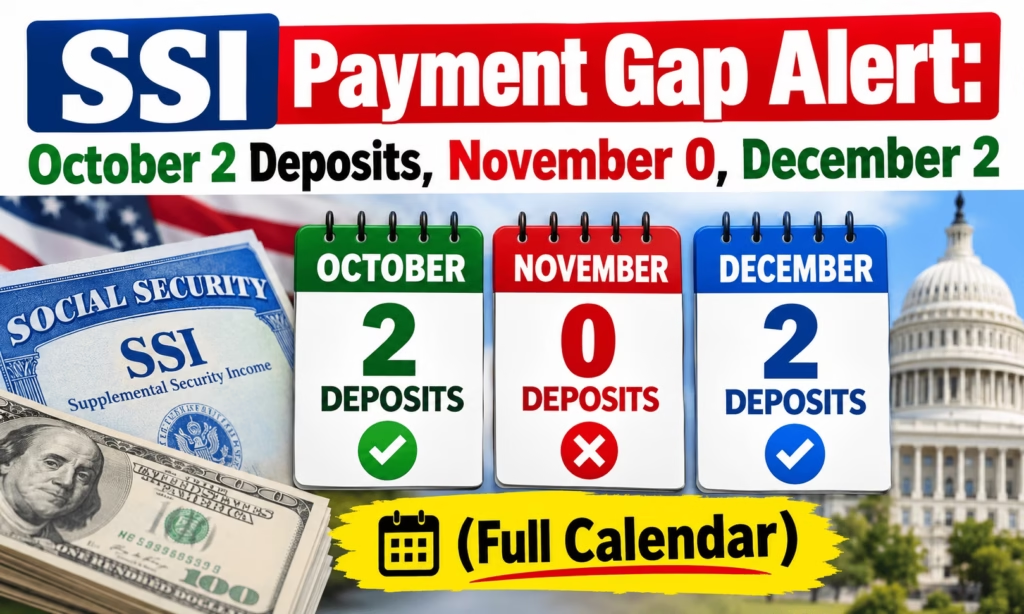
SSI Payment Gap Alert Key Highlights
| Item | Detail |
|---|---|
| October 2026 deposits | 2, on Thursday, October 1 and Friday, October 30 |
| November 2026 deposits | 0, the November payment arrives October 30 |
| December 2026 deposits | 2, on Tuesday, December 1 and Thursday, December 31 |
| January 2027 deposits | 0, the January payment arrives December 31 |
| Why the shift | November 1, 2026 is a Sunday and January 1, 2027 is a federal holiday |
| Length of each gap | About 32 days |
| 2026 federal SSI rate | $994 an individual, $1,491 an eligible couple |
| 2027 COLA announcement | Wednesday, October 14, 2026 |
| Forecast COLA | 3.5% to 3.6% |
| Is it extra money? | No, it is the next month’s payment arriving early |
SSI Payment Dates October 2026 to March 2027 Full Calendar
| Benefit month | Date paid | Day | Why |
|---|---|---|---|
| October 2026 | October 1, 2026 | Thursday | Regular first of the month |
| November 2026 | October 30, 2026 | Friday | November 1 is a Sunday |
| December 2026 | December 1, 2026 | Tuesday | Regular first of the month |
| January 2027 | December 31, 2026 | Thursday | January 1 is a federal holiday |
| February 2027 | February 1, 2027 | Monday | Regular first of the month |
| March 2027 | March 1, 2027 | Monday | Regular first of the month |
Read down the middle column and the pattern is clear: two deposits land in October, none in November, two in December and none in January. After that, SSI returns to one deposit a month. The same SSA calendar applies to everyone who receives SSI, including children, and it does not depend on your birth date.
For context, 2026 has had several early payments. February’s payment was issued on January 30, March’s on February 27, August’s on July 31, and November’s will come on October 30. Each time, the month that follows an early payment has no deposit of its own.
Social Security COLA Increase 2027: How Much Your Check Could Rise and the Catch for Retirees
Why Are There Two SSI Payments in October?
SSI is paid on the first day of the month for that month. When the first falls on a Saturday, Sunday or federal holiday, SSA issues the payment on the preceding business day. November 1, 2026 is a Sunday, and the Friday before it is October 30, so the November payment is dated October 30. As one money outlet put it, the date follows the published rule and not a special decision.
So the October 1 deposit covers October, and the October 30 deposit covers November. That is why some SSI recipients see two payments in October and then wait until December 1 for the next one.
It is not a bonus. Two deposits do not add up to a bigger benefit. A person at the full individual rate receives $994 on October 1 and $994 on October 30, then nothing until December 1.
The December 31 Payment: January SSI and the 2027 COLA
The second December deposit has a special feature. January 1, 2027 is a Friday and a federal holiday, so the January payment is issued on Thursday, December 31, 2026. Because the January payment is the first one at the 2027 rate, recipients may see the new amount arrive on that date, according to one calendar guide.
The cost-of-living adjustment applies to SSI as well as Social Security. SSA will announce the official percentage on October 14, and forecasts put it at 3.5% to 3.6%. The federal benefit rate is rounded to the nearest dollar, so the estimates are as follows.
| COLA | Individual maximum | Eligible couple maximum |
|---|---|---|
| 2026 rate | $994 | $1,491 |
| 3.5% | about $1,029 | about $1,543 |
| 3.6% | about $1,030 | about $1,545 |
That would add about $35 to $36 a month for an individual and about $52 to $54 for a couple, before any reduction for other income. If you live in a state that adds a supplement, the state decides whether its supplement changes.
What If You Get Both SSI and Social Security? The Dual Recipient Calendar
People who receive both SSI and Social Security, and people who started Social Security before May 1997, are paid on the third of the month. That group still gets a Social Security deposit in November even though the SSI deposit is missing. Other Social Security recipients are paid on the second, third or fourth Wednesday, depending on birthday.
| Group | October | November | December |
|---|---|---|---|
| SSI only | October 1 and October 30 | None | December 1 and December 31 |
| Social Security and SSI together, or started before May 1997 | October 2 | November 3 | December 3 |
| Birthdays on the 1st to 10th | October 14 | November 10 | December 9 |
| Birthdays on the 11th to 20th | October 21 | November 18 | December 16 |
| Birthdays on the 21st to 31st | October 28 | November 25 | December 23 |
October 3 is a Saturday, so the third of the month payment moves to Friday, October 2. In November, people born from the 1st to the 10th are paid a day early, on Tuesday, November 10, because Veterans Day falls on Wednesday, November 11.
Social Security pays one month behind, so the October check covers September. SSI pays for the current month. Those two systems are why the calendars look so different.
Who Qualifies for SSI in 2026?
SSI is a needs-based program for people who are 65 or older, blind or disabled, and who have limited income and resources.
| Requirement | 2026 rule |
|---|---|
| Age or disability | Age 65 or older, or blind, or disabled, including children |
| Countable income | Below the federal benefit rate, after exclusions |
| Resources | $2,000 for an individual, $3,000 for a couple, with some items excluded |
| Residency | Live in the United States or Northern Mariana Islands |
| Status | U.S. citizen or qualifying noncitizen |
The maximum federal payment is $994 a month for an individual and $1,491 for an eligible couple. It drops as you have other income. The first $20 of most monthly income is not counted, and for earned income, the first $65 plus half of the rest is not counted. Many states add their own supplement, and some do not.
Resource limits have not changed for decades, so savings above $2,000 can end eligibility. Money in an ABLE account and some other assets are treated differently, so ask SSA about your own situation.
Social Security COLA 2027 for Seniors Could Get Nearly $200 More Per Month
GOP Convention Fact-Check: What Held Up and What Didn’t From the Dallas Midterm Convention
How to Budget Through the SSI Payment Gap?
The practical risk is simple: an early deposit looks like extra money, and then the empty month arrives. A few habits help.
Treat October 30 as November’s money. Set it apart in your head or in a separate account as soon as it lands.
Use the 32 day rule. Divide your payment by 32 to see roughly what you can spend per day across a gap. At $994, that is about $31 a day.
Move fixed bills. If your rent, utilities or phone bill are due in early November, ask the landlord or company to move the due date to the first week of December or to a date after the early deposit. Many will agree if you ask in advance.
Pay the big bills first. When the October 30 deposit arrives, pay the November rent and the most important bills right away, before anything else.
Ask for help early. If you expect a shortfall, contact your landlord, utility company and local assistance programs before a bill is late. Food banks, SNAP, local energy assistance and 211 can help in a gap.
Plan the same way for January. The December 31 deposit has to cover January, and the next payment is February 1.
The calculator attached to this article runs these numbers for you.
SSI Payment Gap Calculator
The planner attached to this article has two parts. The first is a six month calendar from October 2026 to March 2027 that marks the months with two deposits and the months with none. The second is a budget tool. Enter your monthly SSI payment, choose a COLA scenario, add your monthly spending and your balance at the start of October. The tool applies two deposits to October, none to November, two to December with the second at the new rate, none to January, and one each to February and March.
SSI Payment Gap Planner
See your SSI deposit dates from October 2026 to March 2027 and plan your budget around the months with no payment.
1. Full SSI calendar
| Month | Deposits | Dates |
|---|---|---|
| October 2026 | 2 | Thu Oct 1, Fri Oct 30 (November benefit) |
| November 2026 | 0 | None, paid Oct 30 |
| December 2026 | 2 | Tue Dec 1, Thu Dec 31 (January benefit) |
| January 2027 | 0 | None, paid Dec 31 |
| February 2027 | 1 | Mon Feb 1 |
| March 2027 | 1 | Mon Mar 1 |
2. Budget through the gap
| Month | Deposited | Spent | Ending balance |
|---|
Estimate only. The December 31 payment is the January 2027 payment and should include the COLA, which SSA announces October 14. The calculator applies the percentage to your amount. SSA decides your real payment, and state supplements and countable income can change it. Two deposits in one month are not extra money: they are the next month’s payment arriving early.
It then shows your ending balance for every month and warns you if any month dips below zero. For example, a person receiving $994 and spending $950 a month, with $100 saved, would end October with a balance of $1,138, end November with $188, end December with about $2,252, end January with about $1,302, and so on, assuming a 3.5% COLA. The totals work because two payments cover two months, but only if the early deposit is not spent right away. Change the numbers to see where a shortfall could occur.
What If Your SSI Payment Is Late or Missing?
First, check the calendar. Many people think a payment is missing in November when it was paid on October 30. Then check your bank account, your Direct Express card balance or your mail, and look at your online account.
If a scheduled payment has not arrived, SSA generally asks you to wait three business days before contacting the agency. After that, call the national number at 1-800-772-1213 or visit your local office. Have your Social Security number and bank information ready.
Several things can cause a delay: a changed bank account, a returned deposit, a review of your income or resources, or a missing report. In limited cases, SSA may be able to issue an emergency or immediate payment when a payment is lost or delayed and you face a real hardship. Ask the representative whether that is possible in your case. Keep notes on every call.
How to Apply for SSI 2026?
If you do not receive SSI and think you might qualify, you can start an application online for some groups, by phone or at a local Social Security office. Children with disabilities usually start by phone or in person.
- Gather proof of age, citizenship or immigration status, and your Social Security number.
- Collect records of your income, bank accounts, property, vehicles, life insurance and where you live, including rent or mortgage.
- For disability, gather medical records, doctor and hospital contact information, medications and work history.
- Contact SSA by phone at 1-800-772-1213 or visit a local office to start the application.
- Complete any interview and forms SSA requests, and return them quickly.
- Set up direct deposit or a Direct Express card for payments.
Processing Time: How Long Does an SSI Decision Take?
Age based claims can be decided in a matter of weeks to a few months, depending on the evidence. Disability claims take longer, often several months, and appeals take longer still. For certain severe conditions, SSA can pay presumptive disability benefits for up to six months while it makes a final decision. If you are approved, you may receive back payments from the month after you applied. If you are denied, you can appeal within 60 days.
Payments after approval follow the calendar in this article. Your first deposit may be delayed or arrive as a lump sum for past months.
Direct Deposit and Paperless Payments
SSA has been moving payments to electronic delivery. Most SSI payments come by direct deposit or a Direct Express card, and the agency's paperless policy has limited exceptions. Make sure your bank details are correct, and tell SSA if you change accounts. A closed account can cause a returned payment and a delay of days or weeks. If you do not have a bank account, ask SSA about the Direct Express card or other options, and look for a low-cost bank account at a local credit union.
Report Changes So Your SSI Payment Stays on Time
SSI is income and resource tested, so changes matter. Report changes in income, wages, living arrangements, marital status, resources and address to SSA. If you work, many recipients report wages by the 6th of the following month. Failing to report on time can lead to overpayments, reduced payments or a pause. If you receive a notice, respond by the deadline given.
Beware of SSI Payment Scams
Gaps like this create openings for scammers. SSA will not call to threaten you, demand payment by gift card or wire, or ask you to confirm your bank login to receive a payment. No one can charge you to move your payment date or to fix a missing payment. Be careful with texts or emails about a payment problem, and do not click links. Use the official SSA website, or call the number on the agency's site. Report suspicious messages to the SSA inspector general.
Official Websites and Resources
| Resource | What it does | Link |
|---|---|---|
| SSA payment schedule | Official SSI and Social Security payment calendar | https://www.ssa.gov/benefits/retirement/planner/paymentdates.html |
| my Social Security login and registration | Check payments, update address and bank details | https://www.ssa.gov/myaccount/ |
| SSI overview | Eligibility, rates and how to apply | https://www.ssa.gov/ssi/ |
| SSI payment amounts | Federal benefit rates | https://www.ssa.gov/oact/cola/SSI.html |
| SSA COLA page | Official COLA announcement on October 14 | https://www.ssa.gov/cola/ |
| Find a Social Security office | Local office locator | https://www.ssa.gov/locator/ |
| Direct Express | Prepaid debit card for federal benefits | https://www.usdirectexpress.com |
| SSA Office of the Inspector General | Report fraud | https://oig.ssa.gov |
| 211 | Local help with food, rent and utilities | https://www.211.org |
FAQs
Why are there two SSI payments in October 2026?
November 1 is a Sunday, so SSA issues the November payment early on Friday, October 30, in addition to the regular October 1 payment.
Will I get SSI in November 2026?
No payment is issued during November. The November payment arrives on October 30.
When is the next SSI payment after October 30?
Tuesday, December 1, 2026.
Why are there two SSI payments in December?
January 1, 2027 is a federal holiday, so the January payment is issued early on Thursday, December 31, in addition to the regular December 1 payment.
Will I get SSI in January 2027?
No payment is issued during January. The January payment arrives December 31.
Is the second October payment extra money?
No. It is the November payment arriving early.
Does the December 31 SSI payment include the COLA?
It is the January 2027 payment, so it should include the 2027 cost-of-living adjustment, which SSA announces on October 14.
How much is SSI in 2026?
The federal maximum is $994 a month for an individual and $1,491 for an eligible couple, before reductions.
How much will SSI be in 2027?
At a 3.5% to 3.6% COLA, about $1,029 to $1,030 for an individual and about $1,543 to $1,545 for a couple. The official number comes October 14.
When is Social Security paid in November 2026?
On the third for people who get both SSI and Social Security, which is Tuesday, November 3, and on Wednesdays for others, based on birthday.
What if my SSI payment does not arrive?
Wait three business days, then contact SSA at 1-800-772-1213 or your local office.
Can I get SSI and Social Security at the same time?
Yes, if your Social Security benefit is low enough that your income stays under the SSI limit.
How much savings can I have on SSI?
Generally $2,000 for an individual and $3,000 for a couple, with some assets excluded.
What is the next SSI payment date after December 31?
Monday, February 1, 2027.
Conclusion
The SSI payment gap is a calendar quirk, not a cut: two deposits in October on the 1st and the 30th, none in November, two in December on the 1st and the 31st, and none in January. Each gap runs about 32 days, and the December 31 deposit is the first one that should carry the 2027 COLA, expected at 3.5% to 3.6% and confirmed on October 14. Treat early deposits as next month's money, move bill due dates if you can, keep your bank details current and call SSA if a payment is more than three business days late. Use the planner to map your months and keep this calendar handy. We will update this guide when SSA announces the COLA and the 2027 SSI rates.
FEHB Open Season 2027 Dates: November 9 to December 14, Premiums Up 10.9% and What to Do Now
Federal Pay Freeze 2027: Who Gets No Raise and Who Gets 3.8%