US jobless claims fell to 197,000 in the week ended September 26, the lowest level since mid-July, according to the Labor Department’s report on October 1. It was a drop of 1,000 from a revised 198,000 the week before, and it came in below the 200,000 that economists had expected. Continuing claims, which track people still receiving benefits after the first week, fell by 11,000 to 1.701 million, the lowest since March 2023. The four-week average slipped to 200,000. Reuters said claims are near 57-year lows even as the war with Iran pushes up energy prices.
The picture is not as simple as the number suggests. A day after the claims report, the September jobs report showed employers added only 29,000 jobs, far below forecasts of about 84,000 to 90,000, and revisions cut 60,000 jobs from July and August. The unemployment rate rose to 4.2%. In other words, companies are not laying people off in large numbers, but they are not hiring much either. If you are looking for work or thinking about filing for unemployment benefits, this guide explains what the numbers mean, who qualifies, how to file, how long it takes and how much you could receive. We’ll be updating this article monthly.
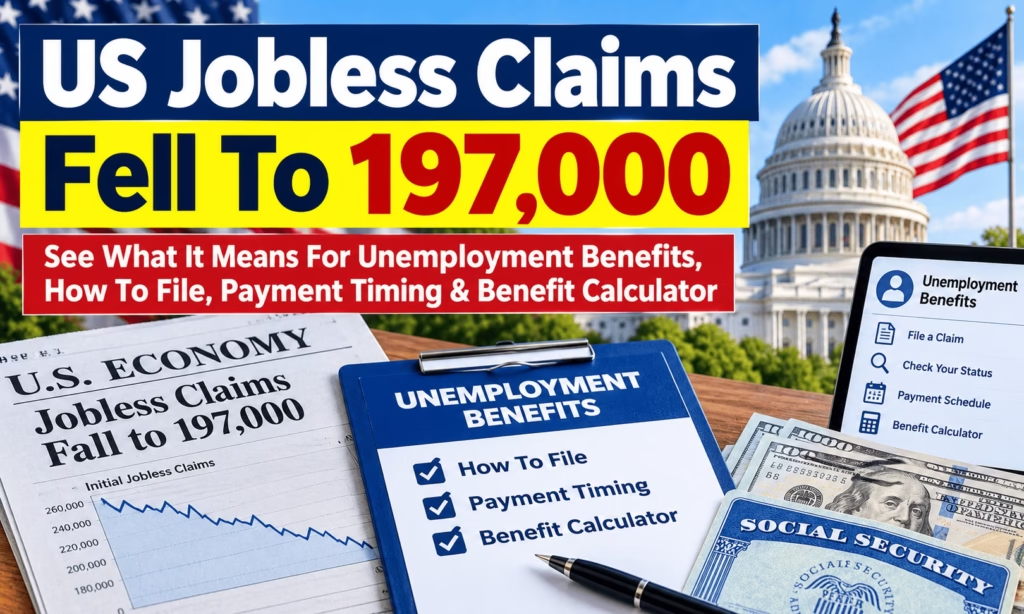
US Jobless Claims 197,000 Key Highlights
| Measure | Latest reading | Context |
|---|---|---|
| Initial jobless claims, week ended September 26 | 197,000 | Down 1,000, lowest since mid-July |
| Prior week | 198,000 | Revised up from 197,000 |
| Economist forecast | About 200,000 | Claims came in lower |
| Four-week average | 200,000 | Down 2,500 |
| Continuing claims, week ended September 19 | 1.701 million | Lowest since March 2023 |
| Unadjusted initial claims | 156,738 | Versus 179,162 a year earlier |
| Past year range | About 200,000 to 230,000 | Held in a narrow band |
| September payrolls | +29,000 | Forecast was about 84,000 to 90,000 |
| Unemployment rate, September | 4.2% | Up from 4.1% |
| Next claims report | Thursday, October 8 | Week ended October 3 |
What Do Low Jobless Claims Mean?
Initial jobless claims count the people who file for unemployment insurance for the first time in a given week. Economists treat them as a quick signal of layoffs, because people usually file soon after losing a job. When claims are low, fewer workers are being let go.
A reading of 197,000 is very low by historical standards. It is below the 200,000 to 230,000 range claims have held over the past year, and Reuters notes that, adjusted for the size of the labor force, it is near the lowest in 57 years. Economists quoted in the coverage say strong corporate profits and resilient demand are shielding workers from layoffs.
For someone who has just lost a job, though, the average does not matter. Your claim is decided by your state agency, using your own work history and reason for separation, and low national claims do not make it harder or easier to qualify.
Social Security COLA by State: Which Retirees Get the Biggest 2027 Raise and Why?
Trump $90 Medicare Check: Who Qualifies, When It Arrives and Why $2 Billion Is Being Redirected?
The Other Side: Weak Hiring and a Softer September Jobs Report
Claims describe layoffs. The jobs report describes hiring, and September’s report was weak. Nonfarm payrolls rose 29,000, the Bureau of Labor Statistics said on October 2, compared with a consensus of about 84,000 to 90,000. Revisions subtracted 60,000 jobs from the prior two months.
| September jobs report | Reading |
|---|---|
| Nonfarm payrolls | +29,000 |
| Revisions to July and August | Down 60,000 combined |
| Unemployment rate | 4.2% (precisely about 4.175%) |
| Number of unemployed | 7.1 million |
| Participation rate | 61.8%, a four-month high |
| Average hourly earnings | Up 0.1% for the month, 3.0% over the year |
| Private sector jobs | +46,000 |
| Government jobs | Down 17,000 |
| Healthcare jobs | +17,000, below the 12-month average of 33,000 |
The unemployment rate rose partly because more people entered the labor force, which is a sign of confidence, and the BLS said the change was small. Wage growth of 3.0% is the slowest annual pace since 2021 and probably lags inflation for the sixth month in a row, according to Bloomberg. The next jobs report is due Friday, November 6.
Economists describe this mix as low firing and low hiring. For people who keep their jobs, conditions are stable. For people who lose them, finding a new one can take longer, which is why continuing claims, though low, show that some people stay on benefits for long spells.
Why the Iran War and Energy Prices Matter for Jobs
Reuters says claims are holding up despite headwinds from the US-Israeli war with Iran, which is driving up energy prices. Higher fuel costs squeeze household budgets and raise business costs, and economists watch for signs that they lead to layoffs. So far, they have not. The Challenger report showed announced job cuts fell in September, and job openings in the August JOLTS survey slipped to about 7.08 million from 7.34 million, according to market data. Those numbers point to cooling, not collapse.
Traders also reacted to the jobs report by trimming bets on an interest rate increase, with one measure putting the probability of an October Fed hike at about 14%, down from roughly 70% earlier in the week. The Fed meets later this month.
Who Qualifies for Unemployment Benefits in 2026?
Unemployment insurance is a federal-state program. States set their own rules, but the basic requirements are similar.
| Requirement | What it usually means |
|---|---|
| Job loss through no fault of your own | Layoffs, plant closings and reduced hours generally qualify |
| Enough work history | Minimum earnings or hours in a base period, often the first four of the last five quarters |
| Able and available | You can work and are ready to accept a suitable job |
| Actively looking for work | You complete weekly job search activities and report them |
| Meet immigration and ID rules | You are authorized to work and can verify your identity |
Quitting without good cause, being fired for misconduct or refusing suitable work can lead to a denial or a delay. Some states allow benefits for quitting with a qualifying reason, such as unsafe conditions or domestic violence. Gig workers and the self-employed are generally not eligible for regular benefits, although rules vary.
Federal employees and ex-service members file under separate federal programs, called UCFE and UCX, but they apply through the state where they last worked. Government employment fell by 17,000 in September and by about 216,000 over the past year, according to one analysis, so these programs are in use.
FEHB Open Season 2027 Dates: November 9 to December 14, Premiums Up 10.9% and What to Do Now
Federal Pay Freeze 2027: Who Gets No Raise and Who Gets 3.8%
How Much Is Unemployment Per Week? Benefits and Duration
Weekly benefits are generally about half of your prior wages, up to a state maximum, and the cap varies widely from state to state. The number of weeks also varies. Many states pay up to 26 weeks, while some pay fewer and a few pay more. Check your own state’s numbers before you rely on an estimate.
| Example worker | Weekly pay | Weekly benefit at 50% with a $600 cap | Benefit over 26 weeks |
|---|---|---|---|
| Lower wage | $700 | $350 | $9,100 |
| Median wage | $1,100 | $550 | $14,300 |
| Higher wage | $1,500 | $600 (capped) | $15,600 |
Benefits are taxable income. You can ask for 10% federal tax withholding when you file, and you will receive a Form 1099-G in January. Some states also tax benefits.
Unemployment Benefit Estimator and Jobless Claims Checker
The calculator attached to this article has two parts. In the first, enter your average weekly pay, a replacement rate (it starts at 50%), your state’s weekly maximum and the number of weeks your state pays. Say whether your state has an unpaid waiting week and whether you want tax withheld, then add your monthly expenses. The tool shows your weekly benefit before and after withholding, your total benefits over the maximum period and the share of your monthly expenses that benefits would cover.
For example, a worker earning $1,100 a week in a state with a $600 cap would get $550 a week, or about $495 after 10% withholding. Over 25 paid weeks, that is about $12,375, which covers roughly 61% of $3,500 in monthly expenses.
The second part is a claims level checker. Type in any weekly initial claims number and the tool tells you how it compares with the recent band of 200,000 to 230,000. It is a handy way to follow the Thursday reports.
Unemployment Benefit Estimator and Jobless Claims Checker
Estimate a weekly benefit and how long it could last, then see how any weekly jobless claims number compares with recent levels. State formulas differ, so treat results as a rough guide.
1. Estimate your unemployment benefit
| Weekly benefit before tax | |
| Weekly benefit after withholding | |
| Paid weeks (after any waiting week) | |
| Total benefits over the maximum period | |
| Monthly benefit after withholding | |
| Share of monthly expenses covered |
Estimate only. Most states pay about half of prior wages up to a cap, but the formulas, caps and weeks vary widely, and some states pay fewer than 26 weeks. Benefits are taxable income. Your state agency decides your actual amount.
2. Jobless claims level checker
Reference points: the latest reading was 197,000 for the week ended September 26, and claims have stayed in a band of roughly 200,000 to 230,000 over the past year. The four-week average was 200,000.
How to File for Unemployment Benefits 2026?
You file with your state's unemployment agency, in the state where you worked. Most states take claims online.
- File as soon as you lose your job or your hours are cut. Benefits usually start from the week you file, not from the day you lost work.
- Gather your documents: Social Security number, ID, contact information, your employer's name and address, dates of employment and the reason you left.
- Complete the online application on your state's official site. If you worked in more than one state, tell the agency.
- Set up direct deposit or choose the debit card option.
- Register for the state job service if your state requires it.
- Respond to every request from the agency, including identity checks and interviews.
- Certify each week, or every two weeks, that you are still unemployed and looking for work.
Processing Time: How Long Until You Get Paid?
Timing depends on your state and whether your claim has issues. Many states process straightforward claims within two to three weeks. Claims that need an interview, employer response or identity check take longer. Some states have a one week unpaid waiting period before benefits begin. Filing late delays payment, because benefits generally cannot be paid for weeks before you file. If you have not heard anything in three weeks, check your online account and contact the state agency.
Low national claims do not mean fast service everywhere. Agencies can have backlogs, and identity verification steps added in recent years can slow a claim.
Payment Schedule: How and When Benefits Are Paid
Benefits are paid weekly or biweekly, after you certify. Most states pay by direct deposit or a prepaid debit card, and money typically arrives within a few days of a successful certification. Missing a certification can delay or stop payment, so mark the days on your calendar.
| Step | Typical timing |
|---|---|
| File your claim | As soon as you lose your job |
| Waiting week, if your state has one | First week of your claim, unpaid |
| First payment | About two to three weeks after filing for simple claims |
| Certify for benefits | Every week or every two weeks |
| Payment after certification | Usually within a few days |
| Tax form | Form 1099-G arrives in January |
What the Latest Claims Mean for People Looking for Work
If you are searching for a job, a stable claims number is good news in one way: layoffs are not spreading, so your risk of losing a job is lower than in past slowdowns. The softer jobs report is a warning in another way: hiring is slow, so a search can take longer, and wage growth is modest. Update your resume, check job boards in your industry and consider temporary or part-time work, which many states allow while you collect partial benefits.
If you have already lost a job, file right away, keep your documents and record your job search activities, since a missed step can delay payment. If you are collecting benefits and receive a job offer, report it and any earnings to your state agency.
What to Watch Next: Data Calendar for the Labor Market
| Date | Release |
|---|---|
| Thursday, October 8 | Weekly jobless claims for the week ended October 3 |
| Thursday, October 15 | Weekly jobless claims for the week ended October 10 |
| Later in October | Federal Reserve meeting |
| Friday, November 6 | October jobs report |
A single week of claims can be noisy. Economists focus on the four-week average, which is 200,000, and on continuing claims, which are at 1.701 million. A sustained rise above 230,000 would suggest that layoffs are picking up.
Beware of Unemployment Benefit Scams
Unemployment fraud is common. Scammers file claims using stolen identities, and they also send fake messages that promise to speed up your claim for a fee. Never pay anyone to file or to get benefits faster. Use only your state's official website. If you receive a 1099-G for benefits you never claimed, or a letter from an agency about a claim you did not file, report it to your state agency and to the Federal Trade Commission, and place a fraud alert on your credit reports.
Official Websites and Resources
| Resource | What it does | Link |
|---|---|---|
| CareerOneStop unemployment benefits finder | Find your state's agency and file a claim | https://www.careeronestop.org/LocalHelp/UnemploymentBenefits/find-unemployment-benefits.aspx |
| Department of Labor unemployment insurance | Federal program information | https://www.dol.gov/general/topic/unemployment-insurance |
| Weekly claims report | Official data release | https://www.dol.gov/ui/data.pdf |
| BLS Employment Situation | Monthly jobs report | https://www.bls.gov/news.release/empsit.nr0.htm |
| USA.gov unemployment | Overview and links to state agencies | https://www.usa.gov/unemployment |
| IRS unemployment compensation | Tax rules and withholding | https://www.irs.gov/taxtopics/tc418 |
| FTC ReportFraud | Report scams | https://reportfraud.ftc.gov |
| IdentityTheft.gov | Recovery steps if your identity was used | https://www.identitytheft.gov |
FAQs
What are initial jobless claims?
They are the number of people who file for unemployment insurance for the first time in a week, a quick signal of layoffs.
What did jobless claims come in at?
197,000 for the week ended September 26, the lowest since mid-July.
What are continuing claims?
They count people who are still receiving benefits after their first week. The latest reading was 1.701 million, the lowest since March 2023.
Are 197,000 jobless claims good?
It is a very low number, which signals few layoffs. But hiring is weak, and the September jobs report showed only 29,000 added jobs.
Why are jobless claims so low if hiring is slow?
Employers are holding on to workers but not adding many new ones.
What was the unemployment rate in September?
4.2%, up from 4.1% in August.
How much is unemployment per week?
It is usually about half of your prior pay, up to a state maximum that varies widely.
How long can you collect unemployment?
Many states pay up to 26 weeks. Some pay fewer and a few pay more.
How do I file for unemployment?
File online with your state's unemployment agency in the state where you worked, as soon as you lose your job.
How long does it take to get unemployment?
Often two to three weeks for simple claims, longer if there are issues.
Is there a waiting week?
Many states have an unpaid waiting week. Check your state's rules.
Are unemployment benefits taxable?
Yes. You can choose 10% federal withholding, and you will receive Form 1099-G.
Can I get unemployment if I quit?
Usually not, unless you left for a reason your state recognizes as good cause.
Do low jobless claims affect my claim?
No. Your state agency decides your claim based on your own work history.
Conclusion
US jobless claims at 197,000 show that layoffs remain rare, with continuing claims at their lowest since early 2023 and the four-week average at 200,000. The September jobs report tells a different half of the story: just 29,000 new jobs, a 4.2% unemployment rate and wage growth of 3.0% that trails inflation. If you lose a job, file right away with your state agency, keep your documents and certify every week. Use the calculator to estimate your benefit and see how long it could last, and watch the next claims report on October 8 for any change in trend. We will update this guide as new data arrives.
Social Security COLA 2027 for Seniors Could Get Nearly $200 More Per Month
GOP Convention Fact-Check: What Held Up and What Didn’t From the Dallas Midterm Convention