A federal judge in Manhattan ordered the Trump administration on Sunday night, October 11, 2026, to cancel every remaining taxpayer-funded TV ad promoting the president, including spots that were set to air that same evening. U.S. District Judge Jennifer Rochon issued a temporary restraining order that lasts 14 days unless extended, and it bars the Department of Homeland Security from spending what is left of a $20 million allocation. Government filings say roughly $19 million has already been spent. The money came out of immigration enforcement funding that Congress approved in the 2025 tax and spending law, which is why this story sits at the crossroads of immigration budgets, federal spending law and the November midterms. The administration had told the court the campaign was ending on Sunday anyway, but the judge did not accept that this made the case moot. It is the first known time a court has blocked the Trump taxpayer-funded ads, and the restraining order runs out in late October, so the next two weeks matter. We’ll be updating this article monthly.
The order is specific. The judge told the government to cancel, or cause to be cancelled, any ads from airing or being spread online. She also barred officials from entering into, renewing or expanding any agreement for the creation, placement or airing of the challenged ads while the order lasts. A coalition that includes the watchdog group Common Cause and several unions sued, and their lawyers at Democracy Forward called the spending unlawful political propaganda. The Democratic National Committee has filed its own separate lawsuit. The administration argued that the plaintiffs had no right to sue, that New York was the wrong venue and that nobody faced irreparable harm because the buying was ending. The ads began airing in late September, and critics say they look and sound like campaign commercials. They end with the on-screen line “Paid for by the US Government.”
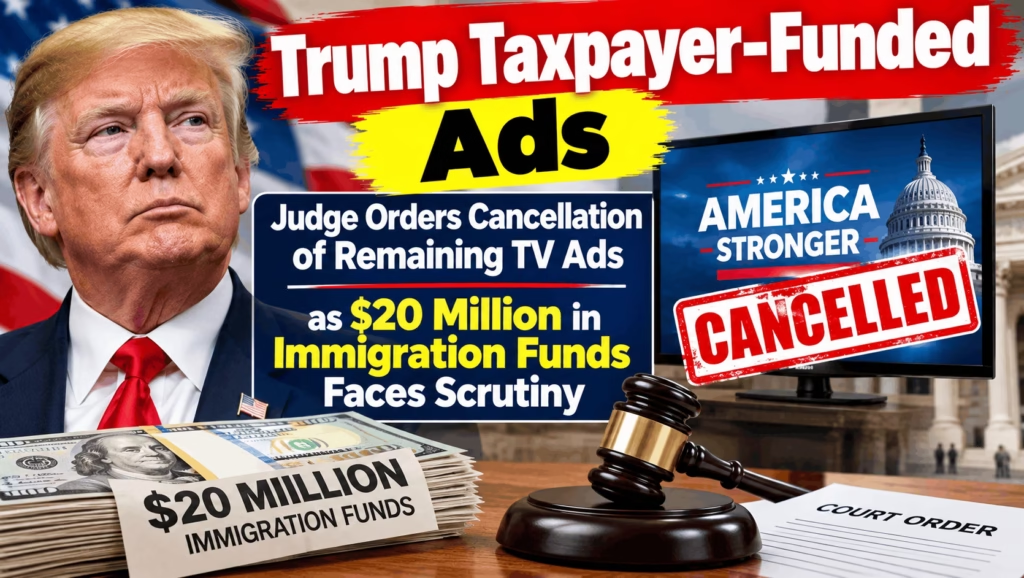
Trump Taxpayer-Funded Ads Key Highlights
| Item | Latest detail |
|---|---|
| Court | U.S. District Court, Southern District of New York |
| Judge | Jennifer Rochon |
| Order | Temporary restraining order, issued Sunday, October 11, 2026 |
| Length of order | 14 days unless extended |
| Amount allocated | $20 million |
| Amount already spent | About $19 million, according to a government filing |
| Funding source | Customs and Border Protection money from the 2025 tax and spending law |
| Budget label used | OBBBA commemorative events |
| Contractor | LMD Agency, Inc. of Maryland, named in federal contract data |
| Main plaintiffs | Common Cause and a coalition including unions, represented by Democracy Forward |
| Separate lawsuit | Democratic National Committee |
| Key law at issue | Federal ban on using appropriated funds for publicity or propaganda |
What Did the Judge Order on October 11, 2026?
Judge Rochon granted the restraining order after finding that the groups suing were likely to succeed in their challenge. The order directs the administration to cancel all remaining airings, including those scheduled for Sunday evening, and to stop DHS from spending any more of the allocation. It also tells officials not to sign, renew or expand any deal tied to the ads.
The Justice Department had filed papers late Saturday arguing that no order was needed because the conduct would end the next day. The judge rejected that argument. A promise to stop is not the same as a legal limit, the plaintiffs argued, and the court agreed the dispute was still live. The administration has also said that Trump’s political committee would pay for future ads, which is a separate matter from the taxpayer money already spent.
A temporary restraining order is short term by design. It holds the situation in place until the judge can hear arguments on a longer preliminary injunction. Neither side has claimed a final win, and the court has not decided whether the ads were illegal. It decided that the challengers were likely to prove it and that further spending should wait.
2027 COLA Estimate Changed Again: What Moved and 3 Smart Moves to Make Before October 14
How $20 Million in Immigration Money Became a TV Ad Budget
The funding trail is what makes this an immigration spending story. The 2025 law known as the One Big Beautiful Bill Act provided about $6.2 billion for border security improvements, and the text also allows spending on commemorating efforts and events related to border security. On September 19, the White House Office of Management and Budget moved $20 million into a Customs and Border Protection account labeled for OBBBA commemorative events. Federal contract data shows that CBP awarded a $20 million contract to LMD Agency, Inc. the next day for a National Media Campaign. The ads started airing within days.
A senior DHS official, Holly Mehringer, told the court in a declaration that the money came from funds Congress made available for, among other things, commemorating border security efforts and events. Critics respond that a commercial praising the president and echoing his campaign themes is not a commemoration of border security.
Reporting by outlets citing people familiar with the matter says Trump personally told his budget director to use taxpayer money for the spots. The White House has said there is precedent for such ads. What is not in dispute is the amount: Congress approved money for immigration and border work, and a large slice of it was steered toward television time.
Taxpayer-Funded Ads Timeline and Important Dates
| Date | What happened |
|---|---|
| July 4, 2025 | Trump signs the tax and spending law that created the funding |
| September 19, 2026 | OMB moves $20 million into a CBP commemorative events account |
| September 20, 2026 | CBP awards a $20 million media contract to LMD Agency |
| Late September 2026 | Ads begin airing during prime time and sports broadcasts |
| Late September 2026 | Democrats and some Republicans question the legality |
| October 5, 2026 | Trump says he will stop using taxpayer money for the ads |
| October 6, 2026 | A fifth ad, focused on the capture of Nicolas Maduro, begins airing |
| October 10, 2026 | DOJ tells the court the buying will end the next day |
| October 11, 2026 | Judge Rochon issues the restraining order |
| About October 25, 2026 | Restraining order expires unless extended |
| November 3, 2026 | Midterm election day |
What the Taxpayer-Funded TV Ads Show and Where They Aired
The administration produced at least 13 campaign-style ads, according to CNN, and some of them aired on CBS, CNN, MS NOW, Fox News and Fox. Two Trump advisers told CNN the White House video team made the ads in-house. One spot features Trump saying America will never be a communist country. Another urges viewers to join a final battle and is built from audio of a January 2024 campaign speech, and one was a replay of an ad from his last presidential campaign. The fifth spot, which started airing on October 6, centered on the capture of Venezuelan leader Nicolas Maduro.
The Associated Press noted that these ads differ from typical public service announcements. A normal government ad explains how to get a benefit, such as health coverage or a tax credit. These ads mostly promote a political message. They aired during college and NFL football games, and each carried a line saying the U.S. government paid for them.
Early estimates of the airtime cost were smaller than the final figure. AdImpact estimated at least $1.7 million in the first days and at least $2.5 million a bit later. Those numbers covered only the early weeks. The government’s own court filing later put spending at about $19 million.
Is It Legal to Use Taxpayer Money for Political Ads?
Federal law bars agencies from using appropriated money for unauthorized publicity or propaganda. The Government Accountability Office, which is Congress’s investigative arm, has said the rule covers communications that are purely partisan, while also accepting that administrations may use public funds to explain and defend their policies. That gray zone is exactly where this fight lives. Legal experts quoted by the Associated Press said the ads may violate the publicity or propaganda ban and possibly other laws, including rules on how appropriated money may be used.
The challengers make two arguments. First, they say the ads are partisan propaganda timed for the midterms. Second, they say the administration repurposed funds Congress set aside for border work. Public Citizen and two senators also challenged the CBP contract itself, according to CNN. Senators Patty Murray and Chris Murphy wrote that using government money to air political ads is illegal and a shockingly corrupt misuse of taxpayer dollars.
The administration’s answer is that the ads are public service announcements like those of past presidents, that the spending fits the commemorative events language, and that Trump is not on the ballot this year. Judges will test those claims against the statute, and the early signal from Judge Rochon favors the challengers.
Republican Reaction: Why Some in the GOP Objected
The criticism did not come only from Democrats. Senate Majority Leader John Thune said the message in one ad was fine, but that it should not be paid for with taxpayer dollars. Senator Thom Tillis, who is retiring, said he hates the ads. Senator Susan Collins confirmed that the money came from CBP. Roll Call reported that Republicans widely agreed taxpayer money should not have been used, regardless of the message, though Republicans in control of Congress had not acted to stop it.
That pressure helped push Trump to change course on October 5. He wrote that he would not use taxpayer money, after first saying the ads were justified because he is not on the ballot. A White House official said the commitment covered future ads and did not say whether the government would be repaid for the ads that ran. After the court ruling, MAGA Inc., the super PAC that entered the fall with about $400 million, is the expected source of any future spending, though that group had not responded to requests for comment at the time of the ruling.
Payment Schedule: How the $20 Million Moved and What Is Left
Readers often ask where the money went and when. The payment path, based on public reporting and the court filings, looks like this.
| Step | Detail |
|---|---|
| Appropriation | Congress provides border security funds in the 2025 law, including a commemorating events line |
| Transfer | September 19, 2026, OMB shifts $20 million into a CBP account |
| Contract | September 20, 2026, CBP awards $20 million to LMD Agency |
| Spending to date | About $19 million, per a government filing |
| Remaining | Roughly $1 million, now blocked from use by the court order |
| Reimbursement | No immediate plan to repay the government, per a White House official |
The government has not publicly itemized every payment, so the exact split between airtime, production and agency fees is unknown. Federal contract records on USAspending.gov are the best place to watch for updates.
Processing Time: How Long Will the Court Case Take?
There is no fixed timetable, but the sequence is predictable. The restraining order lasts 14 days, so it runs to about October 25 unless the judge extends it. Before then, the court normally schedules a hearing on a preliminary injunction, which would keep the block in place while the full case continues. The government can appeal an order to the Second Circuit, and either side can ask for changes.
The election complicates things. The midterms are on November 3, so the practical value of a ruling shrinks quickly after that date. A case about ads can still go on afterward, especially on the question of whether money should be returned or whether rules were broken. Other lawsuits, including the Democratic National Committee case, move on their own schedules. Anyone expecting a final decision before the election should be cautious, because most such cases take months.
$200 Extra Social Security Payment: When Is It Being Approved, and Who Can Get It?
Who Will Get the ACA Payments in 30 States? $500 Refund Eligibility and Payment Schedule
How to Follow the Case and Report Concerns
There is no application form here, but ordinary people can follow the case and make their voices heard in a few direct ways.
Step 1: Read the court filings. The case is in the Southern District of New York. Free access to many filings is available through CourtListener, and the official federal system is PACER, which requires you to register for an account and log in. Fees apply after a small free allowance.
Step 2: Check the money. Search the contractor and amounts on USAspending.gov. Contract awards are posted there, and you can look up the CBP award to LMD Agency.
Step 3: Read the legal standard. The GAO publishes its decisions and guidance on the publicity or propaganda ban at gao.gov.
Step 4: Contact your members of Congress. Appropriations committees decide how funds like these are written, limited and reported. You can find your representative and senators through congress.gov.
Step 5: Report suspected misuse. Federal agencies have inspector general offices, and the DHS inspector general accepts complaints at oig.dhs.gov.
What This Means for Immigration Enforcement Budgets
The ruling puts a spotlight on a bigger question: how flexible are the large sums Congress gave immigration agencies in 2025? The law gave CBP and other bodies billions for border security, detention and technology. Lawmakers who voted for it expected most of that to go toward agents, barriers and equipment. A broad line for commemorating events turned out to be wide enough to hold a national television campaign, and that has some members of both parties asking whether future spending bills should be written more tightly.
For immigration advocates, the story raises a different point. Groups that follow USCIS fees, case backlogs and processing delays have long argued that agencies are short of money for core services. Seeing $20 million go to ads draws sharp contrast. For enforcement supporters, the concern is that controversy over a media buy could distract from border operations that Congress did intend to fund. Both reactions explain why the issue has staying power beyond one court order.
Budget watchers should also note that the amount is small compared with the full appropriation, which is about $6.2 billion for border security improvements. The fight is less about the dollar figure than about the principle of who decides what counts as an allowed use.
Cost per taxpayer calculator
Cost per taxpayer calculator
Spread the ad spending across the number of individual tax returns filed to see the rough share per return. Edit both numbers if new figures come out.
Court filings put spending at about $19 million of a $20 million allocation. The return count is a rounded estimate, not an official figure.Budget used and remaining
See how much of the allocation was spent and how much the court order now blocks.
Restraining order countdown
A temporary restraining order in this case lasts 14 days unless the judge extends it. Change the start date if the court issues a new order.
Official Websites and Resources: Court Records, Contract Data and Spending Law
The usual login, registration and status check pages do not apply to a lawsuit, so the table below lists the sources that matter most. PACER is where you register and log in for federal court documents.
| Resource | Where to find it |
|---|---|
| PACER registration, login and case search | https://pacer.uscourts.gov |
| CourtListener free federal case search | https://www.courtlistener.com |
| Southern District of New York court | https://www.nysd.uscourts.gov |
| Federal contract and spending data | https://www.usaspending.gov |
| 2025 tax and spending law text | https://www.govinfo.gov/content/pkg/PLAW-119publ21/html/PLAW-119publ21.htm |
| Government Accountability Office | https://www.gao.gov |
| Customs and Border Protection | https://www.cbp.gov |
| Department of Homeland Security | https://www.dhs.gov |
| DHS Office of Inspector General complaints | https://www.oig.dhs.gov |
| Congress.gov bills and members | https://www.congress.gov |
| Common Cause | https://www.commoncause.org |
| Democracy Forward | https://democracyforward.org |
| Federal Election Commission | https://www.fec.gov |
FAQs About the Trump Taxpayer-Funded Ads
Did a judge really order Trump to cancel taxpayer-funded ads?
Yes. On October 11, 2026, Judge Jennifer Rochon of the Southern District of New York issued a temporary restraining order requiring the administration to cancel remaining ads, including those scheduled for that night.
How much taxpayer money was spent on the ads?
The government said in a court filing that about $19 million of a $20 million allocation has been spent. The order blocks the rest.
Where did the $20 million come from?
It came from Customs and Border Protection funds tied to the 2025 tax and spending law. OMB moved the money into a commemorative events account on September 19.
Who sued over the ads?
A coalition including Common Cause and unions, represented by Democracy Forward, sued in New York. The Democratic National Committee filed a separate lawsuit.
Is the order permanent?
No. A restraining order is temporary and lasts 14 days unless extended. The court must still decide whether to issue a longer injunction.
Will Trump pay the money back?
Not as of now. A White House official said there were no immediate plans to reimburse the government for the money already spent.
Why are the Trump ads considered illegal?
Critics say they violate a federal ban on using appropriated money for publicity or propaganda and that funds meant for border work were misused. A court has not yet made a final ruling on that question.
Can the president use taxpayer money for political ads?
Not for purely partisan messaging, according to GAO guidance, though administrations may spend public money to explain and defend policies. The line between the two is what is being argued in court.
Conclusion
The restraining order stops the spending for now, but it does not settle the legal question. Judge Rochon found that the challengers were likely to win, the administration says the campaign was already ending, and about $19 million of immigration enforcement money has already been used. The next signposts are clear: a possible hearing before the order expires around October 25, any appeal, the other lawsuits including the DNC case, and the November 3 midterms. Readers who want to verify the facts themselves can use the court records, contract data and law text listed in the resource table. This article is general information, not legal advice, and details may change as the case moves forward. We’ll be updating this article monthly.
Trump $5000 Dividend Check: Latest Update on Cost, Eligibility and Payment Date